









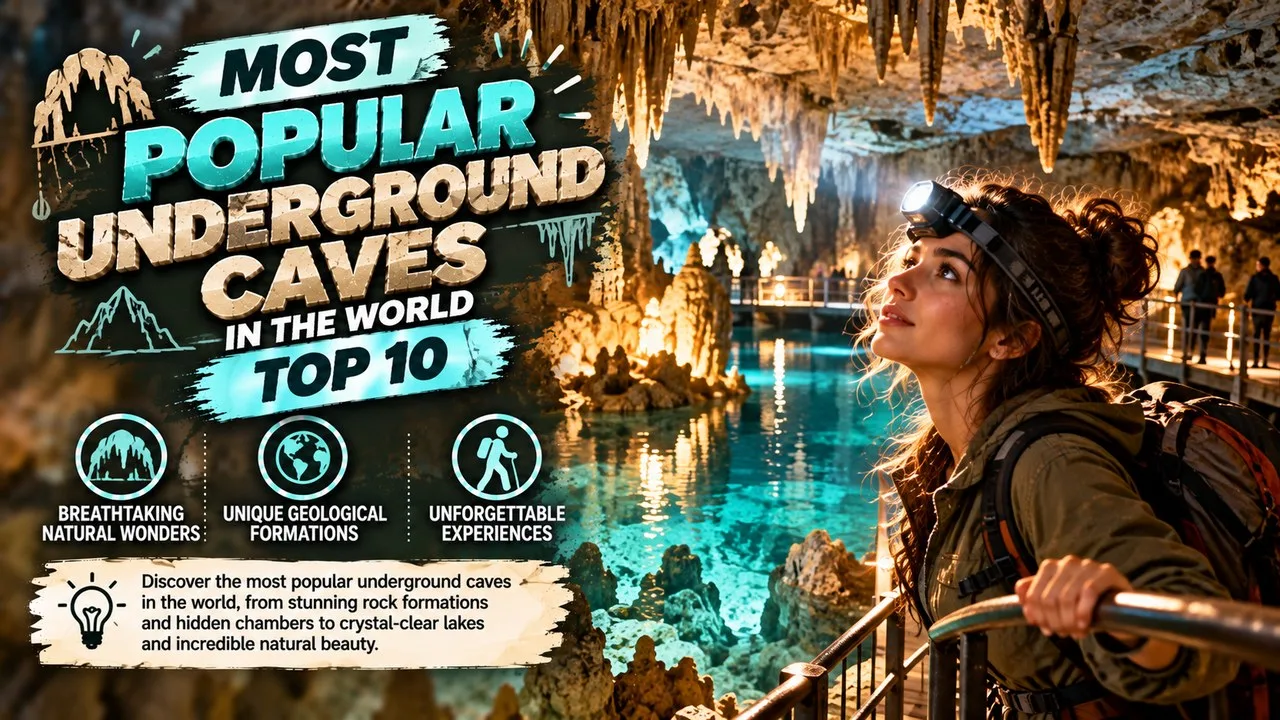
The most popular underground caves on Earth, from Mammoth Cave to Waitomo's glowworms, rank here by visitors, spectacle, science, access and heritage.
Show caves turn geology into a shared experience. Paths, boats, trains, elevators and carefully timed lighting let ordinary travellers walk through limestone canyons, ice halls, bat exits and bioluminescent grottos that once belonged only to explorers and miners. Popularity here is not a slogan: it is a mix of real visitor draw, natural drama, scientific or record significance, everyday accessibility and formal heritage protection.
This Finepedia listicle, written as of October 2026, ranks ten of the most popular underground caves that travellers can actually tour. Each site is scored on a published /25 scorecard. The order is original. It does not copy older roundups, and it does not invent visitor counts, chamber sizes, discovery dates or UNESCO claims. Figures that could not be confirmed against at least two reliable sources were left out.
Classic icons such as Mammoth Cave, Carlsbad Caverns, Waitomo and Postojna still earn places because the evidence supports them. Spectacular but closed or expedition-only chambers are treated honestly: Cave of the Crystals at Naica is an honourable mention because it is not a public show cave, while Hang Son Doong appears because licensed expeditions exist even though capacity is tightly limited. Readers who enjoy dramatic Earth features can also browse Most Stunning Volcanoes in the World: Top 10 and Rarest Rock Formations in the World: Top 10 Wonders.
How We Ranked the Most Popular Underground Caves
Finepedia scored every candidate on five tests that can be checked against park services, UNESCO listings, official show-cave operators and widely cited scientific or Guinness-type records. Each cave received up to 25 points.
- Popularity and visitor draw (up to 5 points): 5 when the cave is a flagship national or continental attraction with sustained mass tourism; 4 when it is regionally famous with strong international traffic; 3 when visitation is meaningful but secondary to a broader park or destination
- Natural spectacle (up to 5 points): 5 when the signature experience is immediately iconic (mirror-like chambers, ice walls, glowworms, tidal underground rivers, mega-passages); 4 when formations or scale are outstanding but less unique worldwide; 3 when beauty is strong yet typical of many decorated show caves
- Scientific or record significance (up to 5 points): 5 for a clear global record or foundational role in cave science (longest system, largest passage, classic karst type locality, major ice-cave or biospeleology landmark); 4 for nationally important science or widely cited dimensions; 3 for interesting but secondary research value
- Accessibility for ordinary visitors (up to 5 points): 5 when independent travellers can join short, well-managed tours with elevators, trains or gentle paths in normal seasons; 4 when tours are easy but need timed tickets, boats or moderate walking; 3 when visits need many stairs, seasonal windows or long transfers; 2 when only multi-day expeditions or specialist permits are realistic
- Heritage status and protection (up to 5 points): 5 for UNESCO World Heritage covering the cave or its core park; 4 for strong national-park or equivalent protection without World Heritage; 3 for managed show-cave conservation without top-tier international listing
- Tiebreaks: first popularity/visitor draw, then natural spectacle, then heritage status
Twenty-plus candidates were scored, including every cave on the most widely shared older underground-cave roundups and strong alternatives from North America, Europe, Asia and Oceania. Places demoted to Honourable Mentions include Cave of the Crystals (extraordinary gypsum giants, but closed to tourism), Majlis al Jinn in Oman (huge chamber, adventure rather than show-cave logistics), Reed Flute Cave in Guilin (beautiful illuminated route, lower global-record weight), Jeita Grotto in Lebanon (famous dual galleries and boat section, uneven recent access and no UNESCO inscription), Gouffre de Padirac in France, Cuevas del Drach on Mallorca, Capri's Blue Grotto and Portugal's Benagil sea cave (coastal spectacles that sit outside this land-karst / classic show-cave focus).
The ranking treats popular as a balance of what crowds seek and what the underground actually is. A record-breaking passage that almost nobody can enter cannot outrank a protected, unique and regularly tourable icon unless its fame and science are overwhelming. That is why Hang Son Doong still appears high for scale, but not above Mammoth or Carlsbad for everyday travellers.
Most Popular Underground Caves at a Glance
| # | Cave | Country | Signature experience | Score (of 25) |
|---|---|---|---|---|
| 1 | Mammoth Cave | United States | World's longest known cave system; ranger-led show tours | 24 |
| 2 | Carlsbad Caverns | United States | Big Room chamber; elevator access; seasonal bat flight | 24 |
| 3 | Puerto Princesa Underground River | Philippines | Tidal underground river boat cruise in UNESCO park | 23 |
| 4 | Skocjan Caves | Slovenia | Reka River underground canyon; classic karst type locality | 22 |
| 5 | Postojna Cave | Slovenia | Double-track cave train; Brilliant stalagmite; olm exhibits | 21 |
| 6 | Waitomo Glowworm Caves | New Zealand | Boat through bioluminescent Arachnocampa grotto | 21 |
| 7 | Hang Son Doong (Phong Nha-Ke Bang) | Vietnam | World's largest documented cave passage; licensed expeditions | 21 |
| 8 | Jenolan Caves | Australia | Historic Blue Mountains show caves inside UNESCO property | 21 |
| 9 | Gunung Mulu show caves | Malaysia | Deer Cave bat exodus; UNESCO tropical karst megasystem | 21 |
| 10 | Eisriesenwelt | Austria | World's largest ice cave; alpine cable-car approach | 19 |
Travellers who collect extreme environments can compare these cool chambers with Coldest Places in the World: Top 10 and the hidden waters of Lake Vostok: The Largest Subglacial Lake Beneath Antarctica. Desert geology fans may also like Most Breathtaking Desert Landscapes: Top 10.
1. Mammoth Cave
| Attribute | Details |
|---|---|
| Location | Mammoth Cave National Park, south-central Kentucky, United States |
| Cave type | Extensive limestone karst system with large horizontal passages and shafts |
| Signature experience | Ranger-guided tours through vast dry passages in the world's longest known cave |
| Protection / status | UNESCO World Heritage Site (1981); U.S. National Park; International Biosphere Reserve |
| Finepedia score | 24 of 25 (popularity 5, spectacle 4, science 5, access 5, heritage 5) |
Origins and Discovery
Indigenous explorers entered parts of Mammoth Cave thousands of years ago. European-American rediscovery around the turn of the nineteenth century launched saltpetre mining, commercial tourism and a long mapping culture. The park was authorized in 1926 and established in 1941. Survey work later proved connections that made Mammoth the world's longest known cave system; National Park Service statistics list about 426 miles (685 kilometres) of surveyed passage as of recent park figures, a total that continues to grow as explorers add footage.
UNESCO inscription in 1981 recognized both the system's scale and its unusually rich cave life. Modern visitors see only a small developed fraction of the maze. That limited footprint is intentional: it keeps the record-breaking length compatible with mass tourism.
Key Features
- Longest known cave system on Earth by surveyed length (park and UNESCO sources)
- Huge horizontal avenues, vertical shafts and diverse speleothems, including sulfate minerals such as gypsum flowers
- Exceptionally diverse cave-adapted fauna for a temperate system
- Surface park of roughly 52,830 acres with rivers, forests and Dark Sky recognition
- Multiple ranger-led tour options rather than a single fixed route
Visiting Tips
Book cave tours in advance in peak seasons; tickets are timed and popular routes sell out. Wear sturdy shoes and expect cool underground temperatures year-round. Combine a cave tour with Green River or surface trails if you have a full day. As of October 2026, check the National Park Service Mammoth Cave pages for current tour menus, reservation rules and white-nose syndrome decontamination guidance before you pack cave clothing used elsewhere.
Interesting Facts
- Park statistics report hundreds of thousands of annual visitors; 2024 park visitation was reported at about 747,000 with strong local spending effects
- Only a small developed share of the total surveyed length is open on public tours
- The site is also an International Biosphere Reserve and an International Dark Sky Park
- Nearly every common cave formation type can be found somewhere in the wider system
- Mapping continues; published length figures are snapshots, not permanent ceilings
2. Carlsbad Caverns
| Attribute | Details |
|---|---|
| Location | Carlsbad Caverns National Park, near Carlsbad, New Mexico, United States |
| Cave type | Limestone caves formed in the Capitan Reef complex; richly decorated chambers |
| Signature experience | Self-paced Big Room trail; optional Natural Entrance hike; seasonal bat flight program |
| Protection / status | UNESCO World Heritage Site (1995); U.S. National Park |
| Finepedia score | 24 of 25 (popularity 5, spectacle 5, science 4, access 5, heritage 5) |
Origins and Discovery
Carlsbad Cavern sits in Permian reef limestone of the Guadalupe Mountains. Guano mining in the early 1900s drew attention to the "Bat Cave." Photographs published in the 1920s helped push federal protection: a national monument in 1923 and national park status in 1930. Elevators installed from the early 1930s onward turned a rope-and-bucket adventure into one of North America's most accessible mega-chambers.
UNESCO listing later grouped Carlsbad's decorated caves and the Capitan Reef context as outstanding examples of cave origin and ongoing speleothem processes. Lechuguilla Cave inside the park remains a scientific jewel closed to general tourism.
Key Features
- Big Room: about 8.2 acres, widely described by the NPS as the largest readily accessible cave chamber in North America
- Roughly 1.25-mile Big Room trail (shortcut available); Natural Entrance trail drops about 750 feet for fitter visitors
- Abundant speleothems and reef-related geology of global research interest
- Seasonal evening flights of Brazilian free-tailed bats from the Natural Entrance
- Elevator access between visitor center and cave level for many guests
Visiting Tips
Reservations are typically required to enter the cavern even when tickets are bought on site; confirm current NPS rules before travel. Arrive early for the free seasonal Bat Flight Program (generally spring through autumn evenings) and follow the park's no-electronics rule at the amphitheater. The Big Room is the best choice for most first-time visitors; skip the steep Natural Entrance if you have heart or respiratory limits. Desert heat on the surface contrasts with the cool cave, so dress in layers.
Interesting Facts
- Actor Will Rogers famously compared the cavern to the Grand Canyon with a roof
- Park materials note more than 30 miles of passage in Carlsbad Cavern itself, with only developed trails open to the public
- Seventeen bat species are known in the park; colony size varies by season and year
- A second elevator system in the 1950s expanded capacity for mass tourism
- Lechuguilla Cave is protected separately and is not part of standard visitor itineraries
3. Puerto Princesa Underground River
| Attribute | Details |
|---|---|
| Location | Puerto-Princesa Subterranean River National Park, Palawan, Philippines |
| Cave type | Coastal limestone karst with an underground river that meets the sea |
| Signature experience | Paddle-boat cruise through tidal chambers beneath old-growth forest |
| Protection / status | UNESCO World Heritage Site (1999); New7Wonders of Nature confirmation (2012) |
| Finepedia score | 23 of 25 (popularity 5, spectacle 5, science 4, access 4, heritage 5) |
Origins and Discovery
The subterranean river drains a karst landscape on Palawan's west coast, about 76 kilometres northwest of Puerto Princesa city according to UNESCO. Local communities and later scientific surveys documented an 8.2-kilometre underground course that empties into the sea, with the lower reaches brackish and tide-influenced. That ocean connection is the site's global calling card: few navigable underground rivers combine mountain-to-sea ecology so directly.
UNESCO inscription in 1999 protected both the cave river and a wider mountain-to-sea park of roughly 22,202 hectares. A later global public vote campaign confirmed the underground river among the New7Wonders of Nature in early 2012, amplifying already strong domestic and international tourism.
Key Features
- About 8.2 km underground river; public boat tours typically navigate a substantial inland section (UNESCO notes navigability up to about 4.5 km)
- Large chambers with dramatic speleothems; UNESCO cites chambers on the order of 120 m wide and 60 m high
- Brackish, tide-affected lower river — a rare show-cave hydrology
- Intact forest approaches and high biodiversity value for the Palawan region
- Local-government-managed national park model often cited in Philippine conservation history
Visiting Tips
Permits and boat slots are limited; arrange through accredited channels in Puerto Princesa or Sabang and expect an early start. Bring a dry bag for splash on the boat and follow guide instructions on silence and lighting around wildlife. Weather and sea conditions can affect lagoon transfers. Pair the river with a calm island day if you want a softer trip afterward — see also Most Relaxing Destinations to Visit: Top 10.
Interesting Facts
- UNESCO highlights the tidal influence as a significant natural phenomenon among underground rivers
- The park is frequently described as the first Philippine national park successfully devolved to local government management
- Deeper scientific exploration has reported upper-level passages and large domes beyond the standard tourist boat route
- The New7Wonders confirmation in 2012 made the river a national tourism emblem beyond its UNESCO status
- Boat commentary often focuses on formation silhouettes; treat nickname stories as folklore unless a guide cites survey data
4. Skocjan Caves
| Attribute | Details |
|---|---|
| Location | Skocjan Caves Regional Park, Kras Plateau, southwestern Slovenia |
| Cave type | Contact karst system with a vast underground river canyon |
| Signature experience | Guided walk above the roaring Reka River through one of Europe's great cave canyons |
| Protection / status | UNESCO World Heritage Site (1986); regional park; Ramsar underground wetland recognition |
| Finepedia score | 22 of 25 (popularity 4, spectacle 5, science 5, access 3, heritage 5) |
Origins and Discovery
The Reka River sinks into the Classical Karst and cuts a subterranean canyon before continuing toward the Adriatic as the Timavo system. Formal exploration and tourist development accelerated in the nineteenth century, but the landscape was already famous earlier; drawings of the collapsed dolines date back centuries. The modern regional park framework and UNESCO listing (1986) protect roughly 413 hectares that include passages, dolines and villages still lived in today.
Skocjan matters to science because the words karst and doline have deep roots in this very region. UNESCO describes an underground channel on the order of two kilometres long, up to about 150 metres high and more than 120 metres wide in places, with the Martel Chamber exceeding two million cubic metres.
Key Features
- One of the world's great underground river canyons with rapids and waterfalls
- Collapsed dolines (Velika and Mala) that open the canyon to daylight
- Speleothems such as the Giants in the Great Chamber and famous rimstone pools
- Living classroom for Classical Karst geology and biospeleology
- Bridges and paths that place visitors high above the river — dramatic, not gentle
Visiting Tips
Expect a long stair count (park guidance often cites on the order of 1,000 steps) and a visit of roughly one and a half to three hours depending on the tour. Buy tickets online, arrive early, wear grippy shoes and carry a warm layer; cave air is cool. Photography rules inside the caves are strict — follow current park instructions. This is a fitness-selective show cave compared with Postojna's train.
Interesting Facts
- The Kras/Karst plateau name underpins global technical vocabulary in geology
- Parts of the underground wetland system are recognized under the Ramsar Convention
- Archaeological evidence shows long human presence around the dolines and cave mouths
- The Martel Chamber's volume is among the figures UNESCO uses to convey scale
- The wider Karst Biosphere Reserve buffers the small World Heritage core
5. Postojna Cave
| Attribute | Details |
|---|---|
| Location | Postojna Cave Park, Inner Carniola, Slovenia |
| Cave type | Classic karst show cave with extensive tourist passages |
| Signature experience | Underground electric train plus walking halls; Brilliant stalagmite; olm exhibits |
| Protection / status | Intensively managed show cave and park; Classical Karst landmark (not itself a UNESCO cave listing) |
| Finepedia score | 21 of 25 (popularity 5, spectacle 4, science 4, access 5, heritage 3) |
Origins and Discovery
Local guide Luka Cec's 1818 exploration of newly accessible passages helped launch two centuries of tourism. A cave railway opened in 1872 and electric lighting followed in the 1880s, making Postojna a template for industrial-age show caves. Operator and tourism materials report cumulative visitation above 38–40 million people — a popularity signal few caves on Earth can match.
The wider Postojna system is on the order of 24 kilometres of passages. Standard tours cover about five kilometres combining train and footpath, including a multi-kilometre ride on what operators call the world's only double-track cave railway.
Key Features
- Double-track underground railway as the signature access mode
- Brilliant white stalagmite and large decorated halls used in concert and event marketing
- Olm (Proteus anguinus) interpretation; Postojna is a historic centre of speleobiology
- Year-round climate near 8–10 °C inside the tourist route
- Easy combination with nearby Predjama Castle for a full karst day
Visiting Tips
Arrive before your timed departure; boarding happens ahead of the listed tour time. Bring a jacket even in summer. Families and many mobility-limited visitors manage the train well; confirm current advice if you cannot walk the steeper footpath section. Audio guides cover many languages. Book busy holiday slots early.
Interesting Facts
- An underground post office tradition dates to the late nineteenth century
- Electric lighting in the 1880s made Postojna an early technological show cave
- Olm hatchlings displayed in recent years renewed global media interest in "baby dragons"
- Predjama Castle sits about 10 km away and is often sold as a combo ticket
- Despite massive tourism, the site remains a living research brand for Classical Karst fauna
6. Waitomo Glowworm Caves
| Attribute | Details |
|---|---|
| Location | Waitomo, Waikato region, North Island, New Zealand |
| Cave type | Limestone stream cave famous for bioluminescent larvae |
| Signature experience | Silent boat ride under a ceiling of Arachnocampa luminosa glowworms |
| Protection / status | Managed tourism caves with strong cultural and conservation oversight |
| Finepedia score | 21 of 25 (popularity 5, spectacle 5, science 3, access 5, heritage 3) |
Origins and Discovery
In December 1887, Maori chief Tane Tinorau and surveyor Fred Mace explored the stream cave on a flax-stem raft. Tinorau opened guided visits in 1889, founding one of the Southern Hemisphere's most enduring cave tourism stories. Management later involved the Crown; land interests for descendants of the original owners were restored in the late twentieth century, and today the site remains a carefully scripted show cave rather than a free-for-all adventure park.
The glowworms are the larvae of a fungus gnat endemic to New Zealand. Their blue-green light lures prey into silk fishing lines. That biology, not giant speleothems alone, is why Waitomo became a household name.
Key Features
- Glowworm Grotto boat finale as the defining visitor moment
- Cathedral and other named chambers with strong acoustics and formations
- Short, highly organized guided tours suitable for a wide age range
- Dense tourism cluster at Waitomo with additional black-water rafting caves nearby for adventure travellers
- Cultural guiding heritage dating to the 1880s
Visiting Tips
Book the classic Glowworm Cave tour timed ticket; keep phones dark and silent in the grotto. Tours are compact, so they fit easily into a day trip from Hamilton or a longer North Island loop. If you want a harder underground day, separate adventure operators run rafting trips in other Waitomo caves — do not confuse those with the main show-cave boat ride. As of October 2026, check official Waitomo operator pages for tour lengths and photography rules.
Interesting Facts
- Guinness World Records has listed Waitomo among the most visited glowworm caves, with annual visitation commonly cited in the hundreds of thousands
- The 1887 raft exploration is one of the best-documented origin stories in show-cave tourism
- Arachnocampa luminosa larvae are often only a few millimetres long despite the spectacular collective glow
- Government and private management phases span more than a century of continuous tourism
- Neighbouring Ruakuri and other caves expand the district beyond a single chamber experience
7. Hang Son Doong (Phong Nha-Ke Bang)
| Attribute | Details |
|---|---|
| Location | Phong Nha-Ke Bang National Park (and linked Hin Nam No context), Vietnam |
| Cave type | Giant river cave passage inside tropical limestone massif |
| Signature experience | Multi-day licensed expedition into the world's largest documented cave passage; easier park caves for most visitors |
| Protection / status | UNESCO World Heritage (Phong Nha-Ke Bang / transboundary extension) |
| Finepedia score | 21 of 25 (popularity 4, spectacle 5, science 5, access 2, heritage 5) |
Origins and Discovery
Local logger Ho Khanh found the entrance in 1991. A British cave research team surveyed Hang Son Doong in 2009, revealing a passage so large that Guinness World Records recognizes dimensions on the order of 200 metres high, 150 metres wide and at least 6.5 kilometres long. UNESCO materials for the Phong Nha-Ke Bang property highlight Son Doong among globally significant passages within a karst landscape hundreds of millions of years in the making.
Tourism is deliberately scarce. Oxalis Adventure holds the licensed expedition concession; annual guest caps are low (often described around 1,000 permits a year in recent coverage), trips last multiple days, and fitness screening applies. That is the opposite of an elevator show cave — and the reason accessibility scores only 2.
Key Features
- Largest documented single cave passage by overall dimensions (Guinness / survey literature)
- Two giant dolines that let jungles grow inside the cave
- Underground river, sand dunes and enormous speleothems along expedition routes
- Surrounding park with more accessible caves (such as popular Phong Nha boat caves) for travellers who cannot join Son Doong
- Strict one-operator model designed to limit impact
Visiting Tips
Treat Son Doong as a once-in-a-decade expedition: book many months ahead, train with a loaded pack, and confirm swimming and health requirements with the licensed operator. If permits are sold out, use the park's shorter cave experiences based in Phong Nha town rather than chasing unofficial access. Rainy-season flooding closes expedition windows; dry-season calendars dominate. Never attempt ungguided entry.
Interesting Facts
- National Geographic and other major outlets helped turn Son Doong into a global bucket-list name after the 2009 survey
- Interior weather can differ from the jungle outside because of the passage scale
- Hang En and other Oxalis routes are sometimes used as stepping-stone adventures
- UNESCO discusses Son Doong alongside other giant passages in the wider Annamite karst
- "Largest cave" headlines usually mean largest passage cross-section/continuity, not longest system — Mammoth still leads on length
8. Jenolan Caves
| Attribute | Details |
|---|---|
| Location | Jenolan Karst Conservation Reserve, west of the Blue Mountains, New South Wales, Australia |
| Cave type | Devonian limestone show-cave complex with rivers and ornate chambers |
| Signature experience | Guided tours through historic show caves inside a UNESCO World Heritage landscape |
| Protection / status | Inside the Greater Blue Mountains Area UNESCO World Heritage property; state karst conservation reserve |
| Finepedia score | 21 of 25 (popularity 4, spectacle 4, science 4, access 4, heritage 5) |
Origins and Discovery
Jenolan has been a tourism landmark since the nineteenth century, with a dense web of named show caves and more than 300 known cave entrances across the reserve according to NSW park materials. Scientific dating work has been used in public interpretation to describe Jenolan as among the world's oldest dated open cave systems, with ages on the order of hundreds of millions of years discussed in heritage assessments — always with the caution that "oldest" claims depend on what is being dated.
Inclusion in the Greater Blue Mountains World Heritage Area (inscribed 2000) ties the underground rooms to one of Australia's best-known protected landscapes. That heritage frame lifts Jenolan above many beautiful but unprotected regional show caves.
Key Features
- Multiple guided show caves rather than a single route, allowing repeat visits
- Underground rivers, fossils and varied speleothems in Devonian limestone
- Historic tourism infrastructure in a steep valley setting
- Easy pairing with Blue Mountains lookouts and bushwalks
- Strong education focus on karst conservation
Visiting Tips
Choose a cave tour by fitness level; some routes involve many stairs. The valley is cool even when Sydney is hot, so bring layers. Book ahead on weekends and school holidays. Driving the final mountain roads needs care at night. Combine with a Blue Mountains day if you want surface scenery after the underground.
Interesting Facts
- NSW National Parks materials emphasize both tourism history and karst science in the same reserve
- "Oldest cave" popular claims should be read as dating results for specific deposits/openings, not a blank cheque over every chamber on Earth
- Eleven show caves are commonly cited as visitor options within the wider system
- The site sits far enough from Sydney for a long day trip or overnight stay
- Heritage listing is landscape-scale (Greater Blue Mountains), not a stand-alone cave inscription like Skocjan
9. Gunung Mulu Show Caves
| Attribute | Details |
|---|---|
| Location | Gunung Mulu National Park, Sarawak, Malaysian Borneo |
| Cave type | Tropical limestone megacaves inside rainforest karst |
| Signature experience | Deer Cave walk and dusk bat exodus; Clearwater and other guided show caves |
| Protection / status | UNESCO World Heritage Site |
| Finepedia score | 21 of 25 (popularity 3, spectacle 5, science 5, access 3, heritage 5) |
Origins and Discovery
Mulu's caves were mapped through late-twentieth-century expeditions that revealed chambers and passages on a planetary scale. UNESCO inscription recognizes pinnacle karst, rainforest and cave systems together. Deer Cave became the public face of the park: a vast passage reached by a boardwalk, culminating in nightly emergences of wrinkle-lipped bats numbered in the millions according to park interpretation.
Sarawak Chamber, often cited among the world's largest known cave chambers by area, sits in the same park but is not a casual show-cave stop. Popularity scores reflect that many travellers still find Mulu remote compared with Kentucky or Slovenia, even though the show caves themselves are guided and well organized once you arrive.
Key Features
- Deer Cave's immense passage and dusk bat exodus
- Clearwater, Wind, Lang's and other developed show caves on guided circuits
- Sarawak Chamber as a scientific mega-chamber benchmark (expedition context)
- UNESCO-listed mix of caves, mountains and rainforest
- Canopy walkways and summit treks for visitors who want more than underground time
Visiting Tips
Fly or boat into Mulu with permits arranged through park channels; independent wandering in show caves is not the model. Bring leech socks for rainforest walks and a light rain jacket. Arrive at Deer Cave with enough daylight margin to reach the bat observatory. Advance lodging inside or near the park is wise because the location is remote.
Interesting Facts
- Park materials describe Deer Cave's bat colony in the multi-million range — treat nightly counts as estimates that vary
- Clearwater Cave systems include long river passages used in adventure caving products beyond basic show tours
- Mulu's pinnacles are a surface icon that pair naturally with the underground itinerary
- UNESCO texts emphasize both cave scale and botanical richness of the limestone flora
- Show-cave access still requires guides; this is not a self-ticket elevator cave
10. Eisriesenwelt
| Attribute | Details |
|---|---|
| Location | Tennengebirge above Werfen, Salzburg region, Austria |
| Cave type | Alpine ice cave with permanent ice in the entrance zone |
| Signature experience | Cable-car approach plus guided walk among vast ice walls and formations |
| Protection / status | Managed show cave / nature attraction; world-record ice-cave length claim |
| Finepedia score | 19 of 25 (popularity 4, spectacle 5, science 4, access 3, heritage 3) |
Origins and Discovery
Intensive exploration of Eisriesenwelt began in the 1910s. Early explorers gave Norse-myth names to halls and ice structures, a storytelling habit that still shapes visitor commentary. The cave system's total length is repeatedly described as more than 40 kilometres, while only about the first kilometre — where perennial ice forms — is part of the tourist route.
A steep cable car, developed from the mid-twentieth century, made the high entrance reachable for mass tourism. Seasonality remains strict: operations focus on late spring through autumn because winter access and ice management constrain the calendar.
Key Features
- Widely billed as the world's largest ice cave by system length
- Monumental ice walls, frozen waterfalls and named halls along a guided path
- Cable-car and mountain-hut approach above the Salzach Valley
- Carbide-lamp or cold-light guiding traditions that keep the ice unmelted by strong heat lamps
- About 1,400 steps and substantial elevation change on the visitor route according to operator guidance
Visiting Tips
Visit only in the open season (operator calendars commonly run roughly May through early November — verify the current year). Dress as for winter indoors: temperatures stay near or below freezing. Sturdy shoes are essential on stairs and wet wood. Allow time for parking, shuttle or walk, cable car and the guided cave circuit (on the order of 75 minutes underground plus transfers). Not ideal for visitors who cannot manage long stair climbs.
Interesting Facts
- Only a fraction of the multi-tens-of-kilometres system is ice-filled and tourable
- Meltwater that freezes inside cold rock is the engine of the ice sculptures visitors photograph
- Austria's steep cable-car approach is part of the attraction's identity
- Climate researchers watch alpine ice caves as sensitive indicators of warming trends
- Mythic hall names date to early twentieth-century explorers rather than medieval legend alone
Honourable Mentions
| Cave | Why it missed the Top 10 |
|---|---|
| Cave of the Crystals (Naica, Mexico) | Gigantic gypsum crystals and extreme heat; not operated as a public show cave |
| Majlis al Jinn (Oman) | Enormous chamber and adventure drops; logistics remain specialist, not mass show-cave tourism |
| Reed Flute Cave (Guilin, China) | Beautiful illuminated limestone route and ancient inscriptions; lower global-record and heritage weight than the top tier |
| Jeita Grotto (Lebanon) | Famous upper and lower galleries with a boat section; access and international travel conditions have been uneven; no UNESCO cave inscription |
| Gouffre de Padirac (France) | Classic chasm-and-boat visit of about 1.5 hours; strong national icon without the global-record stack of the top ten |
| Cuevas del Drach (Mallorca, Spain) | Popular Mediterranean show cave with underground lake concerts; more regional than planetary in science scores |
| Blue Grotto (Capri) / Benagil (Portugal) | Unforgettable sea caves; excluded because this list prioritizes land-karst and classic underground show caves |
| Fingal's Cave (Scotland) | Iconic columnar basalt sea cave; geology type differs from the limestone/ice focus of the main ranking |
Older listicles sometimes elevate closed mines or adventure pits beside family show caves. Finepedia separates those categories so "popular" still means travellers can buy a legitimate visit.
Frequently Asked Questions
What counts as a popular underground cave on this list?
A cave that ordinary travellers can visit through official tours, with strong evidence of visitor draw, plus high marks for spectacle, science or records, everyday access and protection. Closed scientific chambers and pure vertical adventure pits are discussed as honourable mentions instead of forced top-ten entries.
Is Mammoth Cave really the longest cave in the world?
Yes for surveyed length among known systems, according to National Park Service and UNESCO descriptions of Mammoth Cave National Park. Published mileages change as explorers survey new passages, so always treat the number as "at least this long" rather than a final total.
Which underground caves are easiest for first-time visitors?
Carlsbad's Big Room (elevator option), Postojna's train tour and Waitomo's short glowworm boat tour are among the gentlest flagship experiences. Skocjan and Eisriesenwelt demand many stairs. Son Doong requires a multi-day expedition.
Can anyone visit Hang Son Doong?
Only through the licensed expedition operator with capped annual permits, fitness checks and multi-day jungle travel. Most visitors to Phong Nha-Ke Bang National Park tour other park caves instead. Unguided entry is not allowed.
Why is Cave of the Crystals not ranked in the Top 10?
Its crystals are extraordinary, but the Naica chambers are not run as a public show cave. Popularity in this article means tourable access, not only photographic fame.
When is the best time to visit ice caves such as Eisriesenwelt?
During the published open season, typically late spring to autumn, when cable cars and guides operate. Winter closure is normal. Underground temperatures stay cold even in midsummer, so pack winter layers regardless of valley weather.
How do UNESCO listings affect cave visits?
World Heritage status usually signals stronger protection, research attention and sometimes stricter visitor rules. It does not automatically mean easy access — Skocjan is UNESCO and stair-heavy; Postojna is hugely popular without being the UNESCO cave property next door.
Conclusion
The most popular underground caves reward curiosity at every level of fitness and budget. Mammoth and Carlsbad prove that national-park logistics can deliver world records to families. Puerto Princesa, Skocjan and Mulu show how rivers and rainforest karst create spectacles no cathedral can copy. Postojna and Waitomo perfected hospitality underground, while Son Doong and Eisriesenwelt remind travellers that some icons still demand stamina, seasons and permits.
Use the scorecard as a trip filter: chase access when you have one free afternoon, chase science and scale when you can train for stairs or expeditions, and always verify current booking rules as of your travel year. The underground is popular because it is managed — treat that management as part of the wonder.
- UNESCO World Heritage Centre — Mammoth Cave National Park (https://whc.unesco.org/en/list/150/)
- U.S. National Park Service — Mammoth Cave park statistics and tourism reports (https://www.nps.gov/maca/)
- UNESCO World Heritage Centre — Carlsbad Caverns National Park (https://whc.unesco.org/en/list/721/)
- U.S. National Park Service — Carlsbad Caverns Big Room, bat flight and facts pages (https://www.nps.gov/cave/)
- UNESCO World Heritage Centre — Puerto-Princesa Subterranean River National Park (https://whc.unesco.org/en/list/652/)
- New7Wonders — Puerto Princesa Underground River confirmation materials (https://nature.new7wonders.com/)
- UNESCO World Heritage Centre — Skocjan Caves (https://whc.unesco.org/en/list/390/)
- Park Skocjanske jame — official visitor and cave description pages (https://www.park-skocjanske-jame.si/)
- Postojna Cave Park — official cave and tour information (https://www.postojnska-jama.eu/)
- Discover Waitomo / official Waitomo history pages (https://www.waitomo.com/)
- Guinness World Records — largest cave (Hang Son Doong) (https://www.guinnessworldrecords.com/world-records/66739-largest-cave)
- UNESCO World Heritage Centre — Phong Nha-Ke Bang National Park (https://whc.unesco.org/en/list/951/)
- Oxalis Adventure — Son Doong expedition information (https://oxalisadventure.com/)
- NSW National Parks — Jenolan Karst Conservation Reserve (https://www.nationalparks.nsw.gov.au/)
- UNESCO World Heritage Centre — Greater Blue Mountains Area (https://whc.unesco.org/en/list/917/)
- UNESCO World Heritage Centre — Gunung Mulu National Park (https://whc.unesco.org/en/list/1013/)
- Mulu National Park official pages — Deer Cave and show caves (https://mulupark.com/)
- Eisriesenwelt Werfen — official science and visit pages (https://www.eisriesenwelt.at/)
- Topic prompt only (order/wording not reused): 10mosttoday "World's 10 Most Popular Underground Caves" (https://10mosttoday.com/worlds-10-most-popular-underground-caves/)
















Log in with