








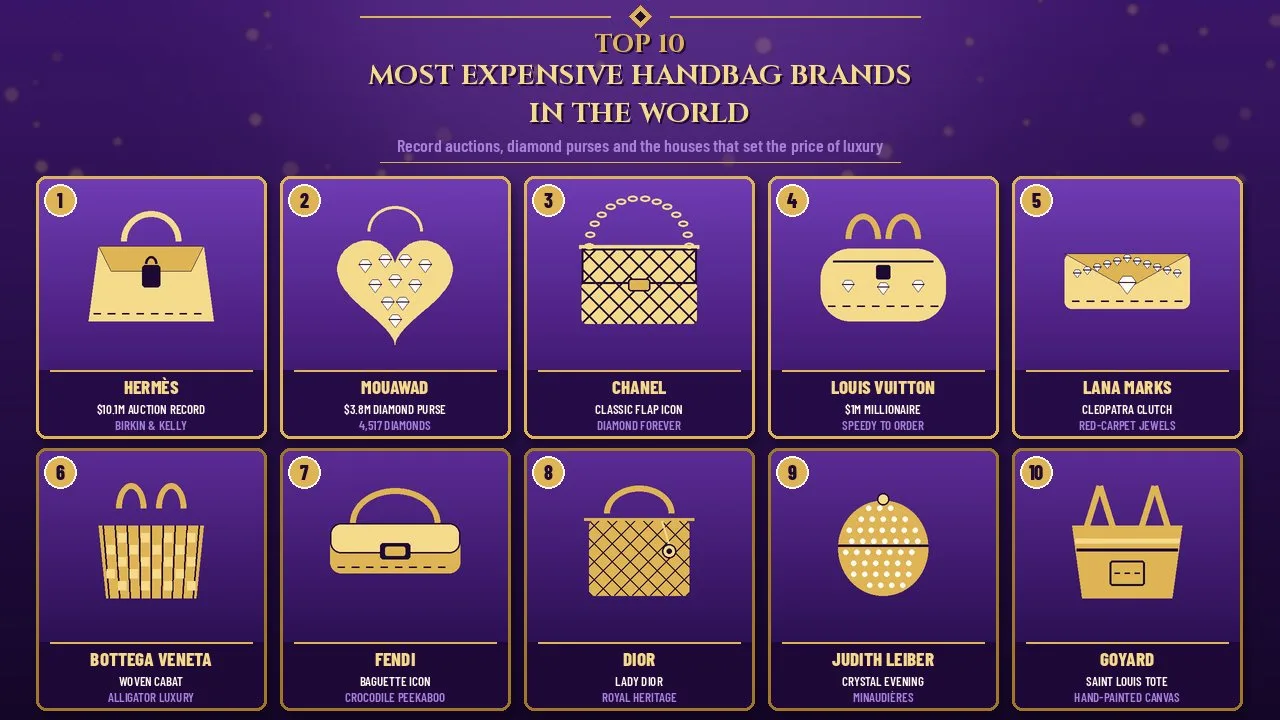
The most expensive handbag brands in the world, led by Hermès, Mouawad and Chanel, craft bags that cost from several thousand dollars to millions each.
A luxury handbag can be a daily tool, a family heirloom and a tradeable asset at the same time. The houses on this list sit at the very top of that market. Their prices come from a mix of rare materials, slow hand work, tight supply and decades of cultural memory, and in a few cases from gemstones that turn a bag into wearable jewellery.
This ranking looks at brands rather than single bags. It weighs the highest price each house has achieved for a documented piece, what its core bags cost in flagship stores as of 2025 and 2026, and how hard those bags are to obtain. Figures come from auction houses, record bodies and official retail listings. Brands whose prices could not be confirmed from reliable sources were left out, and the order below is Finepedia's own.
Most Expensive Handbag Brands at a Glance
| Rank | Brand | Founded | Home country | Signature bag | Highest documented price |
|---|---|---|---|---|---|
| 1 | Hermès | 1837 | France | Birkin, Kelly | About $10.1 million (auction, 2025) |
| 2 | Mouawad | 1890 (family origins) | Switzerland / Lebanon | 1001 Nights Diamond Purse | $3.8 million (valuation, 2010) |
| 3 | Chanel | 1910 | France | Classic Flap, 2.55 | About $261,000 (Diamond Forever, 2008) |
| 4 | Louis Vuitton | 1854 | France | Speedy, Keepall | $1 million (Millionaire Speedy, made to order) |
| 5 | Lana Marks | 1987–1988 | United States | Cleopatra Clutch | Up to about $400,000 (bespoke clutch) |
| 6 | Bottega Veneta | 1966 | Italy | Cabat, Jodie | $54,200 retail (alligator Mini Cabat) |
| 7 | Fendi | 1925 | Italy | Baguette, Peekaboo | About $30,500 retail (crocodile Peekaboo Mini, US) |
| 8 | Dior | 1946 | France | Lady Dior, Saddle | About $6,500 for a medium Lady Dior (2025) |
| 9 | Judith Leiber | 1963 | United States | Crystal minaudière | About $7,195 retail for top crystal designs (2025) |
| 10 | Goyard | 1853 (roots in 1792) | France | Saint Louis tote | About $2,080 for a GM Saint Louis (US, 2025) |
How the Most Expensive Handbag Brands Were Ranked
No single number captures what makes a handbag brand expensive. A jeweller can set thousands of diamonds into one purse, while a leather house can charge five figures for plain calfskin and still have a waiting list. To compare such different businesses fairly, the ranking used four tests.
- Peak documented price: the highest auction result, official valuation or published retail price for one bag from the brand.
- Core retail level: what the brand's best-known everyday bag costs in a flagship store as of 2025.
- Scarcity: limited editions, made-to-order rules and allocation systems that keep supply below demand.
- Craft and materials: hand stitching, exotic skins, precious metals and gemstones that add genuine cost.
Peak price carried the most weight, followed by core retail level. Scarcity and craft broke ties. Prices are quoted in US dollars, rounded where sources differ slightly, and retail figures can change after the seasonal price rises most luxury houses now apply each year.
1. Hermès
| Attribute | Details |
|---|---|
| Founded | 1837, Paris, by Thierry Hermès |
| Original trade | Harness and saddle making |
| Signature bags | Birkin, Kelly, Constance |
| Record sale | Original Birkin made for Jane Birkin, about €8.6 million (about $10.1 million), Sotheby's Paris, 10 July 2025 |
| Typical core retail | Birkin 25 in Togo leather about $12,700 in the US (2025) |
Hermès is the clearest choice for first place. It holds the auction record for any handbag, its everyday leather bags cost more than most rivals at retail, and its famous models are still not simply available on a shop shelf. Few brands combine all three advantages so completely.
Origins and History
Thierry Hermès opened a harness workshop in Paris in 1837, serving carriage owners who wanted the finest tack. As cars replaced horses, the family moved into luggage, saddle-stitched leather goods and, later, silk scarves. That equestrian background still shows in the hand stitching and hardware that define its bags.
The bag now called the Kelly existed for years as a travel and document bag before photographs of Grace Kelly carrying it in 1956 made it famous. Hermès formally gave it her name in 1977. The Birkin followed in 1984, after Jean-Louis Dumas, then head of Hermès, met the actor and singer Jane Birkin on a flight and discussed the perfect roomy bag. The prototype made for her became the record-setting lot sold in Paris in July 2025.
Key Features
- Each bag is normally made by one artisan from start to finish, using a saddle stitch sewn by hand
- Leathers range from Togo and Epsom calfskin to crocodile, alligator, lizard and ostrich
- Himalaya versions use shaded white-to-grey crocodile, sometimes with white gold and diamond hardware
- Popular models are allocated through boutique relationships rather than open online sale
- Regular price increases keep secondary-market prices high for sought-after colours and sizes
Significance
Before the 2025 sale, the world record for a handbag at auction already belonged to Hermès: a white Himalaya Kelly 28 with diamond hardware that sold for about $513,000 in 2021. In 2017, a Himalaya Birkin 30 with 18-karat white gold and diamond fittings fetched HK$2.94 million, roughly $379,000, at Christie's in Hong Kong. The 2025 result multiplied those figures many times over.
The jump shows that Hermès bags are now treated like collectible art. Provenance, condition and story can matter as much as leather or diamonds. A worn, sticker-marked prototype with a famous owner beat every jewelled example that came before it.
Interesting Facts
- Bidding on the original Birkin opened at €1 million and lasted about ten minutes, with nine collectors competing
- The buyer was reported to be a private collector based in Japan
- Hermès began as a supplier of horse equipment, not fashion
- Hermès bags carry a discreet stamp that identifies the artisan and the year of production
- Jane Birkin used her original bag for years and decorated it with personal stickers
2. Mouawad
| Attribute | Details |
|---|---|
| Family origins | 1890, when David Mouawad began training in watchmaking and jewellery; first Beirut workshop in 1908 |
| Headquarters | Geneva since 1972, with a strong Middle East presence |
| Main trade | High jewellery and watches |
| Famous handbag | 1001 Nights Diamond Purse |
| Value | $3.8 million, certified by Guinness World Records on 23 November 2010 |
Mouawad is a jewellery house rather than a leather-goods brand, yet it owns one of the most famous records in the handbag world. Its 1001 Nights Diamond Purse is recognised by Guinness World Records as the most valuable handbag, valued at $3.8 million in 2010. That figure is a valuation, not an auction price, which is why the house ranks just behind Hermès.
Origins and History
The Mouawad story begins with David Mouawad, who left Lebanon in 1890 to learn watchmaking and goldsmithing abroad. He later returned to Beirut and opened a workshop in 1908, first repairing watches and jewellery and then creating his own pieces. Later generations expanded internationally, and Robert Mouawad moved the headquarters to Geneva in 1972.
Over the following decades the family became known for buying and cutting exceptional diamonds and for spectacular one-off commissions. The diamond purse fits that tradition: it is less a bag for daily errands than a showcase of stone-setting skill in the shape of an accessory.
Key Features
- Heart-shaped body handcrafted from 18-karat white and yellow gold
- 4,517 diamonds in total: 4,356 colourless, 105 yellow and 56 pink
- Combined diamond weight of 381.92 carats
- A 5.02-carat heart-shaped centre diamond, according to the Guinness description
- Inspired by the tales of the Thousand and One Nights
Significance
The purse moved the conversation about expensive handbags into the territory of high jewellery. Most leather bags gain value through brand prestige and scarcity. This piece carries a large share of its value in the gold and diamonds themselves, so it would remain extremely valuable even without a famous label.
In 2017, Christie's handled a private sale of the purse, which drew fresh international coverage. The certification ceremony itself had been staged at a jewellery exhibition in Doha in February 2011, underlining how important Gulf collectors are to the house.
Interesting Facts
- Guinness lists the record under the title Most valuable handbag
- The purse was publicly displayed at the Doha Jewellery and Watches Exhibition in 2011
- Mouawad is also known for jewelled lingerie pieces made for fashion shows
- The purse uses about 786 grams of gold alloy, according to Guinness
- Reports of the hours needed to make it vary widely between sources, from about 1,100 to more than 8,800
3. Chanel
| Attribute | Details |
|---|---|
| Founded | 1910, Paris, when Gabrielle Chanel opened a millinery boutique |
| Signature bags | 2.55 (1955) and the Classic Flap (1983) |
| Rarest standard-line piece | Diamond Forever Classic Flap, 2008, edition of 13 |
| Peak price | About $261,000 for the Diamond Forever |
| Typical core retail | Medium Classic Flap $11,300 in the US after the August 2025 increase |
Chanel holds third place because it pairs a high-jewellery limited edition with some of the highest everyday retail prices in fashion. Its quilted Classic Flap has become one of the most closely watched price benchmarks in luxury goods, and it rises almost every year.
Origins and History
Gabrielle Chanel started with hats in 1910 before building a full couture house. In February 1955 she introduced a quilted shoulder bag with a chain strap, later known as the 2.55 after its launch month and year. The design freed the hands at a time when most smart bags were carried by a handle.
In 1983 Karl Lagerfeld reworked the design into the Classic Flap, adding the interlocking CC turn-lock. Over the following decades this became the house's best-known product. In 2008 Chanel issued the Diamond Forever, a white alligator Classic Flap with 18-karat white gold hardware and a clasp set with 334 diamonds, made in a run of just 13.
Key Features
- Diamond-stitched quilting, a design that echoes padded jackets and stable blankets
- Chain straps threaded with leather, allowing shoulder or hand carry
- Lambskin, caviar calfskin and exotic skins across different collections
- A tightly managed price strategy with increases in most recent years
- Limited editions with precious metals or gemstones for top clients
Significance
Chanel's pricing tells a striking story. Sotheby's notes that a medium Classic Flap cost $4,900 in 2016 and $11,300 by August 2025, more than doubling within a decade. At that level the medium flap sits within a few hundred dollars of an entry Hermès Birkin at US retail, a gap that was once far wider.
That steady climb has helped keep pre-owned Chanel prices firm, and it has turned the Classic Flap into a talking point for anyone who views handbags as a store of value. Critics argue that price rises have outpaced quality improvements, which shows how central the debate over luxury pricing has become.
Interesting Facts
- The Maxi Classic Flap cost about $3,700 in 2010 and $12,800 in 2025, according to PurseBlog
- The Diamond Forever's clasp diamonds weighed about 3.56 carats in total
- Some Diamond Forever examples have later appeared at Christie's handbag sales
- The 2.55 name comes from February 1955, its launch date
- Chanel does not sell its handbags through its own online store in most markets
4. Louis Vuitton
| Attribute | Details |
|---|---|
| Founded | 1854, Paris, by trunk-maker Louis Vuitton |
| Monogram canvas | Created in 1896 by Georges Vuitton |
| Signature bags | Speedy (1930), Keepall, Neverfull, Capucines |
| Peak price | Millionaire Speedy at $1 million, made to order |
| Earlier jewel piece | Yayoi Kusama Pumpkin Minaudière, about $133,430 (2012) |
Louis Vuitton is often thought of as an accessible entry into luxury, thanks to canvas bags that start in the low thousands. At the top of its range, however, it now offers one of the most expensive regular-production bags ever announced, which earns it fourth place.
Origins and History
Louis Vuitton opened his Paris trunk business in 1854, making flat-topped trunks that stacked easily for rail and sea travel. His son Georges introduced the famous Monogram canvas in 1896, partly to discourage copying. The Speedy appeared in 1930 as a smaller, city-friendly version of the house's travel bags.
In February 2023 Pharrell Williams became men's creative director. His Speedy in crocodile leather, gold-finished hardware and diamond details was offered as the Millionaire Speedy at $1 million, available only to order for select clients from early 2024. Earlier, in 2012, Louis Vuitton worked with the artist Yayoi Kusama on a pumpkin-shaped jewel minaudière sold through Selfridges in London for about $133,430.
Key Features
- Coated canvas that is light, durable and easy to clean
- Exotic and precious-material versions for high-end special orders
- Collaborations with artists that turn bags into collector pieces
- A vast global boutique network that controls its own distribution
- Heritage trunk-making workshops that still produce custom luggage
Significance
Louis Vuitton shows how a brand can be both widely owned and ultra-exclusive. Its canvas range brings millions of customers into the house, while made-to-order crocodile pieces and artist collaborations push its ceiling into seven figures. That two-level approach has made it one of the most valuable fashion brands in the world.
The Millionaire Speedy also sparked debate. Animal welfare groups criticised the use of crocodile skin, and commentators questioned the timing of such an extravagant release. The discussion itself confirmed how much attention a single handbag price can command.
Interesting Facts
- The Speedy grew out of the larger Keepall travel bag
- The Millionaire Speedy was offered in several crocodile colours, including yellow, red, blue, green and brown
- Pharrell Williams carried a yellow version during Paris Fashion Week
- Louis Vuitton trunks were designed with flat tops so they could be stacked in carriages and ship holds
- Louis Vuitton is part of the LVMH group
5. Lana Marks
| Attribute | Details |
|---|---|
| Founded | Concept in 1987, first design in 1988; based in Palm Beach, Florida |
| Founder | Lana Marks |
| Speciality | Exotic leathers, especially alligator, in bold colours |
| Signature bag | Cleopatra Clutch |
| Price range | About $16,000 for a large alligator Cleopatra; bespoke diamond versions about $100,000 to $400,000 |
Lana Marks is a smaller house than the French giants, but its jewelled clutches have reached prices that rival limited editions from much larger brands. Its fame comes largely from the red carpet, where its bags have been carried by several Academy Award winners.
Origins and History
The brand traces its idea to 1987, when Lana Marks searched without success for a red alligator handbag to carry at a royal birthday event. Concluding that the market lacked colourful, top-quality exotic bags, she studied accessory design and Italian production. Her first design, a hot pink alligator bag shaped like a lunchbox, arrived in 1988.
The Cleopatra Clutch, named for her friend Elizabeth Taylor, became the house's most celebrated design. Marks also designed a bag for Diana, Princess of Wales, who was a client. The brand is a member of the Council of Fashion Designers of America and has boutiques in several countries.
Key Features
- American alligator and crocodile in vivid colours rather than only classic browns and blacks
- Bespoke diamond and gemstone settings for one-off red-carpet clutches
- Small structured shapes designed for evening use
- Italian artisan production with very limited numbers
- Couture studio service in Palm Beach for custom orders
Significance
Lana Marks proved that a newer, founder-led brand could compete at the very top of the handbag market by focusing on bespoke pieces. When Helen Mirren won the Academy Award for Best Actress in 2007, she carried a cream alligator Cleopatra set with 776 diamonds on an 18-karat yellow gold frame, widely reported to be worth about $250,000.
In 2012 Li Bingbing carried a silver alligator Cleopatra with about 1,600 white diamonds, valued at about $400,000. Such pieces are usually returned after the event and kept in the brand's own collection, which makes them more like loaned jewels than retail products.
Interesting Facts
- Charlize Theron, Kate Winslet and Jennifer Aniston have also carried Cleopatra clutches at the Oscars
- Mirren's clutch design drew on European royal tiaras and included a tiny coronation crown
- A standard large alligator Cleopatra is listed at about $16,000 on the brand's own store
- Lana Marks has lived in Palm Beach for more than 30 years
6. Bottega Veneta
| Attribute | Details |
|---|---|
| Founded | 1966, Vicenza, Italy, by Michele Taddei and Renzo Zengiaro |
| Owner | Kering group |
| Signature technique | Intrecciato, hand-woven leather strips |
| Signature bags | Cabat, Jodie, Andiamo, Pouch |
| Top retail example | Mini Cabat in alligator skin, $54,200 (US listing) |
Bottega Veneta avoids large logos, relying instead on its woven leather to signal identity. That quiet approach does not mean modest pricing. Its exotic-skin Cabat totes sit among the highest regular retail prices of any handbag line, which earns the brand sixth place.
Origins and History
Founded in Vicenza in 1966, the company built its reputation on intrecciato, a technique in which narrow strips of leather are woven together by hand. The weave made soft leather stronger and gave the bags a texture that could be recognised without any printed name.
The Cabat tote, introduced in the early 2000s, became the house's purest expression of that idea. It is fully hand-braided and unlined, and Bottega Veneta says two artisans spend about two days making each one. The brand later became part of the Kering group, which also owns Gucci and Saint Laurent.
Key Features
- Hand-woven intrecciato in calfskin, lambskin and exotic skins
- Logo-free design that appeals to buyers seeking discreet luxury
- Unlined Cabat construction that shows the weave on both sides
- Italian artisan workshops and training programmes
- A rotating palette of signature colours, including deep greens
Significance
Bottega Veneta is a strong example of craft-led pricing. A small Mini Cabat in alligator listed at $54,200 in the US costs more than many cars, yet it carries no visible branding at all. Buyers pay for weaving time, skin selection and the knowledge that only a few such bags exist.
The brand's success also shaped the wider market. The rise of quiet luxury, where customers prefer subtle quality to loud logos, made woven leather and understated colour more desirable across the industry.
Interesting Facts
- The Mini Cabat in alligator measures only about 20 cm wide
- Intrecciato weaving is used on shoes, wallets and small accessories as well as bags
- The name Bottega Veneta means Venetian workshop in Italian
- Exotic-skin Cabats are made in very small numbers
7. Fendi
| Attribute | Details |
|---|---|
| Founded | 1925, Rome, by Adele and Edoardo Fendi |
| Owner | LVMH group |
| Signature bags | Baguette (1997), Peekaboo (2008–2009) |
| Top retail example | Peekaboo Mini in crocodile about $30,500 (US) |
| Typical core retail | Medium Baguette about $3,850 (US, 2025) |
Fendi earned its early name in fur and leather workshops in Rome, then shaped modern bag culture with the Baguette. Its exotic Peekaboo models keep it firmly in the five-figure tier, placing it seventh.
Origins and History
Adele and Edoardo Fendi opened a leather and fur shop in Rome in 1925. Their five daughters later expanded the business, and in 1965 they brought in Karl Lagerfeld, who worked with the house for more than five decades.
Silvia Venturini Fendi, a member of the third generation, designed the Baguette in 1997. Its short strap let the bag sit close under the arm, like a loaf of French bread, and it became one of the first true it bags of the modern era. She later created the Peekaboo, a structured bag that opens to show its lining and interior.
Key Features
- Baguette editions in embroidery, beads, sequins, leather and fabric
- Peekaboo bags in calfskin, exotic skins and fur-trimmed versions
- The FF monogram, introduced during the Lagerfeld era
- Heritage in Roman leather craft and fur work
- Frequent limited editions and artist collaborations
Significance
The Baguette changed how fashion houses think about bags. Instead of one classic design sold for decades, it showed that a frequently refreshed model could create collecting habits and repeat buying. Reports say hundreds of thousands of Baguettes had been sold within a decade of its launch.
The Peekaboo, by contrast, lets Fendi compete with Hermès and Bottega Veneta on materials and finish. Crocodile Peekaboo bags priced above $30,000 in the US, and higher in some Asian markets, show how far the house has pushed its top tier.
Interesting Facts
- The Baguette name comes from the French bread loaf carried under the arm
- Fendi's crocodile Peekaboo bags are listed at more than S$50,000 in Singapore
- The Baguette was reissued for its 25th anniversary in 2022 with new collaborations
- Fendi's headquarters is in the Palazzo della Civiltà Italiana in Rome
8. Dior
| Attribute | Details |
|---|---|
| Founded | 1946, Paris, by Christian Dior |
| Signature bags | Lady Dior, Saddle, Book Tote |
| Signature motif | Cannage quilting inspired by Napoleon III chairs |
| Royal link | Diana, Princess of Wales received the bag in 1995; it was renamed Lady Dior in 1996 |
| Typical core retail | Medium Lady Dior about $6,500 in the US (2025) |
Dior's handbags are priced below the very top tier for everyday models, but the Lady Dior carries a history that few rivals can match. The house earns eighth place through steady price growth, exotic editions and its strong collector following.
Origins and History
Christian Dior founded his couture house in 1946 and launched the New Look in early 1947, reshaping post-war fashion. Guests at that first show sat on Napoleon III chairs, whose woven seats later inspired the cannage quilting seen on many Dior bags.
The Lady Dior began as a structured handbag in the mid-1990s. In September 1995, France's then first lady Bernadette Chirac gave one to Diana, Princess of Wales. Diana was photographed with it so often that the bag was renamed in her honour in 1996.
Key Features
- Cannage stitching that creates a raised, padded pattern
- Dangling D-I-O-R letter charms on the handles
- Structured shape with rigid handles for formal styling
- Lady Dior Art editions created with invited artists
- Exotic-skin and embroidered versions at much higher prices
Significance
Dior shows how a single royal association can define a bag for decades. The Lady Dior remains one of the house's most recognised products, while the Saddle bag and Book Tote have attracted younger buyers.
At around $6,500 for a medium Lady Dior in standard leather, Dior stays below Chanel and Hermès for core models. Its top-tier exotic and artist editions, however, keep it within the conversation about the world's most expensive handbag houses.
Interesting Facts
- The Lady Dior began under a different working name before it was renamed
- Dior's cannage motif also appears on shoes, perfume packaging and furniture
- Dior has commissioned artists from many countries for its Lady Dior Art programme
- The house is part of the LVMH group
9. Judith Leiber
| Attribute | Details |
|---|---|
| Founded | 1963, New York, by Judith Leiber |
| Designer origin | Born in Budapest, Hungary, in 1921; died in 2018 |
| Signature bag | Crystal-covered minaudière (from 1967) |
| Museum presence | Works held in collections including the Metropolitan Museum of Art |
| Typical retail | About $1,695 to $7,195 for crystal designs (2025) |
Judith Leiber made evening bags that look like small sculptures. Her crystal-covered minaudières, shaped like fruit, animals and everyday objects, became red-carpet favourites and museum pieces, earning the brand a place on this list.
Origins and History
Judith Leiber trained as a handbag maker in Budapest and became the first woman admitted to the Hungarian handbag guild. She survived the Holocaust and moved to the United States, where she worked for other bag makers before founding her own company in 1963.
Her crystal minaudières began in 1967, when she covered a metal bag frame with rhinestones to hide a flaw in its finish. The result became her signature. She also made bags for American first ladies, including an inaugural bag for Mamie Eisenhower.
Key Features
- Metal minaudière frames hand-covered with thousands of crystals
- Whimsical shapes such as fruit, birds, sweets and household objects
- Small evening sizes that hold only essentials
- Hand-set crystals applied by skilled artisans
- Limited and custom pieces for collectors and special events
Significance
Leiber's work bridged fashion and decorative art. Museums including the Metropolitan Museum of Art hold her bags, and she showed that a small evening clutch could carry an artist's signature as strongly as a painting.
Her retail prices are lower than those of the leather giants above her, but her crystal pieces command strong prices for their size. Rare vintage examples are also traded among collectors, keeping the brand a reference point for evening bags.
Interesting Facts
- Her bags have been carried by several American first ladies
- A crystal Grapes clutch is listed at about $7,195 on the brand's site
- She ran her company for decades before selling it in the 1990s
10. Goyard
| Attribute | Details |
|---|---|
| Founded | Roots in 1792 (Maison Martin); renamed Maison Goyard in 1853 |
| Key figure | François Goyard, followed by his son Edmond |
| Signature canvas | Goyardine, created in 1892 |
| Signature bag | Saint Louis tote |
| Typical core retail | About $1,890 for a PM and $2,080 for a GM Saint Louis (US, 2025) |
Goyard closes the list with a different kind of luxury. Its prices are lower than the brands above it, but its limited distribution, hand-painted personalisation and long trunk-making history make it one of the most exclusive names in fashion.
Origins and History
The house began in 1792 as Maison Martin, a Paris packing and box-making business that served the aristocracy. It later passed to Louis-Henri Morel, who hired a young apprentice named François Goyard. When Morel died, Goyard took over in 1853 and gave the business his name.
His son Edmond created the Goyardine canvas in 1892, with a dotted chevron pattern that forms the letter Y. The house remained largely family-run until 1998, when Jean-Michel Signoles bought it and revived its workshops and boutiques around the world.
Key Features
- Goyardine canvas painted with a distinctive Y-shaped chevron pattern
- Hand-painted initials and stripes for personalised bags
- Light, reversible Saint Louis totes
- Limited online sales in most markets, with most buying done in boutiques
- Custom trunks and luggage made in French workshops
Significance
Goyard proves that exclusivity can matter as much as headline price. The brand rarely advertises, keeps tight control over distribution and produces many items in limited numbers. Its customers often value discretion and craftsmanship over status logos.
Its trunks and special orders cost far more than its totes, and its long list of historic clients, including royalty and celebrities, adds collector interest. That combination keeps Goyard in the luxury handbag elite even at lower entry prices.
Interesting Facts
- Goyard's Paris flagship has stood at the same Rue Saint-Honoré location since 1834
- Edmond Goyard launched a luxury pet accessories line in the 1890s
- The house was among the founders of the Comité Vendôme in 1936
- Karl Lagerfeld was a long-time Goyard client
Comparison of the Top 10 Handbag Brands
| Brand | Main strength | Core retail level | Exotic or jewelled ceiling | How to buy |
|---|---|---|---|---|
| Hermès | Auction record and scarcity | Very high | Multi-million at auction | Boutique allocation |
| Mouawad | Diamond craftsmanship | Not a retail line | $3.8 million valuation | Private sale |
| Chanel | Benchmark Classic Flap | Very high | Six figures (Diamond Forever) | Boutiques |
| Louis Vuitton | Scale plus made-to-order | Medium to high | $1 million Millionaire Speedy | Boutiques and online |
| Lana Marks | Bespoke red-carpet clutches | High | Up to about $400,000 | Couture studio |
| Bottega Veneta | Woven craft | High | About $54,200 alligator tote | Boutiques and online |
| Fendi | Iconic it bags | Medium to high | About $30,500 crocodile Peekaboo | Boutiques and online |
| Dior | Royal heritage | Medium to high | Exotic special editions | Boutiques and online |
| Judith Leiber | Crystal artistry | Medium | Custom jewelled pieces | Boutiques and online |
| Goyard | Exclusivity and personalisation | Medium | Custom trunks and orders | Boutiques mainly |
Frequently Asked Questions
What is the most expensive handbag ever sold at auction?
The original Hermès Birkin made for Jane Birkin sold at Sotheby's in Paris on 10 July 2025 for about €8.6 million, or about $10.1 million, including fees. It beat the previous record of about $513,000, set in 2021 by a white Himalaya Kelly 28 with diamond hardware.
Which handbag is the most valuable ever made?
Guinness World Records lists the Mouawad 1001 Nights Diamond Purse as the most valuable handbag, valued at $3.8 million in 2010. The heart-shaped 18-karat gold purse is set with 4,517 diamonds. The Hermès auction record is higher, but that figure is a sale price rather than a valuation.
Why are Hermès Birkin bags so expensive?
Birkin bags are handmade by a single artisan, use high-grade leathers and are released in limited numbers through boutique allocation. Demand far exceeds supply, so many bags resell above retail. Rare skins, such as Himalaya crocodile, and diamond hardware push prices even higher at auction.
Is a Chanel Classic Flap more expensive than a Birkin?
At US retail in 2025, a medium Chanel Classic Flap cost $11,300, while a Birkin 25 in Togo leather cost about $12,700. The two are now close at retail. On the resale and auction market, rare Birkins usually sell for much more than comparable Chanel bags.
Do luxury handbags hold their value?
Most designer bags lose value after purchase, like other consumer goods. A small group, including popular Hermès models and some classic Chanel bags, often holds or gains value because supply is limited and prices rise regularly. Condition, colour, size and documentation strongly affect resale value.
Why do exotic-skin handbags cost so much more?
Crocodile, alligator and similar skins are scarce, require careful farming and international trade permits, and demand expert handling. Only a small part of each skin is suitable for a top bag. As a result, exotic versions can cost several times more than the same design in calfskin.
Conclusion
The most expensive handbag brands reach their prices in different ways. Hermès combines record auction results with high retail prices and limited supply. Mouawad and Lana Marks turn bags into jewellery, while Chanel and Louis Vuitton blend heritage with bold top-tier editions. Bottega Veneta, Fendi and Dior use rare skins and famous designs to push their ceilings higher, and Judith Leiber and Goyard add artistry and exclusivity. Together they show that a handbag can be both a fashion accessory and a serious collectible.
- Sotheby's press release and sale results for the original Hermès Birkin, Paris, 10 July 2025; BBC News and The Guardian coverage of the same sale.
- Christie's press results for the 2017 Hong Kong handbag auction (Himalaya Birkin 30).
- Guinness World Records entry for Most valuable handbag (Mouawad 1001 Nights Diamond Purse, 23 November 2010) and Mouawad's own record page and family history.
- Sotheby's, PurseBlog and FifthAvenueGirl reports on 2025 Chanel and Hermès US retail prices.
- Fashionista, Robb Report and The Guardian on the Louis Vuitton Millionaire Speedy (2023).
- Palm Beach Post and CFDA profile on Lana Marks and the Cleopatra Clutch.
- Official US listings from Bottega Veneta, Fendi, Dior and Judith Leiber (prices as checked in 2025–2026); Maison Goyard history page.
- Vogue and The New York Times obituaries of Judith Leiber (2018); WWD histories of the Lady Dior and Fendi Baguette.
- Reference topic awareness only: 10MostToday, 10 Most Expensive Handbag Brands in the World (original ranking, structure and wording throughout; unverifiable entries replaced).
















Log in with