







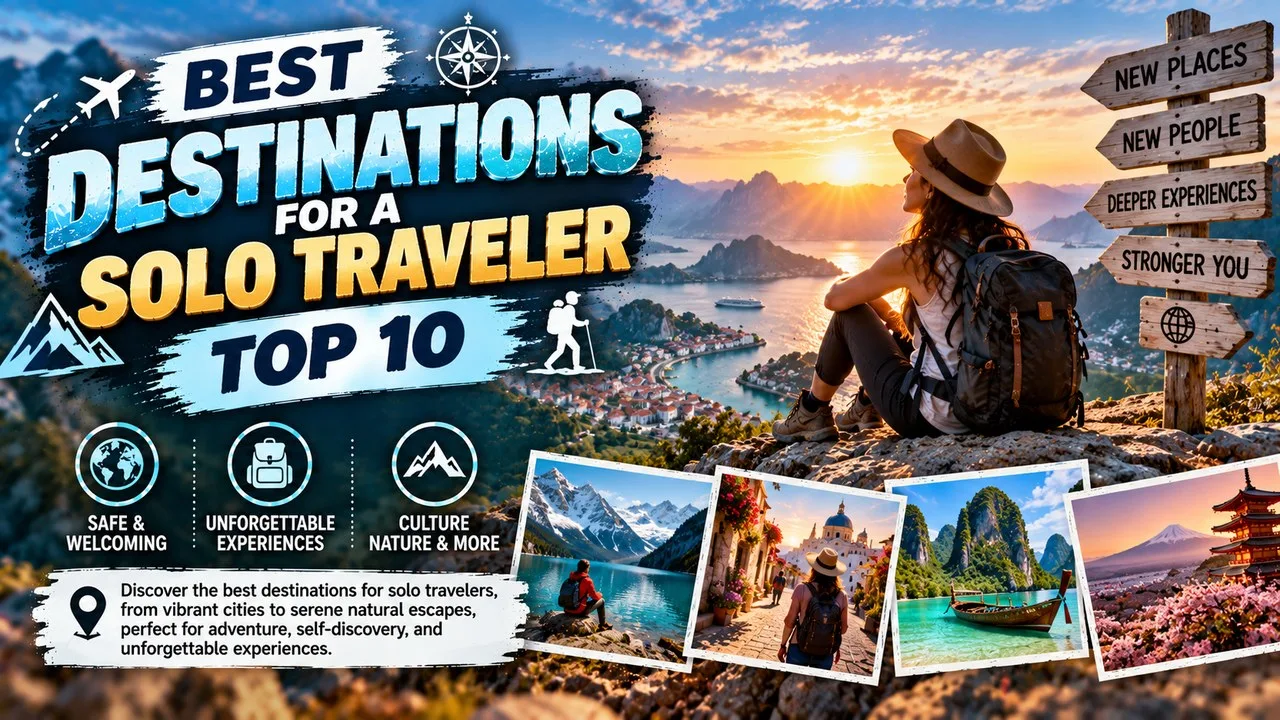
The best destinations for a solo traveler blend safety, easy solo logistics, meetup density, language ease and value on Finepedia's 2026 scorecard.
Traveling alone is less a niche hobby than a mainstream logistics problem: where can one person land, navigate, sleep safely and meet others without a fixed companion? Popular blog lists from 2019 often answered with tropical classics and romantic islands. The better question in 2026 is comparative: which places combine low friction for independents with enough community that solitude stays optional.
This Finepedia guide ranks ten destinations with a public scorecard rather than vibes. It deliberately avoids the older mix of Thailand, Melbourne, Bhutan, Hong Kong, Costa Rica, Cusco, Alaska, the Aran Islands, Malaysia and Bali as a copied set. Instead it mixes East Asian transit hubs, compact European capitals, English-speaking nature gateways and one high-value Caucasus city, all framed as of October 2026. Safety scores use relative national context such as the Global Peace Index as background, not as a certificate that street crime is zero. Practical cautions (pickpockets, weather seasons, altitude-free but windy coasts, late-night transport) appear where they matter.
Budget stretchers can pair this list with Ways Smart Travelers Save Money Abroad: Top 10. Mobility paperwork belongs beside Most Powerful Passports in the World: Top 10. City texture comparisons sit in Most Walkable Cities in the World: Top 10 and Most Colorful Cities in the World: Top 10, while risk literacy is the topic of Most Dangerous Tourist Destinations in the World: Top 10.
How We Chose the Best Destinations for a Solo Traveler
Finepedia scored each destination out of 40 points across five factors. The title promises places that work when you are alone, so safety and solo logistics carry the heaviest weight, with community, language ease and value closing the gap.
| Factor | Max points | What we measured |
|---|---|---|
| Safety for solo travelers | 10 | Relative national peace context plus urban habits that matter alone (late transit, tourist-area theft patterns, emergency access); never a claim of zero risk |
| Ease of getting around alone | 10 | Metro or rail density, walkability, ride-hail coverage, English or pictorial wayfinding, day-trip packaging for independents |
| Community / hostel-or-meetup scene | 7 | Hostel and social lodging density, walking tours, language exchanges, cafe culture where strangers routinely share tables |
| English / low language friction | 7 | How far English (or ultra-clear iconography and apps) carries bookings, food orders and help requests |
| Value + independent infrastructure | 6 | Cost relative to Western Europe/North America norms plus 24-hour conveniences, lockers, luggage storage and tourist information for one-person itineraries |
Tie-breaks preferred higher solo-logistics scores, then community, then value. City hubs are named because that is where solo networks concentrate; countryside day trips remain optional add-ons. Scores are planning tools, not visas, insurance quotes or personal risk tolerances.
Best Destinations for a Solo Traveler at a Glance
| # | Hub | Country / region | Finepedia score /40 | Standout solo strength | Main caution |
|---|---|---|---|---|---|
| 1 | Lisbon–Porto corridor | Portugal | 38 | Hostel density + walkable cores + tourist English | Petty theft in crowded trams and nightlife streets |
| 2 | Seoul | South Korea | 37 | Subway precision + apps + Hongdae social scene | Limited English outside tourist belts; late-night fatigue |
| 3 | Tokyo–Kyoto corridor | Japan | 37 | Exceptional safety + rail + solo dining culture | Cost; complex rail tickets without planning |
| 4 | Taipei | Taiwan | 37 | MRT + night markets + moderate costs | Mandarin dominates paperwork; typhoon season awareness |
| 5 | Ljubljana | Slovenia | 37 | Compact capital + day trips + English ease | Smaller nightlife than larger capitals; winter daylight |
| 6 | Edinburgh | Scotland (UK) | 36 | English + hostels + Highlands tour meetups | Weather; festival-season prices |
| 7 | Singapore | Singapore | 35 | Ultra-clear English + MRT + safety | High costs; thinner classic backpacker hostel scene |
| 8 | Auckland + South Island hubs | New Zealand | 35 | English + hostel/camper culture + nature | Distances and hire-car fatigue; high prices |
| 9 | Tbilisi | Georgia | 34 | Hostel energy + food value + walkable old town | Urban caution; patchy English outside tourist core |
| 10 | Reykjavik | Iceland | 31 | Extreme safety + English + solo-ready tours | Very high costs; thin transit outside capital packages |
1. Portugal — Lisbon–Porto Corridor
| Attribute | Details |
|---|---|
| Hub focus | Lisbon, Porto and the rail/bus links between them |
| Finepedia score | 38 of 40 (safety 8, transit 8, community 8, English 7, value 7) |
| Solo logistics | Walkable historic cores, metro in Lisbon, frequent intercity trains, ride-hail |
| Community cues | Dense hostel network, free walking tours, shared pasteis and late dinners |
| Language | Portuguese official; English widely usable in tourist services |
Background
Portugal rebuilt its tourism model around city breaks, coastal trains and affordable Western European stays. For solo travelers that matters more than postcard beaches: Lisbon and Porto concentrate beds, tours and evening life in compact hills rather than sprawling car suburbs. The corridor also lets one traveler sample two distinct food and architecture cultures without resetting logistics every three days.
Relative peace rankings place Portugal among Europe's calmer large tourism economies in recent Global Peace Index editions, which supports the safety score without implying that crowded trams are theft-free. Solo visitors still use standard city habits: zipped bags on Line 28-style routes, planned late-night transport, and hotel or hostel lockers for passports.
Key Features
- Hostel and social guesthouse density in Alfama/Bairro Alto orbits and Porto's riverside belts
- Walkable miradouro circuits that do not require a companion driver
- Easy Lisbon–Porto trains for a two-city solo itinerary
- English menus and booking platforms in the tourist core
- Day trips (Sintra, Cascais, Douro) sold as joinable group seats
Significance
Portugal ranks first among Finepedia's best destinations for a solo traveler because it balances Western European safety expectations with stronger value and meetup density than many northern capitals. The logistics score is not perfect (hills, cobbles, peak-season crowds), yet a first-time solo visitor can land, buy a transit card, join a walking tour and meet people the same afternoon. That combination is rarer than pure scenery.
Interesting Facts
- Porto and Lisbon are linked by frequent rail, so solo itineraries often treat them as one corridor rather than separate trips
- Pastel de nata queues are an accidental meetup scene; shared tables are common in casual eateries
- Free or tip-based walking tours are a staple first-day social tactic in both cities
- Atlantic weather can swing within a day; layers matter more than fashion for solo walkers
- Petty theft concentrates in crowded tourist vehicles more than in quiet residential lanes
2. South Korea — Seoul
| Attribute | Details |
|---|---|
| Hub focus | Seoul with optional day links to Suwon or the DMZ tour belt |
| Finepedia score | 37 of 40 (safety 9, transit 10, community 7, English 5, value 6) |
| Solo logistics | Extensive subway, T-money cards, Naver/Kakao maps, late trains on key lines |
| Community cues | Hongdae hostels, PC cafes, group food culture, language exchanges |
| Language | Korean official; English uneven; apps and pictorial menus close gaps |
Background
Seoul is built for people who navigate alone: dense subway maps, 24-hour convenience culture and neighborhoods that stay active after dark in selected districts. Solo travelers benefit from a social food norm (many dishes are shared) and from hostel clusters that make meeting others low-effort. National peace context for South Korea is stronger than many large Asian economies on Global Peace Index tables, though local caution around nightlife districts still applies.
English is the main friction point. Station names often appear in Roman letters, yet clinic forms, some restaurants and older staff may not. Translation apps and pointing at menu photos are normal tools, not emergency hacks.
Key Features
- Subway coverage that reduces dependence on taxis
- Hongdae and similar belts with hostels and street performances
- Convenience stores as reliable solo meal and ATM fallback
- Highly developed mobile maps and ride-hail ecosystems
- Organized day tours that fill seats without requiring a private guide hire
Significance
Seoul places second because solo logistics are elite: a traveler can cross the city at night with clearer transit options than in many Western metros. Community scoring is strong in student and nightlife districts even if English is imperfect. Value sits in the middle — not Southeast Asian cheap, but often kinder than Singapore or Iceland for food and local transit.
Interesting Facts
- Many restaurants welcome single diners; counter seats and kiosks reduce awkwardness
- T-money-style cards simplify buses and subway without cash fumbling
- Jjimjilbang spa culture is a uniquely Korean solo downtime option (follow house rules)
- Daylight hiking near the city (Bukhansan area trails) works as a solo half-day with transit access
- Peak cherry-blossom and autumn foliage weeks raise bed prices; book early
3. Japan — Tokyo–Kyoto Corridor
| Attribute | Details |
|---|---|
| Hub focus | Tokyo, Kyoto and the Tokaido Shinkansen spine |
| Finepedia score | 37 of 40 (safety 10, transit 10, community 7, English 5, value 5) |
| Solo logistics | World-class rail/metro, IC cards, luggage lockers, timed walks |
| Community cues | Capsule hotels, hostel common rooms, group cooking classes, temple circuits |
| Language | Japanese official; English improving in tourism nodes; iconography excellent |
Background
Japan is the classic answer to "Where can I travel alone and feel structurally safe?" Lost wallets are frequently returned; late trains run on dense urban networks; convenience stores solve midnight hunger. Finepedia still refuses absolute "safest on Earth" slogans — earthquakes, typhoons and tourist-area pickpocketing in crowds remain real — but the safety score is the list's ceiling.
Community is quieter than Lisbon's hostel bars, yet solo dining is culturally normal and group activities (bike tours, tea ceremonies, cooking classes) are easy to book as a party of one. English varies: major stations help; deep residential alleys less so.
Key Features
- Shinkansen corridor linking Tokyo and Kyoto without a car
- Coin lockers and luggage forwarding services that free solo walkers
- Capsule and business hotels designed for single occupancy
- Extremely reliable urban transit schedules
- Convenience-store ecosystem as independent infrastructure
Significance
Japan ranks third after tie-breaks with other 37-point destinations: transit matches Seoul, safety leads the board, but value is only mid-pack because lodging and rail passes add up. For first solo trips in Asia, the predictability often outweighs cost. Readers comparing passport mobility should still check entry rules via Most Powerful Passports in the World: Top 10 before assuming visa-free arrival.
Interesting Facts
- Solo restaurant culture includes ticket machines and counter ramen bars built for one
- IC cards (Suica/Pasmo-class systems) reduce ticket-counter stress
- Kyoto temple circuits are highly solo-friendly by daylight; night rural roads are not the point
- Peak Golden Week and cherry-blossom periods crush availability
- Quiet car etiquette on trains is part of the solo comfort — bring headphones, not speakerphone
4. Taiwan — Taipei
| Attribute | Details |
|---|---|
| Hub focus | Taipei with TRA/HSR day trips to the coast or Taichung |
| Finepedia score | 37 of 40 (safety 9, transit 9, community 6, English 5, value 8) |
| Solo logistics | MRT, YouBike, HSR, night-market walking loops |
| Community cues | Hostel pockets, cafe culture, night-market crowds as soft social spaces |
| Language | Mandarin official; English mixed; pictorial menus common |
Background
Taipei rewards independents who like food-led itineraries. Night markets, MRT coverage and bike share create a low-friction daily rhythm. Relative safety perceptions for Taiwan are strong in traveler surveys and peace indexes used as context, while typhoon season and mountain weather still demand forecast checks for anyone hiking alone.
Value is a standout versus Japan or Singapore: local meals and transit stretch a mid-range budget. English is imperfect but navigable in MRT signage and tourist information centers.
Key Features
- MRT plus YouBike for car-free days
- Night markets as affordable solo dining circuits
- High-speed rail for simple intercity hops
- Compact hostel and guesthouse options near transit
- Hot-spring and coastal day trips without a private driver
Significance
Taiwan ranks fourth on Finepedia's solo scorecard because it pairs high safety and transit scores with better day-to-day value than Japan or Singapore. Community is a notch quieter than Seoul's Hongdae energy, yet night markets and cafes make solitude feel optional. It is a strong alternative for travelers who want East Asian efficiency without Bangkok-or-Bali clichés.
Interesting Facts
- EasyCard-style payment covers MRT and many buses
- Night markets are social without requiring bar courage
- Jiufen and similar day trips sell as joinable tours or simple TRA links
- Convenience stores rival Japan's for solo midnight logistics
- Summer typhoons can cancel mountain buses; build flexible buffers
5. Slovenia — Ljubljana
| Attribute | Details |
|---|---|
| Hub focus | Ljubljana with Lake Bled, Postojna and coastal day options |
| Finepedia score | 37 of 40 (safety 9, transit 8, community 6, English 7, value 7) |
| Solo logistics | Walkable center, regional buses, bike rentals, compact geography |
| Community cues | Hostel bars, shared boat or cave tours, cafe riverbanks |
| Language | Slovene official; English widely usable with visitors |
Background
Ljubljana is a capital you can cross on foot, which is a quiet superpower for solo travel. Nature icons (Bled, Triglav approaches, karst caves) sit within day-trip range, so a week does not require constant hotel changes. Slovenia's small-country peace context and low violent-crime profile for visitors support a high safety score, with ordinary urban awareness still advised.
English competence in tourism services is notably strong for Central Europe, lowering friction for bookings and emergencies.
Key Features
- Car-free feel in the riverside old town
- Easy packaging of Bled and cave day trips for single seats
- Hostel common rooms in a small-city setting
- English-friendly visitor services
- Competitive mid-range costs versus Alpine neighbors
Significance
Slovenia earns fifth place by making solo logistics simple: one base, many day trips, clear English, calm streets. Community density cannot match Lisbon, yet the scale means you repeatedly see the same cafe faces. For travelers who dislike megacity overload, that is a feature.
Interesting Facts
- The old town's riverbanks work as accidental evening meetup space
- Lake Bled day trips are among Europe's easiest solo nature wins
- Public buses cover many tourist nodes if timed carefully
- Winter daylight is short; summer festivals raise bed prices
- Neighboring Italy, Austria and Croatia make Ljubljana a solo rail/bus hub for multi-country loops
6. Scotland — Edinburgh
| Attribute | Details |
|---|---|
| Hub focus | Edinburgh with Highlands and Isle day tours |
| Finepedia score | 36 of 40 (safety 8, transit 8, community 8, English 7, value 5) |
| Solo logistics | Walkable Old Town, buses, rail to Glasgow, coach day tours |
| Community cues | Hostels, pub conversation culture, festival crowds, tour-bus meetups |
| Language | English (and Scots/Gaelic heritage contexts); zero language barrier for most visitors |
Background
Edinburgh solves the solo traveler's social problem in an English-speaking package: hostels on and near the Royal Mile, pubs where conversation is normal, and Highlands coach tours that fill seats with other independents. Safety is solid in tourist terms with standard big-city caution around late nightlife. Weather is the operational risk — wind and rain punish underdressed walkers more than crime statistics do.
Value is mid because UK prices and festival surges bite, yet skipping a hire car keeps costs controllable.
Key Features
- English throughout bookings, clinics and casual chat
- Dense hostel strip and social pubs
- Day tours that turn Highlands scenery into a solo-friendly product
- Compact walkable core between castle ridge and New Town
- Easy add-on rail to Glasgow or further UK cities
Significance
Scotland ranks sixth as the list's strongest pure-English social hub outside New Zealand. It loses points on value and on weather friction, yet for travelers who want conversation without translation apps, Edinburgh remains a reliable solo base. Festival weeks (especially August) require earlier booking than quiet February.
Interesting Facts
- Free walking tours are a classic day-one meetup tactic
- Coach day tours reduce the need to drive on the left alone
- Hogmanay and Fringe dates transform bed availability
- Arthur's Seat is a popular solo daylight hike with city access
- Cashless payments are widespread; still keep a backup card
7. Singapore
| Attribute | Details |
|---|---|
| Hub focus | Singapore city-state itineraries |
| Finepedia score | 35 of 40 (safety 10, transit 10, community 5, English 7, value 3) |
| Solo logistics | MRT/LRT, clear English wayfinding, Changi as a soft landing |
| Community cues | Smaller classic hostel scene; meetup apps, food courts, walking tours |
| Language | English is an official language alongside Malay, Mandarin and Tamil |
Background
Singapore is the training-wheels solo destination for Asia: English on signs, strict public-order norms, and an MRT map that forgives jet lag. Safety and transit scores hit the ceiling. The trade-off is cost and a thinner backpacker-bar culture than Lisbon or Seoul; community often happens in food courts, museums and paid tours rather than dorm kitchens.
Finepedia keeps Singapore on the list because first-time solo travelers frequently need a high-clarity hub before harder language environments. It is a logistics win, not a budget win.
Key Features
- English as a daily administrative and service language
- MRT coverage with airport links
- Extremely clear tourist information standards
- Hawker centres as affordable solo dining relative to restaurant prices
- Strict local rules that are easy to follow once read
Significance
Seventh place reflects elite safety and transit dragged down by value. For a three-to-five-day solo reset between longer Asia legs, Singapore remains hard to beat. For a two-week hostel crawl on a tight budget, it is the wrong primary base — use it as a gateway, then move.
Interesting Facts
- Hawker centres let solo diners eat well without awkward table minimums
- Chewing gum and smoking rules are famous for a reason; read airport advisories
- Gardens and waterfront walks are safe evening options in busy districts
- Weekend Sentosa or island hops work as structured solo day plans
- Hotel prices spike around major MICE events; flexible dates help
8. New Zealand — Auckland and South Island Hubs
| Attribute | Details |
|---|---|
| Hub focus | Auckland gateway plus Queenstown, Christchurch and hostel-town links |
| Finepedia score | 35 of 40 (safety 9, transit 7, community 8, English 7, value 4) |
| Solo logistics | English everything; intercity buses; campervan culture; tour desks |
| Community cues | Hostel noticeboards, shared hikes, adventure-activity meetups |
| Language | English and Te Reo Maori contexts; English universal for visitors |
Background
New Zealand sells nature, but solo travelers stay for the social infrastructure around that nature: hostels, shared transfers and activity desks that turn bungy, hikes and cruises into joinable products. Safety context is strong nationally; the real solo risks are weather, alpine terrain and fatigue on long drives — not urban chaos.
Transit scores lower than Asian metros because distances are large and trains are limited. Buses and tours fill gaps if you avoid assuming a car is optional everywhere.
Key Features
- English-speaking bookings end to end
- Hostel culture oriented to independents and working holidaymakers
- Packaged adventure activities sold by the seat
- Relatively transparent visitor information and trail alerts
- Strong cafe culture in hub towns
Significance
New Zealand ranks eighth: community and English are excellent, safety is high, but value and pure transit density cannot match Seoul or Taipei. Solo travelers who budget for activities and beds still find it one of the easiest places on Earth to arrive alone and leave with trail friends. Compare cost-control tactics with Ways Smart Travelers Save Money Abroad: Top 10 before locking a campervan.
Interesting Facts
- Queenstown's activity desk model is built for solo joiners
- Freedom camping rules are regulated; follow local council guidance
- InterCity-style coaches connect many tourist towns if timed early
- Sandfly seasons and alpine weather punish underprepared day hikers
- Working holiday visas (where eligible) deepen the hostel community further
9. Georgia — Tbilisi
| Attribute | Details |
|---|---|
| Hub focus | Tbilisi with Kazbegi, Kakheti wine country and day tours |
| Finepedia score | 34 of 40 (safety 6, transit 6, community 8, English 5, value 9) |
| Solo logistics | Walkable old town, ride-hail, marshrutka and tour vans |
| Community cues | Hostel boom, shared supra dinners, nightlife in compact districts |
| Language | Georgian official; English growing in tourist services; Russian also heard |
Background
Tbilisi emerged in the 2020s as a budget-and-hostel alternative to pricier European capitals. Solo travelers find common rooms, walking tours and wine-region day trips that fill vans without private drivers. Value is the list's highest: food, wine tastings and beds stretch a mid-range budget further than Lisbon or Edinburgh.
Safety is scored more cautiously. Georgia's national context is more complex than Iceland or Japan on peace indexes, and urban street smarts matter at night. The score reflects "workable with habits," not "carefree at 2 a.m. everywhere."
Key Features
- High hostel density relative to city size
- Excellent food value for solo diners
- Day tours to mountains and wine villages sold by the seat
- Compact old-town walking that does not need a car
- Growing English in cafes, hostels and tour desks
Significance
Ninth place captures a trade: outstanding value and community versus middling safety and transit scores. For experienced solos who already manage cities carefully, Tbilisi can outperform destinations that score higher on paper but cost twice as much. For a first trip ever alone, Portugal or Singapore may feel gentler.
Interesting Facts
- Sulfur bath districts are a classic solo downtime ritual (book reputable houses)
- Shared feasts (supra-style meals) turn strangers into tablemates quickly on tours
- Ride-hail apps reduce late-night marshrutka uncertainty in the capital
- Mountain weather on Kazbegi routes changes fast; daylight planning matters
- Glaring money-exchange booths deserve the same skepticism as elsewhere
10. Iceland — Reykjavik
| Attribute | Details |
|---|---|
| Hub focus | Reykjavik with Golden Circle and South Coast tour circuits |
| Finepedia score | 31 of 40 (safety 10, transit 6, community 6, English 7, value 2) |
| Solo logistics | English everywhere in tourism; tour buses compensate for thin rural transit |
| Community cues | Hostel common rooms; tour-bus friendships; compact downtown |
| Language | Icelandic official; English extremely widely spoken in visitor services |
Background
Iceland is what solo safety looks like when cost is ignored: low violent crime by visitor standards, English on nearly every tourist counter, and day tours designed for independents who will not rent a car in winter. Global Peace Index editions routinely place Iceland at or near the top of national peace rankings, which informs — but does not solely decide — the safety score.
Transit and value are the penalties. Outside packaged routes, independent movement is expensive or seasonal. Hostel beds exist, yet grocery and activity prices shock first-timers. Finepedia keeps Iceland tenth rather than omitting it because the solo product design (Golden Circle buses, English guides) remains exemplary for travelers who can pay.
Key Features
- Exceptional English in tourism
- Tour products that remove the need for solo winter driving
- Compact Reykjavik downtown for evening walks
- Very strong relative safety context
- Clear official visitor advisories on weather and roads
Significance
Iceland closes the list as the high-cost specialist: unmatched safety and language ease, limited value, and transit that works best when you buy the package. It is a superb solo destination for a short, planned itinerary and a poor choice for open-ended budget backpacking. Weather, not people, is the main adversary.
Interesting Facts
- Many visitors never drive; seat-in-coach tours cover the headline sights
- Wind can make "short walks" punishing — dress for exposure, not Instagram
- Hot pools and geothermal spas are easy solo downtime bookings
- Summer's midnight sun changes sleep schedules more than nightlife does
- Shoulder seasons trade crowds for harsher road conditions outside the capital
Practical Solo Habits That Travel Well
Rankings do not replace personal preparation. Across all ten hubs, the same habits matter: share a rough itinerary with someone trusted, keep digital and paper copies of documents, use official taxi ranks or known apps at night, and treat "friendly stranger with a special deal" skepticism as normal. Destinations on this list reduce friction; they do not remove it.
| Habit | Why it helps alone |
|---|---|
| Book night one before landing | Removes airport decision fatigue and scam vulnerability |
| Prefer social lodging early in a trip | Accelerates meetup density when jet-lagged |
| Join one structured activity on day one | Walking tour, cooking class or day coach creates instant weak ties |
| Carry a soft layer and rain shell | Weather ends more solo days than language barriers |
| Use bank alerts and card controls | Faster response if a wallet is lost |
Readers weighing riskier regions for contrast should study Most Dangerous Tourist Destinations in the World: Top 10 as literacy, not as an itinerary. Walkability lovers can cross-check city form via Most Walkable Cities in the World: Top 10.
Frequently Asked Questions
What are the best destinations for a solo traveler on this 2026 list?
Portugal's Lisbon–Porto corridor ranks first on Finepedia's scorecard, followed by Seoul, the Tokyo–Kyoto corridor, Taipei and Ljubljana. Edinburgh, Singapore, New Zealand hubs, Tbilisi and Reykjavik complete the ten. "Best" here means a balance of safety, solo logistics, meetup potential, language ease and value — not the single cheapest beach.
Is Japan safer than Portugal for solo travel?
Japan scores higher on Finepedia's safety factor, reflecting strong structural predictability and relative national peace context. Portugal still ranks first overall because community density and value pull ahead while safety remains solid for a European capital corridor. Personal comfort with language and crowds should decide between them.
Which solo destinations are best on a tight budget?
Tbilisi leads value on this list, with Taipei and Ljubljana also stretching mid-range money further than Singapore, Iceland or Japan. Budget still depends on season, tours and alcohol habits. Pair any pick with the tactics in Ways Smart Travelers Save Money Abroad: Top 10.
Do I need to speak the local language?
English is enough for basic tourism in Singapore, Scotland, New Zealand and Iceland. Portugal and Slovenia are workable in tourist cores. Seoul, Tokyo, Taipei and Tbilisi reward translation apps and patience outside main strips. Learning greetings still improves every interaction.
Are hostels necessary to meet people?
No, but they accelerate it. Walking tours, day coaches, language exchanges, cooking classes and cafe counter seats also work. Singapore and Iceland lean more on tours and daytime activities than on classic dorm-party culture.
Is solo travel safe for women on these destinations?
These hubs are chosen partly for comparatively manageable solo conditions, yet no destination is risk-free. Standard advice applies: trust daylight for unfamiliar neighborhoods, use vetted transport at night, and read recent traveler reports for your gender and identity. National peace indexes are context, not guarantees.
How long should a first solo trip be?
Seven to twelve days in one or two hubs beats a rushed five-country sprint. Portugal, Taiwan or Singapore work as short confidence builders; New Zealand and Japan reward longer stays because transit days add up. Leave recovery margins for weather and jet lag.
Conclusion
The best destinations for a solo traveler in 2026 are not a recycled 2019 beach list. Finepedia's scorecard puts Portugal first for the rare mix of meetup density, value and workable safety, then favors East Asian transit excellence in Seoul, Japan and Taipei, compact European calm in Ljubljana, English social ease in Edinburgh and New Zealand, ultra-clear logistics in Singapore, high-value energy in Tbilisi, and high-cost safety specialization in Iceland. Choose with your language comfort, budget and appetite for structured tours — then book night one before you land.
- Institute for Economics & Peace, Global Peace Index (methodology and latest public rankings overview): https://www.visionofhumanity.org/maps/global-peace-index/
- Visit Portugal (official tourism): https://www.visitportugal.com/
- Korea Tourism Organization / VisitKorea: https://english.visitkorea.or.kr/
- Japan National Tourism Organization (JNTO): https://www.japan.travel/en/
- Tourism Taiwan: https://eng.taiwan.net.tw/
- Slovenia Tourist Board / Feel Slovenia: https://www.slovenia.info/en
- VisitScotland: https://www.visitscotland.com/
- Singapore Tourism Board / VisitSingapore: https://www.visitsingapore.com/
- Tourism New Zealand: https://www.newzealand.com/
- Georgian National Tourism Administration: https://georgia.travel/
- Visit Iceland: https://www.visiticeland.com/
- Topic prompt only (order, wording and 2019 destination mix not copied): https://10mosttoday.com/10-best-destinations-for-a-solo-traveler/
















Log in with