










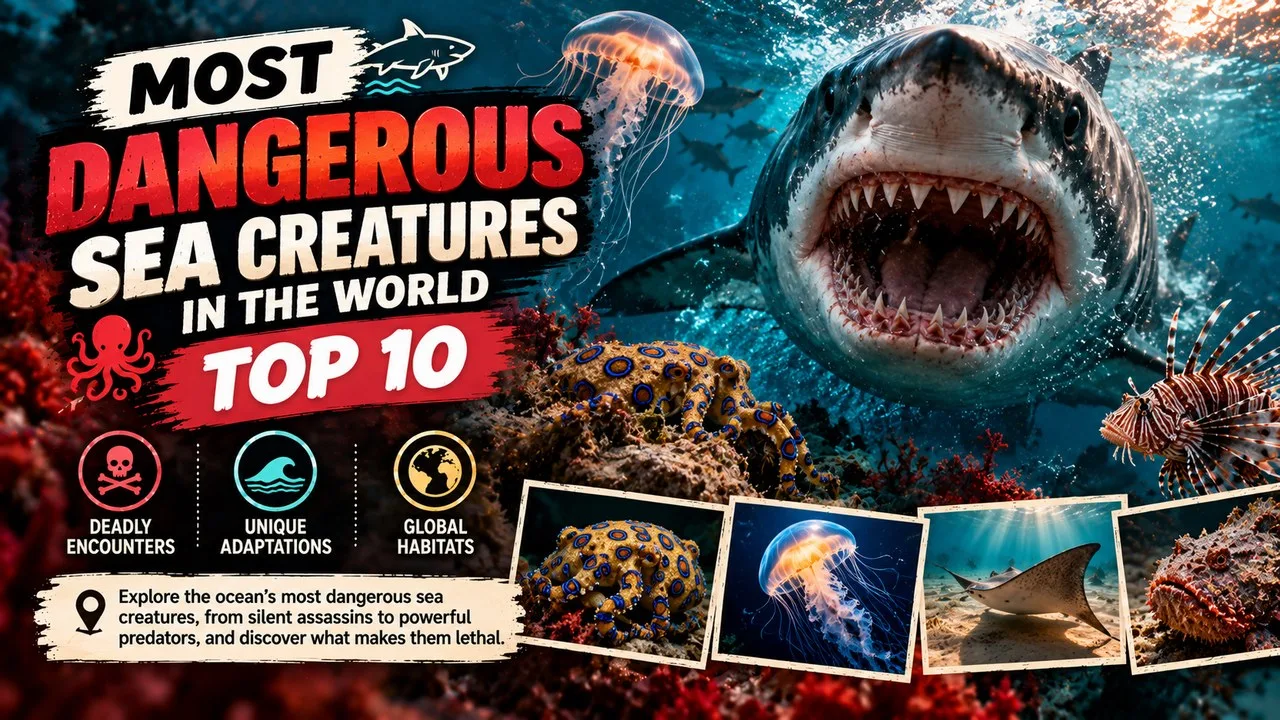
The most dangerous sea creatures, from box jellyfish to bull sharks and blue-ringed octopuses, are ranked here by venom, recorded deaths and real risk.
The ocean does not hide monsters behind every wave. Most marine animals ignore people, and the overwhelming majority of beach days end with nothing worse than sunburn. Yet a short list of species can kill or badly injure a healthy adult, and several of them live exactly where people swim, wade, surf, fish and collect shells.
This Finepedia listicle, written as of October 2026, ranks ten of the most dangerous sea creatures with a published scorecard instead of shock value. Every animal is scored on how lethal a single serious encounter can be, how many human deaths are actually documented, how likely an encounter is, how hard the injury is to treat, and how the animal behaves around people. The order is original, the numbers come from museums, government agencies and peer-reviewed literature, and nothing is rounded up for drama.
Size is a poor guide to danger. A jellyfish the width of a fingernail and a snail that fits in a palm both appear below, alongside a crocodile whose average adult male weighs as much as three or four people and the three sharks responsible for most serious bites. Beach-goers planning a trip can pair this guide with Most Dangerous Beaches in the World: Top 10, where rips and surf usually pose a bigger threat than any animal.
How We Ranked the Most Dangerous Sea Creatures
Finepedia scored each candidate on five tests that can be checked against the International Shark Attack File, Australian first-aid guidelines, museum fact sheets and medical case reports. Each animal received up to 25 points.
- Lethality of a serious encounter (up to 5 points): 5 when one bite or sting can kill a healthy adult within minutes to hours; 4 when a single encounter is often survivable but can be fatal; 3 when deaths are possible but uncommon even after severe envenomation
- Documented human deaths (up to 5 points): 5 for dozens of recorded fatalities in reliable databases; 4 for a substantial but smaller documented toll; 3 for a few dozen deaths spread over centuries; 2 for a handful of confirmed cases
- Likelihood of encounter (up to 5 points): 4 or 5 when the animal shares shallow water with swimmers, waders or fishers in populated regions; 3 when encounters need specific places or activities; 1 when contact requires picking the animal up
- Treatment difficulty (up to 5 points): 4 when death can arrive before advanced care, or when no antivenom exists; 3 for severe trauma or envenomation that hospitals can usually manage; 2 when antivenom and simple first aid make death rare
- Threat behaviour (up to 5 points): 5 for an active predator that can treat a person as prey; 4 for large predators that bite investigatively or by mistaken identity; 2 for animals that sting or bite only when touched or trapped; 1 for animals that never pursue people
- Tiebreaks: first lethality, then documented deaths, then likelihood of encounter
Sixteen candidates were scored. Animals that scored high on fear but low on evidence were moved to Honorable Mentions, including the Portuguese man o' war, stingrays, lionfish, pufferfish and fire coral. Some popular claims were also checked and dropped, such as fixed multiples comparing octopus venom with cyanide, because reputable sources quote different figures.
One reality check frames the whole list. Australian first-aid authority ANZCOR, citing Surf Life Saving Australia data, reports an average of 40,128 jellyfish stings a year across Australia, yet only 4 jellyfish deaths between 2004 and 2022, compared with 60 deaths from other marine animals in the same period, most of them caused by sharks and crocodiles. Danger is real, but it is concentrated in a few species and situations.
Most Dangerous Sea Creatures at a Glance
| # | Creature | Main threat | Where people meet it | Score (of 25) |
|---|---|---|---|---|
| 1 | Box jellyfish (Chironex fleckeri) | Fast-acting venom that can stop the heart | Tropical Australian coasts and estuaries | 20 |
| 2 | Saltwater crocodile | Ambush predation and drowning | River mouths, mangroves, beaches, islands from India to Australia | 20 |
| 3 | Great white shark | Severe bite trauma | Cool to temperate coasts with seal colonies | 19 |
| 4 | Bull shark | Severe bite trauma in shallow and fresh water | Warm coasts, estuaries and rivers | 19 |
| 5 | Tiger shark | Severe bite trauma | Tropical and warm temperate coasts and islands | 18 |
| 6 | Beaked sea snake | Neurotoxic and muscle-destroying venom | Estuaries and fishing grounds, Persian Gulf to Australia | 17 |
| 7 | Blue-ringed octopus | Tetrodotoxin paralysis | Rock pools and reefs around Australia and the Indo-Pacific | 15 |
| 8 | Geography cone snail | Paralytic conotoxins | Indo-Pacific coral reefs and reef flats | 14 |
| 9 | Irukandji jellyfish | Irukandji syndrome, severe hypertension | Tropical Australian reefs and coasts | 14 |
| 10 | Reef stonefish | Excruciating venomous spine stings | Indo-Pacific reef flats and rubble | 12 |
Readers who enjoy animal superlatives may also like Most Extreme Hearing Animals: Top 10, a ranking of the sharpest ears in the animal kingdom.
1. Box Jellyfish (Chironex fleckeri)
| Attribute | Details |
|---|---|
| Scientific name | Chironex fleckeri, also called the sea wasp |
| Range | Tropical Australian coastal waters from Western Australia through the Northern Territory to Queensland |
| Size | Bell up to about 30 cm; up to 60 tentacles reaching about 3 m |
| Main danger | Venom that can cause cardiac and respiratory arrest within minutes |
| Finepedia score | 20 of 25 (lethality 5, deaths 5, encounter 4, treatment 4, behaviour 2) |
Habitat and Biology
The Australian box jellyfish is a cubozoan, a group named for its cube-shaped bell. The Australian Museum describes it as large yet nearly transparent, with up to 60 tentacles growing in four clumps from the corners of the bell. Those tentacles carry vast numbers of stinging capsules that fire on contact with skin. Unlike drifting jellyfish, box jellyfish swim actively by pulsing the bell, and they carry 24 eyes arranged in four sensory clusters.
The species lives in shallow tropical waters near beaches, river mouths and estuaries. Surf Life Saving Australia notes that it becomes deadly once the bell reaches roughly 8 to 10 centimetres, although smaller animals still deliver painful stings. Numbers peak in the warm wet season, which is why northern Australian beaches run stinger seasons with warning signs, netted enclosures and patrols.
Key Features
- Box-shaped, almost invisible bell that is hard to spot in murky shallows
- Clumps of long tentacles that can wrap across limbs and torso in a single contact
- Venom that acts on the heart and nervous system with extraordinary speed
- Active swimming rather than passive drifting
- Whip-like skin marks, often in a ladder pattern, that help medics identify the sting
Significance
The box jellyfish tops this list of dangerous sea creatures because it combines maximum lethality with a well-documented death toll. ANZCOR records more than 80 deaths worldwide and warns that many deaths from similar species in other countries likely go unrecorded. Surf Life Saving Australia states that 2 to 3 metres of tentacle contact can kill an adult within a few minutes, sometimes before help arrives.
Australian guidance is clear: get the person out of the water, call emergency services (000 in Australia), start CPR if they stop breathing, and pour household vinegar over the sting for at least 30 seconds before picking off tentacles. Tropical hospitals and ambulances carry antivenom. Vinegar advice applies to box jellyfish and Irukandji, not to bluebottles, and fresh water should never be poured on the sting.
Interesting Facts
- The species name honours Hugo Flecker, a Queensland doctor and pioneer of marine-sting research
- Lifesavers adopted protective suits after researcher Jack Barnes found that box jellyfish would not fire their stingers into nylon stockings
- Its eyes include lens-bearing types that help it steer around obstacles
- Stinger nets at patrolled northern beaches are designed mainly to keep this species away from swimmers
2. Saltwater Crocodile
| Attribute | Details |
|---|---|
| Scientific name | Crocodylus porosus, also called the estuarine crocodile |
| Range | India to northern Australia and across to Vanuatu and the Solomon Islands |
| Size | Average Queensland male 3 to 4 m and 200 to 300 kg; females rarely exceed 3.5 m |
| Main danger | Ambush attack, drowning and crushing bite |
| Finepedia score | 20 of 25 (lethality 5, deaths 4, encounter 3, treatment 3, behaviour 5) |
Habitat and Biology
The saltwater crocodile is the largest living reptile and the only animal on this list that regularly hunts large land mammals. The Queensland Government describes a range from India to northern Australia and east to Vanuatu and the Solomon Islands. Crocodiles are most common in tidal rivers, yet they also turn up along beaches, around offshore islands of the Great Barrier Reef and Torres Strait, and in freshwater lagoons far inland.
Adults eat whatever they can overpower, from turtles and wallabies to cattle, horses and buffalo. The hunting method is patience: a crocodile waits at the water's edge, lunges sideways, then drags prey under and rolls until it stops struggling. That ambush style is what makes the species so dangerous to people who camp, fish or wade beside murky water.
Key Features
- Ambush hunting from water that can look completely empty
- A powerful bite followed by the death roll used to subdue large prey
- Ability to cross open sea between islands and coastlines
- Long life, expected to exceed 50 years in the wild
- Strong breeding-season movement by males, which raises sighting rates
Significance
The saltwater crocodile ties the box jellyfish on points and loses only on the documented-death tiebreak. Queensland keeps a public record of crocodile attacks since December 1985, and that list includes 15 fatal attacks, the most recent fatal case in January 2025 on the Watson River near Aurukun. The latest entry, a non-fatal attack near Ingham, was logged on 20 January 2026.
There is no antivenom to buy time and no first aid that reverses massive trauma, so prevention is everything. Authorities urge people to be Crocwise: obey warning signs, keep well back from the water's edge, never swim in croc habitat, and avoid cleaning fish or camping beside rivers and estuaries.
Interesting Facts
- Nest temperature decides the sex of hatchlings; around 32 °C produces both sexes but mostly males
- Females guard mound nests of 40 to 70 eggs for about 90 days
- Mothers may carry hatchlings to the water gently in their jaws
- Courtship begins around October and November in Queensland, when crocodiles are more mobile
3. Great White Shark
| Attribute | Details |
|---|---|
| Scientific name | Carcharodon carcharias, also called white shark or white pointer |
| Range | Cool and temperate coasts worldwide, often near seal and sea lion colonies |
| Size | Up to about 21 feet (6.4 m) and 4,500 pounds, according to NOAA Fisheries |
| Main danger | Single large bite causing catastrophic blood loss |
| Finepedia score | 19 of 25 (lethality 4, deaths 5, encounter 3, treatment 3, behaviour 4) |
Habitat and Biology
The great white is the largest predatory shark and a member of the mackerel shark family. NOAA Fisheries lists a lifespan of 70 years or more and describes the species as regionally endothermic, meaning it keeps parts of its body warmer than the surrounding water. That warmth lets it hunt actively in cool seas where fast-moving seals and sea lions gather.
Juveniles feed mostly on fish, while larger adults patrol pinniped colonies and occasionally scavenge whale carcasses. Slow growth and late maturity make the species vulnerable to overfishing, and it is now among the most widely protected sharks on Earth.
Key Features
- Broad, triangular, serrated teeth built to slice rather than grip
- Partial warm-bloodedness that powers bursts of speed in cold water
- Countershaded body, dark above and white below, for ambush from beneath
- Long migrations across ocean basins between feeding and breeding areas
- Strong association with surfing and seal-rich coastlines
Significance
The International Shark Attack File (ISAF) credits the white shark with 351 confirmed unprovoked bites, 59 of them fatal, more fatalities than any other species in its table. In the ISAF 2025 report, released in 2026 and still the latest annual summary as of October 2026, white sharks caused most of that year's deaths, including three surfers in Australia and one person in California.
Context matters, though. ISAF confirmed 65 unprovoked bites worldwide in 2025, in line with the five-year average of 61, and stresses that the risk remains extremely low. Most victims survive: 292 of the 351 confirmed white shark bites in the ISAF table were non-fatal, and researchers often describe many bites as investigative rather than predatory.
Interesting Facts
- Newborn white sharks already measure about 4 feet (1.2 m) long
- ISAF counts the white, tiger and bull sharks as the Big Three of serious bites
- Increasing numbers of white sharks at aggregation sites near popular Australian surf beaches may be one reason for the 2025 rise in fatalities, according to ISAF
- The species can maintain body temperature above that of the water around it
4. Bull Shark
| Attribute | Details |
|---|---|
| Scientific name | Carcharhinus leucas |
| Range | Tropical and subtropical coasts worldwide, plus many rivers and some lakes |
| Size | Commonly to about 340 cm; maximum reported about 400 cm |
| Main danger | Powerful bites in shallow, murky and fresh water near people |
| Finepedia score | 19 of 25 (lethality 4, deaths 4, encounter 4, treatment 3, behaviour 4) |
Habitat and Biology
The bull shark is a stocky, blunt-snouted requiem shark with an unusual talent: it can live in fresh water for long periods. The Florida Museum reports bull sharks 3,700 kilometres up the Amazon in Peru and more than 3,000 kilometres up the Mississippi in Illinois. A population in Lake Nicaragua was once thought to be landlocked until researchers found it moves through rivers to the sea.
This species prefers shallow coastal water less than about 30 metres deep and regularly enters bays, harbours, lagoons and river mouths. Juveniles use low-salinity estuaries as nurseries. Its diet is broad, covering bony fish, smaller sharks, stingrays, turtles, birds and dolphins.
Key Features
- Tolerance of fresh water and of hypersaline water up to 53 parts per thousand
- Small eyes suited to turbid water where vision matters less
- Heavily serrated, triangular upper teeth
- Preference for the same warm shallows that swimmers use
- Mistaken identity risk because it resembles other grey requiem sharks
Significance
The ISAF species table lists 119 confirmed unprovoked bites by bull sharks, 26 of them fatal. Shark researchers widely regard those figures as an undercount: bull sharks are hard to tell apart from relatives, and they live along coasts and rivers in regions where bites often go unreported. The Florida Museum notes that many experts consider the bull shark the most dangerous shark of all for exactly those reasons.
The ranking places it fourth, behind the great white, only because the documented death toll is smaller. On the likelihood-of-encounter test it scores higher than any other shark here, since it shares estuaries, canals and river mouths with people.
Interesting Facts
- Bull sharks are a leading suspect in the 1916 New Jersey shark attacks, a case that remains unresolved
- Its many local names include Zambezi shark in southern Africa and Swan River whaler in Australia
- Bull sharks can migrate north along the US Atlantic coast in summer, reaching as far as Massachusetts
- Short bursts above 19 km/h let a seemingly sluggish shark catch fast prey
5. Tiger Shark
| Attribute | Details |
|---|---|
| Scientific name | Galeocerdo cuvier |
| Range | Tropical and warm temperate seas worldwide, except the Mediterranean |
| Size | Commonly 325 to 425 cm; the largest exceed 5.5 m |
| Main danger | Large bites from a generalist predator in coastal and island waters |
| Finepedia score | 18 of 25 (lethality 4, deaths 4, encounter 3, treatment 3, behaviour 4) |
Habitat and Biology
Tiger sharks take their name from the dark bars on young animals, which fade as they grow. They move between open ocean and shallow coastal water, favouring murky estuaries, harbours and the lagoons of island chains. Much of their hunting happens at night, when they come inshore and closer to the surface.
The species has a reputation as the least picky eater in the sea. The Florida Museum lists sea turtles, rays, other sharks, seabirds, dolphins, squid, crustaceans and carrion among its prey, and stomach contents have included cans, plastic bottles and sacks.
Key Features
- Broad, blunt snout and large eyes
- Notched, serrated teeth with cusplets that saw chunks from large prey such as sea turtles
- Seasonal migrations between tropical and temperate waters
- Solitary hunting style, with groups forming only around food
- Litters of 10 to 82 pups after a gestation of more than a year
Significance
ISAF credits the tiger shark with 142 confirmed unprovoked bites, 39 of them fatal, second only to the white shark. Tiger sharks are often curious and calm when encountered, yet they are one of the three species most often implicated in serious bites.
It ranks fifth because its encounter rate is lower than the bull shark's and its documented death toll is lower than the great white's. Cloudy water after heavy rain, river mouths and dawn or dusk swims raise the risk wherever tiger sharks are present.
Interesting Facts
- Tiger shark embryos are nourished by uterine fluid rather than a placenta
- Confirmed visitors have reached Iceland and the United Kingdom, probably riding the warm Gulf Stream
- Traditional Hawaiian drums have been made with tiger shark skin
- Tiger sharks have been recorded at depths of around 350 m
6. Beaked Sea Snake
| Attribute | Details |
|---|---|
| Scientific name | Hydrophis schistosus (formerly Enhydrina schistosa), also called hook-nosed sea snake |
| Range | Shallow seas from the Persian Gulf to northern coastal Australia |
| Size | Adults average about 1.2 m; large females exceed 1.5 m |
| Main danger | Venom that paralyses nerves and destroys muscle |
| Finepedia score | 17 of 25 (lethality 4, deaths 4, encounter 3, treatment 4, behaviour 2) |
Habitat and Biology
Sea snakes belong to the cobra family, and the beaked sea snake is the species most often involved in serious bites. Britannica describes it as especially common in estuaries and bays near the mouths of great rivers such as the Indus and the Ganges, and it sometimes swims far upriver. It spends its whole life in water, giving birth to live young in quiet shallows.
Its downcurved snout gives the species its name. It feeds on wide-headed fish such as catfish and puffers, seizing them sideways and paralysing them with short fixed fangs before swallowing.
Key Features
- Flattened, oar-like tail for swimming
- Nostrils on top of the snout that close with valves underwater
- Venom that both blocks nerve signals and breaks down muscle tissue
- Usually calm, but quick to strike when grabbed or trapped
- Ridged, overlapping scales and loose skin, especially around the neck
Significance
According to Britannica, the beaked sea snake causes most of the deaths attributed to sea snake bites. The typical victim is not a tourist but a fisher sorting a net by hand, which is why the species is a working-coast hazard across South and Southeast Asia. Bites can be almost painless at first, while paralysis and kidney damage from muscle breakdown develop over the following hours.
Treatment is the weak point. Medical researchers in South Asia have repeatedly flagged limited access to specific sea snake antivenom, especially in rural fishing communities. In Australia, ANZCOR advises treating a sea snake bite exactly like a land snake bite once the person is out of the water.
Interesting Facts
- Females gather in sheltered shallows to give birth to roughly 10 to 30 young
- Newborns are nearly white with dark bands that almost circle the body
- It often turns to face the current while swallowing, using the flow to help
- Its wide gape lets it swallow catfish heads that other sea snakes avoid
7. Blue-Ringed Octopus
| Attribute | Details |
|---|---|
| Scientific name | Hapalochlaena species, including H. maculosa and H. lunulata |
| Range | Australian coastal waters and the western Pacific and Indian oceans |
| Size | Small enough to sit in a child's palm |
| Main danger | Tetrodotoxin that paralyses breathing muscles |
| Finepedia score | 15 of 25 (lethality 5, deaths 2, encounter 3, treatment 4, behaviour 1) |
Habitat and Biology
Blue-ringed octopuses are small, shy animals that hide under ledges and in crevices, often in rock pools at low tide. They hunt crabs, shrimps and small fish, using their beak to make a wound and then releasing saliva laden with paralysing toxin. The Australian Museum explains that the toxin, tetrodotoxin, is produced by bacteria living in the octopus's salivary glands.
When threatened, the animal flashes bright blue rings as a warning. That display is part of the risk: the Australian Museum warns that small children may be drawn to the colours and pick the octopus up.
Key Features
- Brilliant iridescent rings shown as a warning when disturbed
- A bite that is often painless and easy to miss
- Tetrodotoxin, the same nerve toxin found in pufferfish
- Paralysis that can leave a victim unable to move or breathe while still aware
- No antivenom, according to Britannica
Significance
The blue-ringed octopus scores full marks for lethality, yet sits seventh because confirmed deaths are few. Britannica and the Australian Museum both report at least three human fatalities, alongside numerous near-fatal cases. Almost every bite happens because someone handled the animal.
The good news is that survival hinges on simple, fast action. ANZCOR recommends calling an ambulance, applying the pressure immobilisation technique and giving CPR or rescue breathing if breathing fails. The Australian Museum notes that prompt mouth-to-mouth resuscitation has saved more than 10 documented victims, because the paralysis wears off if breathing is supported long enough.
Interesting Facts
- Survivors have reported hearing everything around them while they could not respond
- Most Australian deaths have been attributed to the lesser blue-ringed octopus and its close relatives
- The venom is used to subdue crabs, its main prey
- Rock-pooling families are advised to look, photograph and never touch
8. Geography Cone Snail
| Attribute | Details |
|---|---|
| Scientific name | Conus geographus |
| Range | Indo-Pacific coral reefs, from the intertidal zone to about 20 m deep |
| Size | Usually 7 to 15 cm; the largest shells reach about 16.6 cm |
| Main danger | A venom-loaded harpoon that can cause respiratory failure |
| Finepedia score | 14 of 25 (lethality 5, deaths 3, encounter 1, treatment 4, behaviour 1) |
Habitat and Biology
Cone snails form one of the largest genera of animals in the sea, with more than 800 recognized species. Most hunt worms or other snails, but the geography cone hunts fish. It extends a tubular proboscis and fires a hollow, needle-like tooth that injects venom and holds the prey like a harpoon while paralysis sets in. The fish is then swallowed whole.
The geography cone lives in sand pockets near reef edges, under coral rubble and on reef flats. Its beautifully patterned shell is the problem: most victims were collectors who picked up a living animal.
Key Features
- Disposable harpoon-like tooth fired from a flexible proboscis
- Venom made of many small peptides called conotoxins
- The largest fish-hunting cone species, which may allow bigger venom doses
- Attractive brown-and-white shell prized by collectors
- Separate predatory and defensive venoms produced in different parts of the venom gland
Significance
Biologist Alan Kohn's long-running database, reviewed in the journal Toxins in 2019, lists 141 recorded human envenomations by cone snails from about 1670 to 2017, 36 of them fatal. Kohn concluded that probably all of those fatalities can be traced to a single species, the geography cone. The same table shows no fatal cases in the 2000 to 2017 interval, a trend he linked to better medical care and reporting.
ANZCOR advises pressure immobilisation and close monitoring, because cone shell venom can paralyse breathing muscles within 30 minutes. There is no antivenom, which is why the snail scores high on treatment difficulty despite a very low encounter score.
Interesting Facts
- A painkiller called ziconotide (Prialt), made from a peptide found in the related magician cone, has been sold since 2004
- The eight measured shells of geography cones known to have killed people ranged from 8 to 13.5 cm long
- Conus species are being studied as a source of new medicines and research tools
- Even small cone species should be treated as hazardous and never handled alive
9. Irukandji Jellyfish
| Attribute | Details |
|---|---|
| Scientific name | Carukia barnesi and about ten related box jellyfish species |
| Range | Mainly tropical Australia, with cases reported as far south as Port Phillip Bay |
| Size | Bodies from fingernail size up to about 25 mm, with four tentacles |
| Main danger | Irukandji syndrome, including dangerous surges in blood pressure |
| Finepedia score | 14 of 25 (lethality 3, deaths 2, encounter 4, treatment 3, behaviour 2) |
Habitat and Biology
Irukandji jellyfish are tiny box jellyfish with a single tentacle at each corner of the bell. Several species are so small and transparent that stung swimmers never see them. ANZCOR counts about ten species known or suspected to cause the syndrome, found both offshore on reefs and close to beaches.
The syndrome was first described by Queensland doctor Hugo Flecker in 1952 and named after the Irukandji people, whose country runs along the coast north of Cairns. In 1961 Jack Barnes captured the culprit and let it sting himself, his nine-year-old son and a young lifesaver to prove the link. All three ended up in hospital, and the species was named Carukia barnesi in his honour.
Key Features
- A mild initial sting that may leave no visible mark
- Delayed symptoms appearing 5 to 40 minutes later, typically after 20 to 30 minutes
- Severe back, chest and muscle pain, nausea, sweating and a feeling of impending doom
- Possible heart failure and stroke caused by extreme hypertension
- Tentacles that can reach about a metre despite the tiny body
Significance
Most Irukandji stings lead to hospital care rather than death, which is why lethality scores 3. Yet the danger is real: in 2002 two overseas tourists died in Queensland, one stung off Hamilton Island and one on the outer reef off Port Douglas, both from brain haemorrhage after severe hypertension, as reported in the Medical Journal of Australia.
The species ranks ninth because deaths are rare and modern hospitals manage the syndrome, while frequent encounters on the reef keep it on the list. Australian guidance is to treat any suspected sting in tropical waters with vinegar, watch for delayed symptoms over the next half hour, and seek urgent medical care.
Interesting Facts
- Barnes's 1964 paper in the Medical Journal of Australia documented his self-experiment
- Common names for different species include Morbakka, fire jelly and Halo Irukandji
- Stinger suits help because the tiny stinging cells struggle to penetrate fabric
- Researchers did not realise until the 1980s that several species can cause the syndrome
10. Reef Stonefish
| Attribute | Details |
|---|---|
| Scientific name | Synanceia verrucosa |
| Range | Tropical marine waters of the Indo-Pacific, including the Great Barrier Reef |
| Size | Grows to about 35 cm; reports of 50 cm individuals exist |
| Main danger | Thirteen venomous dorsal spines that cause extreme pain |
| Finepedia score | 12 of 25 (lethality 3, deaths 2, encounter 4, treatment 2, behaviour 1) |
Habitat and Biology
The reef stonefish looks like an encrusted rock or a lump of coral, usually brown or grey with patches of yellow, orange or red. It lives on rubble and coral bottoms, often under rocks or ledges, and can bury itself in sand with its large pectoral fins. It waits for fish and crustaceans to pass, then strikes so fast that high-speed cameras are needed to record it.
Instead of fleeing when disturbed, a stonefish stays put and raises its spines. That is exactly why people get hurt: a barefoot wader or reef walker steps down, and the spines drive deep into the foot.
Key Features
- Thirteen stout dorsal spines connected to venom glands
- Camouflage so complete that it can sit in plain view on a reef flat
- Venom with both cardiovascular and neuromuscular effects
- A sit-and-wait hunting strategy
- Predators that include large sharks and rays
Significance
The Australian Museum calls the reef stonefish the most venomous fish in the world and notes that its venom is believed to have killed many Pacific and Indian Ocean islanders. However, no deaths have been recorded in Australia since European arrival, and an antivenom developed in 1959 further lowers the risk. That treatment record is why the stonefish ranks tenth despite its fearsome reputation.
ANZCOR advises calling an ambulance and placing the stung hand or foot in hot water no hotter than the rescuer can comfortably tolerate, typically about 45 °C, to ease pain. Pressure bandages are not used for fish stings because the venom stays near the wound. Reef shoes with thick soles are the simplest prevention.
Interesting Facts
- A close relative, the estuarine stonefish, lives in muddier coastal water
- Stonefish bones have been found in Aboriginal middens
- Small stonefish are eaten by Stokes' sea snakes
- Many people suffer the agony of a sting every year despite the low death rate
Honorable Mentions
- Portuguese man o' war: NOAA explains that it is a siphonophore colony, not a true jellyfish, with tentacles averaging about 10 m and reaching up to 30 m; stings are painful but rarely deadly, and stranded animals can still sting for weeks
- Stingrays: normally docile, yet a barb can cause deep wounds and occasionally death, as in the case of wildlife presenter Steve Irwin at Batt Reef, Queensland, on 4 September 2006; ANZCOR says never remove an embedded barb
- Pufferfish: dangerous only when eaten, because many species store tetrodotoxin, the same toxin used by the blue-ringed octopus
- Lionfish: venomous spines cause painful stings rather than deaths, and the fish is invasive in the western Atlantic and Caribbean
- Fire coral: a stinging hydrozoan rather than a true coral that causes burning welts on divers and snorkelers
- Oceanic whitetip shark: the ISAF species table lists 15 confirmed unprovoked bites, 3 of them fatal
Survival strategies in the sea come in many forms. For a gentler side of animal adaptation, see Animals That Can Live Without Food for Months: Top 10.
Frequently Asked Questions
What are the most dangerous sea creatures to humans?
On the Finepedia scorecard, the Australian box jellyfish and the saltwater crocodile tie for first place, followed by the great white, bull and tiger sharks. Venomous species such as the beaked sea snake, blue-ringed octopus, geography cone, Irukandji jellyfish and reef stonefish complete the top ten.
Is the box jellyfish really more dangerous than sharks?
For a single encounter, yes. Severe box jellyfish stings can stop the heart within minutes, and ANZCOR records more than 80 deaths worldwide. Sharks have a larger total death toll across all species, but only a few species bite people, and most bite victims survive.
How rare are shark bites?
Very rare. The International Shark Attack File confirmed 65 unprovoked bites worldwide in 2025, with nine unprovoked fatalities, figures close to the recent five-year averages of 61 bites and eight deaths. ISAF describes the risk to any individual as extremely low.
Should vinegar be used on every jellyfish sting?
No. Australian guidance recommends vinegar for 30 seconds only for suspected box jellyfish and Irukandji stings in tropical waters. It should not be used on bluebottles, also called Portuguese man o' war. Always call emergency services for a serious sting and start CPR if breathing stops.
Is there an antivenom for the blue-ringed octopus?
No. Its tetrodotoxin has no antivenom. Survival depends on pressure immobilisation, calling an ambulance and supporting breathing until paralysis wears off. The Australian Museum notes that rapid mouth-to-mouth resuscitation has saved more than 10 documented victims.
How can I avoid dangerous sea creatures on holiday?
Swim at patrolled beaches, follow stinger-season and crocodile warning signs, wear a stinger suit in tropical waters, shuffle or wear reef shoes on reef flats, and never pick up octopuses, cone shells or sea snakes. Avoid murky river mouths at dawn and dusk where large sharks feed.
Why are pufferfish and lionfish not in the top ten?
Pufferfish are only dangerous when eaten, so they are a food-safety risk rather than an in-water hazard. Lionfish stings are very painful but are not known for causing deaths. Both appear in the Honorable Mentions instead.
Conclusion
The most dangerous sea creatures are not the ones that look the scariest. A transparent box jellyfish and a crocodile waiting in a river mouth share first place, the Big Three sharks follow, and five venomous specialists prove that small animals can be the deadliest of all. Respect warning signs, keep your hands off beautiful shells and octopuses, carry vinegar in the tropics, and treat every serious sting or bite as an emergency. Travellers weighing risk at a destination level can compare notes with Most Dangerous Tourist Destinations in the World: Top 10.
- International Shark Attack File, Florida Museum: Yearly Worldwide Shark Attack Summary (2025 report) — https://www.floridamuseum.ufl.edu/shark-attacks/yearly-worldwide-summary/
- International Shark Attack File: Species Implicated in Attacks — https://www.floridamuseum.ufl.edu/shark-attacks/factors/species-implicated/
- Florida Museum Discover Fishes: Bull Shark — https://www.floridamuseum.ufl.edu/discover-fish/species-profiles/bull-shark/
- Florida Museum Discover Fishes: Tiger Shark — https://www.floridamuseum.ufl.edu/discover-fish/species-profiles/galeocerdo-cuvier/
- NOAA Fisheries: White Shark — https://www.fisheries.noaa.gov/species/white-shark
- NOAA Ocean Service: What is a Portuguese Man o' War? — https://oceanservice.noaa.gov/facts/portuguese-man-o-war.html
- ANZCOR Guideline 9.4.5, First Aid Management of Marine Envenomation — https://www.anzcor.org/home/first-aid/guideline-9-4-5-first-aid-management-of-marine-envenomation
- Australian Museum: Box Jellyfish — https://australian.museum/learn/animals/jellyfish/boxjellyfish/
- Surf Life Saving Australia Beachsafe: Box Jellyfish — https://www.beachsafe.org.au/surf-safety/box-jellyfish
- Australian Museum: Southern Blue-lined Octopus (blue-ringed octopus danger notes) — https://australian.museum/learn/animals/molluscs/southern-blue-lined-octopus-hapalochaena-fasciata/
- Australian Museum: Reef Stonefish — https://australian.museum/learn/animals/fishes/reef-stonefish-synanceia-verrucosa-bloch-schneider-1801/
- Australian Museum Blog: Feathers of the Gods, Deadly Syndrome (Irukandji) — https://australian.museum/blog-archive/museullaneous/feathers-of-the-gods/
- Fenner and Hadok, Fatal envenomation by jellyfish causing Irukandji syndrome, Medical Journal of Australia, 2002 — https://www.mja.com.au/journal/2002/177/7/fatal-envenomation-jellyfish-causing-irukandji-syndrome
- Australian Dictionary of Biography: John Handyside (Jack) Barnes — https://adb.anu.edu.au/biography/barnes-john-handyside-jack-12177
- Kohn, Conus Envenomation of Humans: In Fact and Fiction, Toxins, 2019 — https://www.mdpi.com/2072-6651/11/1/10
- Aquarium of the Pacific: Geographic Cone Snail — https://www.aquariumofpacific.org/onlinelearningcenter/species/geographic_cone_snail/
- Queensland Government: Estuarine crocodile — https://www.qld.gov.au/environment/plants-animals/animals/living-with/crocodiles/estuarine-crocodile
- Queensland Government: Crocodile attacks — https://www.qld.gov.au/environment/plants-animals/animals/living-with/crocodiles/crocodile-sightings/crocodile-attacks
- Britannica: Beaked sea snake — https://kids.britannica.com/students/article/beaked-sea-snake/310113
- Britannica: Are the blue-ringed octopuses poisonous? — https://www.britannica.com/question/Are-the-blue-ringed-octopuses-poisonous
- Britannica: Steve Irwin — https://www.britannica.com/biography/Steve-Irwin
- Reference topic prompt only (not copied): https://10mosttoday.com/10-most-dangerous-sea-creatures/

















Log in with