








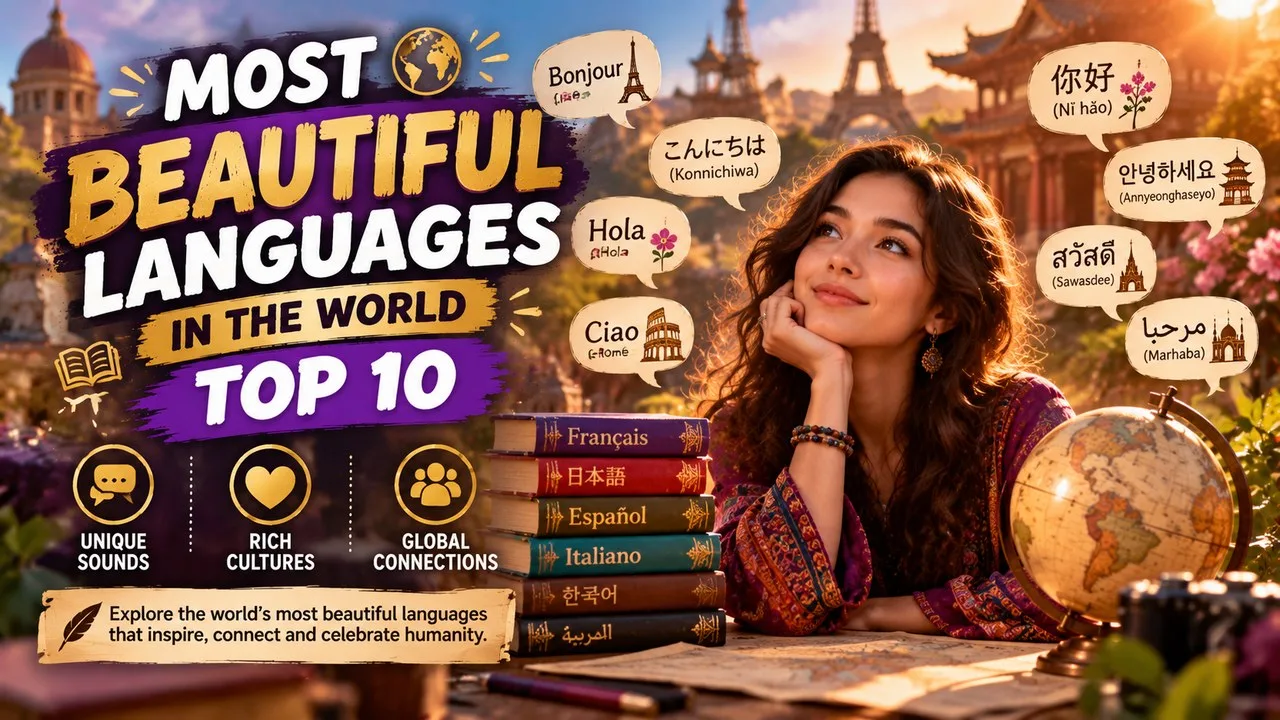
The most beautiful languages in the world, led by Arabic, Japanese and Italian, are ranked here for sound, script, poetry and cultural reach.
Beauty in language is not a scientific constant. What sounds lyrical to one listener can sound harsh to another, and what looks elegant on the page depends on which scripts a reader already knows. A 2023 study in the Proceedings of the National Academy of Sciences found that familiarity and cultural stereotypes strongly shape how pleasant a language seems, and that raters from different language backgrounds rarely agree on a single winner.
Even so, some languages keep returning in polls, poetry classrooms, calligraphy museums and popular culture as favorites. This Finepedia listicle, written as of October 2026, ranks ten of them with an open scorecard rather than a private taste test. Speaker counts are approximate Ethnologue figures as cited on English Wikipedia language pages at the time of writing. The list is original: it does not copy the order or claims of older roundups, and it treats beauty as a mix of sound reputation, literary depth, script art and cultural reach.
How We Chose the Most Beautiful Languages in the World
Finepedia scored every candidate on four tests that can be checked against polls, literary history, writing-system traditions and cultural export. Each language received up to 20 points.
- Melodic reputation (up to 5 points): 5 when a language tops or sits in the top tier of a multi-country attractiveness or romance poll, or is repeatedly preferred in phonesthetics research; 4 when it is regularly named in beauty roundups without a headline poll win; 3 for a mainly regional reputation
- Literary and poetic tradition (up to 5 points): 5 for a continuous classical canon spanning centuries with works taught worldwide; 4 for a major national tradition with several internationally known authors; 3 for notable modern literature or song without deep classical export
- Script and calligraphy (up to 5 points): 5 when the writing system supports a major calligraphic fine-art tradition; 4 for a uniquely designed or historically foundational script prized for its form; 3 for a standard Latin or similar alphabet without distinctive calligraphic fame
- Cultural reach (up to 5 points): 5 for global soft power through music, film or television, diplomacy or large foreign-learner communities; 4 for strong regional and diaspora export; 3 for a mainly national cultural presence
- Tiebreaks: first the melodic score, then the literary score; if still tied, prefer the language that topped a major multi-country attractiveness poll (Babbel/OnePoll December 2023 named Italian most often as the sexiest), then the larger approximate first-language speaker base
Sixteen candidates were scored, including Romance classics, major Asian languages with calligraphic traditions, and languages often praised in informal lists. English was left off the final ten because its global role as a lingua franca is about usefulness more than widely shared aesthetic praise. Mandarin Chinese scores highly for calligraphy and cultural reach, yet phonesthetics studies often find tonal languages rated less warmly for sound alone by many non-tonal listeners, so it appears among the Honorable Mentions rather than the main list. Welsh, Finnish, Russian and Hindi were strong near misses on individual criteria.
A December 2023 Babbel survey run by OnePoll among 6,000 adults in Germany, Spain, France, Italy, the United Kingdom and the United States illustrates how fluid these judgments are: Italian was most often named the sexiest language (about 27 percent), while French remained the most often named romantic language (about 34 percent), with Latin American Spanish also among the most attractive. Those figures inform the melodic scores; they do not settle the debate.
Most Beautiful Languages in the World at a Glance
| # | Language | Family / main regions | Approx. L1 speakers | Score (of 20) |
|---|---|---|---|---|
| 1 | Arabic | Semitic; Middle East and North Africa | About 411 million (all varieties, 2020–2024) | 19 |
| 2 | Japanese | Japonic; Japan | About 123 million (2020) | 19 |
| 3 | Italian | Romance; Italy and Switzerland | About 65 million | 18 |
| 4 | French | Romance; Europe, Africa, Canada | About 74 million | 18 |
| 5 | Korean | Koreanic; Korean Peninsula | About 81 million (2019–2022) | 18 |
| 6 | Spanish | Romance; Spain and the Americas | About 519 million (2025) | 17 |
| 7 | Persian (Farsi) | Iranian; Iran, Afghanistan, Tajikistan | About 91 million | 17 |
| 8 | Bengali | Indo-Aryan; Bangladesh and India | About 242 million | 16 |
| 9 | Portuguese | Romance; Brazil, Portugal, Africa | About 250 million | 15 |
| 10 | Greek | Hellenic; Greece and Cyprus | About 13.5 million | 15 |
Readers who enjoy how culture shows up in places and collections can pair this list with Most Visited Museums in the World: Top 10 and Most Colorful Cities in the World: Top 10. For campuses where many of these languages are taught, see Most Beautiful Universities in the World: Top 10 Campuses.
1. Arabic
| Attribute | Details |
|---|---|
| Language family | Afro-Asiatic, Semitic branch |
| Main regions | Middle East, North Africa and Arabic-speaking diasporas |
| Approx. speakers | About 411 million native speakers of all varieties; about 70 million L2 users (Ethnologue figures cited for 2020–2024) |
| Writing system | Arabic abjad, written right to left |
| Finepedia score | 19 of 20 (melodic 4, literary 5, script 5, reach 5) |
Origins and History
Arabic belongs to the Semitic branch of the Afro-Asiatic family, alongside Hebrew and Aramaic. Classical Arabic is the tongue of the Quran and of a large medieval scientific and literary corpus. Over centuries, spoken Arabic diversified into many regional varieties, from Maghrebi dialects in North Africa to Levantine and Gulf varieties, while Modern Standard Arabic serves education, media and formal writing across the Arab world.
The script itself became a major art form. Because figurative art was often restricted in religious contexts, calligraphy carried much of the visual energy of Islamic civilization: Quranic verses, poetry and royal inscriptions appear on mosques, manuscripts, ceramics and metalwork. Styles such as Kufic, Naskh and Thuluth are studied as seriously as painting schools elsewhere.
Key Features
- A root-and-pattern morphology in which three-consonant roots generate related words through vowel and affix patterns
- Emphatic consonants and a rich set of pharyngeal and uvular sounds that give many varieties a distinctive acoustic profile
- A continuous calligraphic tradition treated as fine art for more than a thousand years
- A diglossia between formal Modern Standard Arabic and everyday spoken varieties
- A deep oral and written poetry culture, from pre-Islamic odes to modern free verse
Significance
Arabic takes first place on Finepedia's scorecard because it combines an unmatched calligraphic tradition, a classical literary and religious corpus of global importance, and hundreds of millions of speakers across many countries. Its melodic score is high but not perfect: Western romance and "sexy language" polls more often crown Italian or French, and some listeners find certain consonants challenging. On script art and literary depth, few languages match it.
The language is also a working language of the United Nations and a bridge across a wide cultural region, which supports its cultural-reach score.
Interesting Facts
- Arabic is written from right to left; numbers in modern texts are often written left to right
- Letter shapes change with their position in a word (initial, medial, final or isolated)
- Classical poetry prized meter and rhyme long before modern free verse became common
- Loanwords from Arabic entered European languages through science, trade and medieval scholarship, including words such as algebra and algorithm in English
- Calligraphy competitions and museum exhibitions keep the script visible as contemporary art, not only as heritage
2. Japanese
| Attribute | Details |
|---|---|
| Language family | Japonic |
| Main regions | Japan |
| Approx. speakers | About 123 million (2020) |
| Writing system | Mix of kanji (Chinese-origin characters) with hiragana and katakana syllabaries |
| Finepedia score | 19 of 20 (melodic 4, literary 5, script 5, reach 5) |
Origins and History
Japanese is the main language of the Japonic family. Its deeper genetic links are still debated by linguists, but its internal history is well documented from Old Japanese through the classical Heian period to the modern standard based largely on Tokyo speech. The writing system layers Chinese-derived kanji with two kana syllabaries, producing a visual texture that learners notice at once.
Classical literature includes The Tale of Genji, often attributed to Murasaki Shikibu in the early eleventh century, and a long tradition of waka and later haiku. Zen-influenced aesthetics and the practice of shodō (calligraphy) treat brush writing as a discipline of form and mind, not only of spelling.
Key Features
- A relatively small vowel inventory and a mora-timed rhythm that many listeners describe as even and musical
- Pitch accent rather than stress accent of the English type
- Agglutinative grammar with particles that mark the role of nouns in a sentence
- Three scripts used together in ordinary adult writing
- Extensive honorific and politeness systems that encode social relationships
Significance
Japanese ties Arabic at 19 points. Calligraphy and the mixed script earn a full script score; the classical and modern literary canon is taught worldwide; and cultural reach in the twenty-first century is enormous through film, animation, games, design and cuisine. Melodic reputation is strong among many learners, though Western "most romantic language" polls still lean toward Romance languages.
For a lighter look at how Japanese popular culture travels, Finepedia's Cutest Cartoon Characters in Japan: Top 10 sits beside the same soft-power story that lifts Japanese on this list.
Interesting Facts
- Hiragana and katakana each represent the same set of syllables with different visual styles
- Vertical writing (tategaki) remains common in novels, newspapers and signage alongside horizontal lines
- Haiku in Japanese traditionally count morae, not English-style syllables
- Loanwords from English and other languages are usually written in katakana
- UNESCO has inscribed several Japanese oral and performing traditions; the language itself is the everyday vehicle for most of them
3. Italian
| Attribute | Details |
|---|---|
| Language family | Indo-European, Romance |
| Main regions | Italy, southern Switzerland, and Italian-speaking communities abroad |
| Approx. speakers | About 65 million first-language speakers |
| Writing system | Latin alphabet |
| Finepedia score | 18 of 20 (melodic 5, literary 5, script 3, reach 5) |
Origins and History
Italian developed from the Tuscan vernacular of the late Middle Ages. Dante Alighieri's Divine Comedy, written in the early fourteenth century, helped prove that a refined literature could be written outside Latin. Petrarch and Boccaccio strengthened that prestige. Political unification in the nineteenth century later spread a Tuscan-based standard across a peninsula that still keeps strong regional languages and dialects.
From the late Renaissance onward, Italian also became the language of opera. Open vowels and clear syllabic timing suited singing, and Italian musical terms (allegro, forte, soprano) entered the international vocabulary of music.
Key Features
- A high proportion of open syllables and pure vowels, which many non-native listeners hear as song-like
- Double consonants that change meaning (for example, pala versus palla)
- Grammatical gender and rich verbal conjugation typical of Romance languages
- A huge regional diversity beneath the national standard
- A long partnership with classical music and opera
Significance
Italian ranks third with 18 points and the strongest melodic score on the list. In the Babbel/OnePoll survey of December 2023, it was the language most often called the sexiest among respondents in six countries. Literary depth is beyond dispute, from Dante to modern novelists and filmmakers. The script score is only average because Italian uses the ordinary Latin alphabet without a separate calligraphic fine-art tradition on the scale of Arabic or East Asian brush writing. Cultural reach through opera, design, cinema and cuisine keeps the fourth pillar high.
Interesting Facts
- Standard Italian is closely based on educated Florentine usage
- Many Italian words end in a vowel, which helps the language's reputation for flowing speech
- The Accademia della Crusca, founded in Florence in 1587, is among Europe's oldest language academies
- Italian remains a working language of the Vatican City State alongside Latin
- Food and fashion vocabulary from Italian travels even farther than the language's speaker count might suggest
4. French
| Attribute | Details |
|---|---|
| Language family | Indo-European, Romance |
| Main regions | France, parts of Belgium and Switzerland, Quebec, much of West and Central Africa, and other Francophone states |
| Approx. speakers | About 74 million L1; total speakers about 312 million including L2 (2012–2022 Ethnologue window) |
| Writing system | Latin alphabet with diacritics |
| Finepedia score | 18 of 20 (melodic 5, literary 5, script 3, reach 5) |
Origins and History
French grew from the Latin of Roman Gaul, shaped by contact with Frankish and other languages. By the seventeenth century it was a leading language of European diplomacy and letters. The Académie française, founded in 1636, became a symbol of deliberate language planning. Colonial expansion and later independence movements spread French across Africa, the Caribbean and parts of Asia and the Pacific, creating today's Francophonie.
Literature from the medieval chansons de geste through Molière, Voltaire, Hugo, Proust and countless modern writers gives French an outsized place in school curricula worldwide.
Key Features
- Nasal vowels and a relatively smooth consonant flow that many listeners call elegant
- Silent final consonants in many words, with liaison linking words in careful speech
- A tense–aspect system and gendered nouns familiar to other Romance learners
- Strong institutional support through academies, ministries and international Francophone bodies
- A large gap between formal written French and everyday spoken registers
Significance
French matches Italian at 18 points and ranks fourth. In the same Babbel survey, it remained the language most often named the most romantic (about 34 percent), while Italian took the sexiest-language headline that Finepedia uses as the next tiebreak after equal totals. Diplomacy, international organizations, African and Canadian media, and a continuous literary canon support a full cultural-reach score. Like Italian, it loses points only on script art, because it shares the Latin alphabet without a separate monumental calligraphy tradition.
Interesting Facts
- French is an official language of the United Nations, the European Union, the African Union and the International Olympic Committee
- Quebec French and African varieties differ in pronunciation and vocabulary from Parisian norms
- English absorbed a large French vocabulary after 1066 under Norman rule, which is one reason many French words look familiar to English readers
- The Toubon Law in France promotes French in certain commercial and public contexts
- French chanson and later pop and rap scenes keep the spoken language audible far beyond literature class
5. Korean
| Attribute | Details |
|---|---|
| Language family | Koreanic |
| Main regions | Korean Peninsula and Korean diasporas |
| Approx. speakers | About 81 million (2019–2022) |
| Writing system | Hangul (alphabet), sometimes mixed with hanja in specialist texts |
| Finepedia score | 18 of 20 (melodic 4, literary 4, script 5, reach 5) |
Origins and History
Korean is the main language of the Koreanic family. Its older history includes substantial vocabulary contact with Chinese, while the modern standard varieties of Seoul and Pyongyang have diverged since the mid-twentieth century. The decisive design event for beauty on the page was the creation of Hangul, promulgated in 1446 under King Sejong the Great so that ordinary people could learn to read and write more easily than with Classical Chinese characters alone.
Hangul letters are grouped into syllable blocks, which gives Korean text a square, modular look. Linguists often praise the system's phonological transparency; designers praise its geometry.
Key Features
- An alphabetic system organized into syllable blocks rather than a linear string of letters only
- Agglutinative grammar with particles and verb endings that encode politeness and clause relations
- A consonant inventory that includes aspirated and tense series
- Extensive use of honorifics tied to age and social hierarchy
- Rapid global growth in foreign learners driven by popular culture
Significance
Korean ties the big Romance languages at 18 points. Hangul earns a full script score as a deliberately designed writing system often cited among the world's most elegant orthographies. Cultural reach has surged through film, drama, music and food. Literary tradition is deep domestically and growing in translation, but the globally taught classical canon is younger in world-literature classrooms than Greek, Arabic or French, which is why the literary pillar stops at 4 rather than 5.
Interesting Facts
- Hangul Day is celebrated in South Korea to mark the script's promulgation
- Syllable blocks can make Korean look similar in texture to Chinese text from a distance, even though the system is alphabetic
- North and South Korea use different standard pronunciations and some divergent vocabulary
- Loanwords from English are common in South Korean popular media
- Language institutes and university programs expanded worldwide alongside the rise of Korean popular culture in the 2010s and 2020s
6. Spanish
| Attribute | Details |
|---|---|
| Language family | Indo-European, Romance |
| Main regions | Spain and most of Latin America; large U.S. communities |
| Approx. speakers | About 519 million first-language speakers; about 117 million L2 (2025 figures on Wikipedia) |
| Writing system | Latin alphabet |
| Finepedia score | 17 of 20 (melodic 4, literary 5, script 3, reach 5) |
Origins and History
Spanish, or Castilian, grew in the Kingdom of Castile and spread through the Americas after the late fifteenth century. Today it is the primary language in twenty countries and one of the world's largest languages by first-language speakers. Miguel de Cervantes's Don Quixote (1605 and 1615) is a foundation stone of the modern novel, and the twentieth-century Latin American Boom carried Spanish prose across the globe.
Pronunciation varies widely: distinguishing features include seseo and ceceo in different regions, yeísmo, and the rhythm of Caribbean, Andean, Rioplatense and Peninsular varieties.
Key Features
- Clear five-vowel system familiar to many learners
- Predictable stress rules with written accent marks when needed
- Grammatical gender and a complex verbal system including the pretérito and imperfect contrast
- Huge dialectal diversity across continents
- A major presence in global music, from classical guitar traditions to contemporary pop and urban genres
Significance
Spanish scores 17. Melodic reputation is strong—Latin American Spanish placed among the most attractive languages in the Babbel survey—yet Italian and French still edge it on headline romance and sexiness rankings. Literary and cultural-reach pillars are full. The Latin alphabet keeps the script score at 3. Sheer demographic weight means Spanish is often the first "beautiful and useful" combination learners choose.
Interesting Facts
- The Real Academia Española coordinates dictionary and grammar work with sister academies in the Americas
- Spanish is a co-official language in Equatorial Guinea and has standing in several international organizations
- Judeo-Spanish (Ladino) preserves older features among Sephardic communities
- English and Spanish share many cognates through Latin and through later borrowing
- Regional slang and music can make mutual understanding harder than classroom Spanish suggests, even for native speakers from distant countries
7. Persian (Farsi)
| Attribute | Details |
|---|---|
| Language family | Indo-European, Iranian |
| Main regions | Iran (Farsi), Afghanistan (Dari), Tajikistan (Tajik); wide historical literary reach |
| Approx. speakers | About 91 million L1; about 127 million total including L2 (2020–2023 Ethnologue window for the wider Persian cluster) |
| Writing system | Perso-Arabic script (Tajik officially uses Cyrillic in Tajikistan) |
| Finepedia score | 17 of 20 (melodic 4, literary 5, script 5, reach 3) |
Origins and History
Persian is an Iranian language with a recorded history from Old Persian inscriptions through Middle Persian to New Persian. After the Arab conquests, New Persian adopted a modified Arabic script and became a major literary language of courts from Anatolia to South Asia. Ferdowsi's Shahnameh preserved pre-Islamic epic tradition in Persian verse; later poets such as Rumi (Jalal al-Din Muhammad Rumi), Hafez and Saadi made Persian ghazals a touchstone of world poetry.
The Nastaʿlīq style of calligraphy, with its sloping rhythm, is closely associated with Persian and Urdu manuscript culture.
Key Features
- No grammatical gender and a relatively analytic grammar compared with many Indo-European neighbors
- A vocabulary layered with Iranian roots plus Arabic and, later, European loans
- A classical poetry tradition centered on meter, rhyme and mystical or courtly themes
- Soft consonant and vowel patterns that many non-speakers describe as gentle
- Shared literary heritage across Iran, Afghanistan and Tajikistan despite political borders
Significance
Persian matches Spanish at 17 points but ranks just behind on the reach tiebreak. Few languages have a stronger claim on literary and calligraphic beauty. Soft power outside the region is real among poetry readers and diaspora communities, yet it is narrower than Spanish, French or Korean media exports today, which caps the cultural-reach score at 3.
Interesting Facts
- Many Persian poetry lines are still memorized and quoted in daily conversation
- Urdu and Ottoman Turkish historically drew heavily on Persian vocabulary and poetic forms
- Tajik Persian is mutually intelligible in speech with Iranian Persian to a large degree, despite the Cyrillic orthography
- The word paradise in English ultimately traces to an Old Iranian root via Greek and Latin
- Contemporary Iranian cinema has brought spoken Persian to international festival audiences
8. Bengali
| Attribute | Details |
|---|---|
| Language family | Indo-European, Indo-Aryan |
| Main regions | Bangladesh and the Indian states of West Bengal, Tripura and Assam's Barak Valley |
| Approx. speakers | About 242 million L1; about 284 million total including L2 (2011–2023) |
| Writing system | Bengali–Assamese script (an Eastern Nagari abugida) |
| Finepedia score | 16 of 20 (melodic 4, literary 5, script 4, reach 3) |
Origins and History
Bengali, or Bangla, developed from Magadhi Prakrit and Apabhramsha stages of eastern Indo-Aryan. It grew into a major literary language across eastern South Asia, with a flowering in the nineteenth and early twentieth centuries. Rabindranath Tagore, who wrote in Bengali, received the Nobel Prize in Literature in 1913, the first Nobel laureate writing primarily in an Indian language.
Language also became a political cause. On 21 February 1952, students in Dhaka were killed while demanding recognition for Bengali in then East Pakistan. UNESCO later proclaimed 21 February as International Mother Language Day, giving Bengali a unique place in global language-rights history.
Key Features
- An abugida script with a distinctive horizontal headline (matra) joining letters
- A rich inventory of vowels and aspirated consonants typical of Indo-Aryan languages
- A major modern literature of novels, songs and essays alongside older poetic forms
- Diglossia between formal shadhu bhasha traditions and contemporary standard colloquial Bengali
- Strong traditions of Rabindra Sangeet and other song forms that carry the language's melody
Significance
Bengali scores 16. Listeners and writers often call it sweet or musical, and Tagore alone would justify a high literary score. The script is visually distinctive and related to other Eastern Nagari traditions. Cultural reach outside South Asia and the diaspora is more limited than for Spanish or Korean, which is why it sits eighth rather than in the top five.
Interesting Facts
- International Mother Language Day on 21 February grew from the 1952 Bengali language movement
- The national anthems of both India and Bangladesh are poems by Tagore (in slightly different forms and contexts)
- Bengali film industries in Kolkata and Dhaka have long parallel histories
- Assamese uses a closely related script with its own letter shapes and orthographic norms
- Soft consonants and vowel harmony patterns contribute to the language's reputation for a flowing sound
9. Portuguese
| Attribute | Details |
|---|---|
| Language family | Indo-European, Romance |
| Main regions | Brazil, Portugal, Angola, Mozambique and other Lusophone countries |
| Approx. speakers | About 250 million L1; about 267 million total (2012–2022) |
| Writing system | Latin alphabet |
| Finepedia score | 15 of 20 (melodic 4, literary 4, script 3, reach 4) |
Origins and History
Portuguese developed in the medieval Kingdom of Galicia–Portugal from Galician-Portuguese lyric roots. Luís de Camões's epic Os Lusíadas (1572) became a national classic. Oceanic expansion carried the language to Brazil, Africa and parts of Asia. Today Brazilian Portuguese accounts for the large majority of speakers, and Brazilian music—from bossa nova to contemporary pop—has done as much as literature to make the language sound familiar abroad.
European and African varieties remain central to the language's identity, and spelling agreements have tried to reduce orthographic gaps between Brazil and Portugal.
Key Features
- Nasal vowels that are especially noticeable in Brazilian Portuguese
- A rhythm and intonation many learners describe as soft or singing, especially in carioca and some northeastern Brazilian accents
- Personal infinitive and other grammatical features that differ from Spanish
- Mutual intelligibility with Galician that is high in writing and variable in speech
- A global Lusophone network linking South America, Europe and Africa
Significance
Portuguese scores 15. Melodic praise is common, particularly for Brazilian speech and song, and cultural reach through music and diaspora communities is solid. The classical literary canon is important but less universally assigned in world-literature surveys than French, Spanish or Greek, and the Latin script keeps the calligraphy pillar at 3.
Interesting Facts
- Portuguese is the most spoken language in the Southern Hemisphere by native speakers
- Fado in Portugal and samba, bossa nova and MPB in Brazil showcase very different musical moods in the same language
- The 1990 Orthographic Agreement aimed to unify spelling across Lusophone countries, with phased adoption
- Portuguese and Spanish look close on the page; spoken forms can still surprise learners who expect easy conversation
- Creole languages with Portuguese roots arose in parts of Africa and Asia during the colonial era
10. Greek
| Attribute | Details |
|---|---|
| Language family | Indo-European, Hellenic |
| Main regions | Greece, Cyprus and Greek diasporas |
| Approx. speakers | About 13.5 million (2015 figure widely cited on Wikipedia) |
| Writing system | Greek alphabet |
| Finepedia score | 15 of 20 (melodic 3, literary 5, script 4, reach 3) |
Origins and History
Greek forms its own branch of Indo-European and has one of the longest continuous written records of any European language, from Mycenaean Greek in Linear B through classical Attic, Hellenistic Koine, Byzantine Greek and modern Demotic. The Greek alphabet, adapted from a Phoenician model, later inspired the Latin and Cyrillic alphabets, so its letterforms sit behind much of the world's everyday writing.
Homer, the tragedians, Plato and the New Testament Koine texts make Greek foundational for European literature, philosophy and religion. Modern Greek poetry and song continue that line in a living spoken language.
Key Features
- A continuous literary identity claimed across three millennia despite major sound changes
- The Greek alphabet of 24 letters, still used for the modern language
- A history of diglossia between formal Katharevousa and vernacular Demotic, largely resolved in favor of Demotic in late twentieth-century education
- Rich derivational morphology that still feeds scientific and medical vocabulary in many languages
- Regional varieties including Cypriot Greek
Significance
Greek ties Portuguese at 15 points and takes tenth place on the speaker-base tiebreak. Literary depth is maximal: few languages have shaped world thought so deeply. The alphabet earns a strong script score for historical design influence, even without an Arabic-style ornamental calligraphy culture. Melodic reputation and present-day cultural reach are more modest than for Italian or Korean, which is why Greek closes the list rather than leading it.
Interesting Facts
- Many English scientific words are built from Greek roots, from biology to democracy
- Modern Greek pronunciation differs sharply from the reconstructed sounds of classical Attic
- The Greek diaspora keeps the language alive in Australia, the United States, Germany and beyond
- Polytonic orthography was officially replaced by monotonic spelling in Greece in 1982 for most everyday uses
- Ancient theatres and modern festivals still stage classical drama in both ancient and modern forms
Honorable Mentions
These languages scored well on at least one pillar but missed the final ten.
| Language | Score (of 20) | Why it missed out |
|---|---|---|
| Mandarin Chinese | 17 | Full marks for script and reach; melodic score held down because many non-tonal listeners rate tonal languages lower for pure sound appeal in phonesthetics research |
| Russian | 15 | Major literary canon and distinctive Cyrillic look; weaker presence in Western beauty and romance polls |
| Hindi | 15 | Huge speaker base, film music and Devanagari aesthetics; split with Urdu and regional languages complicates a single "beauty" brand in global polls |
| Welsh | 14 | Strong revival story and a sound many learners love; smaller literary export and reach than the top ten |
| Finnish | 14 | Unique sound within Europe and a Tolkien connection often mentioned in informal lists; limited global poll presence |
| Swahili | 13 | Important lingua franca with growing learner interest; less often framed as a "beautiful language" in international surveys |
Comparison: What Each Language Is Most Praised For
| Language | Sound reputation | Writing and look | Best-known cultural exports |
|---|---|---|---|
| Arabic | Poetic recitation, varied dialects | Calligraphy as fine art | Quranic arts, poetry, modern media |
| Japanese | Even mora rhythm, pitch accent | Kanji and kana, shodō | Literature, design, animation, film |
| Italian | Open vowels, opera | Latin alphabet | Opera, cinema, design, cuisine |
| French | Smooth flow, nasal vowels | Latin alphabet with accents | Literature, diplomacy, cinema, song |
| Korean | Modern pop delivery, clear syllables | Hangul syllable blocks | Drama, music, film, food |
| Spanish | Clear vowels, regional music styles | Latin alphabet | Novel, film, global pop and folk music |
| Persian | Soft, poetic diction | Nastaʿlīq calligraphy | Classical poetry, cinema |
| Bengali | Often called sweet or musical | Eastern Nagari script | Tagore, song traditions, film |
| Portuguese | Brazilian song-like intonation | Latin alphabet | Bossa nova and Lusophone music, epic poetry |
| Greek | Classical echo in modern speech | Greek alphabet | Philosophy, drama, Orthodox chant traditions |
Music and visual arts travel beside language: Finepedia's Most Popular Artists of All Time: Top 10 is a reminder that melody and image often carry a tongue farther than textbooks alone.
Frequently Asked Questions
What is the most beautiful language in the world?
There is no objective winner. Finepedia's scorecard places Arabic first at 19 of 20 for the combined strength of calligraphy, classical literature and cultural reach, with Japanese tied on points. Polls about romance or attractiveness more often name Italian or French. Beauty depends on the listener's ear and the reader's eye.
Why do people say Italian is the most beautiful language?
Italian has many open vowels and a syllable timing that suits song, and it is the historic language of opera. In a December 2023 Babbel/OnePoll survey of 6,000 adults in six countries, Italian was the language most often called the sexiest. Literary prestige from Dante onward adds to the reputation.
Is French still considered romantic?
Yes, in the same Babbel survey French was still the language most often named the most romantic, at about 34 percent of respondents. Finepedia ranks it fourth overall, tied on points with Italian and Korean; Italian stays ahead because it topped the survey's sexiest-language question, and Korean follows because its melodic score is lower.
How many people speak the languages on this list?
Approximate first-language figures cited from Ethnologue via Wikipedia as of this writing include about 519 million for Spanish, 411 million for Arabic varieties, 250 million for Portuguese, 242 million for Bengali, 123 million for Japanese, 91 million for Persian, 81 million for Korean, 74 million for French, 65 million for Italian and 13.5 million for Greek. Second-language totals can be much higher, especially for French and Spanish.
Why is English not on the list?
English is the main global bridge language and a major literary language, but admiration for it is driven more by utility, media and opportunity than by a shared idea that it is the most beautiful. Finepedia's scorecard therefore keeps it out of the top ten and focuses on languages repeatedly praised for sound, script or poetry.
Why does script beauty count in a language ranking?
Many people meet a language first on the page or on a phone screen. Arabic calligraphy, Hangul's designed geometry, Japanese brush writing and Persian Nastaʿlīq are part of why those languages feel beautiful even in silence. Ignoring script would bias the list toward languages that happen to use the Latin alphabet.
Can a constructed language be beautiful?
Yes, for some listeners. Tolkien based Quenya partly on his love of Finnish, and fans often praise the sound of Esperanto or other invented tongues. Constructed languages fall outside this list's scope, which is limited to natural languages with large speaker communities and documented literary or calligraphic traditions.
Conclusion
The most beautiful languages in the world are beautiful for different reasons. Arabic and Japanese lead Finepedia's October 2026 scorecard because they excel across sound reputation, literature, script art and cultural reach. Italian, French and Korean follow closely, propelled by polls, poetry and popular culture. Spanish and Persian show how demographic weight and poetic prestige can match each other in different ways, while Bengali, Portuguese and Greek round out a list that spans scripts, continents and centuries.
No ranking can replace listening. The surest way to test these judgments is to hear a poem, a song or a conversation in each language and decide what beauty means to you.
- Ethnologue speaker statistics as cited on English Wikipedia language pages (Italian, French, Spanish, Japanese, Arabic, Portuguese, Persian, Korean, Greek, Bengali), read October 2026
- https://en.wikipedia.org/wiki/Italian_language
- https://en.wikipedia.org/wiki/French_language
- https://en.wikipedia.org/wiki/Spanish_language
- https://en.wikipedia.org/wiki/Japanese_language
- https://en.wikipedia.org/wiki/Arabic
- https://en.wikipedia.org/wiki/Portuguese_language
- https://en.wikipedia.org/wiki/Persian_language
- https://en.wikipedia.org/wiki/Korean_language
- https://en.wikipedia.org/wiki/Greek_language
- https://en.wikipedia.org/wiki/Bengali_language
- https://en.wikipedia.org/wiki/Hangul
- https://en.wikipedia.org/wiki/International_Mother_Language_Day
- Anikin, A., et al. (2023). Do some languages sound more beautiful than others? Proceedings of the National Academy of Sciences. https://www.pnas.org/doi/10.1073/pnas.2218367120
- Babbel / OnePoll survey (5–12 December 2023), reported February 2024: Italian most often named sexiest language; French most often named most romantic (coverage e.g. https://www.malaymail.com/news/life/2024/02/13/italian-topples-french-as-the-worlds-sexiest-language/117715)
- Topic prompt only (not copied): https://10mosttoday.com/worlds-10-most-beautiful-languages/

















Log in with