





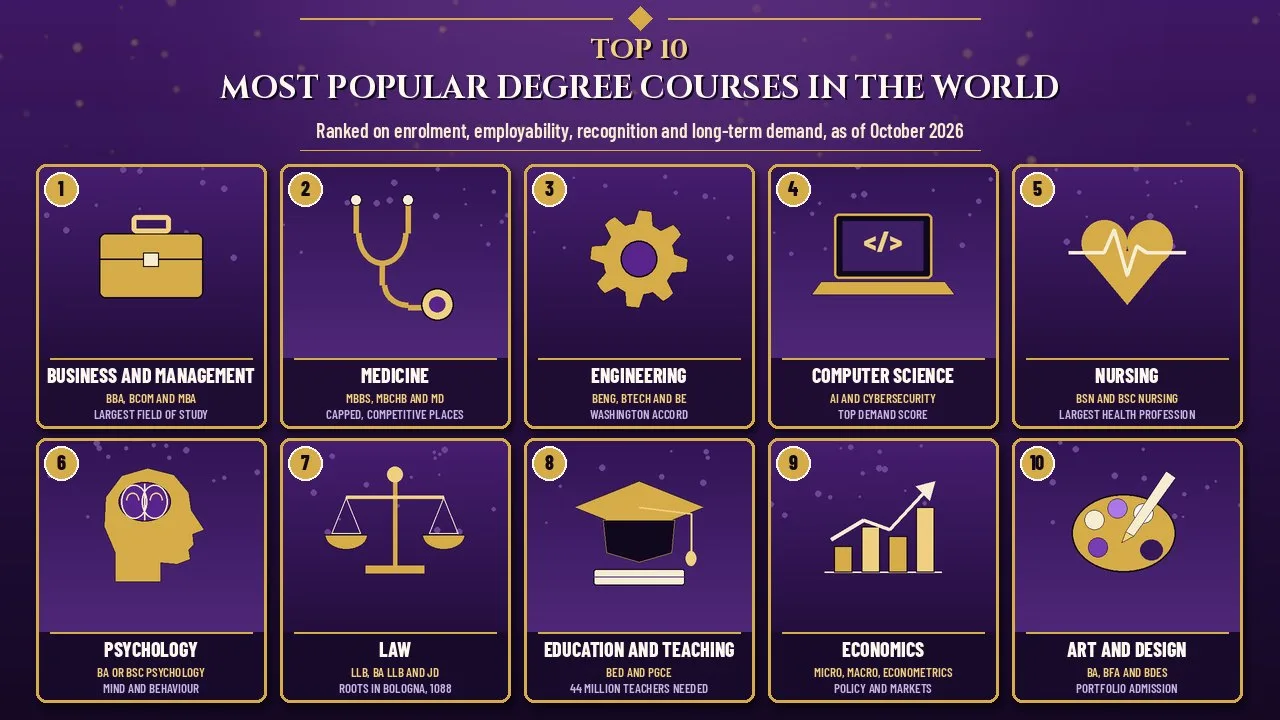
The most popular degree courses in the world, led by business, medicine, engineering and computer science, open doors to careers in demand worldwide.
Choosing a university subject is one of the biggest decisions a student and family make together. It shapes years of study, the cost of that study, the first job after graduation and often the direction of a whole working life. Some subjects attract huge numbers of applicants in almost every country, while others are well known because their graduates fill professions that societies cannot run without.
This Finepedia guide ranks ten of the best-known university degrees worldwide as of October 2026. It is not a list of the "easiest" or the "highest-paid" subjects. It weighs how many people study each field, how well graduates do in the job market, how widely the qualification is recognised across borders and how steady demand is likely to stay. Entry requirements, course length and professional rules vary by country and university, so always check the official pages of the institutions and regulators you are considering.
The ranking deliberately departs from older round-ups. Engineering, Education and Economics are included because international data shows them among the largest or most widely recognised fields of study, while Sports Science, English Studies and Social Work appear in Honourable Mentions.
How We Ranked the Most Popular Degree Courses
Four equally weighted criteria, each scored from 1 to 5, produce a total out of 20. The scores are Finepedia's editorial judgement, applied with the same definitions to every subject and checked against published patterns in the OECD's Education at a Glance series, the U.S. National Center for Education Statistics (NCES), UK higher-education admissions and student data from UCAS and HESA, India's All India Survey on Higher Education (AISHE), the U.S. Bureau of Labor Statistics Occupational Outlook Handbook, QS World University Rankings by Subject and well-documented encyclopedic history of each discipline.
- Enrolment and application volume (1 to 5): how many students choose the field across large higher-education systems, or how many apply when places are capped.
- Employability and earnings (1 to 5): how directly the degree leads to skilled work and how graduate pay typically compares with other fields in national labour-market data.
- International recognition (1 to 5): how easily the qualification is understood and accepted in other countries, including formal mutual-recognition agreements and accreditation.
- Long-term demand (1 to 5): whether workforce reports from bodies such as the World Health Organization, UNESCO and national labour agencies point to lasting need for the skills.
When totals tie, the subject with the higher Volume score ranks first, then the higher Demand score. Subjects that were shortlisted but missed the top ten appear under Honourable Mentions.
The Scorecard
| Rank | Degree subject | Volume | Employability | Recognition | Demand | Total |
|---|---|---|---|---|---|---|
| 1 | Business and Management | 5 | 4 | 5 | 4 | 18 |
| 2 | Medicine | 3 | 5 | 5 | 5 | 18 |
| 3 | Engineering | 5 | 4 | 4 | 4 | 17 |
| 4 | Computer Science | 4 | 4 | 4 | 5 | 17 |
| 5 | Nursing | 4 | 4 | 3 | 5 | 16 |
| 6 | Psychology | 5 | 3 | 4 | 3 | 15 |
| 7 | Law | 4 | 4 | 3 | 4 | 15 |
| 8 | Education and Teaching | 4 | 3 | 3 | 4 | 14 |
| 9 | Economics | 3 | 4 | 4 | 3 | 14 |
| 10 | Art and Design | 3 | 3 | 4 | 3 | 13 |
Medicine ties with Business and Management on 18 but ranks second because medical school places are tightly capped in most countries, so far fewer students actually enrol even though applications are intense. Psychology edges Law on volume, and Education edges Economics for the same reason.
Most Popular Degree Courses at a Glance
| Rank | Degree subject | Common first-degree titles | Typical first-degree length | Best suited to |
|---|---|---|---|---|
| 1 | Business and Management | BBA, BCom, BSc Business, BA Management | 3 to 4 years | Organisers, planners and future founders |
| 2 | Medicine | MBBS, MBChB, MD (graduate-entry in the US) | 5 to 6 years, plus training | Patient, science-minded carers |
| 3 | Engineering | BEng, BTech, BE, BS Engineering | 3 to 4 years | Practical problem-solvers who enjoy maths |
| 4 | Computer Science | BSc Computer Science, BTech CSE, BS CS | 3 to 4 years | Logical thinkers who like building things |
| 5 | Nursing | BSN, BSc Nursing | 3 to 4 years | Calm, caring people who like teamwork |
| 6 | Psychology | BA or BSc Psychology | 3 to 4 years | Curious readers of human behaviour |
| 7 | Law | LLB, BA LLB, JD (graduate-entry in the US) | 3 to 5 years | Careful readers, writers and debaters |
| 8 | Education and Teaching | BEd, BA with teaching credential, integrated teacher programmes | 3 to 4 years, plus certification | Patient explainers and mentors |
| 9 | Economics | BA or BSc Economics | 3 to 4 years | Analytical students interested in policy and markets |
| 10 | Art and Design | BA, BFA, BDes | 3 to 4 years | Visual thinkers with a portfolio |
Lengths are typical ranges, not rules. Scottish honours degrees usually run four years, many Indian programmes changed under the National Education Policy 2020, and graduate-entry routes in medicine and law add years before professional practice.
1. Business and Management
| Attribute | Details |
|---|---|
| Common degrees | BBA, BCom, BSc or BA in Business or Management; MBA at postgraduate level |
| Typical length | About 3 years in the UK and India, 4 years in the US; MBA usually 1 to 2 years |
| Core subjects | Accounting, finance, marketing, operations, organisational behaviour, strategy |
| Key accreditations | AACSB, EQUIS and AMBA for business schools |
| Career paths | Management, consulting, finance, marketing, human resources, entrepreneurship |
Business sits at the top because no other subject combines such enormous enrolment with such broad recognition. The OECD's Education at a Glance reports have repeatedly found that the broad field of business, administration and law produces the largest share of tertiary graduates across member countries, and NCES data shows business as the single largest field of bachelor's degrees awarded in the United States.
Origins and History
Commercial schooling existed long before the modern university course. ESCP Business School in Paris, founded in 1819, describes itself as the oldest business school in the world. In the United States, the Wharton School at the University of Pennsylvania opened in 1881 as the first collegiate business school, funded by industrialist Joseph Wharton.
The twentieth century turned business into a graduate profession. Harvard Business School, founded in 1908, helped make the Master of Business Administration the best-known postgraduate business qualification. After the Second World War, management education spread rapidly across Europe and Asia, and today business schools range from small specialist colleges to large faculties inside research universities.
Key Features
- Foundations in financial accounting, management accounting and corporate finance
- Marketing, consumer behaviour and digital marketing analytics
- Operations and supply-chain management, often with case studies from real companies
- Organisational behaviour, leadership and human resource management
- Business law, ethics and sustainability modules, which are increasingly common
- Group projects, internships or placement years in many programmes
Significance
A business degree is valued for its flexibility. Graduates work in banks, retailers, technology firms, hospitals, governments and charities, because every organisation needs people who understand budgets, customers and teams. The trade-off is competition: so many students take the subject that the reputation of the school, internships and specialist skills such as data analysis or accounting qualifications often decide who gets the strongest first jobs.
International recognition is strong. Accreditation from AACSB, EQUIS and AMBA is used as a quality signal worldwide, and a small number of schools hold all three, a status often called the triple crown.
Interesting Facts
- AACSB, the oldest of the major business-school accreditors, was founded in 1916 in the United States.
- The case method of teaching, built around real company dilemmas, is closely associated with Harvard Business School.
- Analytics and artificial intelligence modules are increasingly common in business degrees.
- In India, the BCom has long been one of the most widely taken undergraduate programmes, according to AISHE reports.
2. Medicine
| Attribute | Details |
|---|---|
| Common degrees | MBBS or MBChB (UK, India and many Commonwealth countries); MD or DO (US, after a first degree) |
| Typical length | 5 to 6 years in the UK; 5.5 years in India including a one-year internship; 4 years of medical school after a bachelor's in the US |
| Entrance tests | UCAT (UK), NEET-UG (India), MCAT (US and Canada) |
| Licensing | National exams such as USMLE (US) and the Medical Licensing Assessment (UK) |
| Career paths | Hospital and family medicine, surgery, psychiatry, research, public health |
Medicine is often seen as the most prestigious degree on this list, and it is among the hardest to enter. Its Volume score is held back only because medical schools cap places to match clinical training capacity, which keeps enrolment far below demand. India's NEET-UG alone has drawn more than two million registered candidates in recent cycles, according to the National Testing Agency, for a much smaller number of seats.
Origins and History
Medicine was one of the three higher faculties of the medieval university, alongside law and theology. The Schola Medica Salernitana in southern Italy is widely regarded as the earliest medical school of medieval Europe, and Montpellier in France developed one of the most influential medical faculties.
Modern medical education took shape in the nineteenth and early twentieth centuries, when laboratory science, hospital wards and formal clinical training were joined into a single path. Reforms in the United States after the 1910 Flexner Report pushed medical schools to adopt university-based, science-heavy curricula, a model that spread to many other countries.
Key Features
- Anatomy, physiology, biochemistry, pharmacology and pathology in the early years
- Clinical rotations across medicine, surgery, paediatrics, obstetrics, psychiatry and general practice
- Communication skills, medical ethics and patient-safety training
- Research methods and evidence-based medicine
- Supervised practice after graduation, such as the UK Foundation Programme or US residency of roughly 3 to 7 years
Significance
Doctors are needed everywhere, and the World Health Organization projects a global shortfall of about 11 million health workers by 2030, concentrated in low- and lower-middle-income countries. That gives medicine the strongest long-term demand score on this list. Recognition is also high, though doctors moving abroad still have to pass the receiving country's licensing exams and registration checks.
The path suits students who are comfortable with a long apprenticeship. Qualifying as a specialist can take a decade or more from the first day of medical school, and the work involves night shifts, emotional strain and lifelong study.
Interesting Facts
- The UK introduced the Medical Licensing Assessment for medical students graduating from the 2024 to 2025 academic year onwards.
- UCAS applications for most UK medicine courses close in mid-October, earlier than the main undergraduate deadline.
- The Hippocratic Oath is named after the Greek physician Hippocrates, though modern schools usually use updated pledges.
- In India, the MBBS includes a compulsory rotating internship before full registration.
3. Engineering
| Attribute | Details |
|---|---|
| Common degrees | BEng or MEng (UK), BTech or BE (India), BS in Engineering (US) |
| Typical length | 3 years for a UK BEng (4 for an integrated MEng); 4 years in India and the US |
| Main branches | Civil, mechanical, electrical, electronics, chemical, aerospace, biomedical |
| International agreement | Washington Accord (1989) for mutual recognition of accredited engineering degrees |
| Career paths | Design, construction, manufacturing, energy, transport, consulting, research |
Engineering is one of the largest fields of study in several of the world's biggest higher-education systems. India's AISHE reports list the BTech and BE among the country's biggest undergraduate programmes, and engineering is one of the most common bachelor's fields in many Asian and European countries.
Origins and History
Military engineers built fortifications for centuries, but civil engineering as a university-style subject emerged in eighteenth-century France. The École nationale des ponts et chaussées, founded in Paris in 1747, is often cited as the world's oldest civil engineering school. In the United States, Rensselaer Polytechnic Institute opened in 1824 and became a model for technical education.
The industrial age multiplied engineering branches. Electrical engineering grew with power grids and the telegraph, chemical engineering with large-scale industry, and aerospace and computer engineering in the twentieth century. Germany's technical universities, the Massachusetts Institute of Technology and later India's Indian Institutes of Technology became global reference points.
Key Features
- Advanced mathematics, physics and, in some branches, chemistry in the first years
- Engineering design, drawing and computer-aided design (CAD)
- Laboratory work, testing and materials science
- Specialist modules such as structures, thermodynamics, circuits or control systems
- Capstone design projects, often in teams and sometimes with industry partners
- Professional ethics, safety and sustainability
Significance
Engineers build and maintain the physical world, from water supplies and bridges to power plants and phones. Graduates often earn above-average salaries in national labour data, and the energy transition, infrastructure renewal and advanced manufacturing keep demand steady.
Recognition is strong thanks to the Washington Accord, under which signatory bodies accept each other's accredited undergraduate engineering degrees as substantially equivalent. India became a full signatory in 2014 through its National Board of Accreditation. Practising as a licensed or chartered engineer still requires local registration, such as a Professional Engineer licence in the US or Chartered Engineer status in the UK.
Interesting Facts
- The word engineer is linked to the Latin ingenium, meaning cleverness or an ingenious device.
- Entry to the Indian Institutes of Technology runs through the JEE Main and JEE Advanced exams, among the most competitive tests in the world.
- Biomedical engineering, once a niche, is now offered at many universities as a full degree.
- A UK integrated MEng combines bachelor's and master's study in a single four-year course.
4. Computer Science
| Attribute | Details |
|---|---|
| Common degrees | BSc or BS in Computer Science, BTech in Computer Science and Engineering (CSE), BCA (India) |
| Typical length | 3 years in England, 4 years in Scotland, the US and for a BTech in India |
| Core subjects | Programming, algorithms, data structures, operating systems, networks, databases |
| Popular specialisations | Artificial intelligence, machine learning, cybersecurity, data science, software engineering |
| Career paths | Software developer, data scientist, security analyst, systems architect, researcher |
Computer Science is the fastest-rising subject of the last generation, and its Demand score is the highest possible. The U.S. Bureau of Labor Statistics projects employment for software developers to grow much faster than the average for all occupations, and similar shortages of digital skills are reported by governments across Europe and Asia.
Origins and History
The University of Cambridge launched its Diploma in Computer Science in 1953, often regarded as the first taught course in the subject. In the United States, Purdue University created the first dedicated computer science department in 1962. Early programmes grew out of mathematics and electrical engineering, and many universities still house the subject in one of those faculties.
The arrival of personal computers in the 1980s, the web in the 1990s and smartphones in the 2000s turned computing from a specialist subject into one of the most demanded degrees. Joint curriculum guidelines from the Association for Computing Machinery (ACM) and the IEEE Computer Society, updated as CS2023 with input from the AI community, help universities keep courses current.
Key Features
- Programming in several languages, from low-level to high-level
- Algorithms, data structures and computational complexity
- Discrete mathematics, logic, probability and linear algebra
- Operating systems, computer architecture, networks and databases
- Software engineering practices, version control and team projects
- Electives in artificial intelligence, machine learning, graphics, security and human-computer interaction
Significance
Software now runs banks, hospitals, logistics, entertainment and government services, which is why computer science graduates are hired well beyond the technology sector. Pay is typically strong, though the field moves quickly: graduates must keep learning, and hiring can cool when the technology industry slows, as it did in parts of 2023 and 2024.
The rapid spread of generative AI tools has changed how programming is taught and practised, but it has also increased demand for people who understand how such systems work, how to test them and how to keep them secure.
Interesting Facts
- The ACM, founded in 1947, presents the Turing Award, often described as the highest honour in computing.
- Cambridge's 1953 diploma began just a few years after the university's EDSAC computer ran its first program in 1949.
- Many Indian students take a three-year BCA as an alternative route into software careers.
- Cybersecurity and data science are now offered as standalone degrees at many universities.
5. Nursing
| Attribute | Details |
|---|---|
| Common degrees | BSN (US), BSc Nursing (UK, India and elsewhere) |
| Typical length | 3 years in the UK, 4 years in India and for a US BSN |
| UK fields | Adult, children's, mental health and learning disabilities nursing |
| Licensing | NCLEX-RN (US), Nursing and Midwifery Council registration (UK), state and national nursing councils (India) |
| Career paths | Hospital and community nursing, specialist practice, midwifery, nurse practitioner, education, management |
Nursing is the backbone of every health system, and graduates are hired almost everywhere. The World Health Organization's State of the World's Nursing 2020 report counted 27.9 million nurses worldwide, making nursing the largest health profession, and estimated a global shortage of 5.9 million nurses.
Origins and History
Caring for the sick is ancient, but trained secular nursing is closely tied to Florence Nightingale. After her work in the Crimean War, she founded the Nightingale Training School at St Thomas' Hospital in London in 1860, setting out principles of hygiene, observation and discipline that shaped nursing schools around the world.
For much of the twentieth century, nurses trained in hospital schools rather than universities. That changed gradually as health care grew more complex. Many countries now require a bachelor's degree for registration, and in the US the BSN has become the preferred entry route for many hospitals, alongside shorter associate-degree pathways.
Key Features
- Anatomy, physiology, pharmacology and microbiology
- Clinical skills such as assessment, medication administration and wound care
- Long supervised placements in hospitals and community settings
- Mental health, maternal and child health, and care of older adults
- Communication, ethics, patient safety and leadership
Significance
Demand for nurses is driven by ageing populations, chronic disease and the expansion of health coverage, so the Demand score is at the maximum. International movement is common, with nurses trained in countries such as India and the Philippines working across the Gulf, Europe and North America. Recognition scores lower than medicine only because each country runs its own registration exams and language tests.
The work suits people who stay calm under pressure and like hands-on teamwork. Shift patterns, physical strain and emotional stress are real, but so are clear career ladders into specialist, advanced-practice and management roles.
Interesting Facts
- International Nurses Day is marked on 12 May, Florence Nightingale's birthday.
- WHO designated 2020 as the International Year of the Nurse and the Midwife, the bicentenary of Nightingale's birth.
- UK nursing students choose one of four fields of practice at the start of their degree.
- Nurse practitioners in the US hold graduate qualifications and can diagnose and prescribe within state rules.
6. Psychology
| Attribute | Details |
|---|---|
| Common degrees | BA or BSc in Psychology |
| Typical length | 3 to 4 years |
| Core subjects | Research methods and statistics, cognitive, developmental, social, biological and clinical psychology |
| Professional route | Postgraduate training for clinical practice, such as a doctorate in the US or the DClinPsy in the UK |
| Career paths | Clinical, counselling, educational and occupational psychology, HR, UX research, marketing, data analysis |
Psychology is one of the most popular undergraduate subjects in the English-speaking world, consistently among the largest fields of bachelor's degrees in NCES data and regularly among the most applied-for subjects at UCAS. Its Employability score is moderate because becoming a practising psychologist usually requires further study beyond the first degree.
Origins and History
Philosophers debated the mind for thousands of years, but psychology as a laboratory science began when Wilhelm Wundt opened an experimental psychology laboratory at the University of Leipzig in 1879. William James published The Principles of Psychology in 1890, and the American Psychological Association was founded in 1892.
The twentieth century added behaviourism, psychoanalysis, cognitive psychology and neuroscience, each changing what students study. Today a typical psychology degree mixes laboratory experiments, statistics and brain science with the study of child development, personality and mental health.
Key Features
- Research design, statistics and data analysis using specialist software
- Cognitive psychology: memory, attention, perception and decision-making
- Developmental and social psychology
- Biological psychology and introductory neuroscience
- Abnormal or clinical psychology and the basics of mental health assessment
- A final-year research project or dissertation
Significance
The World Health Organization's World Mental Health Report 2022 noted that nearly a billion people were living with a mental disorder in 2019, which helps explain steady interest in psychology careers. Outside clinical work, psychology graduates bring research and data skills to human resources, marketing, user-experience design and public policy.
In the UK, degrees accredited by the British Psychological Society give the Graduate Basis for Chartered Membership, the first step towards chartered status. Students who want to treat patients should plan from the start for several further years of supervised training.
Interesting Facts
- There is no Nobel Prize in psychology, but psychologist Daniel Kahneman shared the 2002 economics prize for work on judgement and decision-making.
- Wundt's Leipzig laboratory attracted students from many countries, who spread experimental methods worldwide.
- Psychology departments often invite students to take part in research studies as participants.
- Occupational psychology applies research to workplaces, selection and leadership.
For a lighter look at the subject, see Finepedia's interesting psychological facts about human behaviour.
7. Law
| Attribute | Details |
|---|---|
| Common degrees | LLB (UK, India, Commonwealth), integrated BA LLB (India), JD (US, after a first degree) |
| Typical length | 3 years for a UK LLB; 3 years for a US JD after a bachelor's; 5 years for an integrated Indian degree |
| Entrance tests | LSAT (US), CLAT (India's National Law Universities), LNAT (some UK universities) |
| Professional route | Bar exams, the Solicitors Qualifying Examination in England and Wales, Bar Council enrolment in India |
| Career paths | Solicitor, barrister, advocate, in-house counsel, judiciary, compliance, policy, diplomacy |
Law is one of the oldest university subjects and remains a byword for a respected professional degree. It scores lower on Recognition than medicine or business because law is tied to national legal systems: a lawyer trained in one country usually needs conversion exams to practise in another.
Origins and History
The University of Bologna, traditionally dated to 1088, grew around the teaching of law, especially the rediscovered Roman law of Justinian's Corpus Juris Civilis. Scholars known as glossators, led by Irnerius, built a method of close textual commentary that spread across Europe.
Common-law countries took a different path. In England, lawyers long trained through the Inns of Court and apprenticeship before university law degrees became the normal entry. In the United States, the three-year graduate JD became standard during the twentieth century, while India introduced the five-year integrated degree with the National Law School of India University in Bengaluru, established in 1987.
Key Features
- Constitutional and administrative law
- Contract, tort and property law
- Criminal law and procedure
- Legal research, writing and moot court advocacy
- International, human-rights, commercial and technology law electives
- Legal ethics and professional responsibility
Significance
Lawyers draft contracts, defend clients, advise governments and resolve disputes, and legal training is valued well beyond courtrooms in compliance, journalism, business and public service. Earnings vary widely, from modest salaries in public-interest work to very high pay at large commercial firms.
In England and Wales, the Solicitors Qualifying Examination, introduced in 2021, opened new routes to becoming a solicitor, including for graduates of other subjects. In India, law graduates enrol with a State Bar Council and must pass the All India Bar Examination to practise.
Interesting Facts
- The abbreviation LLB comes from the Latin Legum Baccalaureus; the doubled L marks the plural of lex, meaning law.
- Many civil-law countries teach law as a first degree that leads to state examinations rather than a separate graduate school.
- Moot court competitions let students argue fictional cases before practising judges and lawyers.
- India's CLAT is the common admission test for most National Law Universities.
8. Education and Teaching
| Attribute | Details |
|---|---|
| Common degrees | BEd, BA or BSc with a teaching qualification, integrated teacher education programmes |
| Typical length | 3 to 4 years, or a first degree plus a one-year postgraduate teaching course |
| Professional route | PGCE and Qualified Teacher Status (England), state licensure (US), BEd and teacher eligibility tests (India) |
| Core subjects | Child development, learning theory, curriculum, assessment, classroom practice |
| Career paths | Early-childhood, primary and secondary teaching, special education, curriculum design, educational leadership, ed-tech |
Teaching degrees train the largest professional workforce in many countries, and demand is global. UNESCO's Global Report on Teachers, published in 2024, estimated that the world needs 44 million additional primary and secondary teachers by 2030 to meet its education goals.
Origins and History
Formal teacher training grew from the French idea of the école normale, a school that set the standards or norms of teaching. The first state-supported normal school in the United States opened in Lexington, Massachusetts, in 1839, championed by education reformer Horace Mann.
Over the twentieth century, many normal schools became teachers' colleges and then full universities. Teaching moved steadily towards degree-level entry, and India's National Education Policy 2020 set a four-year integrated BEd, delivered through the Integrated Teacher Education Programme, as the long-term minimum qualification for school teachers.
Key Features
- Psychology of learning and child and adolescent development
- Subject knowledge and subject-specific teaching methods
- Curriculum design, lesson planning and assessment
- Inclusive education and support for students with special educational needs
- Supervised teaching practice in real classrooms
- Educational technology and classroom management
Significance
Teachers are needed in every town and village, which keeps Demand high even where pay is modest. Recognition is limited by national licensing: a teacher qualified in one country often needs extra assessment before teaching in state schools elsewhere. International schools, online tutoring and education technology have widened options for qualified teachers.
The degree suits people who enjoy explaining ideas, have patience with different learners and value long-term impact over quick financial reward.
Interesting Facts
- World Teachers' Day is celebrated every year on 5 October, a date promoted by UNESCO.
- In England, many graduates train through a one-year PGCE after a degree in their teaching subject.
- Ancient centres of learning such as Nalanda in India show how old the idea of a teaching institution is.
- Special education has become one of the most sought-after teaching specialisms in many systems.
To explore one of the earliest great centres of learning, read Finepedia's guide to Nalanda University, an ancient centre of education and learning.
9. Economics
| Attribute | Details |
|---|---|
| Common degrees | BA or BSc in Economics; joint degrees with mathematics, politics or finance |
| Typical length | 3 years in the UK and India, 4 years in the US |
| Core subjects | Microeconomics, macroeconomics, econometrics, mathematics and statistics, economic history |
| Notable award | Sveriges Riksbank Prize in Economic Sciences in Memory of Alfred Nobel, first awarded in 1969 |
| Career paths | Central banks, finance, consulting, government, international organisations, data analytics |
Economics combines international prestige with strong analytical training, which is why it often appears among the most competitive subjects at leading universities. Its Volume score is lower than business because fewer students take it, but the qualification is understood almost everywhere.
Origins and History
Adam Smith's The Wealth of Nations, published in 1776, is widely treated as a founding text of modern economics, though the subject was long taught as political economy within philosophy or law. Alfred Marshall established a separate Economics Tripos at the University of Cambridge in 1903, an important step towards economics as its own degree.
The London School of Economics was founded in 1895, and the twentieth century brought mathematical and statistical methods that turned economics into a highly quantitative field. The economics prize in memory of Alfred Nobel, established by Sweden's central bank in 1968, raised the subject's public profile.
Key Features
- Microeconomics: markets, prices, firms and consumer choice
- Macroeconomics: growth, inflation, unemployment and monetary policy
- Econometrics and statistical analysis of real data
- Mathematics for economists, including calculus and optimisation
- Development, labour, environmental and public economics electives
- Economic history and the history of economic thought
Significance
Economics graduates work wherever decisions depend on data and incentives, from central banks and finance ministries to technology companies and consultancies. The degree is a common path into policy roles at international bodies such as the IMF, the World Bank and the OECD, usually after postgraduate study.
In the United States, programmes classified as econometrics and quantitative economics appear on the Department of Homeland Security's STEM-designated degree list, which reflects how mathematical modern economics has become.
Interesting Facts
- The first economics prize in memory of Alfred Nobel went to Ragnar Frisch and Jan Tinbergen in 1969.
- Elinor Ostrom became the first woman to receive the economics prize, in 2009.
- Amartya Sen, honoured in 1998 for work on welfare economics, is one of India's best-known economists.
- Esther Duflo was 46 when she shared the 2019 prize, the youngest economics laureate to date.
10. Art and Design
| Attribute | Details |
|---|---|
| Common degrees | BA or BFA in Art and Design, BDes (Bachelor of Design) |
| Typical length | 3 years in the UK (often after a foundation year), 4 years in India and the US |
| Admission | Portfolio review; in India, entrance tests such as NID DAT and UCEED |
| Specialisations | Graphic and communication design, product and industrial design, fashion, interiors, animation, UX and UI |
| Career paths | Designer, art director, UX designer, illustrator, product designer, design researcher |
Art and Design rounds out the top ten as the most popular creative degree family, now closely tied to digital products and user experience. It scores well on Recognition because admission and hiring rely on portfolios, which travel across borders more easily than national licences.
Origins and History
Art academies have trained painters and sculptors since the Renaissance, but design as a university subject owes much to industrial-era schools. The UK's Government School of Design, founded in 1837, later became the Royal College of Art. The Bauhaus, founded by Walter Gropius in Weimar in 1919, joined fine art, craft and industrial production and influenced design teaching worldwide until it closed in 1933.
India's National Institute of Design in Ahmedabad was established in 1961, and design schools have since spread across Asia. The rise of the web, apps and games created new fields such as interaction design and UX, which now sit alongside traditional studio subjects.
Key Features
- Drawing, colour theory, typography and visual communication
- Studio projects judged in critiques by tutors and peers
- Digital tools for illustration, 3D modelling, animation and interface design
- Design history and theory
- User research, prototyping and testing in product and UX courses
- A graduation show or final portfolio
Significance
Every product, app, brand and building interior needs designers, and design thinking is now taught in business and engineering schools too. Earnings vary widely between freelance creative work and in-house roles at technology and product companies, which keeps Employability at a middle score.
The degree suits visual thinkers who enjoy making, revising and presenting work. A strong portfolio often matters more to employers than the name of the university.
Interesting Facts
- Bauhaus sites in Weimar and Dessau were added to the UNESCO World Heritage List in 1996.
- The Royal College of Art has repeatedly ranked first for art and design in the QS World University Rankings by Subject.
- Many UK students complete a one-year Foundation Diploma in Art and Design before their degree.
- UX design, almost unknown as a course title two decades ago, is now a common specialisation.
Typical Degree Length by Country
| Degree subject | United Kingdom | United States | India |
|---|---|---|---|
| Business and Management | 3 years (BSc or BA) | 4 years (BS or BBA) | 3 years (BBA or BCom); 4-year honours options |
| Medicine | 5 to 6 years (MBBS or MBChB) | 4-year bachelor's, then 4-year MD or DO | 5.5 years (MBBS, including internship) |
| Engineering | 3 years (BEng) or 4 years (MEng) | 4 years (BS) | 4 years (BTech or BE) |
| Computer Science | 3 years (4 in Scotland) | 4 years (BS) | 4 years (BTech CSE) or 3 years (BSc or BCA) |
| Nursing | 3 years (BSc) | 4 years (BSN) | 4 years (BSc Nursing) |
| Law | 3 years (LLB) | 4-year bachelor's, then 3-year JD | 5 years (BA LLB) or 3 years after a degree |
Requirements vary by country and university, so these are typical patterns rather than fixed rules.
Honourable Mentions
| Degree subject | Why it is popular | Why it missed the top ten |
|---|---|---|
| Pharmacy | Clear professional route and steady demand in hospitals and retail | Smaller enrolment than the fields above; licensing is national |
| Data Science and Artificial Intelligence | Fast-growing new degrees linked to high demand | Still often taught inside Computer Science, Statistics or Engineering |
| Architecture | Well-known professional degree with long training | Smaller intake and long qualification routes |
| Sports Science | Popular with athletes and fitness professionals | Narrower career market than the ranked subjects |
| English Studies | Classic humanities degree with strong writing skills | Lower enrolment trend in several English-speaking countries |
| Social Work | Essential public-service profession | Smaller intake; registration tied to national systems |
Frequently Asked Questions
Which is the most popular degree course in the world?
On Finepedia's 2026 scorecard, Business and Management ranks first. OECD data places business, administration and law as the largest broad field of tertiary graduates across member countries, and NCES data shows business as the biggest bachelor's field in the United States. Medicine ties on points but has capped places.
Which degree has the best job prospects?
Medicine, nursing and computer science score highest on long-term demand because health systems and digital services keep growing. Job prospects also depend on country, specialisation, internships and grades, so students should check national labour-market data, such as the U.S. Occupational Outlook Handbook, before deciding.
Is medicine the hardest degree to get into?
In many countries it is among the most competitive, because universities cap places to match clinical training capacity. Applicants usually need top science grades plus an entrance test such as UCAT, NEET-UG or MCAT, and often interviews. The course is also long, with years of supervised training after graduation.
How long does a typical bachelor's degree take?
Most bachelor's degrees take three years in England and much of India and four years in Scotland and the United States. Professional degrees such as medicine, architecture and some engineering or law programmes last longer. Course length always depends on the country, university and any placement or honours year.
Can I switch to a different field after my first degree?
Yes. Many countries offer conversion routes, such as master's degrees in computer science for non-specialists, postgraduate teaching courses, and graduate-entry medicine or law. Switching takes extra time and cost, so it helps to research entry requirements early and keep options open with strong maths and writing skills.
Should students choose a degree for salary or for interest?
Both matter. A well-paid field can feel exhausting without genuine interest, while a loved subject may need a clear career plan. Many careers advisers suggest comparing course content, graduate outcomes data and personal strengths, then choosing the subject a student can stay motivated in for several years.
Are degrees from one country recognised in another?
Usually, but with limits. General degrees such as business, economics or psychology are widely accepted, and agreements such as the Washington Accord help engineers. Regulated professions such as medicine, nursing, law and teaching normally need local licensing exams, language tests or extra training before practice.
Conclusion
The most popular degree courses share a simple pattern: they connect clearly to work that societies need. Business and engineering lead on scale, medicine and nursing on long-term demand, computer science on growth, and psychology, law, education, economics and design on their wide range of careers. None of them is the right choice for everyone, and the best degree is the one that matches a student's strengths, interests and plans.
Before applying, compare course structures, accreditation, entry tests and graduate outcomes at several universities, and remember that requirements vary by country and university. For inspiration on where to study, browse Finepedia's list of the most beautiful universities in the world.
- Reference overview (Sept 2019, short and dated): https://10mosttoday.com/10-most-well-known-top-degree-courses/
- OECD, Education at a Glance (annual series), fields of study of tertiary graduates
- U.S. National Center for Education Statistics, Digest of Education Statistics and Condition of Education, bachelor's degrees by field
- UCAS undergraduate application and deadline information; HESA higher-education student data
- Government of India, Ministry of Education, All India Survey on Higher Education (AISHE)
- U.S. Bureau of Labor Statistics, Occupational Outlook Handbook
- World Health Organization, State of the World's Nursing 2020; health workforce fact sheets; World Mental Health Report 2022
- UNESCO, Global Report on Teachers (2024)
- International Engineering Alliance, Washington Accord
- QS World University Rankings by Subject
- National Testing Agency (India), NEET-UG information
- Finepedia internal: https://finepedia.com/post/most-beautiful-universities-in-the-world-top-10-campuses
- Finepedia internal: https://finepedia.com/post/nalanda-university-an-ancient-center-of-education-and-learning
- Finepedia internal: https://finepedia.com/post/interesting-psychological-facts-about-human-behavior


















Log in with