






Top 10 Ancient Earth Events That Sound Like Science Fiction
 By Dhiraj Sharma · Published
Share Post
Loading…
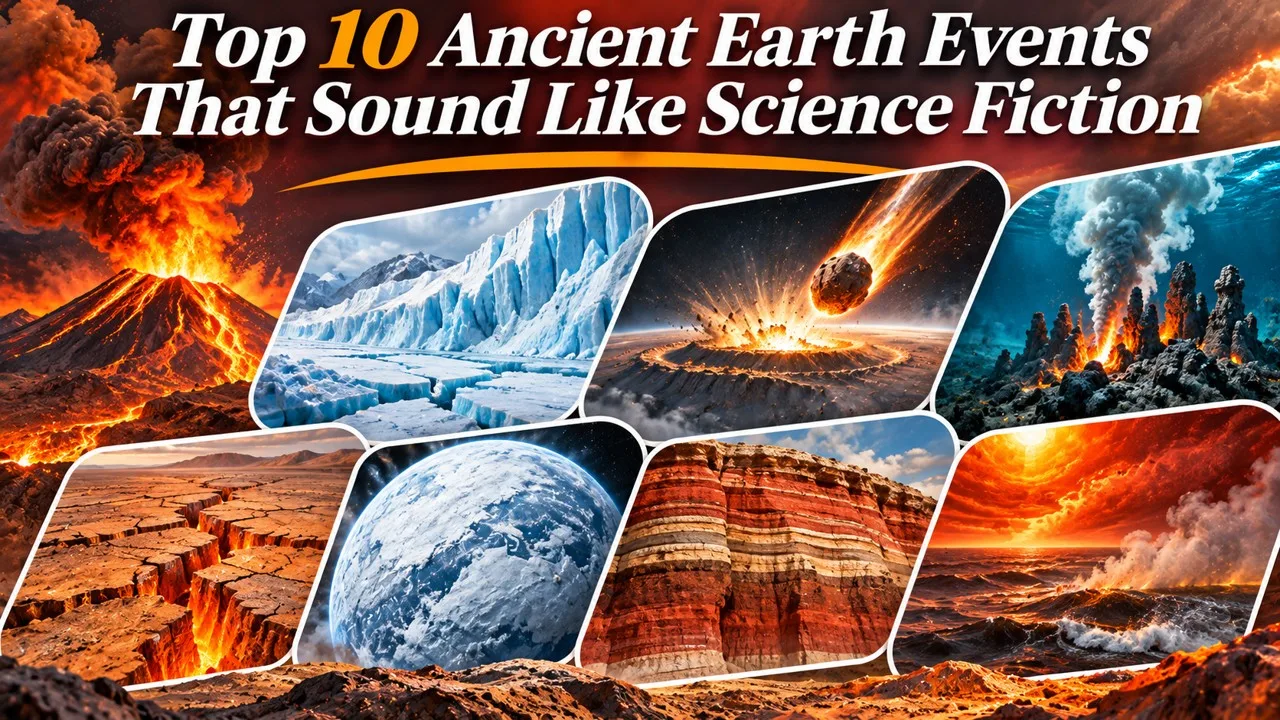
Snowball Earth, the Oklo reactors and a briefly parched Mediterranean are real chapters, as are polar Antarctic forests and a mid-Pleistocene climate shift. They sound like science fiction because the scale is hard to hold in the mind, not because they are rumors [2][5][7]. Each item below is a documented episode or a documented debate. None of them needs a secret civilization, a time machine, or a claim larger than the rocks and the fossils will support [1][6].
The tone is geological. Dates are approximate, mechanisms are sometimes still argued, and "ruled the Earth" is a phrase that has to be taken back down to a period, a habitat, and a set of fossils [3][9].
Key Facts
Deep time includes glaciations that may have reached the tropics, a natural nuclear reactor, a desiccated Mediterranean, and forests at a dark polar shore, all of which can be told without inventing a new planet.
Ten Events at a Glance
| Rank | Claim | Careful version |
|---|---|---|
| 1 | Impact oasis | After Chicxulub, a hydrothermal system in the crater may have offered a microbial habitat; it is a researched possibility |
| 2 | Snowball Earth | Neoproterozoic glaciations were extreme; how fully the planet froze is still argued |
| 3 | Oxygen as poison | During the Great Oxidation, rising oxygen was lethal for many anaerobic microbes |
| 4 | Oklo reactors | Natural fission reactors operated in Gabon about two billion years ago |
| 5 | A stubborn fossil | The Tully monster remains hard to place on the tree of life; "giant" is a headline, the puzzle is the classification |
| 6 | Messinian crisis | The Mediterranean deposited huge evaporites and was later refilled; total dry-down is debated |
| 7 | Giant insects | Some Carboniferous and Permian insects, and other arthropods, were unusually large; not every bug was a giant |
| 8 | Mid-Pleistocene shift | Glacial cycles changed in tempo during the mid-Pleistocene, a transition rather than a two-million-year pause |
| 9 | Bipedal suchians | Some Triassic crocodile-line archosaurs were bipedal and diverse; they did not make later crocodiles bipedal |
| 10 | Antarctic forests | Cretaceous and Eocene forests grew in Antarctica, including through seasonal polar darkness, not a sunless planet |
1. Heat, Water, and a Crater Floor
The asteroid that ended the Cretaceous left a crater, now under the Yucatan, and in the years and millennia after the impact, water circulating through fractured, hot rock could have created a hydrothermal system [1]. Some researchers have argued that such a system might have been a local "oasis" for microbes, a habitat in a wrecked landscape, not a tropical resort [1]. Cores from the peak ring have been read for signs of that circulation. The idea is serious and still being tested. It does not turn the extinction into a creation story, and it does not require a science-fiction refuge for larger animals.
An oasis, in this usage, is a patch of chemistry and warmth. That is already strange enough.
2. Ice, perhaps to the Tropics
In the Neoproterozoic, during the episodes often grouped as Snowball Earth, ice appears to have reached low latitudes, a conclusion drawn from glacial deposits on what were then tropical continents [2]. Whether the oceans froze over completely, or whether a "slushball" of open water remained, is still a live argument [2]. The event, or events, sit near other great changes, including later rises in complex life, but those links are research programs, not slogans. The unexpected fact is the ice itself: a planet that can, on the evidence of the stones, glaze its tropics.
A snowball is a metaphor. The papers spend their time on the parts of the metaphor that may be too round.
Related: Top 10 Most Bizarre Dinosaurs
3. When a Waste Product Became the Air
Oxygen accumulating in the atmosphere and oceans during the Great Oxidation Event, more than two billion years ago, was a crisis for organisms that had evolved in an anoxic world [3]. For many anaerobic microbes, oxygen was a poison, and the rise of oxygenic photosynthesis rewrote the biosphere as well as the rust-colored rocks [3]. The timing and the number of pulses are still being refined; the qualitative point is not. A gas that later animals would treat as a necessity began as a pollutant. That inversion is the science-fiction flavor, and it is ordinary geochemistry.
The air you breathe is, in deep time, someone else's waste. The sentence is dramatic. The evidence is sedimentary and isotopic, which is better.
4. A Reactor that Assembled Itself
About two billion years ago, in what is now Gabon, uranium-rich deposits at Oklo reached the conditions for self-sustaining fission, a natural nuclear reactor moderated by groundwater [4]. The signature is in the leftover isotopes, which do not match ordinary uranium ore. Several reactor zones operated, off and on, over long periods, and then stopped as the geology changed [4]. No one designed them. They are a reminder that physics does not wait for a laboratory, and that a "natural reactor" is a carefully documented anomaly, not a legendary lost machine.
The unexpected fact is the date and the place. A reactor can be a rock formation, and it can have finished its work before complex animals existed.
5. A Mid-sized Puzzle, Not a Named Giant
Lists of "giants that defy classification" often want a monster. A more honest item is Tullimonstrum gregarium, the Tully monster of the late Carboniferous Mazon Creek beds in Illinois, a soft-bodied animal with a stalked tail and a long snout [5]. It is not enormous. It is stubborn. Over the last decade, papers have placed it among vertebrates and, in other readings, taken it back out again, and the debate has not closed [5]. "Defies classification" is fair if it means "is still argued." It is not fair if it means "science has failed" or "the fossil is beyond biology."
Related: Ball Lightning: The Mysterious Spherical Phenomenon
A classification fight can last for years because the specimen is incomplete, or because two good anatomical readings disagree. That is a normal, if aggravating, part of paleontology, and it is the reason this animal belongs on the list.
6. A Sea that Shrank, then Returned
In the late Miocene, during the Messinian salinity crisis, the Mediterranean deposited vast thicknesses of evaporite, a sign that the basin had become a place of extreme evaporation, with the connection to the Atlantic restricted [6]. Some reconstructions picture a deeply desiccated basin, almost a dry floor; others keep substantial brine lakes and argue against a complete, uniform dry-down [6]. Around 5.33 million years ago, the Atlantic connection was re-established in the Zanclean, and water returned, perhaps rapidly. "The Mediterranean evaporated and refilled" is therefore true as a popular summary and too neat as a single picture. The evaporites are not in doubt. The exact shoreline, day by day, still is.
A vanished sea is a strong image. The papers prefer a basin that became, for a time, a different kind of sea, and then a sea again.
7. Large Insects, and Larger Arthropods
In the late Carboniferous and into the Permian, some insects reached sizes that have no modern match, including dragonfly-like griffin flies with wingspans measured in tens of centimeters [7]. High atmospheric oxygen is a leading explanation, because insect respiratory systems may scale more easily in a richer atmosphere; other factors, including fewer flying predators in some habitats, are also discussed [7]. Arthropleura, a giant millipede-like arthropod of the same broad interval, often joins the story, but it is not an insect. "Earth was once inhabited by giant insects" is true for some lineages, in some periods. It is not a claim that every bug was huge, or that a person could have met a flying insect the size of a bird in every forest.
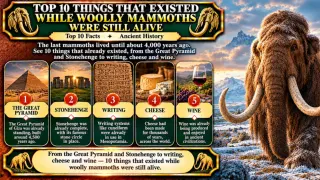
Related: Top 10 Things That Existed While Woolly Mammoths Were Still Alive
The fossils are enough. They do not need a fantasy poster to be surprising.
8. A Change in the Beat of the Ice
During the mid-Pleistocene, roughly between 1.2 million and 700,000 years ago, the rhythm of glacial and interglacial cycles shifted, from a dominant period near 41,000 years toward one near 100,000 years [8]. The Mid-Pleistocene Transition is not a two-million-year standstill, and it is not a single year in which the climate "broke." It is a prolonged change in tempo, still being modeled, with ice volume, carbon dioxide, and the way the ice sheets themselves behaved all in the argument [8]. A "two-million-year climate shift" is a rounding of that interval and of neighboring Pleistocene change, useful only if the rounding is admitted.
The unexpected fact is that the ice ages have a meter, and that the meter can change, without the Sun becoming a different star.
9. Crocodile Relatives on Two Legs
In the Triassic, the crocodile line of archosaurs, the pseudosuchians, was far more various than the later, mostly quadrupedal crocodilians suggest [9]. Some of those relatives, including animals such as Effigia and Poposaurus, were bipedal, filling roles that a modern eye might reserve for dinosaurs [9]. They were important in Triassic ecosystems; "ruled the Earth" is too large a sentence, but "were among the dominant archosaurs of their time, in many habitats" is fair. Dinosaurs rose in the same period and, after the end-Triassic extinctions, took a larger share of those roles. Later crocodiles did not keep the bipedal habit as a standard gait.
A crocodile relative on two legs is a real fossil, not a movie design. The surprise is phylogenetic: the family tree was bushier than the living remnant.
Related: Top 10 Misidentified Prehistoric Animals and How Science Corrected Them
10. Forests at the Dark End of the Year
Antarctica has, at times in the Cretaceous and again in the Eocene, grown forests, including dense, humid, even rainforest-like stands, at latitudes that today are ice [10]. Those woods did not live on a sunless planet. They lived with a polar light regime: a long summer day and a long winter night, a seasonal darkness that trees and other plants had to endure [10]. Fossils of wood, leaves, and pollen, including finds from the Antarctic Peninsula and from cores, make the forests a fact, and they help explain how high-latitude life worked in warmer greenhouse climates. "Sunless Antarctic rainforest" is a vivid label. The careful version keeps the night, and also keeps the summer sun.
A forest that spends part of the year in the dark is already a science-fiction image. The leaves in the rock are the reason it can be written as history.
Conclusion
The ten events above are strange in the way the Earth is strange when the time axis is long enough. Ice can reach the tropics, or nearly so. Oxygen can be a poison. A reactor can start without a physicist, a sea can shrink behind a sill, and a crater can run with hot water. Insects can be large, crocodile relatives can run on two legs, and a forest can stand in Antarctica through a polar night. In the middle of the Pleistocene, even the beat of the ice can change. A mid-sized Carboniferous fossil can still refuse a tidy name.
None of this requires a second, invented planet. It requires the one we already have, read carefully, with the arguments left in.
- ^ [1] Research on post-impact hydrothermal circulation in the Chicxulub crater, treated as a possible microbial habitat. Britannica: K-T extinction, and related Chicxulub studies
- ^ [2] Overviews of Neoproterozoic Snowball Earth glaciations, including the debate between a hard snowball and a slushball. Britannica: Snowball Earth hypothesis
- ^ [3] Accounts of the Great Oxidation Event and the toxicity of rising oxygen for anaerobic life. Britannica: Great Oxidation Event
- ^ [4] Documentation of the Oklo natural fission reactors in Gabon. Britannica: Oklo
- ^ [5] Research on Tullimonstrum and its still-debated place among animals. Britannica: Tully monster
- ^ [6] The Messinian salinity crisis and the later Zanclean refilling of the Mediterranean, with debate over complete desiccation. Britannica: Messinian salinity crisis
- ^ [7] Fossil evidence for large late Paleozoic insects, and the oxygen and ecology hypotheses that try to explain them. Britannica: Griffinfly
- ^ [8] The Mid-Pleistocene Transition in glacial-cycle tempo. Britannica: Pleistocene Epoch
- ^ [9] Triassic bipedal pseudosuchians, including animals such as Effigia and Poposaurus. Britannica: Thecodontian, and related archosaur overviews
- ^ [10] Cretaceous and Eocene Antarctic forest fossils, including the problem of seasonal polar darkness. Britannica: Antarctica



















Discussion
Log in with