




 By
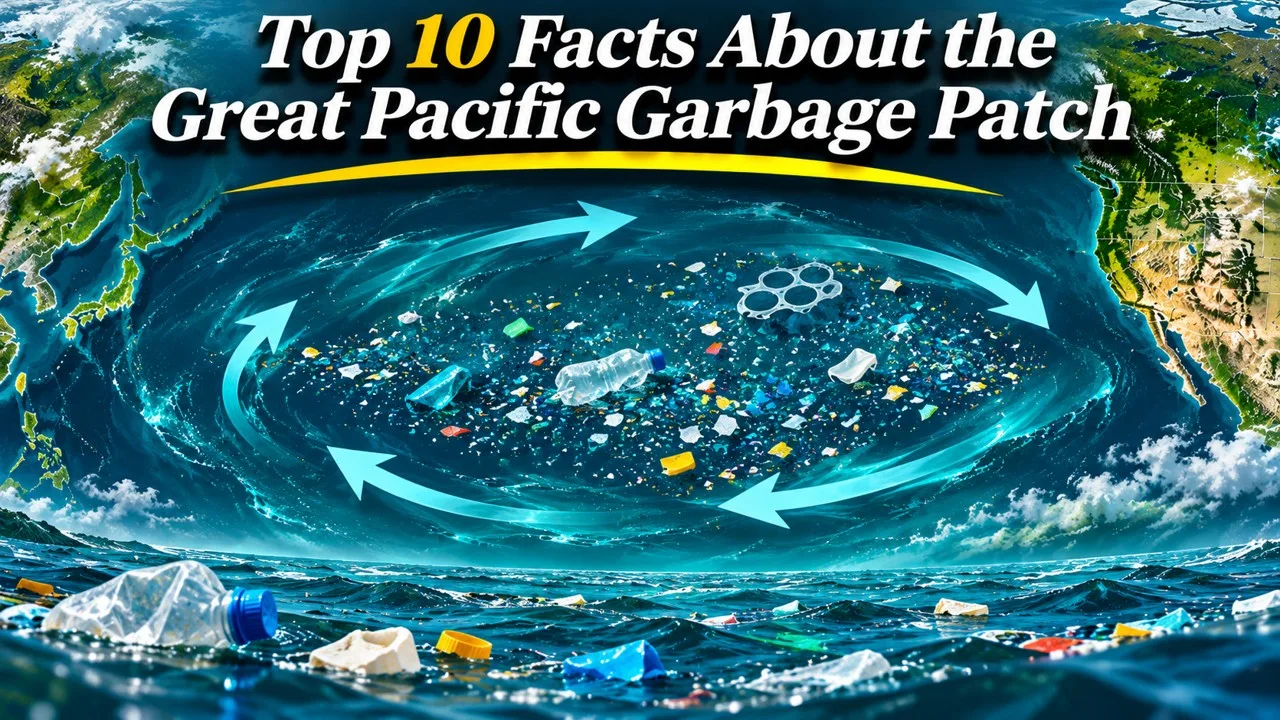
The Great Pacific Garbage Patch is a thin soup of plastic in a gyre, not a solid island, and cleanup plans should be judged by evidence, not by a slogan. In the North Pacific, prevailing winds and currents gather floating debris into a broad region between California and Japan, with a denser core often placed between Hawaii and the North American west coast [1][5]. The popular name is useful and misleading at once. It is useful because the accumulation is real. It is misleading because it suggests a walkable continent of bags, when much of what is there is small, scattered, and suspended near the surface [2].
The ten facts below are about currents, sources, harm, scale, and the hard problem of taking the material out again.
Key Facts
A "garbage patch" is a region of elevated plastic concentration inside an oceanic gyre, not a single solid object with a shoreline.
Ten Facts at a Glance
| Rank | Fact | Careful version |
|---|---|---|
| 1 | The current does the gathering | The North Pacific Subtropical Gyre concentrates floating debris over years |
| 2 | It is a soup, not an island | Much of the material is microplastic and mixed fragments, widely spaced |
| 3 | Wildlife is affected | Animals ingest plastic or become entangled, especially in lost fishing gear |
| 4 | The field is hard to see and hard to map | Density varies, and estimates depend on what size of particle is counted |
| 5 | Other oceans have patches too | Each major subtropical gyre has a similar, if less famous, accumulation |
| 6 | The scale is large and uneven | Figures in square kilometres describe a region of higher concentration, not a packed mat |
| 7 | Fishing and shipping matter | Nets, ropes, and gear are a large share of the visible mass in some surveys |
| 8 | A modern "discovery" had earlier hints | Charles Moore's 1997 account made the patch famous; researchers had already been sampling plastic at sea |
| 9 | Plastic can carry a living community | A floating biota, sometimes called a neopelagic community, can live on the debris |
| 10 | Cleanup is a test, not a miracle | Removal projects are real and limited; cutting waste at the source still matters more |
1. It Is All in the Current
The North Pacific Subtropical Gyre is a great clockwise loop of current, driven by wind and by the rotation of the Earth, that tends to hold floating material toward its interior [1]. Plastic that escapes rivers, coasts, and ships and remains buoyant can drift for years and, if it does not beach or sink, may spend a long time in that slow whirl [1]. The patch is therefore not a dumping ground in one territorial sea. It is a physical consequence of circulation, which is why similar patches appear in other basins as well.
A current is not a villain. It is a machine that sorts whatever we let float, and it will go on sorting for as long as the wind blows and the plastic remains light enough to ride.
2. A Soup, Not a Continent
Photographs of bottled storms and netted rafts are real, and they are not a typical square kilometre of the patch [2]. Surveys find a dilute mixture of fragments, lines, and microplastics, with denser windrows here and there, and with plenty of open water between objects [2]. You could sail through much of the region and see only occasional debris, which is one reason the problem was easy to understate, and also why the "island" metaphor is a poor guide to cleanup. A net built for a solid dump will miss a soup.
The honest image is a contaminated stretch of ocean, not a landfill with a beach. That image is harder to photograph, which is one reason the island metaphor has been so hard to retire, even among people who know it is wrong.
Related: Exploring the Great Barrier Reef: Ecosystem and Biodiversity
3. Harm That Does Not Need a Spectacle
Marine animals eat plastic, mistake it for food, or become caught in it, especially in abandoned nets and lines [3]. The injuries are documented in turtles, seabirds, mammals, and fishes, and they range from blockage and malnutrition to entanglement [3]. This article will not linger on wounds. The scientific point is already hard enough: a material that does not belong in the food web is now in it, and some of that material is inherited from fishing, not only from household litter.
Misery is a fair word for some of the outcomes. It is not an excuse for a graphic catalog.
4. A Debris Field That Resists a Simple Map
The patch has no legal border and no single shoreline to survey [4]. Researchers use nets, visual counts, and models, and they argue about how to count particles too small for a given mesh [4]. A daunting field, in this sense, is daunting because it is patchy and three-dimensional, with fragments near the surface and, in other studies, material mixed downward by storms and biology. A press map with a bright oval is a diagram, not a census.
Uncertainty about the exact outline is not uncertainty about the existence of the accumulation.
5. Not the Only Patch
The North Pacific gets the famous name, but the South Pacific, the North and South Atlantic, and the Indian Ocean have their own subtropical gyres and their own raised concentrations of floating plastic [5]. Comparing them is difficult, because sampling methods differ, but the physical story is the same: a long-lived buoyant waste, a looping current, and a hinterland of coasts and fleets [5]. "There are others" is not a consolation. It is a reason not to treat one patch as a unique accident.
Related: Top 10 Strange Deep-Sea Animals
A global industry of disposable polymer has a global geography of leftovers, and a policy that names only one famous patch can still miss that wider map of gyres.
6. Large, and Not Evenly Packed
Estimates of the Great Pacific Garbage Patch's area have ranged into the millions of square kilometres when the outer, thinner region is included, with a smaller, denser core in some studies [6]. Mass estimates, including a widely cited 2018 survey that found a large share of the floating mass in fishing gear, are also model-dependent and have been revised [6]. The shocking scale is real as a region of contamination. It is not a packed surface you could walk, and a comparison to "the size of Texas," or to any other land, should always say what is being measured: area of elevated concentration, not area of solid plastic.
Scale without that clause becomes a poster, not a measurement.
7. Nets and Ships, Not Only Bottles
Household packaging is part of the story, and so are rivers that deliver it to the sea [7]. In the eastern North Pacific accumulation, though, several surveys have found that a large fraction of the floating mass is abandoned, lost, or discarded fishing gear: nets, ropes, and related tackle [7]. Shipping and other maritime sources add to the load. A cleanup or a policy that stares only at straws will miss a heavy, lethal, and professional stream of plastic. "Fishing and shipping hurt, too" is not a way to excuse consumers. It is a way to count the mass correctly.
Ghost gear is both debris and a trap at once. That double role is why it looms in the harm as well as in the measured floating tonnage as well.
Related: Top 10 Longest Coral Reefs in the World
8. Found, and then Made Famous
The sailor and ocean advocate Charles Moore is often credited with coming upon the patch in 1997 and then writing it into public view [8]. His account mattered. It was not, strictly, the first time scientists had found plastic at sea; researchers had been recording pellets and fragments in the North Atlantic and the Pacific for years before the nickname stuck [8]. The "accidental discovery" is therefore best told as a public discovery, a moment when a known, under-noticed pollution became a named place.
Names change policy more easily than scattered data points do. That is the real event of the late 1990s, and it is why a sailor's story and a scientist's net both belong in the same history, in that order of public effect and the opposite order of first evidence.
9. A New, Unwelcome Habitat
Floating plastic lasts long enough to grow a film of microbes and to carry coastal organisms far into the open sea [9]. Researchers have described communities living on the debris, sometimes gathered under the label of a neopelagic, or mid-ocean surface, fauna on a synthetic substrate [9]. This is an ecosystem only in a dry, ecological sense. It is not a restoration of a lost paradise, and it does not make the patch a refuge that should be left alone as if it were a reef. It does change how we think about rafting, invasive species, and the chemistry of a sea already under other stresses.
Life on plastic is a finding. It is not a redemption of the waste.
10. Cleanup, Tried in Public
Projects such as The Ocean Cleanup, and a range of smaller gear-recovery and coastal efforts, have tried to take plastic out of the gyre or to stop it in rivers [10]. They have moved real mass, they have hit storms, design limits, and questions about bycatch and about cost per tonne, and they have been both oversold and unfairly dismissed [10]. A "solution" that leaves production and fishing gear unchanged will not empty the gyre. A serious program can still be worth doing at the dense end of the patch, as one tool among others, if its claims are kept in proportion to its catch.
Related: Top 10 Most Bizarre Phobias: Strange Fears That Exist
The ocean will not be swept like a floor. That is not a reason to do nothing. It is a reason to measure the broom, to keep fishing gear in the account, and to treat a press-friendly boom as one instrument in a much larger, slower reduction of waste.
Conclusion
The Great Pacific Garbage Patch is a consequence of a current and of a century of durable waste. It is large, dilute, partly made of fishing gear, harmful to animals, and now a habitat for organisms that should not have a plastic island to ride. Other oceans have their own versions. Cleanup machines and river booms are experiments, not last pages.
The facts that most need repeating are the unglamorous ones. It is not an island. It is not only a consumer's water bottle. It will not vanish because a slogan found a net. Those sentences are less funky than the nickname, and they are the ones that still help a reader who has to decide what to believe about a place that is real and still easy to misdescribe.
- ^ [1] Descriptions of the North Pacific Subtropical Gyre and the wind-driven gathering of floating debris. Britannica: Ocean gyre
- ^ [2] Scientific surveys showing a dilute field of fragments and microplastics rather than a continuous solid mat. Britannica: Plastic pollution
- ^ [3] Reviews of ingestion and entanglement harm to marine animals, especially from lost fishing gear, described here without graphic detail. Britannica: Marine ecosystem
- ^ [4] Method papers on sampling, mesh size, and the difficulty of mapping a patchy debris field. NOAA marine debris program pages
- ^ [5] Comparisons of plastic accumulation in the five major subtropical gyres. Britannica: Plastic pollution
- ^ [6] Area and mass estimates for the eastern North Pacific accumulation, including later survey revisions. Scientific Reports, 2018 gyre survey
- ^ [7] Survey results on the large share of floating mass in abandoned fishing gear, and on maritime sources. FAO and related discussions of abandoned, lost, or discarded fishing gear
- ^ [8] Charles Moore's 1997 account, and earlier scientific sampling of plastic at sea in the 1970s and after. Britannica: Plastic pollution
- ^ [9] Research on microbial films and rafting communities on open-ocean plastic, including neopelagic descriptions. Scientific American and primary ecology papers
- ^ [10] Public and critical assessments of open-ocean and river cleanup systems, including The Ocean Cleanup, treated here as limited tools. The Ocean Cleanup, and independent coverage





















Discussion
Log in with