






Top 10 Unexpected Objects People Have Treated as Sacred
 By Dhiraj Sharma · Published
Share Post
Loading…
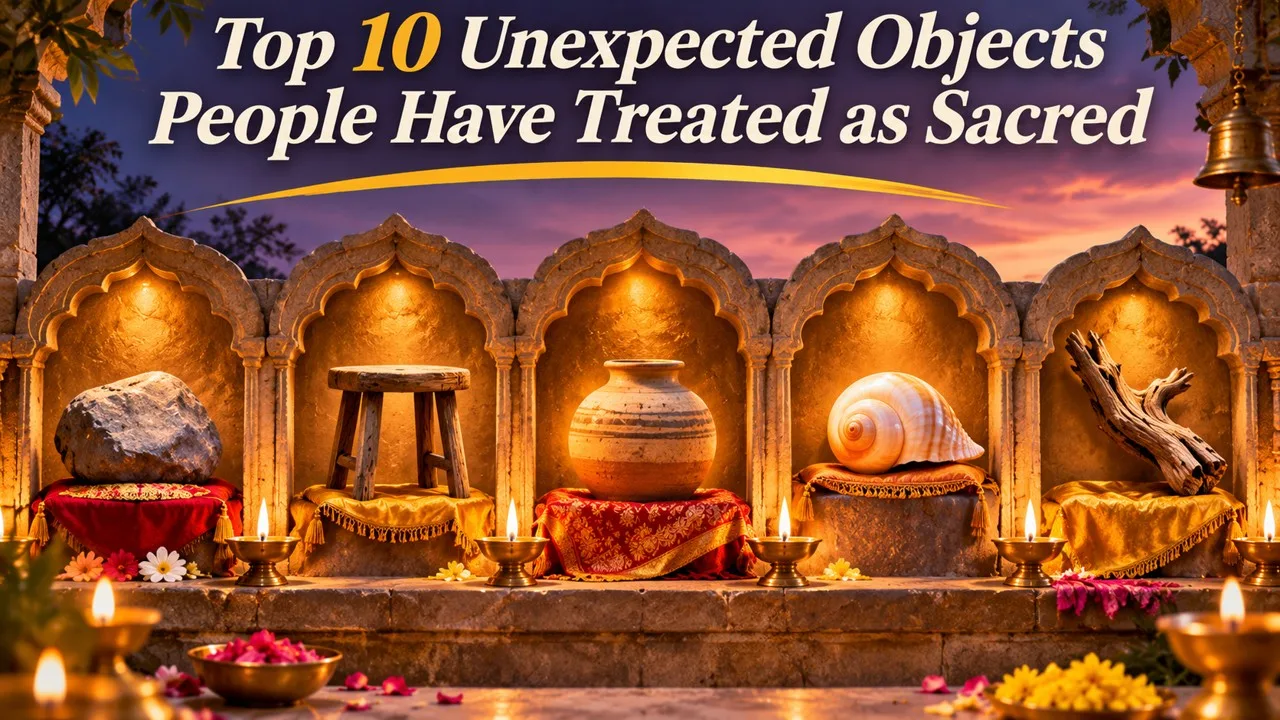
Gold stools, fossil shells, memorial needles and a sanctuary stone show how ordinary-looking objects can be sacred in documented religious practice. This list is a curated set of ten cases in which a stool, a fossil, a tool, a machine, a stone, a mirror, or a relic is treated as holy, or as more than a commodity, in a way that can be checked in historical and ethnographic sources [3][7][9]. The tone is descriptive and respectful. Living religions are not puzzles, and a "cargo cult" label is used, if at all, with care for what local communities actually say [1].
Two often-repeated items are not used here. A medieval Christian relic tradition concerning the Holy Prepuce is too crude, and too poorly served by joke-book treatment, to belong on this page. The Palladium of Troy is a literary object more than a documented cult object in a surviving community. In their place are the Black Stone of the Kaaba and the Sacred Tooth Relic in Kandy, both with long, public religious histories [9][10].
Key Facts
Sacredness, in these entries, is a social and religious fact: people ritually protect, greet, house, or mourn an object. The entries describe that practice, not a test of the object's physical origin.
Ten Documented Cases at a Glance
| Rank | Object or practice | Place or tradition | What is documented |
|---|---|---|---|
| 1 | John Frum and cargo ritual | Tanna, Vanuatu | A local religious movement that ritually expects a world-changing return |
| 2 | Shaligram fossils | India and Nepal, Vaishnava practice | Ammonite-bearing stones treated as forms of Vishnu |
| 3 | The Golden Stool | Asante, Ghana | A stool that embodies the Asante nation and is not sat upon |
| 4 | Hari-kuyÅ needle memorials | Japan | Worn needles laid to rest, often in tofu or similar soft offerings |
| 5 | NingyÅ kuyÅ | Japan | Ritual memorials for dolls and figures that have left daily use |
| 6 | Blessings of cars and machines | Several industrial and religious settings | Vehicles and tools formally blessed as they enter work |
| 7 | The stone of Pessinus | Rome and Anatolia, 204 BCE | A sacred stone of the Great Mother, brought to the city in a crisis |
| 8 | Yata no Kagami | Japan | A sacred mirror in the imperial regalia, treated as a body of Amaterasu |
| 9 | The Black Stone of the Kaaba | Mecca, Islam | A stone in the Kaaba's corner, kissed or touched in the tawaf |
| 10 | The Sacred Tooth Relic | Kandy, Sri Lanka | A tooth relic housed in a temple and carried in public ritual |
1. John Frum on Tanna
On Tanna, in Vanuatu, followers of John Frum maintain a religious movement that emerged in the twentieth century and that has often been described, from the outside, as a "cargo cult" [1]. The term is a scholars' and journalists' label, and it can flatten a local theology that includes ritual, flags, and an expected transformation of the moral and material world [1]. American wartime presence in the New Hebrides is part of the historical setting; it is not a complete explanation of what people on Tanna believe or do.
The unexpected object, if any, is not a single relic. It is the seriousness with which everyday manufactured goods and a promised return can be placed inside a religion. A respectful account listens to that seriousness instead of treating the movement as a punchline about shopping.
2. Shaligrams
Shaligrams, or saligrams, are typically dark fossiliferous stones, often ammonites, collected from the Kali Gandaki and related rivers and treated in Vaishnava Hindu practice as natural forms of Vishnu [2]. They are housed, bathed, and honored in temples and homes according to ritual rules, not displayed as geology-class specimens [2]. Paleontology can identify the fossil; it cannot, by itself, cancel the religious meaning, which is a fact about practice.
The unexpected meeting is between a Mesozoic shell and a living devotion. Both identifications can be true at once. The stone is a fossil, and it is, for worshippers, a sacred body.
Related: Top 25 Unique Religions You Have Probably Never Heard Of
3. The Golden Stool
The Golden Stool, Sika Dwa Kofi, is the preeminent stool of the Asante, understood not as an ordinary throne but as the seat of the nation's soul, a royal and sacred object that is not sat upon [3]. In 1900, British demands connected with the stool helped to precipitate the war associated with Yaa Asantewaa, a reminder that an object can be political as well as holy [3]. The stool has a documented ceremonial life, with its own protocol of display and respect.
A piece of furniture, in this history, is a person-like presence for a people. That is why colonial officials who treated it as loot or as a chair misunderstood both the object and the state.
4. Hari-kuyÅ
Hari-kuyÅ is a Japanese memorial rite for broken or worn needles, historically associated especially with seamstresses and with Buddhist or Shinto temple practice, in which needles are offered and often placed into tofu, konnyaku, or another soft medium as a final rest [4]. The rite thanks tools for their service and marks a refusal to throw them out as mere scrap [4]. Dates and temples vary; the logic is stable enough to be described as a recurring custom.
A needle is as ordinary an object as a household contains. The memorial makes that ordinariness visible, and it treats sharp, used metal as something that can be owed a farewell.
5. NingyÅ kuyÅ
NingyÅ kuyÅ refers to Japanese ritual memorials for dolls and human figures that are no longer kept, held at temples and shrines and sometimes ending in a respectful disposal or burning after prayers [5]. The practice recognizes a lingering presence in an object that has a face, a name, or a long place in a house, and it offers a formal way to let that presence go [5]. Similar memorials exist, in related forms, for other used objects.
Related: Top 10 Most Bizarre Phobias: Strange Fears That Exist
The "unexpected" element, for an outsider, is that a toy can require a funeral. In the documented practice, the doll is not being treated as a joke, and the rite is not a horror story. It is a manner of parting.
6. Blessing Cars and Machines
In many industrial and religious settings, vehicles, computers, and factory machines are formally blessed at the start of work, after an accident, or at a new plant [6]. Japanese factory and office rites, the blessing of fishing fleets, and Christian or other blessings of cars are all documented, in different theologies, as ways of placing a dangerous or valuable tool under protection [6]. The object remains a machine. The rite treats its use as a moral and hazardous act, not only a technical one.
A computer on an altar, or a priest at a car dealership, can look like a mismatch. In the communities that do it, the mismatch is the point: the new tool is being fitted into an older language of care and danger.
7. The Stone of Pessinus
In 204 BCE, during the Second Punic War, Roman authorities brought to the city a sacred stone of the Great Mother, Cybele, from Pessinus in Anatolia, after a consultation of the Sibylline Books and a diplomatic approach to the Attalid court [7]. Ancient writers describe the object as a black stone, possibly meteoritic, treated as the goddess herself or as her most concentrated sign, and housed in a new temple on the Palatine [7]. The episode is one of the clearest cases of a state recruiting a foreign sacred object in a military crisis.
Whether the stone was a meteorite is a later scientific question. The historical fact is the transfer: a city at war decided that an Anatolian holy stone belonged in Rome, and it built a cult around that decision.
Related: Top 10 Oldest Buildings in the World
8. Yata no Kagami
Yata no Kagami is the sacred mirror among the three imperial regalia of Japan, associated in mythology with the sun goddess Amaterasu and treated, in Shinto and imperial ritual, as a body or symbol of the deity [8]. The object is not a public museum piece; it is described in chronicles and in ceremonial protocol, and photographs of a "the" authentic mirror are not the point of a respectful account [8]. Mirrors in East Asian religious history often stand for presence, truth, or a deity's light, which makes a household object into a theological one.
The unexpectedness, for a reader who thinks of a mirror as furniture, is the degree of seclusion and honor. A reflective disc can be among a state's most carefully kept things.
9. The Black Stone of the Kaaba
The Black Stone, al-Hajar al-Aswad, is set in a corner of the Kaaba in Mecca and is kissed, touched, or greeted from a distance by pilgrims during the tawaf, following the practice of the Prophet Muhammad and earlier Abrahamic tradition in Islamic belief [9]. It is a stone, worn smooth by touch, in a sanctuary that is the orientation of Muslim prayer [9]. Scientific guesses about a meteoritic origin appear in some modern writing; they are secondary to the religious fact, and they are not required for the pilgrimage rite.
This entry stands in for cruder relic stories that do not belong here. The Black Stone is public, central, and densely documented in Islamic law and history. An "unexpected object" only if one expects a sanctuary not to have a stone; in this sanctuary, the stone is part of the architecture of devotion.
Related: 10 Sikh Gurus: The Pillars of Sikhism Who Shaped Faith, Equality, Courage, and Humanity
10. The Sacred Tooth Relic
The Temple of the Tooth, Sri Dalada Maligawa, in Kandy, Sri Lanka, houses a relic believed to be a tooth of the Buddha, a palladium of Sinhalese Buddhist kingship and a focus of pilgrimage and of the Esala Perahera procession [10]. The object is kept in nested caskets and is not a casual exhibit; its political and religious history includes wars, colonial encounters, and a continuing temple ritual [10]. A tooth is, in another context, an ordinary fragment of a body. In this temple, it is a public, guarded centre of a civilization's ceremony.
The substitution, again, is toward a well-recorded living cult rather than a half-legendary wooden statue or a relic treated as a joke. The Kandy relic can be described in institutional history, which is the right register for this list.
Conclusion
Sacredness can attach to a stool, a fossil, a needle, a doll, a factory tool, a meteoritic or at least stony holy object, a mirror, a sanctuary corner, and a tooth. The ten cases above are all on the documentary record, and two weaker or cruder items were left out on purpose. The right tone is not astonishment that other people are credulous. It is attention to how communities formalize care, memory, sovereignty, and worship around things that could, in another room, be sorted as furniture or stone.
An object is not sacred because a list says so. It is sacred because people keep saying so, in ritual, law, and danger, long enough for the rest of us to have to take the practice seriously.
- ^ [1] Ethnographic and historical overviews of the John Frum movement on Tanna. Britannica: John Frum
- ^ [2] "Shaligram" and Vaishnava ritual use of Gandaki fossils. Wikipedia: Shaligram
- ^ [3] "Golden Stool" and Asante history, including the war of 1900. Encyclopaedia Britannica. Britannica: Golden Stool
- ^ [4] Accounts of hari-kuyÅ, the Japanese needle memorial rite. Wikipedia: Hari-kuyÅ
- ^ [5] Accounts of ningyÅ kuyÅ, Japanese doll memorial rites. Wikipedia: NingyÅ
- ^ [6] Reporting and ethnographic notes on the blessing of cars, fleets, and factory machines. Wikipedia: Blessing of the Fleet
- ^ [7] The transfer of the Magna Mater and the stone of Pessinus to Rome, 204 BCE. Britannica: Great Mother of the Gods
- ^ [8] "Imperial Regalia of Japan" and Yata no Kagami. Wikipedia: Imperial Regalia of Japan
- ^ [9] "Black Stone" of the Kaaba. Encyclopaedia Britannica. Britannica: Black Stone
- ^ [10] "Temple of the Tooth" and the Sacred Tooth Relic, Kandy. Encyclopaedia Britannica. Britannica: Temple of the Tooth






















Discussion
Log in with