






Top 10 'Ancient Alien' Artifacts with Ordinary Explanations
 By Dhiraj Sharma · Published
Share Post
Loading…
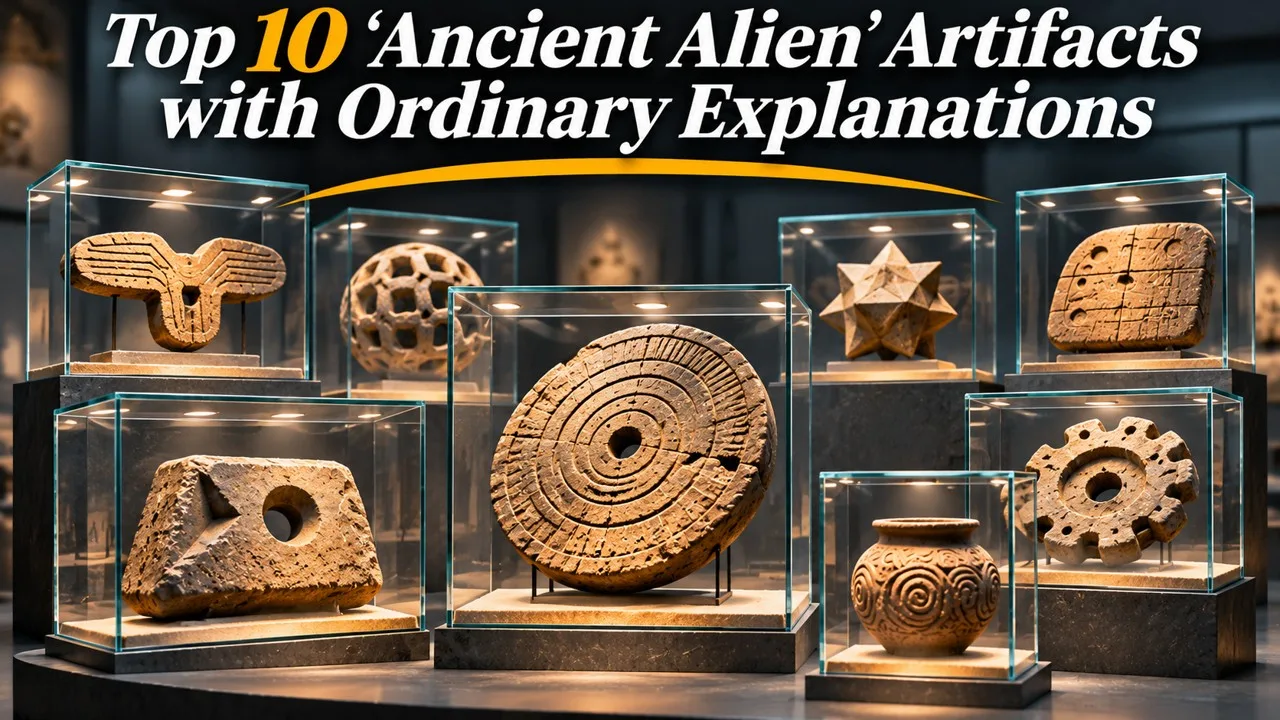
The Coso spark plug, the Abydos palimpsest and a shelf of crystal skulls have ordinary histories; none of them is evidence of an ancient visit from elsewhere. "Ancient alien" lists usually work by showing an object out of context, asking a startled question, and stopping before the specialist's answer [3][10]. The ten artifacts below have all been asked to prove a visit from the sky. Each has a documented, terrestrial account: a spark plug in a concretion, a carved palimpsest, a religious relief, a piece of good iron, a map compiled from older maps, a gold animal, a clay figure, a Victorian curiosity [1][10]. This article is about those accounts. It is not a debate staged to give a flying saucer the last word, and it will not pretend that a gap in a popular television script is the same thing as a gap in the excavation record.
No invented spacecraft, no copyrighted alien characters, and no reconstructed "secret technology" appear in the image brief. The pictures that belong here are objects and contexts.
Key Facts
An ordinary explanation is not a claim that the past was dull. It is a claim that geology, craft, religion, and later forgery already suffice.
Ten Objects at a Glance
| Rank | Object | The extraordinary claim | The ordinary account |
|---|---|---|---|
| 1 | Coso artifact | An ancient spark plug, or similar device, encased in stone | A 1920s Champion spark plug in a concretion |
| 2 | Baigong pipes | Metallic pipes left by visitors | Iron-rich natural tubes and other geological features at a Chinese site |
| 3 | Abydos "helicopter" | A machine carved on an Egyptian temple | A palimpsest: later hieroglyphs over earlier ones, not a single picture of an aircraft |
| 4 | Dendera "light" | An electric lamp in a relief | A lotus, a djed pillar, and a snake, in a religious scene |
| 5 | "Baghdad battery" | An ancient electrical cell, perhaps alien-taught | Clay vessels that may have held scrolls; the battery reading is unproven and, even if a weak cell were possible, not evidence of visitors |
| 6 | Iron Pillar of Delhi | Metal that "should not" exist, hence a nonhuman craft | High-quality historic iron with a protective film, remarkable and human |
| 7 | Piri Reis map | A chart that shows an ice-free Antarctica, hence lost high technology | A 1513 compilation of earlier coastal sources, misread in the modern claim |
| 8 | Quimbaya gold figures | Model jets | Stylized animals, probably birds, fish, or insects, in a known goldworking tradition |
| 9 | Dogu figurines | Astronauts in clay | Jomon-period Japanese figures with stylized human features |
| 10 | Crystal skulls | Pre-Columbian, perhaps nonhuman, ritual objects | Nineteenth- and twentieth-century European manufacture |
1. A Plug in a Lump of Rock
In 1961, in the Coso range of California, a lump of hard material was cut open and found to contain a manufactured metal and ceramic object [1]. Popular retellings turned it into a spark plug from an impossible antiquity, a favorite of the "out-of-place artifact" circuit. Later examination identified a Champion spark plug of a type made in the 1920s, enclosed in a natural concretion that can form, in some soils and mineral waters, far faster than a lay reader expects [1]. The surprise is geological impatience, not a time traveler's garage.
A modern object in a hard case is still a modern object. The case is the only part that needed a specialist, and even that part is a known geological habit, not a signature from another world.
2. Tubes That Need No Plumber
At a site in Qinghai, often called the Baigong or White Pyramid area in popular writing, rusty tubular structures have been presented as metal pipes from an ancient installation [2]. Geologists and skeptical investigators have described iron-rich, naturally formed tubes and related features, the sort of thing that can occur when minerals deposit around roots, vents, or other temporary cores [2]. A rusty cylinder in a rock face is not, by itself, a specification for a lost city, and it is certainly not a docking port.
If a later survey were to find a human pipe in the same landscape, that would still be a human pipe. The present popular claim does not need visitors to stand up.
Related: Top 20 Archaeological Hoaxes That Fooled the Public
3. A Helicopter That Is Two Inscriptions
A relief at the Temple of Seti I at Abydos, in a photograph taken at a certain angle and with a certain amount of wish, looks to some viewers like a helicopter, a submarine, and other modern machines [3]. Egyptologists read a palimpsest. The temple wall was recarved: later hieroglyphs were cut over earlier ones, plaster and shadow produce hybrid shapes, and the "machines" dissolve once the two inscriptions are separated [3]. The ordinary explanation is almost disappointingly technical, which is why it travels less easily than the photograph.
A palimpsest is a known habit of Egyptian monumental writing. It is not a hangar.
4. A Lamp That Is a Lotus
Reliefs in the Hathor temple at Dendera show a lotus, a djed pillar, and a serpent in a scene that electrical hobbyists have liked to read as a bulb, a socket, and a cable [4]. The elements are standard religious signs, readable in the context of other Egyptian art, not a wiring diagram [4]. The "Dendera light" is a modern projection onto a temple that already had a language. Egyptians were skilled with stone, gold, and ritual. They did not, on this evidence, leave a user's manual for a Tesla coil.
A snake in a flower is allowed, in a temple, to be simply a snake in a flower and nothing more than that at all here.
5. A Jar That Might Not Be a Cell
Clay vessels found near Baghdad, sometimes with a copper cylinder and a bit of metal, were later packaged in popular science as the "Baghdad battery," an ancient cell that might have been used for plating or medicine [5]. The archaeological context is thin, the reconstruction is debated, and even a generous reading, that someone could have made a weak current with vinegar and metals, would be a fact about Hellenistic or Parthian craft, not about a visit [5]. An unproven battery is not a spaceship. A proven one, if it ever were proven, would still be a pot.
Related: Top 10 Famous Shipwrecks That Rewrote History
The extraordinary claim was never the jar. It was the leap from jar to lost electrical civilization.
6. Iron That Has a Human Chemistry
The Iron Pillar of Delhi, standing at Mehrauli, has resisted rust to a degree that still impresses metallurgists [6]. The ordinary explanation, developed in modern analyses, involves the iron's composition, including phosphorus, and a protective film that forms at the surface, together with a relatively dry climate and a mass of metal that is not a thin sheet [6]. The pillar is a genuine achievement of historic Indian ironworking. "It should have rusted away, therefore aliens" is not a metallurgical argument. It is a shrug dressed as a conclusion.
Remarkable iron is still iron. The people who made it deserve the credit.
7. A Chart Compiled, Not Downloaded
The 1513 world map of the Ottoman admiral Piri Reis, which survives in a partial copy, draws on earlier Portuguese, Arabic, and other sources, and it shows parts of the Atlantic coasts with a mixture of accuracy and error typical of the period [7]. A modern claim, popularized in the twentieth century, holds that the southern edge depicts an ice-free Antarctic coastline, hence a lost survey from a forgotten age or from the air [7]. Specialists read a distorted South American coast and the ordinary faults of compilation, not a scientific survey of a hidden continent. The map is historically important. It does not require a nonhuman cartographer.
A sixteenth-century admiral can be a good compiler without being a prophet of the International Geophysical Year.
Related: Top 10 Historic Maps and What They Reveal
8. Gold Animals, Not a Fleet
A group of small gold objects from the Quimbaya and related traditions of what is now Colombia have a sleek, tailed look that, to a modern eye used to jets, can suggest aircraft [8]. In their own tradition they sit among stylized birds, insects, and fish, in a goldworking culture that did not need a runway to value a beautiful small form [8]. "Looks like a plane if you squint" is not a typological method. A zoomorphic reading is.
The makers were metallurgists of a high order. Their compliment is not improved by turning a bird into a fuselage.
9. Clay Figures with Goggle Eyes
Dogu are ceramic figures from Japan's Jomon period, often with wide eyes, broad hips, and patterned surfaces, and they have been asked, in popular writing, to represent astronauts in suits [9]. Archaeologists treat them as stylized human, or sometimes hybrid, figures with ritual or social meaning that is still discussed, in a long prehistoric culture that left no other evidence of a space program [9]. Goggle eyes can be a style. They do not have to be a visor.
A clay person is allowed to look strange. Strangeness is not a flight plan.
10. Skulls from a Later Workshop
Crystal skulls, marketed as ancient Mesoamerican or as objects of mysterious origin, have been central to a modern myth of lost temples and, in some versions, of nonhuman craft [10]. Studies of tool marks, including work associated with the British Museum and the Smithsonian, have found rotary wheels and other techniques that belong to nineteenth- or twentieth-century European or later workshop practice, not to pre-Columbian lapidary work [10]. The skulls are real objects. Their antiquity, and their alien aura, are the part that does not survive a microscope.
Related: Top 10 Pilgrim and Mayflower Myths: What History Really Shows
A Victorian or later carver can be a very good carver. That is the ordinary, and sufficient, wonder.
Conclusion
The ten objects are not equally famous, and they are not equally close calls. A spark plug in a concretion is an open-and-shut geological story. A palimpsest at Abydos is an epigraphic one. A Delhi pillar is a genuine metallurgical success that was never in need of a visitor. A crystal skull is a later product with a marketing department in its past. The "Baghdad battery" and the Piri Reis map are the cases that most reward a careful "maybe, but even then not aliens."
What none of them supplies is evidence of an ancient visit from elsewhere. The ordinary explanations are not a conspiracy of museums. They are what happens when you keep the object in its site, its style, and its date, and let those facts finish the sentence the photograph began. The past is already strange enough, in iron that refuses to flake and in a 1513 chart compiled on a deck, without a visitor who never had to leave a mark in a place we can actually dig.
- ^ [1] Investigations identifying the Coso artifact as a 1920s Champion spark plug in a natural concretion. Britannica: Concretion
- ^ [2] Geological discussions of iron-rich tubular structures at the Baigong site and of natural pipe-like mineralization. Britannica: related geological processes
- ^ [3] Egyptological readings of the Abydos temple palimpsest, as later hieroglyphs cut over earlier ones. Britannica: Abydos
- ^ [4] Iconographic accounts of the Dendera Hathor temple reliefs, including lotus, djed, and serpent motifs. Britannica: Dendera
- ^ [5] Critical discussions of the so-called Baghdad battery and of its thin archaeological context. Britannica: Battery, and archaeological reviews
- ^ [6] Metallurgical studies of the Iron Pillar of Delhi and of its corrosion resistance. Britannica: Delhi
- ^ [7] Historical studies of the 1513 Piri Reis map as a compilation of earlier coastal sources, and critiques of the ice-free Antarctica claim. Britannica: Piri Reis
- ^ [8] Archaeological accounts of Quimbaya and related gold figures as stylized animals in a known tradition. Britannica: Colombia, pre-Columbian goldwork
- ^ [9] Archaeology of Jomon dogu figurines as stylized human figures. Britannica: Jomon culture
- ^ [10] Museum studies of crystal skulls, including tool-mark evidence for nineteenth- or twentieth-century European manufacture. The British Museum, and Smithsonian research summaries





















Discussion
Log in with