




 By
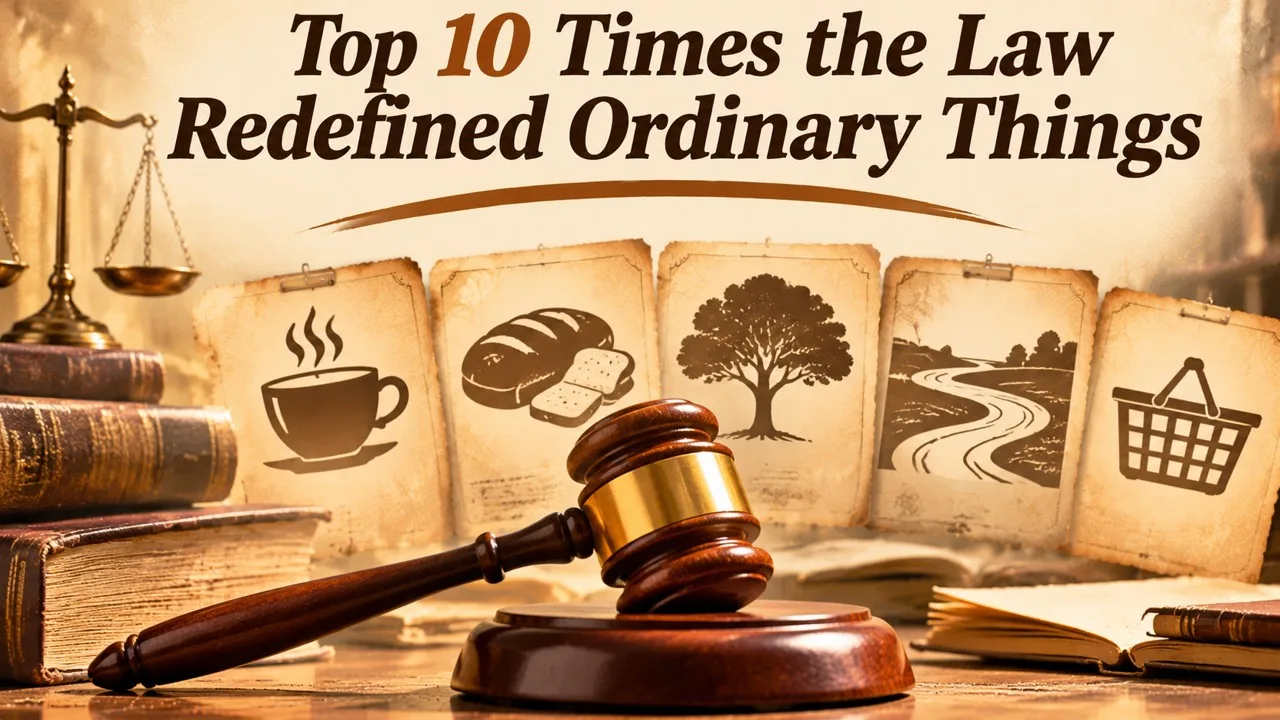
Tomatoes, Jaffa Cakes, Pringles, burritos and even a river have gone to court, and the rulings show how law can redraw the borders of ordinary things. A tariff schedule, a value-added tax, a conservation statute, or a copyright rule sometimes has to say whether a food is a fruit or a vegetable, whether a cake is a biscuit, or whether a river can be a legal person [1][5][10]. This list is a curated set of ten documented cases, not a joke book, and not legal advice. The surprising part is not that lawyers argue. It is that everyday objects can change their legal category without changing their appearance [2][7].
Where a case involved a trademarked character or a film costume, this article describes the legal issue and does not need the character's likeness [8][9].
Key Facts
Legal definitions are often narrower, or stranger, than dictionary definitions, because they follow a statute, a treaty, or a tax code. A later court can narrow them again.
Ten Legal Redefinitions at a Glance
| Rank | Thing | Case or setting | What the law decided, in brief |
|---|---|---|---|
| 1 | The tomato | Nix v. Hedden, 1893, United States | For tariff purposes, a tomato was taxed as a vegetable |
| 2 | Jaffa Cakes | A United Kingdom VAT dispute | They were treated as cakes, not biscuits, for tax |
| 3 | Pringles | HMRC v. Procter & Gamble, United Kingdom | A majority of the product was "potato" enough to be taxed as a similar good |
| 4 | The burrito | United States sandwich-shop litigation | Courts have been asked whether a burrito is a sandwich, with more than one answer |
| 5 | A sandwich-chain roll | An Irish VAT case about Subway-style bread | A high sugar content meant the rolls were not "bread" under that tax rule |
| 6 | A bumblebee | Almond Alliance v. Fish and Game Commission, California | Bumblebees could be protected as "fish" under a state endangered-species law |
| 7 | A fish as evidence | Yates v. United States, 2015 | A fish was not a "tangible object" in the sense of one anti-shredding statute |
| 8 | Superhero figures as toys | A United States customs classification | Some mutant figures were classed as non-human toys for duty rates |
| 9 | A film helmet | Lucasfilm v. Ainsworth, United Kingdom | A stormtrooper helmet was treated as a costume prop, not a sculpture, for copyright |
| 10 | A river as a person | Te Awa Tupua / Whanganui, New Zealand, and kindred cases | A river can be given legal personality by statute |
1. When a Tomato Became a Vegetable
In Nix v. Hedden (1893), the United States Supreme Court had to decide whether imported tomatoes should be taxed as vegetables or admitted as fruit under a tariff act [1]. Botanically, a tomato is a fruit. The Court looked instead at ordinary language and at the way tomatoes were served at dinner, and it held that they were vegetables for the tariff [1]. The plant did not change. The customs category did.
The case is taught because it shows a court preferring common usage to technical botany, in a statute that did not define the words. It is also a reminder that "ordinary" is itself a legal choice. A chef and a botanist were both reasonable, and only one of them won the duty.
2. Jaffa Cakes and the Cake Test
Jaffa Cakes, a sponge base with a jelly and a chocolate coating, became the subject of a well-known United Kingdom value-added tax dispute over whether they were cakes, which were zero-rated, or chocolate-covered biscuits, which were not [2]. A tribunal looked at ingredients, texture, size, and what happens when the product goes stale — a cake hardens, a biscuit softens — and treated them as cakes [2]. The name on the box was not, by itself, the deciding fact.
The humor of the case is genuine, and so is the money. Tax law has to draw a line through a supermarket aisle. Once it does, a snack can be a cake in law and a biscuit in casual speech, and both descriptions can be sincere.
Related: Top 10 Historic Documents That Changed the World
3. Pringles and Potato
A later United Kingdom tax fight asked whether Pringles, a formed potato snack, were "similar to potato crisps" and therefore standard-rated [3]. The manufacturer argued, at one stage, that the product was too transformed, and contained too many other ingredients, to be treated as a potato crisp. Courts ended by looking at the product as a whole, including a substantial potato content, and treating it as similar enough to fall under the tax rule [3].
Again, the object on the shelf did not change shape. The legal question was resemblance and composition, not a tasting note. Food engineering, which can make a snack that is neither a simple chip nor a cracker, almost invites this kind of litigation.
4. When a Burrito Is, and Is Not, a Sandwich
American courts have been asked, more than once, whether a burrito is a sandwich, usually because a shopping-center lease reserved "sandwiches" to one tenant and a later tenant wanted to sell burritos or similar filled breads [4]. In one widely cited Massachusetts case, a judge concluded that a burrito was not a sandwich in the sense of that lease, looking at ordinary meaning and at how the foods are prepared and eaten [4]. Other disputes, in other documents, have come out differently or have been settled without a grand definition.
The lesson is not a national official definition of lunch. It is that a contract or a zoning rule can force a yes-or-no answer on a word that everyday speakers use loosely. The burrito became a legal object because a clause was narrower than a menu.
5. When a Roll Was Not Bread
In Ireland, a value-added tax case involving Subway franchisees asked whether the chain's rolls counted as "bread" under a tax exemption that limited the sugar in bread [5]. The Supreme Court of Ireland held that the rolls, with a sugar content above the statutory threshold, were not bread for that purpose [5]. The product could still be called bread in ordinary speech. It failed a numerical test written into the tax code.
Related: Top 10 Most Bizarre Phobias: Strange Fears That Exist
The case is a clean example of a legal redefinition that is almost mechanical: a percentage, a category, a bill. It is also a warning against reading a supermarket label as a statute. The law was not deciding what a sandwich is. It was deciding what counted as exempt bread.
6. When Bumblebees Became "Fish"
In 2022, a California appellate court held, in a case brought with the Almond Alliance, that terrestrial invertebrates, including bumblebees, could fall within the word "fish" in the state's Fish and Game Code for purposes of the California Endangered Species Act [6]. The court looked at the statute's definition, which had been written broadly enough, in earlier amendments, to include invertebrates, and at the legislature's use of "fish" as a term of art [6]. Critics called the result absurd. The court called it statutory construction.
The bees did not grow gills. A conservation law used an old heading and a wide definition, and a court declined to narrow that definition by common zoology. Whether one likes the result or not, it is a documented way that ordinary language and legal language can part company.
7. When a Fish Was Not a "Tangible Object"
In Yates v. United States (2015), a fishing-boat captain thrown undersized fish overboard was charged under a Sarbanes-Oxley provision that punishes anyone who destroys a "tangible object" with intent to obstruct a federal investigation [7]. The Supreme Court held, in a divided opinion, that "tangible object" in that statute meant objects used to record or preserve information, such as papers or hard drives, not a fish [7]. The fish was, of course, tangible. It was not, the Court said, the kind of object Congress had in mind after an accounting scandal.
The redefinition here is narrowing, not widening. A phrase that looks unlimited in a dictionary was read in context. The case has become a standard example of the point, and of the odd facts that sometimes make statutory interpretation memorable.
Related: Top 10 Oldest Buildings in the World
8. When Some Figures Were Not, for Duty, Human
United States customs classification has, in at least one well-reported episode, treated certain action figures of mutant characters as toys representing non-human creatures, rather than as dolls representing humans, a distinction that affected duty rates [8]. The legal question was a tariff heading, not a claim about biology or about the stories in which the characters appear. This article does not need the characters' likenesses, costumes, or names as artwork; the documented point is the classification [8].
A customs schedule can split a toy aisle into "human" and "other" with large financial consequences. The surprising move is not a court declaring a fictional person unreal. It is an import rule asking what a figure represents, and answering with a category that sounds metaphysical only if one forgets that it is a tax code.
9. When a Film Helmet Was Not a Sculpture
In Lucasfilm Ltd v. Ainsworth, a United Kingdom litigation over copies of a well-known film trooper helmet, the Supreme Court held that the helmet, designed as a costume for a film, was not a "sculpture" for the purposes of copyright in that category [9]. Design and other rights can be a different question; the sculpture route failed. The object could be striking, collectible, and central to a film's look, and still not meet the statutory idea of sculpture [9]. The character need not be shown to state the holding.
The redefinition is aesthetic only in a legal sense. Copyright categories were written with fine art and industrial design in mind, and a screen-used helmet sat awkwardly between them. A prop can be famous and still be, in law, a utilitarian costume piece rather than a statue.
Related: 10 Sikh Gurus: The Pillars of Sikhism Who Shaped Faith, Equality, Courage, and Humanity
10. When a River Became a Legal Person
In 2017, New Zealand's Parliament passed legislation recognizing Te Awa Tupua, the Whanganui River, as a legal person, a settlement with Whanganui iwi that appointed representatives to speak for the river [10]. The statute did not claim that the water had a human body. It created a legal personality, so that the river could have rights and interests in law, in terms negotiated after a long dispute [10]. Other jurisdictions have tried related ideas, with mixed success, for rivers, parks, or ecosystems.
This is one of the more substantial redefinitions on the list. A "person" in law was already a flexible idea, wide enough for corporations. Extending it to a river is a change in legal imagination, rooted in a specific political and MÄori legal history, not in a riddle about grammar.
Conclusion
Law redefines ordinary things when a statute, a tariff, a lease, or a settlement needs a yes or no. A tomato can be a vegetable, a cake can escape a biscuit tax, a snack can be potato enough, a burrito can fall outside a sandwich clause, a sweet roll can fail a bread test, a bee can be a "fish," a fish can fall outside a document-shredding law, a toy can be classed as non-human, a helmet can fail as sculpture, and a river can be a person.
None of these results is a claim that the physical world changed. They are claims about categories, money, conservation, copyright, and authority. The surprise, for a non-lawyer, is how much can hang on a definition that no one in a kitchen or a river valley would have written that way unaided.
- ^ [1] Nix v. Hedden, 149 U.S. 304 (1893). Justia: Nix v. Hedden
- ^ [2] United Kingdom VAT decisions on Jaffa Cakes; overview in tax commentary. Wikipedia: Jaffa Cakes, tax case
- ^ [3] Commissioners for Her Majesty's Revenue and Customs v. Procter & Gamble UK, on Pringles. Wikipedia: Pringles, tax case
- ^ [4] White City Shopping Center, LP v. PR Restaurants, LLC, Massachusetts, on burritos and sandwiches. Wikipedia: Sandwich, legal definitions
- ^ [5] Bookfinders Ltd v. The Revenue Commissioners, Supreme Court of Ireland, on the sugar content of bread. Courts of Ireland
- ^ [6] Almond Alliance of California v. Fish and Game Commission (Cal. Ct. App. 2022). California Courts
- ^ [7] Yates v. United States, 574 U.S. 528 (2015). Supreme Court: Yates v. United States
- ^ [8] Reporting and customs commentary on the tariff classification of certain mutant-character action figures. Wikipedia: X-Men, merchandising notes
- ^ [9] Lucasfilm Ltd v. Ainsworth, [2011] UKSC 39. UK Supreme Court: Lucasfilm v. Ainsworth
- ^ [10] Te Awa Tupua (Whanganui River Claims Settlement) Act 2017, New Zealand. New Zealand Legislation: Te Awa Tupua Act












Discussion
Log in with