






 By
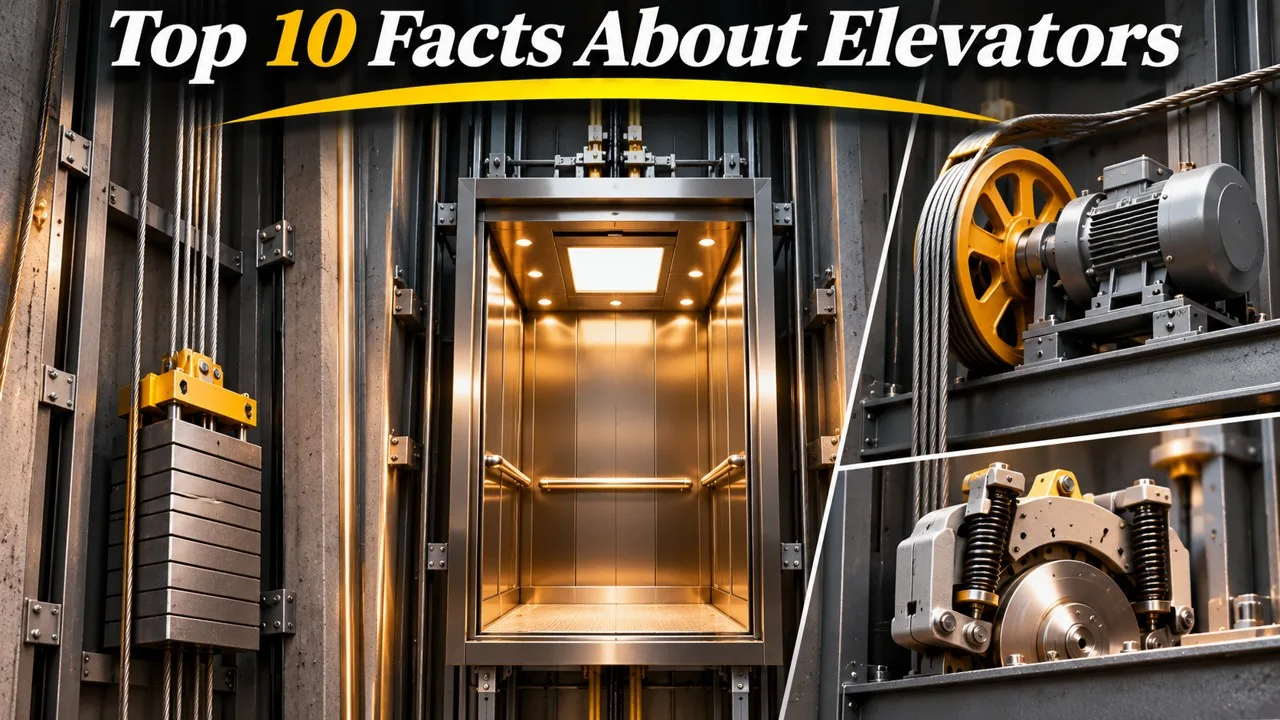
Otis did not invent the hoist, but a public safety-brake test in 1854 helped make passenger elevators a civic technology rather than a dare. A lift is easy to take for granted because, when it works, it disappears into the building [8][10]. The facts worth keeping are older and stranger than a list of speeds: ancient hoists, a showman's brake, the curved legs of a tower in Paris, buttons that do not always do what they say, and a safety culture that assumes the rope should not be the only thing you trust [1][7][9]. This article is not a manual. It will not offer advice on what to do in a falling car, a scenario that popular culture has inflated far beyond the ordinary record of elevator accidents [5].
The ten items below are historical and technical facts, written so that a brand name is a date in a story, not a logo on a page.
Key Facts
Passenger elevators made the tall office building practical. The hoist itself is much older than the office building.
Ten Facts at a Glance
| Rank | Topic | The careful version |
|---|---|---|
| 1 | A public safety-brake demonstration | In 1854, Elisha Otis showed a platform that would catch if the hoisting rope were cut |
| 2 | Music in the car | Recorded music became a standard, and sometimes resented, part of the ride; no tunes are quoted here |
| 3 | The elevator and the skyline | Reliable passenger lifts made tall commercial buildings livable and rentable |
| 4 | Ancient hoists | Greeks and Romans already used muscle-, water-, and animal-powered lifts, described by writers such as Vitruvius |
| 5 | Record speeds | The fastest cars are now in a small group of supertall towers, and the record changes |
| 6 | A falling-car myth | Modern elevators have multiple cables, governors, and safeties; "jump at the last second" is not a procedure |
| 7 | Old lifts still in service | Some nineteenth- and early-twentieth-century installations still carry people, under inspection |
| 8 | The Eiffel Tower's lifts | Curved-leg hydraulics, later replacements, and a private apartment at the top are the documented story |
| 9 | Buttons that may not obey | Some "close door" buttons are limited by timed, accessible operation |
| 10 | Brakes behind brakes | Safety gears, overspeed governors, buffers, and redundant ropes are the real system |
1. Put Up, and Cut the Rope
Elisha Graves Otis did not invent the first hoisting platform. What he sold, and what he made famous at the New York Crystal Palace in 1854, was a safety brake: a wagon-spring mechanism that would bite into the guide rails if the hoisting rope failed [1]. In the demonstration, he stood on the platform and had the rope cut. The platform caught. The showmanship was the point. A passenger elevator could now be advertised as a device that did not depend on a single unfailing rope [1].
"Put up or shut up" is a later, slang way of describing that bet. The historical fact is the public test, and the industry that could grow once the test was believed.
2. A Soundtrack, Not a Required Playlist
By the mid-twentieth century, many passenger cars carried recorded music, a practice later nicknamed, not always kindly, as elevator music [2]. The aim was to fill a small, awkward silence and to make the cabin feel like a managed, indoor space rather than a box on a cable [2]. This article will not name a required catalog, quote a lyric, or treat a particular tune as part of the machinery. The fact is sociological as much as technical: a short, vertical journey became a place where background sound was thought to be necessary.
Related: Top 10 Most Remarkable Elevators in the World
Whether the music helped, or only became a joke, is a separate question from the fact that it was installed. A short ride is a social situation as well as a mechanical one, and the soundtrack was an attempt, sometimes a clumsy one, to manage that situation.
3. Straight to a Rentable Top
A masonry warehouse can have a hoist. A twenty-story office building cannot function as a business if the upper floors are a climb [3]. From the late nineteenth century, first in cities such as New York and Chicago, reliable passenger elevators, together with steel frames, made height a commercial plan rather than a stunt [3]. Express cars, sky lobbies, and later destination-dispatch systems are refinements of the same idea: the top floor is only valuable if it is as reachable as the second.
The elevator did not "invent" the skyscraper alone. It is hard to name a skyscraper that would have worked without it, and that is why a lift fact is also, very quickly, a fact about how modern cities were allowed to grow upward.
4. The Greeks, and Others, Did It Early
Ancient writers describe hoists and lifting cages. Vitruvius discusses pulleys and lifting machines; Roman palaces and amphitheaters used winched platforms, including the animal and scenery lifts of the Colosseum; Greek engineers, including the tradition associated with Archimedes, knew the compound pulley [4]. A "first" is a risky word across a millennium of workshop practice. A fair sentence is that muscle- and water-powered elevators existed in classical antiquity, long before a steam or hydraulic passenger car in a hotel [4].
The modern elevator is a child of the Industrial Revolution. The problem it solves, raising a load in a shaft, is not.
Related: Top 10 Curious Facts About Quicksand
5. Top Floor, with a Speed Record Attached
Manufacturers and building owners have spent decades advertising the fastest passenger elevators, with recent record holders in supertall towers in China and in other East Asian cities, and with advertised speeds on the order of twenty metres per second in the most extreme cases [5]. The exact leader changes, and a press figure should be checked against a later official record [5]. Comfort, air pressure, and cable or belt design are the real engineering story. "Step on it" is a slogan. The car still has to stop without making the passengers ill.
A record is a fact about a particular installation, not a law of the industry.
6. Do Not Treat a Film Stunt as a Procedure
Popular culture has produced a durable fantasy in which a packed car goes into free fall and the passengers are told to jump in the last second [6]. Ordinary modern elevators have several hoisting ropes, each able to take more than the car's load; they have an overspeed governor and mechanical safety gears that grip the rails; they have buffers in the pit [6]. Catastrophic free fall of the movie type is not how typical elevator accidents occur. This article will not offer a mid-air technique, because that is not how the machine is designed to be used, and because unsourced advice of that kind is a hazard in its own right.
"Jump on quick" is a better caption for a closing door than for a falling box.
7. Some of Them Are Still Working
A surprising number of early hydraulic and traction elevators, some more than a century old, remain in service in European apartment houses, in department stores, and in public buildings, usually after refits that keep the cabin and add modern safeties [7]. Paternoster lifts, the continuous open-shelf systems once common in offices, still run in a few places under special rules [7]. The fact is not that old machines are automatically safe. It is that a well-inspected lift can have a working life that outlasts many of the fashions in the lobby.
Heritage and safety have to share the shaft. When they do, the car is a moving antique that still has a job.
Related: Top 25 Interesting Facts About the Solar System
8. Eiffel's Tower, and a Private Stop
The Eiffel Tower's original elevators were a design problem as much as a convenience: the legs curve, so a straight vertical shaft of the later office type would not do, and the 1889 hydraulic solutions, including work by French and American firms, were watched as closely as the ironwork [8]. Gustave Eiffel kept a private apartment near the top, a documented, now sometimes exhibited room, reached as part of the same vertical system rather than by a mysterious hidden shaft in a thriller sense [8]. Later electric replacements have changed the machinery. They have not changed the fact that the tower was, from the start, a lift story as well as a skyline story.
"Secret" is too strong if it suggests a concealed second tower. A private room at the top is already a good fact.
9. The Button That May Not Listen
In some buildings, especially where accessibility rules require a minimum door-open time, the "close door" button does little or nothing in normal service: the door obeys a timer, not a fingertip [9]. Emergency and attendant modes are a different case. The unexpected fact is not a conspiracy. It is that a control can be a placebo in ordinary use and still be wired for a real function when the car is under manual or fire service [9]. "Don't touch that" is also, in a fire, the standard advice about passenger lifts themselves: the stairs, not the car, are the escape route in most codes.
A button is only a fact about a building if you know which mode the car is in.
10. Backup, Then Backup Again
The safety culture of the modern elevator is a stack: more than one hoisting rope, a governor that trips if the car overspeeds, safety gears that clamp the rails, buffers at the bottom, interlocks that keep doors closed, and inspection regimes that treat all of the above as required, not optional [10]. Otis's 1854 brake is an ancestor in that stack, not the whole of it [10]. When people say they are "relying on backup brakes," they are, without usually knowing the diagram, describing the right idea. The car is not a box held by a single faith in a single cable.
Related: Top 10 Mythical Creatures in World Mythology - That Inspired Myths Across Civilizations (unchanged)
That is why the passenger can read the floor numbers and think about something else. The boring reliability is the achievement, and it is a more interesting achievement than a record speed that only one tower can hold for a year or two.
Conclusion
The elevator is a Greek and Roman problem with a nineteenth-century safety demonstration, a skyscraper career, a soundtrack, and a set of buttons that do not always mean what they show. Paris needed curved hydraulics. Some old cars are still working. Some popular fears are about a fall that the machine is specifically designed, in redundant ways, not to take.
None of this requires a brand campaign, a lyric, or a stunt procedure. It requires the ordinary history of a device that made the upper floors of a city into real estate, and then became invisible by succeeding.
- ^ [1] Historical accounts of Elisha Otis's 1854 Crystal Palace safety-brake demonstration. Encyclopaedia Britannica. Britannica: Elisha Otis
- ^ [2] Histories of recorded background music in commercial and elevator settings, discussed here without a playlist or lyrics. Britannica: Background music
- ^ [3] Architectural histories of the skyscraper and the passenger elevator in late-nineteenth-century Chicago and New York. Britannica: Skyscraper
- ^ [4] Vitruvius and modern summaries of Greek and Roman hoists, pulleys, and arena lifts. Britannica: Vitruvius
- ^ [5] Industry and press records of the fastest passenger elevators in supertall buildings, which change over time. Britannica: Elevator
- ^ [6] Safety literature on hoisting-rope redundancy, overspeed governors, and safety gears; this article does not offer falling-car advice. Britannica: Elevator
- ^ [7] Heritage and technical accounts of still-operating historic elevators and of remaining paternoster lifts. Britannica: Elevator
- ^ [8] Histories of the Eiffel Tower's 1889 elevators, later replacements, and Gustave Eiffel's apartment. Britannica: Eiffel Tower
- ^ [9] Accessibility and elevator-code discussions of door-dwell time and the limited effect of some "close door" buttons in normal service. Britannica: Elevator
- ^ [10] Technical overviews of elevator safety systems, including governors, safety gears, buffers, and interlocks. Britannica: Elevator






















Discussion
Log in with