




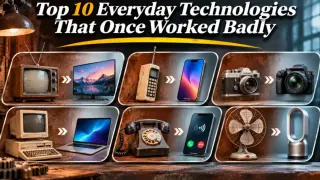

Top 10 Everyday Technologies That Once Worked Badly
 By Dhiraj Sharma · Published
Share Post
Loading…
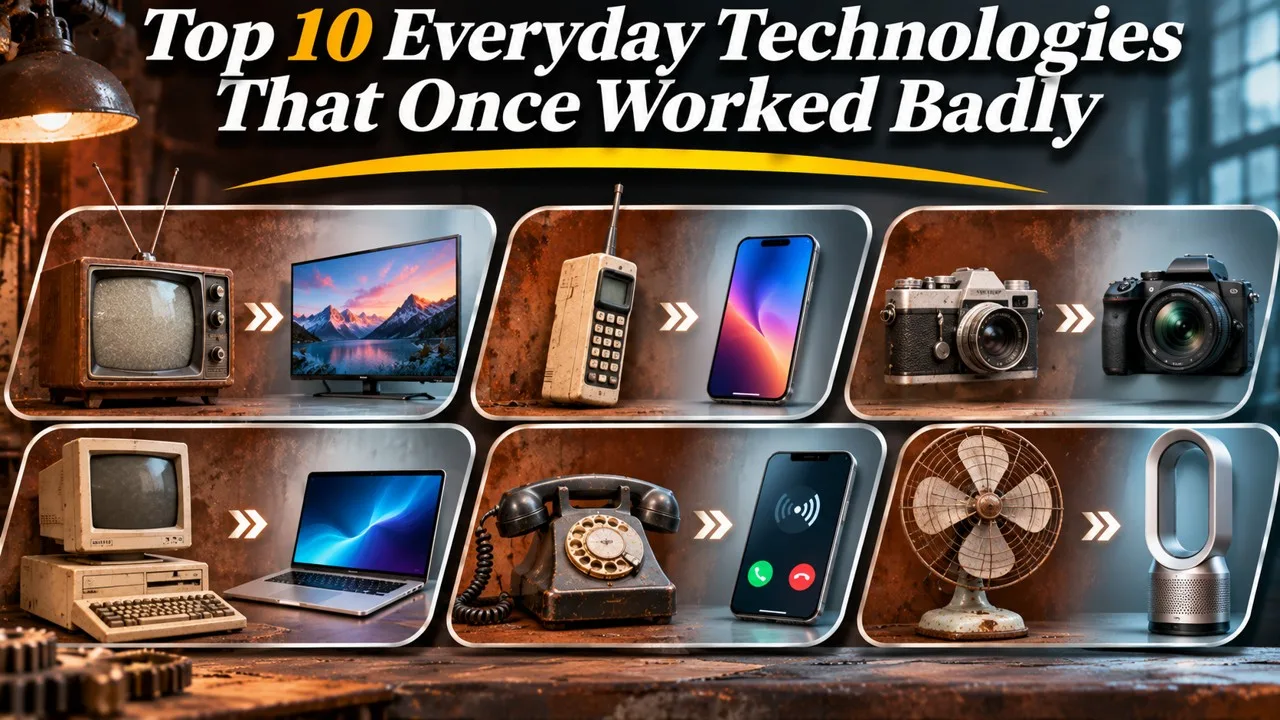
Early flush toilets, cars, phones and computers were clumsy or unreliable; the familiar versions come from a long, often embarrassing engineering history. A device that now looks inevitable usually spent a long time being heavy, rare, dangerous, or simply bad at its job [1][8]. This list is about that awkward youth, not about a nostalgia for "when things were built to last." Some early versions were built to last and still worked poorly. Others were brilliant and still failed in ordinary use. Firearms appear only as a historical case of early inefficiency; this article will not discuss operation, design for use, or improvement as a how-to [5]. Game machines are described as hardware history, without copyrighted characters or box art [9].
The ten stories below are about toilets, cars, vacuums, a famous medicine, guns as early machines, cameras, watches, computers, game consoles, and phones.
Key Facts
"Worked badly" here means early performance, reliability, cost, or safety, measured against what the same category later became, not against a joke.
Ten Devices at a Glance
| Rank | Technology | What was early and awkward | What later changed |
|---|---|---|---|
| 1 | Flush toilets | Incomplete traps, poor sewers, and indoor smells that made the first "improvements" controversial | S-traps, venting, and municipal sewers |
| 2 | Cars | Hand cranks, weak brakes, rare fuel, and roads that were not made for them | Electric start, better brakes, fuels, and highways |
| 3 | Vacuum cleaners | Huge, horse-drawn or fuel-burning machines, then heavy electrics | Smaller motors and household machines |
| 4 | Aspirin | A useful drug with a long prehistory and real early side-effect and dosing problems | Standardized tablets and later safety work; this is not medical advice |
| 5 | Early firearms | Inaccurate, slow to load, and often as dangerous to the user as to the target | Centuries of manufacturing and design change, described here only as history |
| 6 | Cameras | Minute-long exposures, fragile plates, and a craft for specialists | Faster film, then digital sensors |
| 7 | Watches | Portable timepieces that drifted badly until better escapements and springs | Jewels, regulation, and later quartz |
| 8 | Computers | Room-sized, failure-prone, and available only to institutions | Transistors, then microprocessors |
| 9 | Game consoles | Limited graphics, fragile markets, and a crash that emptied shelves | Later hardware generations, told without character art |
| 10 | Phones | Crank lines, party lines, and later bricks that barely lived a day | Automatic exchanges and modern mobiles |
1. A Flush That Was Not Yet a System
Flushing a closet with water is an old idea, and so is the disappointment that followed when the water, the trap, and the sewer did not form a complete system [1]. Early indoor water closets could carry smell back into the house if the trap failed or was missing, and they could overload cesspits and crude drains that had been built for a smaller, less watery waste [1]. Nineteenth-century cities then had to invent, in parallel, the humble S-bend or P-trap, venting, and sewers that could actually take what the cisterns sent. Thomas Crapper's later fame is a popular footnote, not the whole invention story. The toilet became "everyday" only when the building and the street caught up with the bowl.
A flush without a sewer is a way to move a problem a few yards. It is not yet a technology that works.
2. Cars That Had to Be Argued onto the Road
The first automobiles were expensive toys that stalled, overheated, and, if they had engines started by hand, could break an arm [2]. Brakes were weak, headlights were poor, tires punctured constantly, and fuel had to be sought as if it were a specialty chemical. Roads, laws, and manners had been made for horses [2]. Reliability arrived slowly, through mass manufacture, electric starters, better metallurgy, and a fuel trade, not through a single genius of the steering wheel. The early car "worked" in the sense that it sometimes completed a journey. It worked badly in the sense that a farmer or a clerk could not yet depend on it the way a later commuter would.
A horseless carriage was a proof. A car, in the everyday sense, is a proof that stopped failing so often.
Related: Top 10 Inventions That Changed the World
3. Cleaning by Machine, at a Heroic Scale
Before a vacuum cleaner was a household object, it was a spectacle: large petrol or horse-drawn machines parked in the street, with hoses run through windows, or heavy early electrics that were closer to furniture than to tools [3]. They were also, for a time, status objects more than daily labor-savers. Motors shrank, bags and later filters improved, and the machine became something a person could haul from room to room without a crew [3]. The early versions worked in the narrow sense that they sucked. They worked badly as everyday technology because everyday people could not easily own or lift them.
A good idea can be fifty years ahead of a motor that a household will tolerate.
4. A Drug That Had to Be Tamed
Willow bark and related salicylic preparations were used long before a German firm trademarked a purified acetate that the world came to know as aspirin [4]. The early chemical story includes irritation, dosing uncertainty, and a long argument about safety, especially in some patients and some uses, that later labels and later drugs had to address [4]. This article is not medical advice, and it is not a history of a brand as advertising. The point is only that a medicine now treated as ordinary was, for a long time, a rough tool: effective for many, hard on some, and not yet the standardized tablet in a kitchen cupboard.
"Worked badly" here means "worked with a price, and with less control," not "did not work at all."
5. Early Guns as Inefficient Machines
Early firearms were, as machines, inefficient: slow to load, inaccurate at any ambitious distance, unreliable in wet weather, and capable of injuring the person holding them when a barrel or a lock failed [5]. They still changed warfare, which is a reminder that a badly working device can be historically decisive. Later centuries of manufacture improved consistency and safety, a history that can be told as industrial change [5]. This entry stops at that historical fact. It does not describe mechanisms in a way that would serve as instruction, and it does not offer advice about weapons.
Related: Top 10 Historic Jobs Transformed by Technology
The everyday technology, if a gun can be called that in some places, was once an awkward, dangerous novelty with a short reach.
6. Pictures That Took Patience
The first practical cameras demanded long exposures, toxic or delicate chemistry, and, often, a glass plate that had to be prepared and developed with skill [6]. A smiling snapshot of a child at play was not the original product. A still building, a stiff portrait, or a landscape that would wait for the lens was. Faster plates, roll film, easier shutters, and then electronic sensors turned the camera into something a tourist could misuse and still get a picture from [6]. The early camera worked badly as an everyday device because it was a laboratory that had to be carried, not a button.
Photography is old. Casual photography is not as old as the word suggests.
7. Time That Drifted in the Pocket
A clock on a church tower and a watch in a pocket are different problems. Early portable timepieces, even expensive ones, could drift by minutes in a day, and they were sensitive to position, temperature, and a rough road [7]. The hairspring, improved escapements, jewels, and later systematic regulation made a personal watch into something a railway and a factory could argue with [7]. Quartz, much later, made cheap accuracy ordinary. The early watch worked as jewelry and as a claim of status more reliably than it worked as a measurement.
A bad watch is not "approximately baroque." It is a measuring instrument that has not yet earned its name.
Related: Top 10 Most Bizarre Phobias: Strange Fears That Exist
8. Rooms That Computed, Sometimes
The first electronic computers filled rooms, ate power, failed often, and were programmed in ways that only a small priesthood could stand [8]. They were miracles of capability and, at the same time, terrible everyday tools, because there was no everyday user. Transistors, then integrated circuits, then microprocessors shrank the machine, dropped the failure rate, and finally put a computer on a desk and, later, in a pocket [8]. The early computer worked badly in the sense that it was not yet a reliable appliance. It worked astonishingly well in the sense that it could do arithmetic no office of clerks could match, on a good day, when it was up.
Downtime was part of the culture. That is not a culture a modern passenger would accept from a ticket machine.
9. Playable, Barely, and Then a Crash
Home game consoles began as limited boxes: crude graphics, few colors, cartridges or dedicated chips, and a market that, in the early 1980s, overfilled and then collapsed in some countries [9]. They were everyday technologies that worked badly as businesses and, often, as durable household objects. Later hardware generations made richer play ordinary. This article will not describe copyrighted characters, pack-in mascots, or box art, and it does not need them. The historical fact is the limitation of the hardware and the fragility of the early market [9].
A console that can only play a few simple games is still a computer in the living room. It is just a computer that has not yet grown up.
Related: Top 10 Oldest Buildings in the World
10. Voices on a Difficult Wire
Early telephones demanded operators, patience, and, on party lines, a willingness to share a wire with a neighbor [10]. Sound quality was poor, long-distance was a luxury, and the instrument was a fixture, not a personal object. A century later, the first widely sold mobile phones were still bricks with short battery lives and spotty coverage, everyday only for people who could afford a novelty [10]. Automatic exchanges, better networks, and smaller radios made the phone into the thing now taken for granted. The early versions worked in the sense that a voice could, under good conditions, arrive. They worked badly in the sense that calling was a project.
A technology becomes everyday when it stops being a project. The telephone took longer than the slogan "Watson, come here" suggests, and this article will not lean on a set-piece quotation to stand in for that history.
Conclusion
The flush toilet, the car, the vacuum, the camera, the watch, the computer, the console, and the phone all spent a youth in which they were possible and still not convenient. Aspirin and early firearms, in very different ways, show that a device or a compound can "work" and still be rough, incomplete, or dangerous in ordinary hands. The later, smoother object hides that youth, which is why the early failures are useful to remember.
Nothing on the list failed because people in the past were foolish. It failed, or worked badly, because the surrounding system, sewers, roads, motors, chemistry, manufacturing, networks, had not yet been built to the same scale as the idea. The embarrassing history is, in that sense, the real history of invention.
- ^ [1] Histories of the water closet, traps, and the nineteenth-century sewered city. Britannica: Plumbing
- ^ [2] Early automobile reliability, starting, brakes, and roads. Britannica: Automobile
- ^ [3] The development of vacuum cleaners from large service machines to household electrics. Britannica: Vacuum cleaner
- ^ [4] Historical accounts of salicylic preparations and aspirin, including early safety and dosing problems, not as medical advice. Britannica: Aspirin
- ^ [5] Historical overviews of early firearms as inaccurate, slow, and hazardous machines, without operational instruction. Britannica: Firearm
- ^ [6] The evolution of cameras from long-exposure plates to faster film and digital sensors. Britannica: Camera
- ^ [7] Portable timekeeping, early watch error, and later regulation, including quartz accuracy. Britannica: Watch
- ^ [8] Early electronic computers, reliability, and the later shift to transistors and microprocessors. Britannica: Computer
- ^ [9] Histories of early home game consoles and of the early-1980s market crash, described without copyrighted characters or box art. Britannica: Electronic game
- ^ [10] Early telephone systems, operators, party lines, and the later rise of automatic and mobile phones. Britannica: Telephone





















Discussion
Log in with