





 By
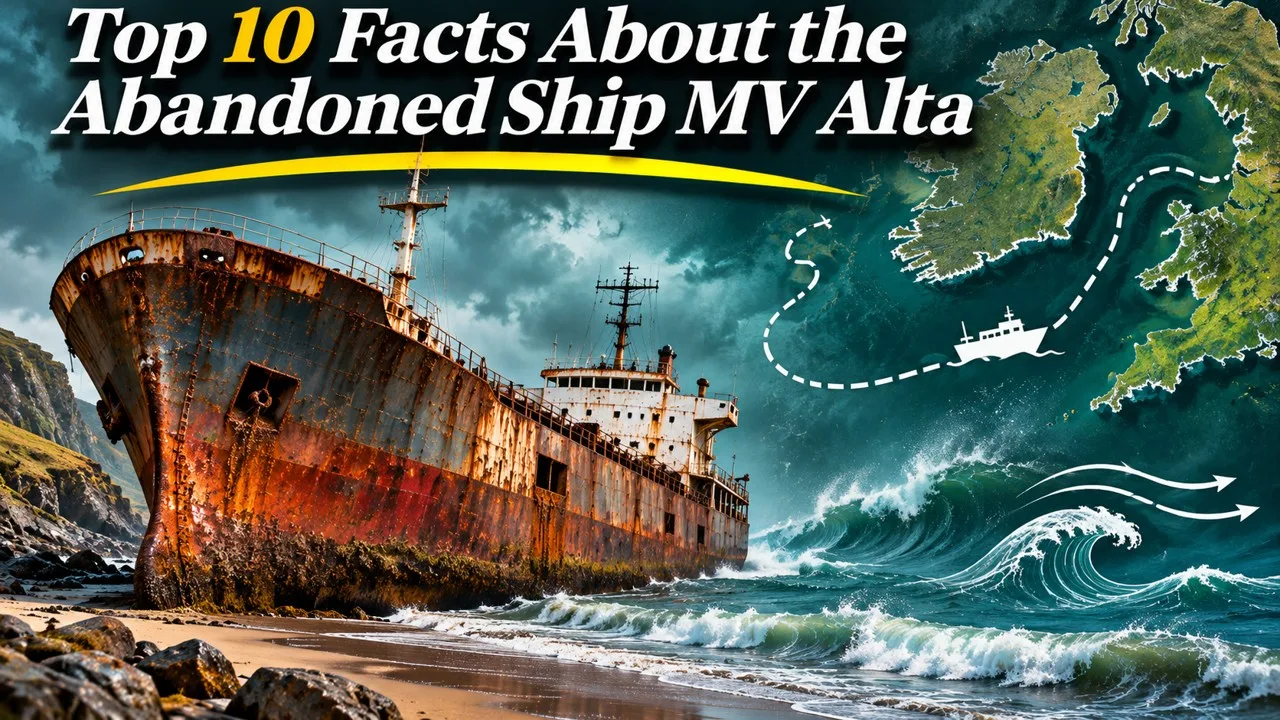
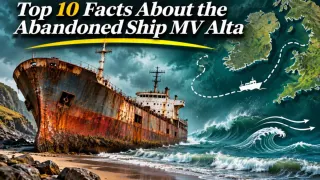
The MV Alta, a 1976 cargo ship, was abandoned in mid-Atlantic in 2018 and driven onto the Cork coast in 2020; the story is marine and legal, not a haunting. Popular accounts like to call her a ghost ship, a phrase that only means, in this case, a derelict left unmanned and adrift [1][4]. There was no curse, no phantom crew, and no mystery that cannot be walked through with a voyage plan, a storm, and a marine investigation [1]. The official Irish report into the grounding, and contemporary coverage, give a documented timeline: engine failure on a Greece-to-Haiti run, a mid-ocean rescue, a long drift, and a landfall at Ballyandreen Bay, near Ballycotton, County Cork, on 16 February 2020, in the weather of Storm Dennis [1][3].
What remains on the rocks is a legal and environmental problem as much as a spectacle, and that is the story worth telling.
Key Facts
MV Alta was a general cargo ship, built in 1976, Tanzanian-flagged at the time she was abandoned, with a crew of ten who left her alive.
Ten Facts at a Glance
| Rank | Fact | What is documented |
|---|---|---|
| 1 | A rusting wreck on the Cork coast | She grounded at Ballyandreen Bay, near Ballycotton, on 16 February 2020, and later broke in two |
| 2 | An unwanted attraction | Sightseers arrived quickly; the coast is awkward and the wreck is not a playground |
| 3 | Storm Dennis | The same storm system that battered Ireland that week put the derelict onto the rocks |
| 4 | About 496 days adrift | From abandonment in October 2018 to grounding in February 2020, a drift of thousands of nautical miles |
| 5 | Failed attempts at a tow | Owners tried, unsuccessfully, to arrange tugs from several Caribbean and South American ports; dramatic "hijack" stories are poorly supported |
| 6 | A mid-ocean rescue | After engine failure and a food drop, the United States Coast Guard cutter Confidence took the crew off as Tropical Storm Leslie approached |
| 7 | A working ship with a changing past | Built in 1976, she had the ordinary, sometimes opaque life of an aging cargo vessel, including flag and name changes |
| 8 | A costly wreck with a thin owner trail | A Receiver of Wreck was appointed; removal estimates ran into millions of euros, and a full removal has not followed |
| 9 | Pollution risk, then a cleanup | Fuel tanks were found empty and open to the sea; barrels and other hazards were taken off after she grounded |
| 10 | A modern legend, in the newspaper sense | The unmanned crossing made her famous; fame is not the same as folklore |
1. A Sentinel Only in the Photographic Sense
Since February 2020, the Alta has sat on the rocks of Ballyandreen Bay, a short stretch of coast from the village of Ballycotton, a rusting vertical wall against the water [1]. In 2022, after further storms, she split in two, a change visible in later photographs and official and press accounts [1]. "Rusting sentinel" is a caption, not a vocation. The wreck is a large, unstable object on a public shoreline, and the Marine Casualty Investigation Board's report is the place to start for how she got there, not a postcard.
A grounded ship can look timeless. This one has a date, a weather system, and a file number.
2. Sightseers, and a Coast That Can Punish
The wreck became a local and then an international curiosity almost as soon as it landed [2]. People walked out to look, and some climbed where they should not have, on a coast of rocks and weather. Officials and local voices warned that the site was not a tourist facility, and that "curse," in any useful sense, was only the ordinary curse of a dangerous attraction no one had asked for [2]. There is no documented supernatural event to explain, and this article will not invent one.
An unwanted attraction is a planning and safety problem. It is not a campfire story that happens to have a hull.
Related: Top 10 Famous Shipwrecks That Rewrote History
3. Dennis, and a Ship Already Adrift
Storm Dennis, in mid-February 2020, was a named system that brought heavy weather to Ireland and Britain [3]. The Alta was already a derelict in European approaches when that weather arrived. Members of the public reported her ashore on 16 February, and the Irish Coast Guard's coordination centre at Valentia took the reports [3]. The storm did not "hunt" the ship in any folkloric sense. It supplied the last push to a hull that had been moving, slowly and without a crew, for more than a year.
A named storm is a meteorological fact. Combined with a derelict, it becomes a grounding.
4. A Long, Unmanned Crossing
The crew left the ship in October 2018, about 1,380 nautical miles southeast of Bermuda [4]. She was sighted still adrift, empty, by the Royal Navy's HMS Protector on 3 September 2019, mid-Atlantic, a useful confirmation that the derelict had not quietly sunk or been salvaged [4]. On 16 February 2020 she was on the Irish rocks, a span often rounded to 496 days, and a distance, in some reports, of more than 2,000 nautical miles, under the influence of the Gulf Stream and later the North Atlantic Current and the weather [4]. "Phantom voyage" is a magazine phrase. The voyage was real, and it was empty of people.
Currents do not need a ghost to carry a hull from the western Atlantic toward Europe. They do it with anything that floats long enough.
5. Tugs That Did Not Come, and a Rumor
After the engine failed, the owners tried to hire and send tugs, with attempts associated in the official narrative with Venezuela, Guyana, and the Bahamas, and those attempts did not succeed before the crew had to leave [5]. Popular retellings sometimes upgrade that murky interval into a hijacking story set in Guyana. The Marine Casualty Investigation Board's account, which is the better source, does not establish a documented hijack; it establishes a disabled ship, unsuccessful commercial arrangements, and a clock running down on food and weather [5]. This article will not turn a question mark into a plot.
Related: Top 10 Most Bizarre Phobias: Strange Fears That Exist
A failed tow is already a serious fact. It does not need a pirate chapter to be worth recording.
6. Taken off before a Storm
On 19 September 2018, on a voyage from Greece toward Haiti, the Alta's main engine failed and could not be repaired at sea [6]. The crew, running short of supplies, asked for help; a United States Coast Guard aircraft dropped food on 2 October, and the cutter Confidence reached the ship on 8 October [6]. With Tropical Storm Leslie approaching, the ten people on board abandoned the vessel, were taken off without reported injury, and were later repatriated [6]. The "rescue from the eye of the storm" is close to the truth and slightly theatrical. They were taken off because a tropical storm was coming, and because no tug had arrived in time, not because a film needed a climax.
The documented heroism is ordinary professional rescue: a plane, a cutter, a decision to leave a dead ship.
7. An Aging Cargo Ship, Not a Mystery Hull
The Alta was built in 1976 as a merchant ship, and by 2018 she was an elderly general-cargo vessel on a long international run, Tanzanian-flagged at abandonment, with the changes of name, owner, and registry that often accumulate on such ships [7]. "Shady past" is an easy caption. Some of the opacity is real: beneficial ownership of older tramp ships can be hard to follow, and official follow-up after the grounding had to deal with that thin trail [7]. Some of the caption is just the atmosphere of a rust-stained wreck. This article will not invent crimes the investigation does not record.
A 1976 cargo ship that still goes to sea is a common object. This one became uncommon only when she would not go any farther under her own power.
Related: Top 10 Oldest Buildings in the World
8. A Wreck with a Bill and a Thin Defendant
After the grounding, Irish authorities appointed a Receiver of Wreck under the salvage and wreck statute, and Cork County Council and others had to deal with a large, foreign-owned, lightly attached problem on a public coast [8]. Estimates for a full removal have been reported in the range of millions of euros, sometimes quoted near a ten-million figure, and years later the hull was still there, then in two pieces [8]. "Legal ghost" is a metaphor for an owner who is hard to hold, not for a spirit in the forecastle. The unexpected fact is administrative: a mid-ocean abandonment can wash up as a local invoice.
A state can clean a beach of oil drums more easily than it can collect a bill from a vanished beneficial owner.
9. Fuel, Barrels, and a Bounded Risk
At abandonment she was reported to have a substantial quantity of marine gas oil on board [9]. After she grounded, contractors boarding for Cork County Council found the main fuel tanks empty and open to the sea; any remaining fuel had likely gone out and been dispersed in the storm [9]. Barrels of oil, gas cylinders, and other hazards on deck were collected or made safer, and a later inventory did not treat the wreck as a major long-term pollution event after that work [9]. A "helicopter heist" is not what the official cleanup describes. The air assets in the documented story are a Coast Guard drop and a cutter's arrival, plus later official access, not a cinematic theft. Souvenir-hunting and unofficial boarding, where they occurred, are a different, smaller, and still unwise problem.
The environmental fact is mixed and therefore easy to get wrong: there was a risk, there was a loss of fuel to the sea, and there was a cleanup that reduced what was left.
Related: 10 Sikh Gurus: The Pillars of Sikhism Who Shaped Faith, Equality, Courage, and Humanity
10. Famous because She Was Empty
The Alta became a "modern legend" in the only sense a newspaper can honestly use: a story people retold, with a nickname, a map, and a photograph of a ship where no ship should be able to arrive alone [10]. The legend is the 496-day drift and the sudden appearance on a Cork shore. The facts that underwrite it are all human and mechanical: a failed engine, a failed tow, a correct decision to take ten people off, a current, a storm, and a legal system that then had to stare at a wreck [10]. Calling her a ghost ship is fine as shorthand for "unmanned derelict." It is not fine as a claim about the dead.
A modern legend, in this case, is a well-documented accident with a long second act on the rocks.
Conclusion
The MV Alta's story is complete enough without a haunting. A 1976 cargo ship broke down between Greece and Haiti, her crew were rescued in October 2018, and the empty hull drifted into Storm Dennis and the rocks near Ballycotton. She then became a rusting attraction, a cleanup job, a legal headache, and, in 2022, a ship in two pieces. Those are marine facts, of a kind coasts have seen before, made unusual by the length of the unmanned crossing and by the difficulty of finding someone to pay for the last act.
The phrases that should not survive contact with the file are the curse, the hijack told as a certainty, and the heist told as a set-piece. The phrases that should are engine failure, failed tow, Coast Guard, 496 days, Storm Dennis, Receiver of Wreck, and a hull that is still, for now, on someone else's shore.
- ^ [1] Marine Casualty Investigation Board, report on the grounding of MV Alta at Ballyandreen Bay, Ballycotton, County Cork, 16 February 2020, and later reports of the wreck breaking in two. Marine Casualty Investigation Board
- ^ [2] Contemporary Irish reporting on sightseers and safety concerns at the wreck. The Irish Times
- ^ [3] Official and press accounts of Storm Dennis and of the 16 February 2020 landfall, including Irish Coast Guard involvement. Marine Casualty Investigation Board
- ^ [4] The October 2018 abandonment position, the September 2019 sighting by HMS Protector, and the duration and path of the drift. Marine Casualty Investigation Board
- ^ [5] The official narrative of unsuccessful tug arrangements, including attempted hires associated with Venezuela, Guyana, and the Bahamas, distinct from unverified hijack stories. Marine Casualty Investigation Board
- ^ [6] The engine failure on the Greece-to-Haiti voyage, the Coast Guard food drop, and the rescue of ten crew from USCGC Confidence as Tropical Storm Leslie approached. Marine Casualty Investigation Board
- ^ [7] Particulars of the 1976-built cargo ship, her flag at abandonment, and the difficulty of following later ownership. Marine Casualty Investigation Board
- ^ [8] Appointment of a Receiver of Wreck, reported removal-cost estimates, and the wreck's continued presence. Irish Revenue, Receiver of Wreck context, and MCIB
- ^ [9] Findings that main fuel tanks were empty and open to the sea, and the subsequent removal of barrels and other hazards for Cork County Council. Marine Casualty Investigation Board
- ^ [10] Irish and international reporting that made the unmanned crossing a public story, treated here as documentation, not folklore. RTÉ News






















Discussion
Log in with