





 By
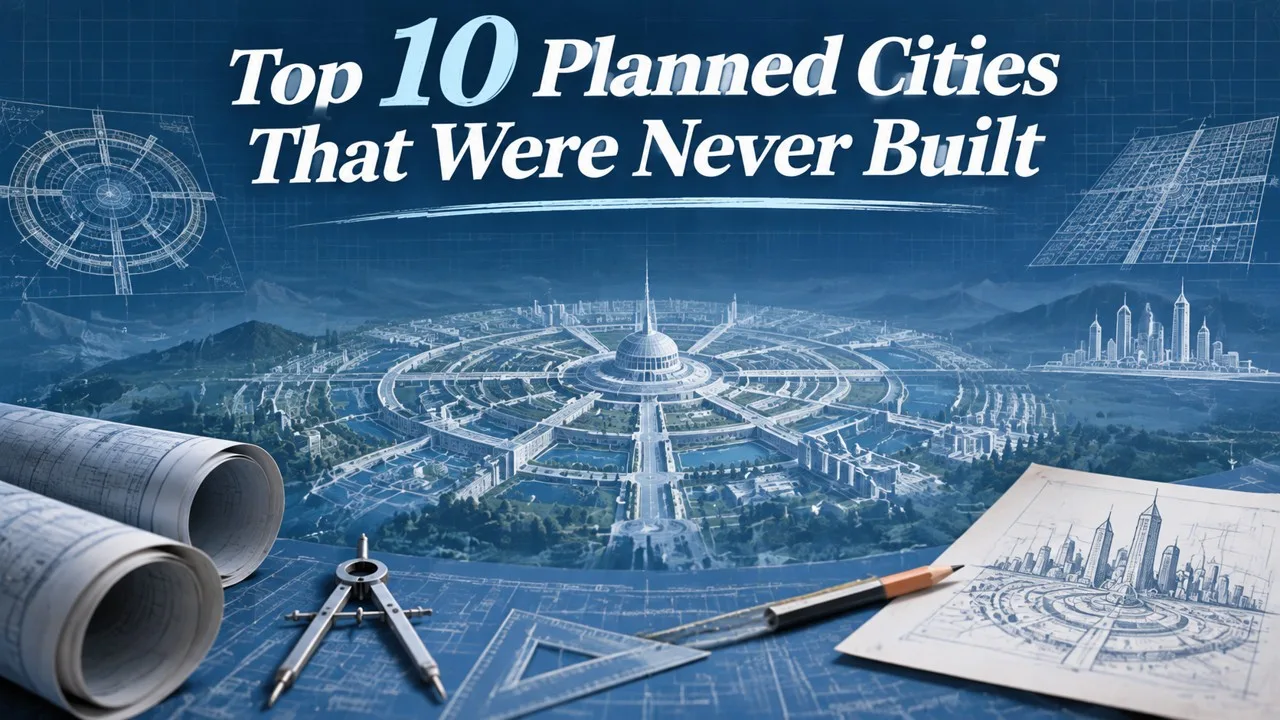
From Le Corbusier's Paris plan to a platted desert grid in California, these ten cities were drawn in detail and then never built as intended. Some existed only on paper. Some got roads, an airport, or a factory district and then stopped. One is still being promoted as a future desert capital that has not yet even chosen a site [1][6][8]. This is a curated list of documented plans and stalled projects, not a ranking by how close they came, and not a list of mythical lost capitals.
A planned city can fail in more than one way. Atlantropa and the Plan Voisin were never started. Alice City and the original EPCOT community stayed as concepts. Dongtan, Zingonia, and Modderfontein began in public and then stalled. California City and Ciudad Real's airport were built in part, then left far short of the cities advertised around them [2][4][7]. The honest question in each case is what was promised, what was built, and what the record shows now.
Key Facts
"Never built" includes plans that stayed on paper and projects that were only partly constructed. California City is a legal city with a small population and a large unfinished grid.
Ten Unbuilt or Unfinished Planned Cities at a Glance
| Rank | Plan or project | Place | When it was proposed | What became of it |
|---|---|---|---|---|
| 1 | Atlantropa | Mediterranean basin | 1920s–1952 | Never started |
| 2 | Plan Voisin | Central Paris | 1925 | Never implemented |
| 3 | Original EPCOT city | Central Florida | 1960s | Became a theme park, not a city |
| 4 | Alice City | Tokyo, underground | 1989 | Concept only |
| 5 | Dongtan eco-city | Chongming Island, Shanghai | Mid-2000s | Stalled, not built as announced |
| 6 | Zingonia | Province of Bergamo, Italy | 1960s | Only partly built, then stalled |
| 7 | California City | Mojave Desert, United States | 1950s onward | Incorporated, mostly empty streets |
| 8 | Ciudad Real airport city | Castilla–La Mancha, Spain | 2000s | Airport opened in 2009, then failed |
| 9 | Modderfontein New City | Johannesburg, South Africa | 2010s | Stalled; later sold for piecemeal development |
| 10 | Telosa | Site not chosen, United States | Announced 2021 | Still a proposal |
1. Atlantropa
Atlantropa, also called Panropa, was the scheme of the German architect Herman Sörgel, who promoted it from the 1920s until his death in 1952 [1]. The core idea was to dam the Mediterranean at choke points, including the Strait of Gibraltar, lower the sea, generate huge amounts of hydroelectric power, and reclaim land for settlement. It was a continental engineering fantasy, not a municipal street plan, but it was a planned new geography, with maps, lectures, and a long public campaign [1].
The project was never started, and later readers have pointed out both the political context of interwar Europe and the ecological damage a lowered Mediterranean would have caused. Those objections are part of why Atlantropa is now studied as a warning, not as a missed opportunity [1]. It stands at the extreme end of this list: a "city" that was really a redesigned sea, drawn in great detail and never built at all.
2. Plan Voisin
In 1925 Le Corbusier exhibited the Plan Voisin, a redevelopment that would have replaced a large area of central Paris on the Right Bank with a grid of cruciform towers, expressways, and open ground [2]. The plan grew out of his wider ideas about the contemporary city and was never implemented. Its principles, however, were widely discussed and later inspired other projects around the world, for better and worse [2].
What would have been lost is as important as what would have been built. The plan treated a historic urban fabric as something that could be cleared for a diagram. Paris kept its older streets; the Plan Voisin remained a famous unbuilt image, a reminder that a complete paper city can influence real cities even when it is rejected [2].
Related: Top 10 Tallest Buildings in the World
3. The Original EPCOT City
Walt Disney's Experimental Prototype Community of Tomorrow was conceived in the 1960s as a planned, working city in central Florida, not as a theme park. Disney described a community with a radial plan, new transport, and a constantly updating urban core, to be built on land assembled for the Florida project [3]. After his death in 1966, the company did not build that city. The name EPCOT was later used for a park at Walt Disney World, which opened in 1982 as a permanent world's-fair-style attraction rather than as a municipal experiment [3].
The unbuilt city is unusually well documented in films, models, and company archives, which is why it belongs on a list of planned cities that never materialized. Visitors who walk through today's EPCOT are not walking through the community Disney pitched. They are walking through the project that replaced it.
4. Alice City
Alice City was a 1989 concept proposal by the Taisei Corporation for an underground suburb of Tokyo [4]. The idea was to put housing, offices, and infrastructure below ground in a self-contained development, at a time when Japanese construction firms were publishing ambitious urban visions for a crowded capital. The city was never built [4].
Underground urbanism of that scale raises questions of cost, safety, light, and public acceptance that the presentation did not have to answer in practice. Alice City remains a named, dated proposal — a useful example of a late-twentieth-century "future city" that stayed in the brochure.
5. Dongtan Eco-City
Dongtan, on Chongming Island at the mouth of the Yangtze, was announced in the mid-2000s as a flagship eco-city for Shanghai, with the British engineering firm Arup in a leading design role. The project was to be a low-carbon, high-profile new town beside important wetlands, and it attracted international press as a model for urban China [5][6]. It was not built as advertised.
Related: Top 10 Most Remarkable Elevators in the World
Reporting as early as 2009 already treated Dongtan as a stalled or failing showcase, pointing to political change, practical obstacles, and a gap between the published images and work on the ground [6]. Later accounts have kept it in the file of eco-cities that were easier to announce than to inhabit. Chongming Island is real, and planning there has continued in other forms, but the specific Dongtan city that was sold to the world in the mid-2000s did not appear.
6. Zingonia
Zingonia, in the province of Bergamo in northern Italy, was a privately planned new town associated with the entrepreneur Renzo Zingone and, in its design, the architect Franco Negri. Work in the mid-1960s aimed at a complete community of housing, industry, schools, and leisure, intended in some accounts for tens of thousands of residents, with prefabricated industrial buildings as a core [7][8]. People did move in, and an industrial landscape was built.
The larger city did not arrive. The economic shocks of the 1970s, and the difficulty of coordinating a project that crossed municipal lines, stalled the plan. What remains has been discussed in Italian architectural writing as a half-finished utopia, later patched and redeveloped in pieces rather than completed as a single design [7][8]. Zingonia is therefore not a blank field. It is a planned city that was only partly realized, which is one of the more common ways a "new town" fails.
7. California City
California City, in Kern County in the Mojave Desert, was promoted from the late 1950s as a huge new city in Antelope Valley, north of Los Angeles. It is, legally, a city. In the 2020 census it had 14,973 residents, while covering more than 200 square miles, one of the largest land areas of any city in California [9]. A large part of that area is still an unfinished grid: paved roads, empty lots, and a plan that far outran the population [9].
The project is often linked to the developer Nat Mendelsohn and to a mid-century habit of selling desert lots on the strength of a map. California City is the rare case in which the map was incorporated, utilities and a street network were laid down, and the city still did not fill in. It is an almost-city in the most literal sense: the lines are on the ground, and most of the houses are not.
Related: Top 10 Famous Water Towers of the World
8. Ciudad Real's Airport City
Ciudad Real International Airport, in Spain's Castilla–La Mancha region, was built at a cost of about €1.1 billion and opened in 2009 as the country's first private international airport, under names that included Don Quijote Airport and South Madrid Airport [10]. The implied city was as important as the runway: a new international gateway south of Madrid, with the development that airports are supposed to attract.
The passengers did not come in the numbers required. The airport failed as a commercial project, later saw periods of closure, and has been used for aircraft storage and other secondary roles [10]. The "airport city" did not materialize. What was built is a very expensive piece of infrastructure waiting for a metropolis that never arrived, which is a different failure from a plan that never left the drawing office, and just as complete.
9. Modderfontein New City
In the 2010s the Chinese developer Zendai promoted a vast "new city" at Modderfontein, in Johannesburg, sometimes billed in the press as a kind of Manhattan in Africa. The site was a real, large tract with an industrial history, and the announcement included ambitious housing, office, and skyline images [11][12]. The city as sold did not get built.
Reporting and later academic work have described a stall caused by planning conflict, including disputes over affordable housing and the terms of development, and then a sale of the land toward more piecemeal projects [11][12]. Modderfontein is a case of a twenty-first-century, internationally financed master plan that met a local political and regulatory reality and broke apart. The land is not empty of all later building, but the named New City did not appear.
Related: Top 10 Most Impressive Highway Interchanges in the World
10. Telosa
Telosa is a proposed planned city in the United States, announced in 2021 by the businessman Marc Lore, with a long-term target, in the project's own materials, of millions of residents by mid-century and an opening phase of tens of thousands [13]. A distinctive land-ownership model has been part of the pitch. What has not been part of the project, so far, is a chosen site. Planners have talked about cheap land in the American West or in Appalachia, but the city remains a proposal [13].
Telosa is the most unfinished entry on this list because it is still in the announcement stage. It is included because it is a named, dated, well-publicized plan for a complete new American city, and because, as of the latest public record used here, it has not broken ground. Future reporting may move it off a list of unbuilt places. Until it does, it belongs with the paper cities.
Conclusion
Unbuilt cities are not all fantasies, and they are not all scams. Atlantropa and the Plan Voisin show how far a drawing can go without a foundation. Alice City and the original EPCOT show how a corporate or architectural vision can be replaced by something else that keeps the name. Dongtan, Zingonia, and Modderfontein show how a launched project can stall. California City and Ciudad Real show how much concrete can be poured without producing the metropolis on the brochure. Telosa is a reminder that the genre is still alive.
The useful habit, when a new city is announced, is to ask what legal power, what money, and what first phase are actually in place. The ten plans above all had images. Only some of them ever had streets, and none of them, as advertised, had the city.
- ^ [1] "Atlantropa." Wikipedia. Wikipedia: Atlantropa
- ^ [2] "Plan Voisin." Wikipedia. Wikipedia: Plan Voisin
- ^ [3] "EPCOT (concept)" and the history of Walt Disney World's EPCOT park. Wikipedia. Wikipedia: EPCOT (concept)
- ^ [4] "Alice City." Wikipedia. Wikipedia: Alice City
- ^ [5] "Dongtan, Shanghai." Wikipedia. Wikipedia: Dongtan, Shanghai
- ^ [6] Pearce, F., "Greenwash: The dream of the first eco-city was built on a fiction." The Guardian, 23 April 2009. The Guardian: Dongtan
- ^ [7] "Zingonia." Italian Wikipedia. Wikipedia (IT): Zingonia
- ^ [8] "Zingonia: Utopia and Reality." Doppiozero. Doppiozero: Zingonia
- ^ [9] "California City, California." Wikipedia. Wikipedia: California City
- ^ [10] "Ciudad Real International Airport." Wikipedia. Wikipedia: Ciudad Real International Airport
- ^ [11] "The quiet failure of a Chinese developer's 'Manhattan in Africa'." The Guardian, 24 October 2019. The Guardian: Modderfontein
- ^ [12] "Failed Fantasies in a South African Context: the Case of Modderfontein, Johannesburg." Urban Forum. Urban Forum: Modderfontein
- ^ [13] "Telosa." Wikipedia. Wikipedia: Telosa


















Discussion
Log in with