






Top 10 Extraordinary Places People Have Made a Home
 By Dhiraj Sharma · Published
Share Post
Loading…
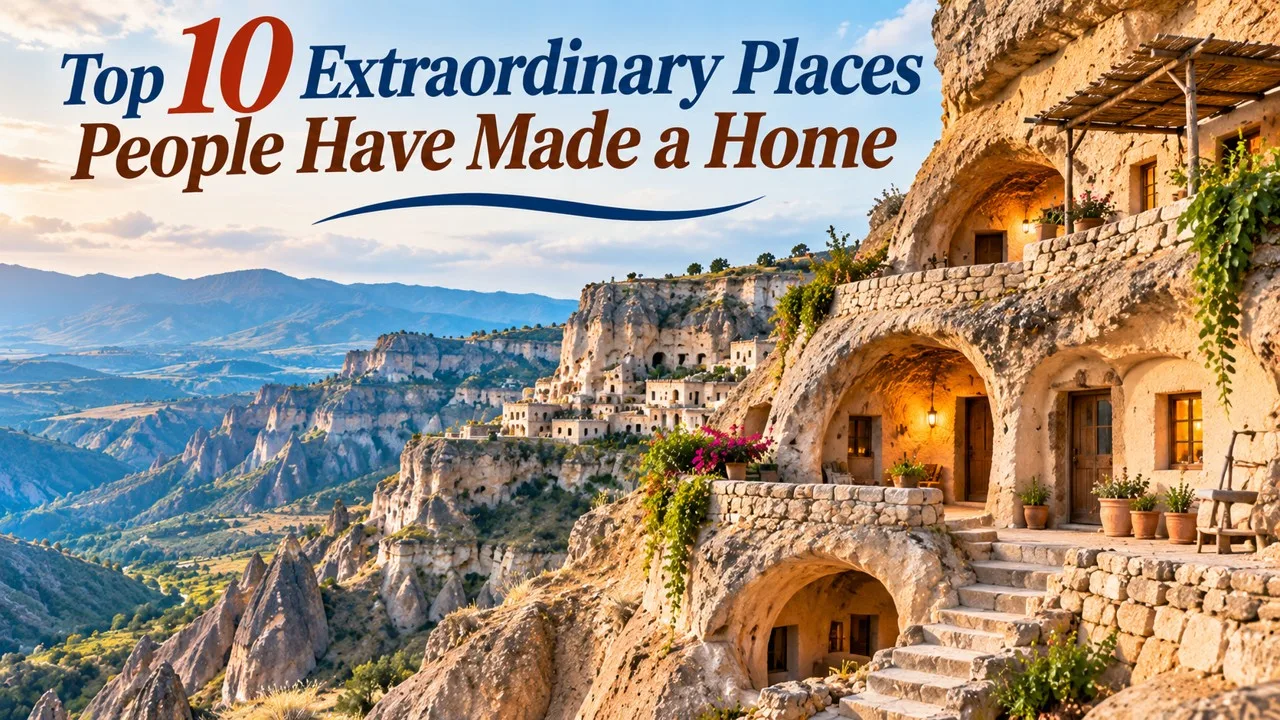
Treehouses, volcanic calderas, cave towns and floating villages are among the documented ways people have made lasting homes in difficult landscapes. The ten entries below are living, or recently living, arrangements that can be checked in ethnography, geography, and official descriptions [1][7][8]. This list is not a catalogue of extremes for their own sake, and it does not treat poverty as a curiosity. Where a community's housing is tied to hardship or to stigma, that fact is stated plainly and without a tourist flourish.
Two often-repeated images are not used as headline cases. Accounts of people living long-term in New York's utility tunnels are too mixed, and too often sensational, to treat as a stable "housing type" here. Claims of homes in abandoned cargo ships were not securely documented in the sources used for this article. In their place are Tonle Sap floating villages and the well-recorded houseboat and narrowboat communities of the Netherlands and Britain [9][10].
Key Facts
People adapt housing to height, heat, cold, water, and work. The examples below are specific places and traditions, not a ranking of toughness.
Ten Documented Home Places at a Glance
| Rank | Place or tradition | Setting | What is documented |
|---|---|---|---|
| 1 | Korowai treehouses | Papua, Indonesia | Family houses built high in trees, a tradition now also shaped by visitors |
| 2 | Aogashima | A volcanic island in Tokyo Prefecture, Japan | A village inside a caldera, still inhabited |
| 3 | Bajau and Moken | Maritime Southeast Asia | Sea-oriented communities, with houses on water or at the shore |
| 4 | Mongolian herders | The steppe | Mobile homes, the ger, tied to seasonal pasture |
| 5 | Tibetan plateau communities | High Asia | Permanent and seasonal settlement at extreme altitude |
| 6 | Manshiyat Nasser | Cairo, Egypt | A dense neighborhood whose economy has long included waste collection and recycling |
| 7 | Cave towns | Turkey, Tunisia, Australia, Spain, and elsewhere | Rock-cut and underground housing still used in several regions |
| 8 | Oymyakon | Sakha Republic, Russia | One of the coldest permanently inhabited places on Earth |
| 9 | Tonle Sap floating villages | Cambodia | Houses and services built to rise and fall with a seasonal lake |
| 10 | Houseboats and narrowboats | The Netherlands, Britain, and kindred places | Legal, long-standing homes on water |
1. Korowai Treehouses
The Korowai, in the forests of Papua, Indonesia, have a documented tradition of building family houses high in trees, using timber, rattan, and sago-palm materials, sometimes at striking heights [1]. Ethnographic and later journalistic accounts have often exaggerated isolation or "first contact." A careful version is enough: tree houses have been a real, practical form of dwelling in this region, and they have also been changed by missionization, government presence, and tourism, including houses built more visibly because visitors expect them [1].
The home is a technology for living in a forest with limited dry, level ground, and for keeping a household off the forest floor. It is not a stunt. Like any famous vernacular form, it deserves to be described as architecture and as a changing social fact, not as a postcard of the primitive.
2. Aogashima
Aogashima is a small volcanic island in the Izu chain, administratively part of Tokyo Prefecture, with a village set inside a caldera and a still smaller cone rising within that basin [2]. The island has a recorded history of eruption, evacuation, and return. People live there year-round, with a school, a port, and a helicopter link to the rest of the prefecture [2]. The extraordinary fact is simply the site: a community that has chosen, and been able, to remain in a volcanic bowl in the open Pacific.
Aogashima is not a lost world. It is a Japanese municipal village with an unusual geography. The caldera walls that look, from the air, like a natural fortress are the everyday horizon of a post office and a fishing harbor.
Related: Top 10 Most Bizarre Phobias: Strange Fears That Exist
3. The Bajau and the Moken
The Bajau, in parts of Indonesia, Malaysia, and the Philippines, and the Moken, in the Andaman Sea along Myanmar and Thailand, are among the best-documented maritime peoples of Southeast Asia [3]. Some families have lived on boats; some have lived in stilt houses over water or at the edge of reefs and islands; many now also live in shore villages, with all the political complications of borders, fishing rights, and settlement programs [3]. Popular science has paid recent attention to Bajau diving, including a 2018 study of spleen size and diving adaptation, which is a biological finding, not a complete account of a culture.
The home, in these traditions, can be a boat, a platform, or a house that faces the tide. What should be avoided is a frozen picture of "sea nomads" who never come ashore. The documented story is of movement, of skill on the water, and of change under modern states.
4. Mongolian Herders and the Ger
A large share of Mongolia's rural population still lives, at least seasonally, in the ger (in Russian-influenced usage, the yurt): a circular, felt-covered, wooden-framed dwelling designed to be taken down, moved, and raised again as herds follow pasture [4]. The form is old, the materials are adapted to wind and cold, and the legal and economic setting is modern, with a market in cashmere and meat, urban migration, and harsh winters, the zud, that can wreck a household's animals [4].
The extraordinary element is not romance. It is a housing system that remains compatible with mobility in a continental climate, at a national scale, in the twenty-first century. A ger is a home and a piece of infrastructure, as specific as a terraced house, and much easier to relocate.
5. Homes on the Tibetan Plateau
Communities on the Tibetan Plateau live at altitudes that, in other parts of the world, are treated as the limit of permanent settlement [5]. Housing types include stone and rammed-earth farmhouses, monastic and village clusters, and tents used with pastoral movement. The plateau is not empty and not only a wilderness. It is a densely meaningful inhabited landscape, with agriculture in valleys, pastoralism on higher ground, and towns along trade and now highway routes [5]. Human biological adaptation to hypoxia, including genetic findings related to the EPAS1 gene, is part of the scientific literature, and it should not be used to reduce people to a trait.
Related: Top 10 Oldest Buildings in the World
The home fact is simpler: families have made lasting settlements in a cold, dry, high world, with architecture and seasonal movement matched to that world. The plateau is extraordinary because it is lived in, not because it is uninhabitable.
6. Manshiyat Nasser, Cairo
Manshiyat Nasser, on the edge of Cairo, is a dense neighborhood often referred to in English as "Garbage City," a label that flattens a more specific history [6]. For decades, Coptic zabbaleen families have collected, sorted, and recycled a large share of the city's household waste, living and working in the same streets, with rooftops and courtyards used as sorting space [6]. The work is hard, the stigma is real, and the recycling rates have often been high by international standards. Housing here is not a vernacular curiosity. It is urban informality organized around a metropolitan service.
This entry is included because it is a documented way of making a home next to a city's waste stream, and because the people who do that work are often described from the outside as a spectacle. They are residents of Cairo. Their streets, churches, and compacting rooms are a functioning district, not a metaphor.
7. Cave and Underground Communities
Rock-cut and underground housing is not a single culture, but it is a repeating solution, still in use in several regions [7]. In Cappadocia, in Turkey, volcanic tuff has been carved into rooms and churches for centuries, and some cave spaces remain inhabited or have been reused as inns. In Matmata, Tunisia, sunken courtyard houses are a traditional response to heat, and some are still homes and hotels. In Coober Pedy, South Australia, opal miners cut dugouts into the hills to escape desert temperature swings. In Guadix and nearby districts in Spain, cave houses remain a living housing stock [7].
What these places share is geology more than folklore: a soft rock or a stable slope, and a climate that makes a thick earthen wall or a dug room rational. Visitors see a wonder. Residents see a house that stays cooler, or warmer, than a thin box on the surface.
Related: The Science Behind Auroras: How Solar Winds Create Colorful Skies
8. Oymyakon
Oymyakon, in the Sakha Republic of Russia, is routinely cited among the coldest permanently inhabited places on Earth, with recorded winter temperatures that have dropped below minus 60 degrees Celsius [8]. People live there year-round, with a school, shops, and the ordinary services of a rural settlement, in a region of cattle, horse, and reindeer husbandry and of Soviet and post-Soviet administration [8]. Housing and infrastructure have to cope with permafrost, brief summers, and a darkness and cold that define the working year.
The point of including Oymyakon is not to collect a temperature record. It is to note that a permanent community exists at that extreme, with a documented local history, and that "uninhabitable" is a word outsiders use more quickly than residents do.
9. Floating Villages on the Tonle Sap
The Tonle Sap, in Cambodia, is a lake that expands and shrinks dramatically with the Mekong flood pulse. Around its edges, and on the water, communities have long built houses, shops, and churches or temples on floats or on very high stilts, so that a home can rise with the flood and sit above the dry-season mud [9]. Kompong Phluk, Chong Kneas, and other named villages appear in geographic and heritage descriptions; tourism is now part of the economy, with all the usual pressures that brings [9].
This entry replaces a weaker "underground New York" item. The Tonle Sap case is a clear, mapable housing system tied to a seasonal hydrology. It is also a reminder that a floating village is not automatically a picturesque escape. It is a labor landscape, often of fishing, and it is vulnerable to changes in water, fish stocks, and visitor traffic.
Related: 10 Sikh Gurus: The Pillars of Sikhism Who Shaped Faith, Equality, Courage, and Humanity
10. Houseboats and Narrowboats
In the Netherlands, living on a houseboat is a long-established, often legal, urban housing choice, especially in Amsterdam and other canal cities, with moorings, utilities, and a body of regulation [10]. In Britain, narrowboats on the canal system include both holiday craft and people who live aboard, some of them "continuous cruisers" who move at legally required intervals, a way of life documented in housing studies and in official navigation rules [10]. Neither tradition is a reuse of abandoned cargo ships.
The extraordinary element, if any, is only that a boat can be a primary address in a modern European city or on a working canal. The rest is plumbing, winter heating, mooring fees, and neighbors. That ordinariness is the point: a home on water need not be a wreck, a stunt, or a last resort, and in these places it often is not.
Conclusion
People have made homes in trees, in a caldera, on the tide, on the steppe, on a high plateau, in a recycling district, in the rock, in extreme cold, on a pulsing lake, and on canals. The ten cases above are all documented, and two weaker tropes were left out on purpose. The right tone for this subject is geographic and social, not adventurous. A house is a tool for staying.
What looks extraordinary from a distance is usually a rational answer to height, heat, cold, flood, work, or the cost of land. The answers differ. The need — a dry, livable room, in a place one can remain — does not.
- ^ [1] Ethnographic and later overviews of Korowai housing in Papua. "Korowai people." Wikipedia: Korowai people
- ^ [2] "Aogashima." Official and geographic overviews of the village and caldera. Wikipedia: Aogashima
- ^ [3] "Bajau people" and "Moken people," with the 2018 Cell paper on Bajau diving physiology as a biological supplement. Wikipedia: Sama-Bajau
- ^ [4] "Yurt" and Mongolian pastoral housing. Encyclopaedia Britannica. Britannica: Yurt
- ^ [5] Geographic overviews of settlement on the Tibetan Plateau. Encyclopaedia Britannica. Britannica: Tibet
- ^ [6] Reporting and academic work on Manshiyat Nasser and the zabbaleen of Cairo. Wikipedia: Zabbaleen
- ^ [7] "Coober Pedy," "Cappadocia," "Matmata," and "Guadix" cave and dugout housing. Encyclopaedia Britannica and official tourism-heritage descriptions. Britannica: Cappadocia
- ^ [8] "Oymyakon." Geographic and meteorological overviews of the settlement. Wikipedia: Oymyakon
- ^ [9] Tonle Sap hydrology and floating and stilt villages, including Kompong Phluk. UNESCO and geographic overviews. Wikipedia: Tonle Sap
- ^ [10] Houseboats in the Netherlands and British canal narrowboat living, including official navigation-authority rules for continuous cruising. Wikipedia: Houseboat




















Discussion
Log in with