






 By
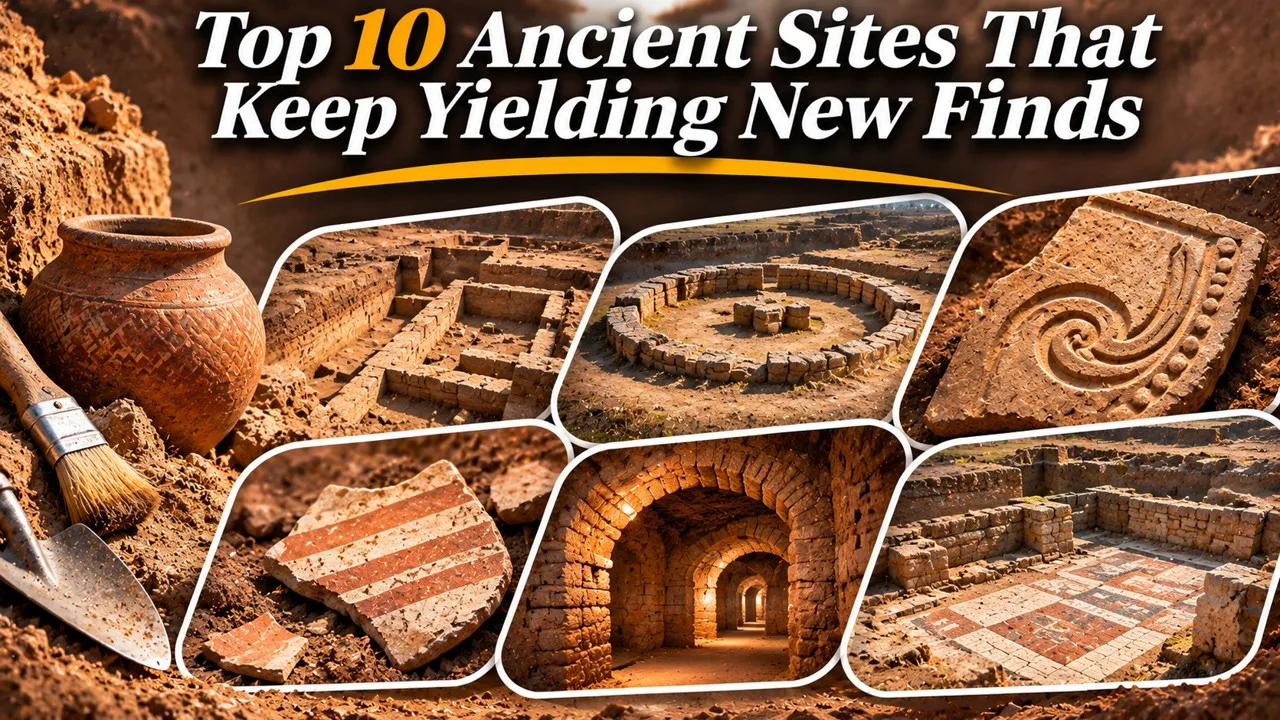
New work at Pompeii, Petra, Callacpuma and Koh Ker keeps changing the picture, if headlines are not allowed to run ahead of the papers. Ancient places are not finished objects. They are still being dated, sampled, scanned, and, in a few cases, re-inhabited in the archaeological record long after a famous disaster [1][10]. This list takes ten recent or recently clarified finds and keeps them in proportion: a lab model is not a field proof, a tomb in a mausoleum complex is not automatically an emperor's personal carriage, and a new inscription reading is one scholar's argument until others have had their say [3][4][8].
The ten items are independent of a companion list of world stone circles, which used a different set of sites. Callacpuma appears here as a 2024 dating result, not as a mysterious ring without a paper behind it [1].
Key Facts
The finds below are documented in excavation reports, journal papers, or official site communications. Several remain interpretive, and those interpretations are labeled as such.
Ten Finds at a Glance
| Rank | Claim | Careful version |
|---|---|---|
| 1 | Peru stone circles | A megalithic circular plaza at Callacpuma, Cajamarca, was dated in 2024 to the Late Preceramic, around 2750 BCE |
| 2 | Tombs under the Treasury | A 2024 excavation in front of Petra's Khazneh recovered a chamber with twelve burials; earlier tombs were already known, and some claims were over-hyped |
| 3 | An unusual team of sheep | Harnessed sheep remains in a tomb of the Qin mausoleum complex suggest a rare sheep-drawn carriage; the occupant is not confirmed as the first emperor himself |
| 4 | Wind and the Sphinx | A 2023 laboratory model shows that wind can carve yardangs with a recumbent-animal outline; it does not prove how the Great Sphinx began |
| 5 | Rapa Nui genomes | A 2024 ancient-DNA study found no genomic sign of a pre-European population crash, which challenges, but does not end, debates about the island's environment |
| 6 | Roman Egyptian blue | A large cake of Egyptian blue was recovered from Nero's Domus Aurea, a workshop clue rather than a new invention of the color |
| 7 | Koh Ker | Research on an undersized spillway suggests the great reservoir may have failed early; whether that forced the court's return to Angkor is still argued |
| 8 | Hidden signs on an obelisk | A 2021 inspection of the Luxor Obelisk in Paris prompted a cryptographic reading, published more fully later, that remains one specialist's account |
| 9 | Sarsen as silcrete | A returned core from Stone 58 is almost pure silica, a hard silcrete, which helps explain durability without turning the circle into a "crystal" monument |
| 10 | Pompeii after 79 | 2025 work shows people lived among the ruins for centuries in a reduced settlement, not that the city slept untouched until modern rediscovery |
1. A Plaza of Upright Stones in Cajamarca
At Callacpuma, in the Cajamarca basin of northern Peru, archaeologists have documented an 18-meter circular plaza built of two concentric rings of large, unmortared stones set on end, a construction method not previously reported in that Andean tradition [1]. A 2024 paper in Science Advances reported radiocarbon dates, from charcoal in the wall foundations, that place the initial construction around 2750 BCE, in the Late Preceramic, among the earliest monumental, megalithic ceremonial works now known in the Americas [1]. The plaza sits near a summit, with little in the way of ordinary household refuse, and is reasonably read as a gathering and ceremonial place for people who were still, in the main, hunters, gatherers, and early farmers.
It is not a lost twin of a famous European circle, and it does not need that comparison in order to matter. It is a dated Andean monument, with a construction technique of its own, and a reminder that ceremonial architecture in the highlands has a deep preceramic root [1].
2. Burials at the Threshold of the Khazneh
In 2024, a project of Jordan's Department of Antiquities, the Petra authority, and the American Center of Research, with geophysical help from the University of St Andrews, excavated a chamber associated with the Treasury, or al-Khazneh, at Petra [2]. The team recovered the remains of twelve people and a set of grave goods, and later analysis has been used, tentatively, to refine the date of the facade's construction to about the first decade of the reign of Aretas IV, in the late first century BCE [2]. Earlier work, in the mid-2000s, had already opened tombs in the same area, and some specialists later said the 2024 announcement was stronger on spectacle than on novelty [2].
The find is still valuable: relatively complete Nabataean burials are uncommon, and the pottery, sediments, and bones can be studied. It does not require a film reference, a "holy grail," or a claim that no one had ever suspected tombs near the Treasury. A broken ceramic vessel found with one burial is a broken vessel. The careful story is a dated chamber, a group of dead, and a famous facade that was probably already a monument to the dead.
Related: Cleopatra's Tomb: History, Theories and the Search at Taposiris Magna
3. Sheep, Harness, and a Missing Carriage Body
In a large tomb on the western side of the mausoleum complex of Qin Shi Huang, near Xi'an, excavators reported the remains of six sheep laid out with fittings of the kind used to pull a vehicle [3]. The wooden body of any carriage had not survived. Sheep-drawn carriages are rare in the archaeological record of early imperial China, and later written tradition, including stories about a Jin dynasty ruler, made the idea familiar in literature long after the Qin [3]. The 2023 reports were right to call the burial unusual. They were on thinner ice if they treated the find as the first emperor's own daily ride. The tomb is part of the mausoleum landscape; the identity of its occupant was still under study, and the emperor's own burial chamber has not been opened [3].
A row of sheep with harness is enough. It shows that a rare kind of turnout could be included in a high-status Qin funeral, centuries before the famous literary anecdote.
4. A Wind-Tunnel Lion Is Not a Finished Sphinx
The Great Sphinx of Giza is, in the standard Egyptological account, a Fourth Dynasty monument, carved and recarved in limestone [4]. That has not stopped researchers from asking whether a natural landform, already vaguely animal-like, might have invited the sculpture. In 2023, a team at New York University published laboratory work in which clay mounds, eroded in a fast flow that stood in for wind, produced yardang-like shapes with a recumbent, head-and-body outline [4]. Some real desert yardangs have a similar silhouette. The experiment is a useful analogy. It is not a field excavation of a pre-Sphinian yardang, and it does not date the monument to a different millennium [4].
Wind may help explain why a limestone knoll can look, from some angles, like a resting animal. Human carvers still had to make a sphinx. The unexpected fact is the model, which should be kept in the laboratory until the geology of the Giza yard, not a tank of water, says more.
5. Genomes, and a Story that Was Already Too Neat
Rapa Nui has long been burdened with a parable: that its people cut the last trees, fought, and collapsed in numbers before Europeans arrived. Environmental change on the island, including the loss of palm forest, is real. The neat "ecocide" plot has been contested for years [5]. In 2024, a Nature paper reported genomes from fifteen ancient Rapanui individuals, dated from the late seventeenth century into the twentieth, and found no genomic signature of a severe pre-European crash [5]. The same study also reported Native American ancestry that points to trans-Pacific contact before sustained European presence. Population-size estimates from a small sample have limits, and genetics cannot inventory every tree. What the paper does support is resilience, a smaller and more stable population history than the most dramatic older guesses, and a later catastrophe, in the nineteenth century, that is already in the historical record, including Peruvian slave raids and disease [5].
Related: Top 10 Oldest Surviving Buildings on Earth
DNA here tells another story than the parable. It does not tell every story about the island, and it does not need the statues restaged as a mystery poster in order to be heard.
6. A Cake of Blue in Nero's House
During work at the Domus Aurea, the Golden House built for Nero after the fire of 64 CE, archaeologists recovered materials from what appear to have been preparation areas for plaster and paint, including red and yellow ochres and a strikingly large mass of Egyptian blue [6]. Official descriptions put the blue cake at about 2.4 kilograms, on the order of fifteen centimeters high, a prepared ingot ready to be ground, much larger than the powdery traces usually found [6]. Egyptian blue, a copper calcium silicate, is the oldest widely known synthetic pigment, with a history in Egypt and the Near East stretching back into the third millennium BCE. The Roman court was a customer, not an inventor [6].
The unexpected object is the size of the stock. A palace that later vanished under later Rome still had, in a corner, a lump of color waiting for a wall.
7. A Capital, a Reservoir, and a Possible Breach
For a short period in the tenth century, under Jayavarman IV, the Khmer court was based at Koh Ker, northeast of Angkor, and a very large reservoir was part of that new landscape [7]. Geoarchaeological work, including LiDAR, excavation, and ground-penetrating radar, has argued that the outlets and spillway were too small for the catchment, and that the embankment likely failed, perhaps within a few seasons of use [7]. The capital's return to the Angkor region, around the mid-940s, has been linked by some researchers to that failure, as a blow to prestige and to the water system that advertised royal competence. Others note that the exact sequence is not settled: the breach could have come after, or beside, a political decision already underway [7]. Later Angkor had its own, later hydrologic troubles, which is a different chapter.
Koh Ker is a case of ambition meeting monsoon arithmetic. The papers are careful, and this list should be too: a poorly designed outlet is documented; a single cause for the move of a court is not.
Related: Top 10 Lost Cities That Were Rediscovered
8. Signs Near the Top of a Paris Obelisk
The Luxor Obelisk in the Place de la Concorde was given by Egypt to France in the nineteenth century and has been in plain sight ever since [8]. In 2021, when scaffolding made the upper shaft accessible, the Egyptologist Jean-Guillaume Olette-Pelletier reported additional signs that he reads as cryptographic, or playful, hieroglyphs, a known elite practice of writing one set of meanings inside or beside another [8]. His fuller account appeared in later specialist publication. He has argued, from the monument's original setting at Luxor Temple, that some of the signs were meant to be noticed from a particular angle by elite visitors, and that the content is royal praise of Ramesses II and a reminder of offerings [8]. Those readings should be treated as a specialist proposal, not as a decoded letter that every visitor can now check from the pavement. This article will not reproduce a long running translation.
A well-known monument can still yield a new epigraphic argument. The unexpected fact is the argument, and the duty is not to pretend the debate is over.
9. A Core, Returned, and Almost Pure Silica
A core taken from Stone 58, a sarsen upright at Stonehenge, during work in 1958, was later misplaced and then returned, which gave researchers a rare sample at a time when new coring of the protected stones was not on offer [9]. Petrological and geochemical work, including a 2021 study, showed that the rock is a groundwater silcrete: quartz sand locked in a cement of interlocking quartz, with silica around 99.7 percent by weight and only traces of other elements [9]. That mineralogy helps explain why the sarsens are so stubborn in the weather. Whether Neolithic builders "knew" the microscopic crystal interlocking is an inference, not a quotation from a prehistoric handbook. Related provenance work has also tied most of the sarsens to sources in West Woods, in Wiltshire, which is a separate, complementary result [9].
Calling Stonehenge "more crystal than stone" is a flourish. The accurate surprise is quieter: the great stones are a very pure, very hard silcrete, and a wandering core finally let that fact be measured in modern detail.
Related: Top 10 Things That Existed While Woolly Mammoths Were Still Alive
10. A City that Did Not Stay Empty
The eruption of 79 CE buried Pompeii. It did not, according to 2025 excavation and study in the Insula Meridionalis, end all occupation for sixteen centuries [10]. Archaeologists have reported hearths, ovens, mills, and a pattern of living in surviving upper levels while treating lower, buried rooms as cellars, a reduced and poorly serviced settlement among the ruins that appears to have lasted, in some form, until about the fifth century, perhaps until later volcanic trouble in 472 [10]. Some of the returnees may have been survivors; some may have been later arrivals looking for material or for a place to stay. The older popular sentence, that no one lived there until modern rediscovery, was already too tidy, and the new work makes the untidiness visible [10].
This was not the old city restored, and it should not be described as a spectacle of bodies. It was a long, hard afterlife of a ruined town, which is a different kind of archaeological yield, and a more interesting one than a sealed time capsule.
Conclusion
The ten finds share a habit of arriving after the site is already famous. A plaza in Cajamarca is older, once it is dated, than a casual visitor might guess. A chamber at Petra adds burials, and a little chronology, to a facade everyone already photographs. A Qin tomb can hold a rare team of sheep. A laboratory can suggest, without proving, that wind has a role in a famous outline. Genomes can shrink a parable about Rapa Nui, a cake of blue can sit in a Roman palace, and a Khmer reservoir can fail in the first monsoons. An obelisk in Paris can still be argued over, a sarsen can be almost pure silica, and Pompeii can have a second, poorer life in its own wreckage.
The duty, in each case, is the same. Report the find, name the uncertainty, and resist the urge to make the headline do the work of the paper.
- ^ [1] Toohey, J. L., Murphy, M. S., and colleagues, "A monumental stone plaza at 4750 B.P. in the Cajamarca Valley of Peru," Science Advances, 2024. Science Advances: Callacpuma plaza
- ^ [2] Official and academic accounts of the 2024 excavation of a burial chamber at al-Khazneh, Petra, including cautions that earlier tombs were already known. ACOR: Petra Treasury Tomb 62c
- ^ [3] Reports from the Qin Shi Huang mausoleum complex on sheep remains with harness fittings in a western tomb, distinguished here from a confirmed imperial daily carriage. Britannica: Qin tomb
- ^ [4] Laboratory studies of yardang-like forms as an analogy for a possible natural starting shape of the Giza Sphinx, treated as a hypothesis, not a redating of the monument. Britannica: Great Sphinx
- ^ [5] Moreno-Mayar and colleagues, "Ancient Rapanui genomes reveal resilience and pre-European contact with the Americas," Nature, 2024, and related discussions of the older ecocide narrative. Nature: Ancient Rapanui genomes
- ^ [6] Official communications on pigment finds, including a large cake of Egyptian blue, at the Domus Aurea. Parco archeologico del Colosseo: Domus Aurea colors
- ^ [7] Lustig, Klassen, Evans, Moffat, and colleagues on the Koh Ker reservoir's undersized outlets and possible early failure, with the political link treated as argued rather than proved. Britannica: Koh Ker
- ^ [8] Specialist work by Jean-Guillaume Olette-Pelletier on cryptographic readings of the Luxor Obelisk in Paris, presented here as a proposed interpretation. Britannica: Obelisk
- ^ [9] Nash and colleagues, and the 2021 PLOS One petrological study of the returned Stone 58 sarsen core, including the high silica content of the silcrete. PLOS One: Petrological characterisation of the sarsen stones
- ^ [10] 2025 archaeological reporting on post-79 occupation in Pompeii's Insula Meridionalis, including official park communications, described without graphic detail. Park of Pompeii, and contemporaneous summaries of the reoccupation research




















Discussion
Log in with