






 By
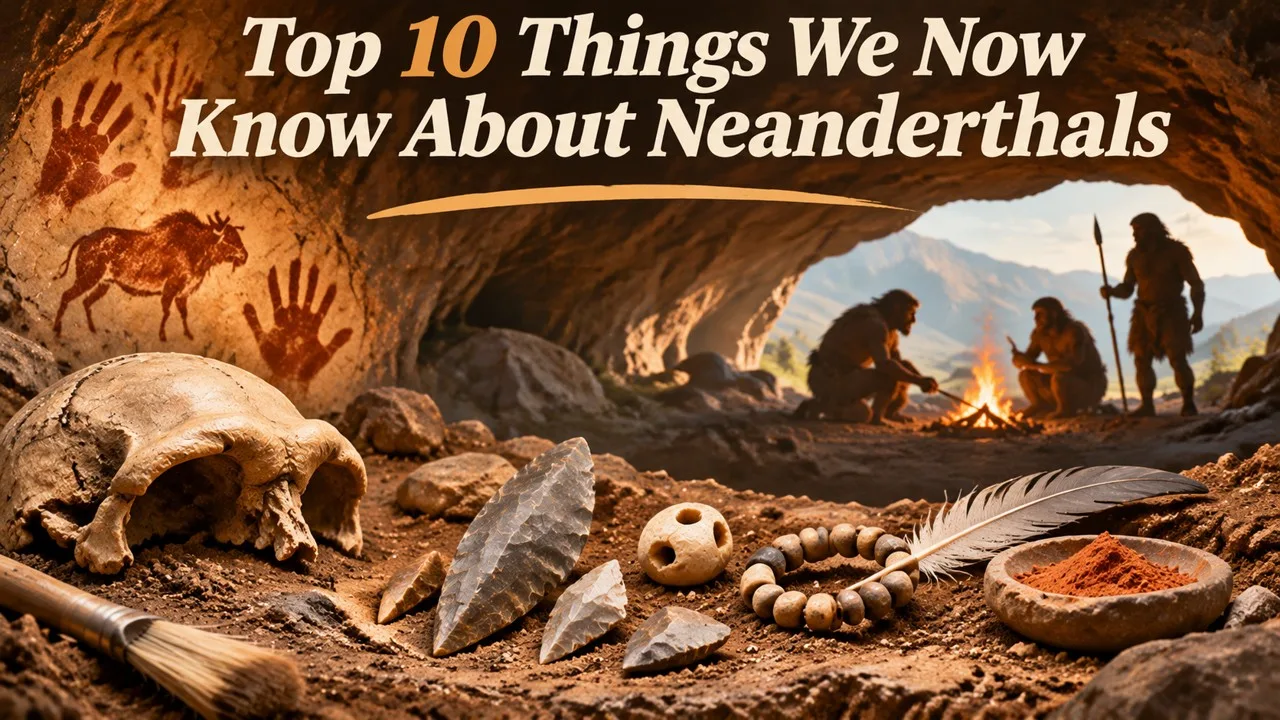
A Spanish pebble carries an ochre fingerprint, and a child with Down syndrome who lived several years is evidence of care, not a window into every feeling. What "we now know" about Neanderthals is a mix of hard laboratory results and interpretations that still need a leash [2][4]. Genomes, residues, and careful excavation have ended the old cartoon of a brute who could not hunt, cook, or leave a mark. They have not ended every argument, and two of the items that often travel with this list, a magnetic-field extinction and a hibernation hypothesis, are much softer than a fingerprint in ochre [8][9].
The ten entries below are things the literature actually supports, or, in two cases, hypotheses that should be labeled as such. A list that treated every headline as equal would be easier to write and less use to a reader who wants to know what has actually changed.
Key Facts
Neanderthals were a Eurasian human population, not a failed rehearsal for later people, and they interbred with both Denisovans and the ancestors of living humans.
Ten Findings at a Glance
| Rank | Claim | Strength of the evidence | Caution |
|---|---|---|---|
| 1 | Bed bugs have a deep human history | A 2025 genomic study ties a human-associated lineage to the Pleistocene | It does not prove a particular cave was infested |
| 2 | A pigmented pebble with a fingerprint | A 2025 analysis of a San Lázaro object dated to about 43,000 years ago | Symbolism is an interpretation, even when the print is real |
| 3 | Mixed, processed meals | Residues, calculus, and "leftovers" show more than raw meat | "Recipe" is a modern word for a repeated combination |
| 4 | A child with Down syndrome who lived years | Skeletal diagnosis plus an age that implies prolonged care | Motive and "compassion" are inferences |
| 5 | Coastal seafood in Portugal | Figueira Brava and related sites document marine foods | Not every group ate the same diet |
| 6 | Ancient microbial and viral DNA | Caves in the Altai have yielded rich genetic records | "Record-breaking virus" claims need a named result |
| 7 | Elephant hunting and butchery | Sites in Germany and elsewhere show large-game processing | Group size is modeled, not filmed |
| 8 | A magnetic excursion and extinction | The Laschamp event is real; a causal link is not established | This is a hypothesis, not a finding |
| 9 | Hibernation-like physiology | A disputed reading of Sima de los Huesos bones | Those fossils are not classic Late Pleistocene Neanderthals |
| 10 | Mixed families in the Altai | Denisova Cave holds Neanderthals, Denisovans, and their offspring | One cave does not describe every region |
1. Bed Bugs and a Deep Human Past
A 2025 genomic study of bed bugs, published in Biology Letters, found that a human-associated lineage split from bat-associated relatives deep in the Pleistocene and later expanded in steps that roughly track later human population growth and settlement [1]. Popular summaries have linked the early host switch to people who lived alongside Neanderthals, or to Neanderthals themselves, about 60,000 years ago [1]. The useful scientific point is demographic: a parasite of humans is old, and its family tree can be laid beside our own. The useful caution is that a lineage date is not a bed recovered from a particular Mousterian mattress.
Neanderthals, like later people, lived in caves and shelters that also housed bats. A shared pest is plausible. It is not a reconstructed bedroom.
2. A Fingerprint in Ochre
From the San Lázaro rock-shelter in Segovia, Spain, researchers in 2025 described a granite pebble, dated to about 43,000 years ago, with a red ochre dot that contains a human fingerprint, documented with imaging and forensic methods [2]. The stone's natural hollows can be read, if one is willing, as a face, with the pigment as a nose. The team, writing in Archaeological and Anthropological Sciences, argued for a deliberate, symbolic act by a Neanderthal [2]. Critics and cautious readers will want more than one object before rewriting the entire theory of art. They should still take the pebble seriously. A pigmented print is a hard fact; a painted face is a reading of that fact.
Either way, the last Neanderthals of Iberia were not, on this evidence, a people without marks. One pebble cannot carry the whole debate about Neanderthal art, but it can end the habit of assuming that pigment and a print are automatically later-human things.
Related: Top 10 Most Bizarre Dinosaurs
3. Leftovers and Mixed Meals
Dental calculus, burned bone, and residues on tools have shown that Neanderthals ate more than steaks cut from a single carcass [3]. Plant starches, cooked foods, shellfish in some regions, and combinations that look like repeated processing, a fat-rich broth, a mashed plant, a roasted nut, appear in the literature from sites across Europe and western Asia [3]. Calling these "complex recipes" is a modern convenience. The underlying result is solid: meals were prepared, sometimes with several ingredients, and "leftovers" in an archaeological sense can still be chemically read.
The cartoon of a species that only cracked bones and ran is finished. The Michelin-star version was never the point.
4. Care for a Child, Carefully Worded
In 2024, researchers reported that a child from Cova Negra, in Spain, had skeletal features consistent with Down syndrome and had lived to about six years of age [4]. A young child with that condition would have needed extended support from others in the group. The paper, and the coverage that followed, has been framed as evidence of compassion. The safer wording is that the child was not abandoned at birth and that survival to that age implies care [4]. Feelings cannot be excavated. Behavior, in the limited sense of a dependent who was kept alive, can be inferred.
That inference is already important. It does not require a speech about universal tenderness, and it should not be used to sentimentalize a whole species.
5. Seafood on a Portuguese Coast
At Figueira Brava and related Portuguese sites, João Zilhão and colleagues have documented a Neanderthal diet that included marine resources, shellfish, crabs, and other coastal foods, not only large land mammals [5]. The work, reported in 2020 and developed since, undercuts the idea that a regular use of the sea was a unique modern-human invention in this region [5]. Diet still varied with place. A coastal group is not a template for the Altai.
Related: Top 10 Lost Cities That Were Rediscovered
The cave did not "shed light" in a vague sense. It showed plates, in the archaeological meaning, that had been easy to leave out of the story.
6. Genomes, Microbes, and Viral Sequences
Remains and sediments from Denisova, Chagyrskaya, and other caves in Russia's Altai Mountains have produced some of the most important ancient genomes on Earth, and they have also yielded microbial and viral genetic material that paleogeneticists continue to parse [6]. Popular headlines about "record-breaking viruses hidden in remains" should be tied to a specific, peer-reviewed result; the broader, defensible fact is that these sites preserve DNA far beyond the host skeleton, including pathogens and environmental organisms [6]. The same caves are also where Neanderthal and Denisovan histories were rewritten.
A virus claim without a paper is a rumor. The Altai genetic record, as a whole, is not.
7. Hunting the Largest Game
Sites such as Lehringen and Neumark-Nord, in Germany, and other European localities, show that Neanderthals butchered elephants and used the fat, meat, and bone of animals that no single hunter could casually take down [7]. Recent archaeological arguments have emphasized planning, numbers, and the sheer quantity of food a straight-tusked elephant represents, which implies cooperation even when the hunt itself was not photographed [7]. The "used to take down elephants" wording is fair if it means repeated, skilled exploitation of the largest terrestrial prey, not a cartoon of weekly trophy hunts.
Related: Top 10 Things That Existed While Woolly Mammoths Were Still Alive
Large-game competence was never a late invention of later people alone.
8. A Magnetic Hypothesis, Not a Verdict
The Laschamp geomagnetic excursion, about 42,000 years ago, was a real weakening and shifting of the field [8]. A few popular and scientific treatments have asked whether the excursion, through climate, radiation, or auroral skies, helped to stress Neanderthal populations already under pressure from climate and from expanding Homo sapiens. The excursion is not in doubt. A causal role in extinction is not established, and most specialists still look first to climate, demography, and interaction with incoming modern humans [8].
This item is on the list as a caution. A changing field did not, on present evidence, "wipe out" a people.
9. The Hibernation Idea, and Its Limits
A 2020 discussion of bones from Sima de los Huesos, in Spain, suggested that lesions and growth interruptions might reflect a seasonal, hibernation-like slowdown in early humans living through brutal glacial winters [9]. The fossils are about 400,000 or more years old and sit on, or near, the Neanderthal lineage; they are not the classic Late Pleistocene Neanderthals of the textbooks [9]. Critics have offered other explanations for the lesions, including disease and nutritional stress, and they have doubted that large-brained humans could have entered a true hibernation as bears do.
The question is interesting. It is not a finding we "now know," and it should not be listed as if the species regularly slept away the Ice Age.
Related: Top 10 Misidentified Prehistoric Animals and How Science Corrected Them
10. A Cave Where Lineages Met
Denisova Cave, in the Altai, has yielded Neanderthals, Denisovans, and at least one individual, often nicknamed Denny, whose parents were of those two groups [10]. The same mountain system, and the genomes of living people, show that these populations met and had children on more than one occasion [10]. "Lived and bred together" is true in the genetic sense. It does not mean a single, peaceful household in every century of the cave's use, and it does not reduce three human groups to a romance.
It does mean that the old picture of sealed-off species, meeting only to replace one another, is finished in this part of Asia. The genetic record is clearer than the social one, and that should be said plainly: we know that mixed offspring existed, and we know far less about the daily terms on which the meetings happened.
Conclusion
The Neanderthal record is now rich enough to support a list that is mostly good news for complexity: a pigmented fingerprint, mixed meals, coastal food, elephant butchery, care for a dependent child, and a genetics of contact in the Altai. Bed bugs, oddly, belong in the same Pleistocene story of bodies in shared shelters.
The list is only as honest as its weak items. A magnetic excursion is not a demonstrated cause of extinction. A hibernation hypothesis about much earlier fossils is not a winter habit we can claim for later Neanderthals. Those two entries earn their place as warnings. The rest earn theirs as evidence.
- ^ [1] Miles, L.S., Booth, W. et al., 2025. "Were bed bugs the first urban pest insect? Genome-wide patterns of bed bug demography mirror global human expansion." Biology Letters. Biology Letters
- ^ [2] 2025. "More than a fingerprint on a pebble: A pigment-marked object from San Lázaro rock-shelter in the context of Neanderthal symbolic behavior." Archaeological and Anthropological Sciences. Springer
- ^ [3] Reviews of Neanderthal diet from dental calculus, residues, and cooked remains, including plant and mixed-food evidence. Britannica: Neanderthal
- ^ [4] Conde-Valverde, M. et al., 2024, on a child from Cova Negra with skeletal features consistent with Down syndrome. Science Advances. Science Advances
- ^ [5] Zilhão, J. et al., 2020, and later work on marine resources at Figueira Brava, Portugal. Science. Science
- ^ [6] Palaeogenetic studies of Denisova, Chagyrskaya, and related Altai remains, including host genomes and recovered environmental and microbial DNA. Max Planck Institute for Evolutionary Anthropology
- ^ [7] Archaeological studies of elephant butchery and hunting at Lehringen, Neumark-Nord, and related European sites. Britannica: Neanderthal
- ^ [8] Research on the Laschamp geomagnetic excursion and critical discussions of proposed links to Late Pleistocene human change. Britannica: Geomagnetic reversal
- ^ [9] 2020 discussions of possible hibernation-like stress in Sima de los Huesos hominins, and subsequent criticism. Wikipedia: Sima de los Huesos hominins
- ^ [10] Slon, V. et al., and related papers on a first-generation Neanderthal-Denisovan offspring and mixed ancestry at Denisova Cave. Nature. Nature




















Discussion
Log in with