






 By
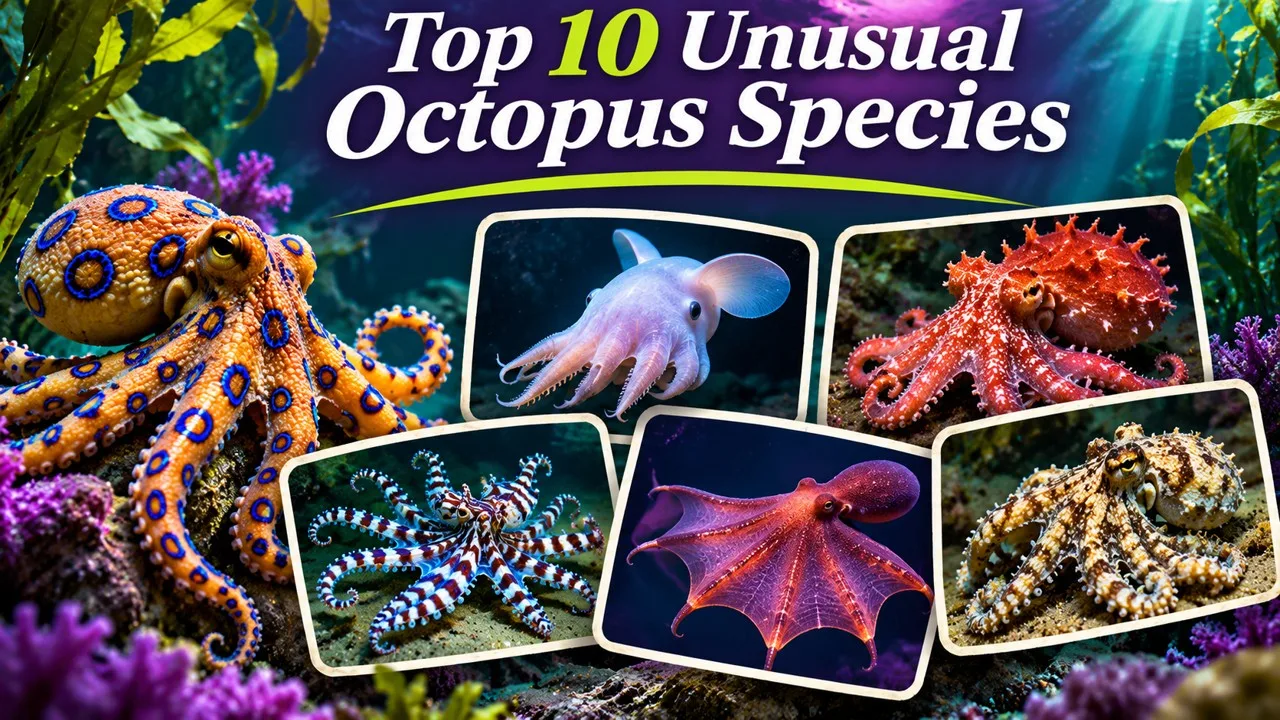
Argonauts, mimics, dumbo octopuses and a still-undescribed deep-sea nursery species show how far the octopus body plan can stretch. This list is a curated set of ten forms, some long familiar to naturalists and some still awaiting a formal scientific name [8][10]. The aim is not to crown a "weirdest" animal. It is to show, with independent sources, how shell-making, camouflage, venom, fins, tools, and brooding have been taken in different directions inside one group of cephalopods [1][2][5].
Two of the entries are unofficial nicknames, and they are labelled as such. A responsible account should not treat a press nickname as if it were already a Linnaean species [8][10]. The described species on the list are no less interesting for having names that can be checked in a catalog.
Key Facts
Octopuses are soft-bodied cephalopods, most of them with eight arms and no internal shell. The ten below include shallow-water, pelagic, and deep-sea forms.
Ten Unusual Octopuses at a Glance
| Rank | Animal | What is unusual | Status of the name |
|---|---|---|---|
| 1 | Argonaut, or paper nautilus | Females secrete a thin egg-case that looks like a shell | Described (genus Argonauta) |
| 2 | Mimic octopus | Can impersonate several other animals in shape and motion | Described (Thaumoctopus mimicus) |
| 3 | Blue-ringed octopuses | Small animals with a medically serious venom | Several described Hapalochlaena species |
| 4 | Dumbo octopuses | Ear-like fins and a deep-sea, gelatinous body | Genus Grimpoteuthis and close relatives |
| 5 | Coconut octopus | Uses shells and similar objects as portable cover | Amphioctopus marginatus |
| 6 | Blanket octopus | Extreme size difference between sexes; females trail long webs | Genus Tremoctopus |
| 7 | The "ghost" or Casper octopus | A pale, undescribed deep-sea animal filmed in 2016 | Informal nickname, not a formal species yet |
| 8 | Star-sucker pygmy octopus | Among the smallest known octopuses | Octopus wolfi |
| 9 | The "Dorado" octopus | A Muusoctopus from a Costa Rican nursery site, not yet formally named | Provisional nickname |
| 10 | The "hairy" octopus of muck-dive sites | A small, papilla-covered animal familiar to divers | Undescribed; often listed as Octopus sp. |
1. The Argonaut
Argonauts, sometimes called paper nautili, are pelagic octopuses. The female secretes a thin, calcareous egg-case from membranes on two arms, a structure that holds her eggs and also helps her stay in the water column [1]. It is not a true nautilus shell, and it is not a remnant of an ancestral external shell in the way a casual resemblance suggests. Males are tiny by comparison and do not build a case [1].
The unusual fact is architectural. An octopus, a group famous for having abandoned the heavy shell, has reinvented a lightweight, secreted case for eggs and buoyancy. Nineteenth-century naturalists already puzzled over the "paper" boat. Modern accounts still rest on that same, checkable anatomy. The animal is a swimmer first and a shell-maker only in the female's adult life, which is why a washed-up case can sit on a beach with no obvious owner.
2. The Mimic Octopus
Thaumoctopus mimicus, described in 1998 from Indonesia, is a pale, striped octopus that can change both its outline and its movement to resemble other animals, including flatter, more dangerous, or more boring neighbours such as a lionfish, a sea snake, or a flatfish [2]. The mimicry is not a cartoon transformation. It is a set of postures and color patterns, used in a sand or mud habitat where a long, thin octopus would otherwise be obvious [2].
The species became famous quickly, which has produced some over-claiming in popular lists. The conservative, documented point is already enough: a benthic octopus with an unusually broad impersonation repertoire, living in a habitat that rewards looking like something else. Later popular lists sometimes add impersonations that the original papers did not claim. The safer habit is to stay close to the observed postures.
Related: Top 10 Bioluminescent Sea Animals That Use Light to Survive
3. Blue-Ringed Octopuses
Blue-ringed octopuses, in the genus Hapalochlaena, are small Indo-Pacific animals whose rings flash as a warning [3]. Their saliva can contain tetrodotoxin, and a bite is a documented medical emergency, even though the animals are not large and are not looking for people to attack [3]. This entry states that fact without turning it into a scare story. The unusual combination is a modest size, a vivid display, and a neurotoxin more often associated, in the public mind, with certain pufferfishes.
They are also a reminder that "unusual" in octopuses is not only a matter of shape. Chemistry and signaling belong on the same list as fins and tools.
4. Dumbo Octopuses
Dumbo octopuses, chiefly the genus Grimpoteuthis, are deep-sea cirrate octopuses with a pair of ear-like fins that they use, together with the arms and web, to move through midwater and just above the seafloor [4]. The body is gelatinous, the eyes are often large, and the animals have been filmed in their own habitat only as camera technology has gone deeper [4]. The common name is a popular comparison with a cartoon elephant; the comparison is informal, and no cartoon character needs to be pictured to understand the fins.
These are among the deepest-living octopuses. The unusual body plan is a solution to a cold, dark, high-pressure world, not a costume. Unlike a shallow-water octopus that crawls and jets between dens, a dumbo octopus is often filmed hanging or finning just above the mud, in a world with few hard shelters.
5. The Coconut Octopus
Amphioctopus marginatus, the coconut or veined octopus, has been documented carrying coconut shells, bivalve shells, and similar objects and assembling them as a portable shelter [5]. A 2009 paper in Current Biology, by Julian Finn, Tom Tregenza, and Mark Norman, treated the behavior as a rare example of tool use in an invertebrate, because the animals transport the objects for later use, not only hide under them in place [5]. The behavior is now widely filmed in shallow Indo-Pacific waters.
Related: Top 10 Remarkable Jellyfish of the World
A soft-bodied animal that goes shopping for a lid is an easy image to oversell. The documented behavior is still striking: locomotion with an awkward load, and a shelter that the octopus has to choose, carry, and later occupy.
6. The Blanket Octopus
Blanket octopuses, Tremoctopus, are open-ocean animals named for the long, unfurling webs that adult females can trail between their arms [6]. The sexual size difference is extreme: females may reach a meter or more, while males are a few centimeters long and, like some other cephalopods, use a specialized arm in reproduction [6]. Females have also been reported to carry Portuguese man-of-war tentacles, a claim that appears in the natural-history literature and should be kept in proportion to the observations behind it.
The unusual design here is social and physical at once: a pelagic life, a living "blanket," and one of the starkest size gaps between sexes in the octopus world.
7. The Casper or "Ghost" Octopus
In 2016, during a NOAA Office of Ocean Exploration and Research expedition on Okeanos Explorer, cameras recorded a pale, almost featureless octopus at around 4,000 meters near the Hawaiian Archipelago [7]. Commentators nicknamed it "Casper." Scientists have treated it as likely new to science, and possibly a new genus, but as of the sources used here it has not been formally described from a collected type specimen in the ordinary way [7]. It should not be listed as if it already had a stable Latin name.
The unusual fact is the combination of depth, appearance, and status: a real animal, on a real dive, still waiting on taxonomy. Informal names are useful as long as they are labelled as informal.
Related: Top 10 Strangest Deep-Sea Creatures
8. The Star-Sucker Pygmy Octopus
Octopus wolfi, the star-sucker pygmy octopus, is often cited as the smallest octopus, with adults only a couple of centimeters long [8]. It lives in the western Pacific, in shallow rubble and reef, and is easily overlooked. "Smallest" records in soft-bodied animals should always be read with a little caution, because specimens and definitions vary, but there is no serious doubt that this is among the tiniest members of the group [8].
On a list of unusual octopuses, extreme smallness belongs with extreme depth and extreme disguise. A fully equipped octopus, at a scale closer to a large insect than to the common octopus of a market tank, is a reminder that the body plan scales in both directions.
9. The Dorado Octopus
In 2023, a Schmidt Ocean Institute expedition off Costa Rica filmed and collected deep-sea octopuses at a hydrothermal outcrop informally called El Dorado Hill or the Dorado Outcrop [9]. Researchers, including Janet Voight, have said that one brooding Muusoctopus there is a new species, nicknamed the Dorado octopus, related to but distinct from the pearl octopus, Muusoctopus robustus, known from a California seamount nursery [9]. As of the reports used here, the formal description was still in preparation. The nickname records a place, not a finished classification.
The scientifically interesting point does not depend on the nickname. It is the growing evidence that some Muusoctopus species brood eggs at warm seafloor springs, which may speed a notoriously slow deep-sea incubation. A nursery of undescribed octopuses is unusual enough without dressing the finding up as a completed species list.
Related: Top 10 Strange Deep-Sea Animals
10. The Hairy Octopus of Muck Sites
Divers in places such as Lembeh Strait, Indonesia, have long photographed a tiny, well-camouflaged octopus covered in papillae or "hairs," usually listed in identification guides as an undescribed Octopus species [10]. It has no generally accepted formal name in the sources checked for this article, and it should not be treated as if it did. What is documented is a repeated field identification: a very small, benthic octopus whose skin sculpture makes it look like a tuft of algae or debris [10].
Undescribed does not mean imaginary. It means that the animal is known from photographs and sightings, and that the taxonomic work has not caught up with the dive logs. On a list of unusual octopuses, that lag is itself a fact: some of the strangest forms are already familiar to divers and still nameless in the literature.
Conclusion
Octopuses share a soft body and a reputation for flexibility. The ten forms above show how far that reputation can be unpacked: a secreted egg-case, a mimic's posture, a small animal with a serious toxin, fins in the deep sea, a carried shell, a trailing blanket, an undescribed ghost-pale animal at 4,000 meters, a pygmy species, a nursery at a warm outcrop, and a "hairy" diver's favorite still waiting for a name.
A good list keeps nicknames and formal names in different boxes, and it does not need to invent extra strangeness. The animals, as described in papers, expedition reports, and field guides, are already strange enough. Some of them will have Latin names by the next decade. The body plans will not become less odd when that happens.
- ^ [1] "Argonaut (animal)." Encyclopaedia Britannica and standard cephalopod overviews. Britannica: Argonaut
- ^ [2] Norman, M.D. and Hochberg, F.G., 1998? and later accounts; "Mimic octopus." Wikipedia: Mimic octopus
- ^ [3] "Blue-ringed octopus." Encyclopaedia Britannica. Britannica: Blue-ringed octopus
- ^ [4] "Dumbo octopus" (Grimpoteuthis). NOAA and taxonomic overviews. Wikipedia: Grimpoteuthis
- ^ [5] Finn, J.K., Tregenza, T. and Norman, M.D., 2009. "Defensive tool use in a coconut-carrying octopus." Current Biology 19: R1069–R1070. Current Biology: Coconut-carrying octopus
- ^ [6] "Blanket octopus" (Tremoctopus). Standard zoological overviews. Wikipedia: Tremoctopus
- ^ [7] NOAA Office of Ocean Exploration and Research, 2016, Hawaiian deep-sea "Casper" octopus observations. NOAA Ocean Explorer
- ^ [8] "Octopus wolfi." Taxonomic and size-record overviews. Wikipedia: Star-sucker pygmy octopus
- ^ [9] Schmidt Ocean Institute, 2023–2024, announcements of new Costa Rican deep-sea octopuses, including the Dorado octopus. Schmidt Ocean Institute
- ^ [10] Field identifications of the undescribed "hairy octopus" at Indo-Pacific muck sites. Wikipedia: Hairy octopus




















Discussion
Log in with