






Top 10 Animal Adaptations That Inspired Human Technology
 By Dhiraj Sharma · Published
Share Post
Loading…
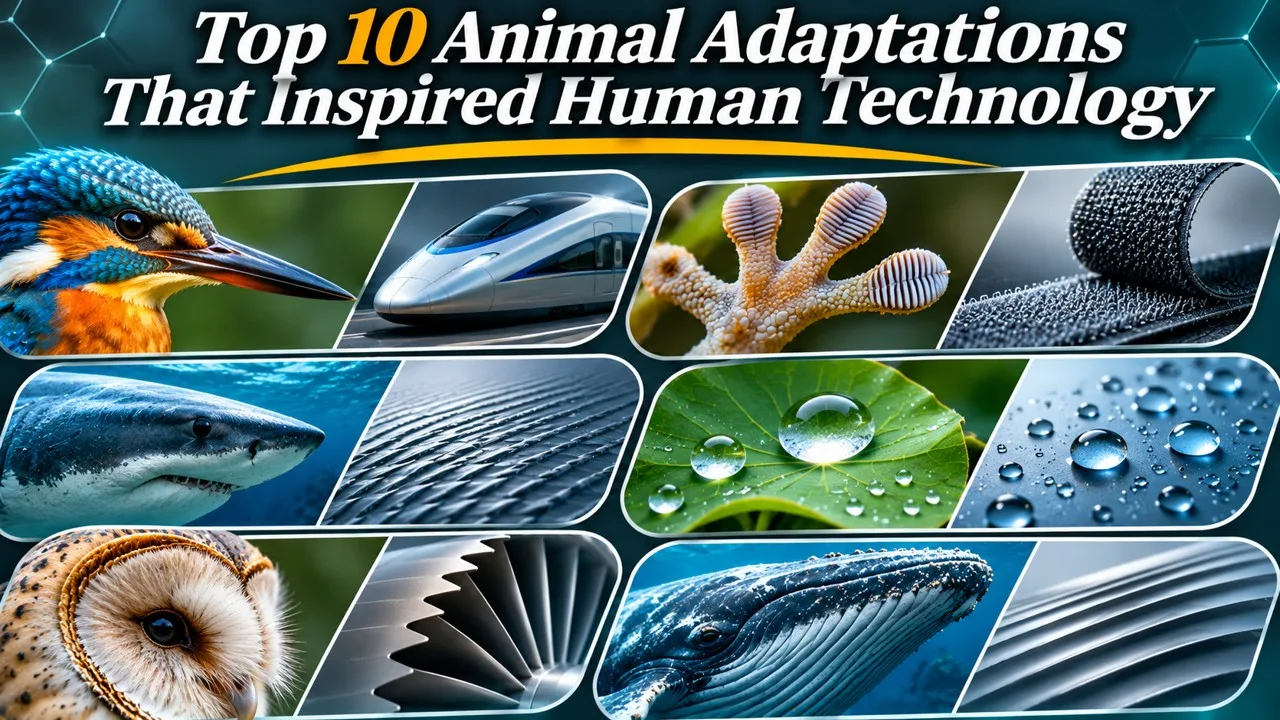
A kingfisher-inspired nose cone quieted a Japanese train; gecko feet, lotus leaves and mussel glue have moved from biology into the lab, if not always the shop. Biomimicry is at its best when an engineer can point to a part, a test, and a living model, and at its worst when a press release treats a leaf as a finished factory [1][6]. The ten cases below are documented transfers, or documented attempts, from an organism to a device. A shark-skin pattern can reduce some bacterial attachment on a surface; it is not a universal "bacteria shield" [3]. A chameleon-like tongue mechanism has been studied as a soft gripper, including in speculative space settings; it is not a fleet of tongue-ships [10].
No company logos, no train livery, and no likenesses appear in the image brief for this article. The pairs are forms: a beak and a nose cone, a seta and a pad, a mound and a chimney.
Key Facts
An adaptation inspired a technology only if the designers actually used the biology, not if the two objects merely look alike after the fact.
Ten Transfers at a Glance
| Rank | Living model | Technology | How far it has gone |
|---|---|---|---|
| 1 | Kingfisher beak | A reshaped nose cone on a high-speed train | A documented, in-service redesign |
| 2 | Gecko feet | Dry adhesives and climbing robots | Real lab and prototype devices; everyday tape is still catching up |
| 3 | Shark skin denticles | Drag and anti-fouling surfaces, including micropatterns that discourage some bacterial films | Useful in niches; not a general disinfectant |
| 4 | Humpback flipper tubercles | Tubercles on some turbine and fan blades | Tested and, in some products, used |
| 5 | Termite mounds | Passive cooling ideas, including a well-known office building in Harare | A design lesson, not a portable climate machine |
| 6 | Lotus leaf | Superhydrophobic, self-cleaning coatings | A mature idea with many commercial versions |
| 7 | Mussel foot proteins | Wet adhesives, including medical research glues | Strong in tests; still being engineered for cheap, reliable use |
| 8 | Morpho and other butterfly wings | Structural color that does not rely on a fading pigment | Used in materials and display research |
| 9 | Octopus arms | Soft robots that bend, grip, and sometimes change stiffness | A growing lab field, not a household tool |
| 10 | Ballistic tongues | Soft, high-speed grippers inspired by chameleon or frog tongues | Experimental, including proposed space uses |
1. A Beak for a Tunnel Boom
When a high-speed train leaves a tunnel, it can push a pressure wave that cracks like a boom at the exit [1]. In the 1990s, engineers working on a Japanese bullet-train redesign, including Eiji Nakatsu, used the kingfisher's smooth, plunging beak as a model for a longer, tapering nose cone, a change that helped cut the tunnel boom and also reduced drag [1]. The story has been told often, and it survives because it is specific: a bird, a pressure problem, a reshaped nose, and a train that then ran in public service. It is one of the cleanest biomimicry cases we have.
A bird did not "invent" a railway. An engineer who watched birds helped invent a quieter way to exit a hole in a hill.
2. Feet That Hold without Glue
A gecko can hang from a smooth wall because millions of microscopic setae, split into still finer tips, use weak intermolecular forces, together with the mechanics of the toe, to make and break contact [2]. Laboratories have spent two decades trying to copy that dry, repeatable stick, in tapes, pads, and climbing robots that can walk up glass [2]. Some devices work impressively in tests. Dust, moisture, cost, and the difference between a toe that is alive and a pad that must be manufactured still keep most of the "future of grip" in the future, or in special jobs, rather than in every kitchen drawer.
Related: Top 10 Extraordinary Lizards of the World
The physics is not a myth. The hardware is just harder than a nature documentary makes it look.
3. Denticles, Drag, and a Modest Shield
Shark skin is covered in dermal denticles, tiny tooth-like scales that affect how water flows along the body [3]. Engineers have copied riblet-like patterns to reduce drag on some swimsuits, hulls, and aircraft tests, and they have also made micropatterned surfaces, sometimes sold under trade names this article will not advertise, that make it harder for some bacteria to settle as a film [3]. "Nature's bacteria shield" overstates the second half. The pattern is not an antibiotic, it does not replace cleaning, and the evidence is about adhesion on particular surfaces, not about a general disinfection of the world.
A skin can teach a texture. It cannot be asked to do the work of a drug.
4. Bumps That Changed a Blade
The leading edge of a humpback whale's flipper is not smooth. It carries tubercles, rounded bumps that, in studies led by researchers including Frank Fish, help the flipper keep lift at steep angles and delay stall [4]. That geometry has been applied to some wind-turbine blades, fans, and related foils, with tests showing quieter or more efficient performance in some conditions [4]. "Rewired wind power" is a large phrase for a useful, still-selective modification. Not every farm has tubercled blades, and not every test is a revolution. The ones that work are already a good argument for looking carefully at a flipper.
A bump, in the right place, can be an engineering parameter, not an ornament.
5. Towers That Manage Heat
Some termite mounds maintain usable internal conditions in harsh outdoor climates by a combination of form, orientation, and air movement, a system that is more complicated than a single "air-conditioning chimney" slogan [5]. The Eastgate Centre in Harare, designed by Mick Pearce and colleagues, is the usual citation for a building that learned from that lesson: a passively assisted, largely less-refrigerated office block in a hot climate [5]. Later research has refined, and sometimes argued with, earlier simple models of mound airflow. The transfer still stands as a design attitude: look at how a structure breathes before you reach for a bigger plant.
Related: Top 10 Unexpected Abilities Found in Animals
A mound is not a blueprint you can photocopy. It is a set of principles that a building can adapt, with measurements, not with a totem.
6. A Leaf That Sheds the Dirt
The lotus leaf is superhydrophobic: water beads, picks up dirt, and rolls off, because of a waxy chemistry and a rough, hierarchical surface [6]. The "lotus effect" has been named, patented around, and turned into paints, glasses, textiles, and other coatings that try to stay cleaner with less effort [6]. Some products work well; some wear down, get oily, or disappoint in the rain of a real city. The underlying physics is textbook now, which is a kind of success. A secret of the leaf is no longer a secret. It is a specification.
Self-cleaning, in this sense, is a surface that makes the dirt easier to remove, not a surface that never needs the world.
7. A Glue That Works Wet
Mussels stick to rocks in the surf with protein glues that set in salt water, a job that defeats many ordinary adhesives [7]. Chemists have isolated, copied, and modified the responsible proteins and their catechols, aiming at medical glues, underwater repair, and other wet bonds [7]. "Stronger than the sea" is poetry. The useful fact is "works where a dry glue fails," and even there the engineering problems are dose, cost, shelf life, and the difference between a living foot and a tube in a kit. The research is one of the more serious biomimetic programs in chemistry, which is why it belongs here without a miracle price tag.
Related: Top 10 Most Bizarre Phobias: Strange Fears That Exist
A mussel does not have a factory. It has a gland, and a lot of time on a single rock.
8. Color That Is a Structure
The blue of some Morpho wings is not mainly a pigment that can fade like a dye. It is a structural color, produced by microscopic layers and ridges that interfere with light [8]. Materials researchers have tried to copy that idea in paints, fabrics, and display components that might keep their hue without as much pigment load, or that can be tuned by changing the spacing [8]. "Never fade" is a hope and, in some designs, an improvement, not an immortality clause. Sun, abrasion, and dirt still exist. The unexpected fact is already large: a wing can hold a color in its architecture.
A pigment is a chemical. A Morpho blue is, in large part, a tiny building.
9. Arms That Do Not Have to Be Stiff
An octopus arm can bend anywhere, stiffen when it needs to, and manipulate an object without a skeleton of the vertebrate kind [9]. Soft robotics has taken that lesson seriously: researchers have built grippers and arms in silicone and other elastomers, sometimes with methods for changing stiffness, sometimes with sucker-like contact [9]. The field is lively and still mostly in laboratories and specialist tasks, from handling fruit to navigating a tight space. It is not a replacement, yet, for every factory robot, and it does not require a science-fiction octopus on a poster.
The rise is real as a research rise. A product aisle is a later question.
10. A Tongue as a High-Speed Grip
Chameleons and some frogs fire a tongue in a ballistic, almost catapulted grab, then hold wet or irregular prey [10]. Engineers have built soft, rapidly extending grippers that borrow the kinematics, and some papers and proposals have asked whether that kind of gentle, fast, stowable grabber could help in space, where a stiff claw is not always the right tool for a floating object [10]. "Aiming for space" is, today, a direction of research, not a launch manifest. The unexpected ability to copy is the shot itself: a soft device that goes out, sticks, and comes back, without a hard jaw.
Related: Top 10 Oldest Buildings in the World
A tongue is a proof that a grabber can be stored in a small mouth and still reach. That is the design brief, whether the target is a fly or, someday, a tool on orbit.
Conclusion
The ten transfers above are not all equal, and they should not be sold as equal. A train nose that ran in service, a lotus coating you can buy, and a growing literature on gecko pads, mussel glues, and soft arms are different kinds of fact from a tongue gripper that might one day be useful off the Earth. Shark skin can inform a texture that reduces drag or makes a film harder to start; it cannot be asked to sterilize a hospital by itself.
What the list still shows, with those limits in place, is that biology has already solved a remarkable number of engineering problems, and that the good copies are specific. A beak for a boom, a bump for a stall, a leaf for a bead of water: those are designs, not mascots. They work when the engineer keeps the physics and drops the advertising.
- ^ [1] Accounts of the kingfisher-inspired nose redesign on Japanese high-speed trains, including work associated with Eiji Nakatsu. Britannica: Bullet train
- ^ [2] Research on gecko setae, van der Waals adhesion, and synthetic dry adhesives and climbing robots. Britannica: Gecko
- ^ [3] Studies of dermal denticles, riblet drag reduction, and micropatterned surfaces that reduce some bacterial adhesion, described here without a brand campaign. Britannica: Shark
- ^ [4] Frank Fish and colleagues on humpback tubercles, and later applications to turbine and fan blades. Britannica: Humpback whale
- ^ [5] Descriptions of termite-mound climate regulation and of the Eastgate Centre in Harare as a building informed by those ideas. Britannica: Termite
- ^ [6] The lotus effect and superhydrophobic, self-cleaning coatings. Britannica: Sacred lotus
- ^ [7] Chemistry of mussel adhesive proteins and research on wet-setting medical and industrial glues. Britannica: Mussel
- ^ [8] Structural color in butterfly wings, including Morpho, and materials that copy layered interference. Britannica: Morpho
- ^ [9] Reviews of octopus-inspired soft robotics, variable stiffness, and suction. Britannica: Octopus
- ^ [10] Research on chameleon- and frog-tongue kinematics and on experimental soft, ballistic or rapidly extending grippers, including proposed space uses. Britannica: Chameleon






















Discussion
Log in with