






 By
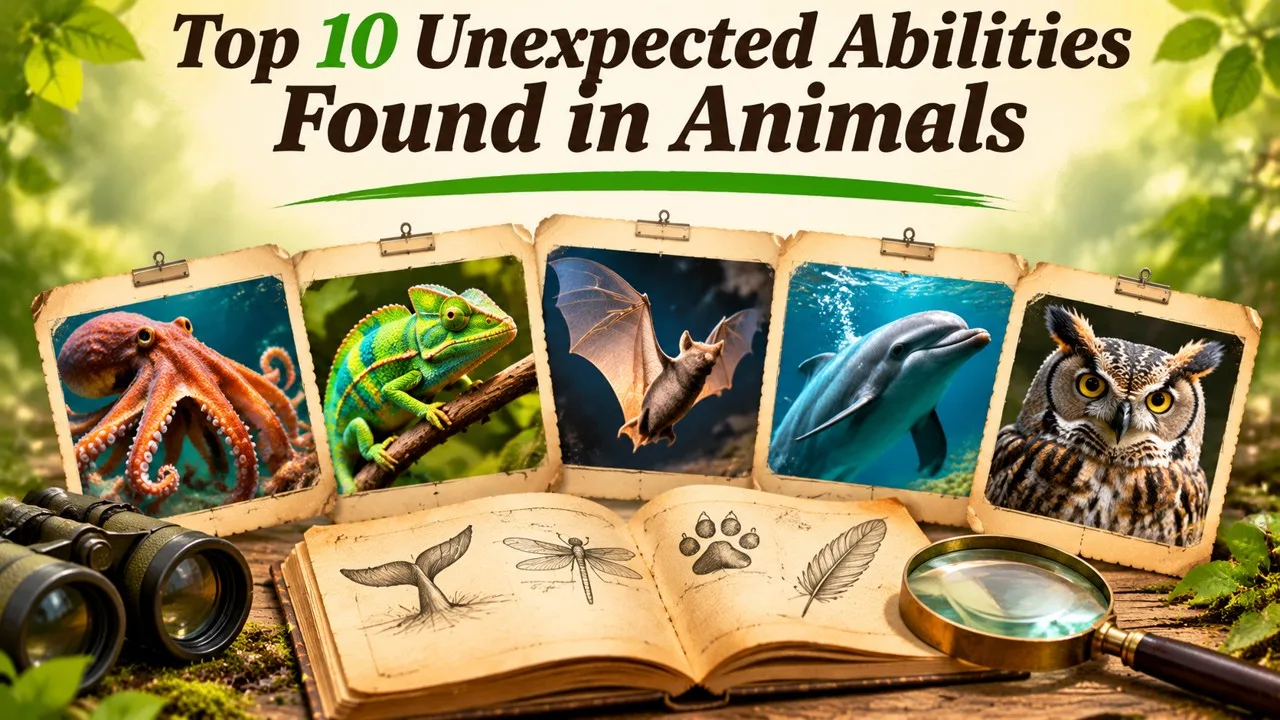
Elephants appear to use name-like calls, and hibernating bumblebee queens can survive a week underwater, according to recent papers, not folklore. Unexpected abilities are easy to advertise and easy to spoil. A fire-foraging raptor is a documented forager, not a wizard. A seal that imitated human speech is a famous individual, not a species that recites verse, and this article will not treat his voice as a novelty record [10]. The ten cases below are abilities that have been observed or experimentally supported, with the limits that belong to each.
Several of the results are new. Several are old facts that later work has made sharper.
Key Facts
An "ability" here is a behavior or a physiology that would be easy to miss, not a superpower invented for a headline.
Ten Abilities at a Glance
| Rank | Animal | Ability | Caveat |
|---|---|---|---|
| 1 | Pilot whales | Groups have been seen to approach and displace killer whales | Not every meeting ends this way |
| 2 | Apennine brown bears | Populations show traits and habits that reduce conflict with people | Evolution "to avoid conflict" is a summary of selection and behavior, not a plan |
| 3 | Honey bee larvae | They spin a silk cocoon inside the cell | The silk is a larval product, not a worker embroidery |
| 4 | Some Australian raptors | They have been documented using fire as a hunting tool | The behavior is local and still being quantified |
| 5 | African elephants | They appear to use name-like, individual-directed calls | "Name" is a careful analogy, not a dictionary entry |
| 6 | Bumblebee queens in diapause | They can survive days of submersion, up to about a week in tests | This is a hibernating queen, not a swimming worker |
| 7 | Humpback whales | They have been filmed blowing bubble rings near people | Play is a reasonable reading, not a proven message |
| 8 | Some oribatid mites | Ancient asexual lineages have persisted for millions of years | Not all mites are asexual |
| 9 | Bdelloid rotifers | They can withstand shattered DNA and recover lineages after drying | The repair is extraordinary, not unlimited |
| 10 | Hoover, a harbor seal | He imitated human speech with a recognizable New England accent | One trained and socialized animal, described without quoted speech |
1. Pilot Whales That Do Not Yield
Killer whales are often treated as the ocean's dominant mammalian predators, which makes a recorded pattern of short-finned or long-finned pilot whales approaching, crowding, and apparently seeing off orca groups more surprising than it first sounds [1]. Field observations and compiled encounters have described orcas breaking off and leaving an area after pilot whales move in, sometimes in numbers [1]. The mechanism may be harassment, sheer group size, or a risk the orcas do not choose to run. It is not a fairy tale about a gentle giant.
The ability, if that is the right word, is social and numerical. A pod can be a deterrent, and a reputation of that kind would be easy to miss if observers only ever asked which animal sits at the top of a simple food chain.
2. Bears That Live Beside People
Apennine brown bears, a small, isolated population in central Italy, have been studied for the ways they use landscape, time of day, and diet in a country full of roads and villages [2]. Recent work has emphasized shifts, in behavior and in some biological traits, that reduce the odds of a conflict encounter, a pattern that can be read as survival under human pressure rather than as tameness [2]. "Evolved to avoid human conflict" is a compressed sentence. The longer one is that a threatened population has been filtered, and has learned, to keep its distance and to use cover and night.
The result matters for conservation. It is not a promise that every bear will stay out of trouble.
Related: Top 10 Most Intelligent Animals
3. Bee Larvae That Spin Silk
A worker honey bee does not weave the cocoon. The larva, late in its growth inside the comb cell, spins a silk lining and covering that helps protect the pupa and adds strength to the wax house around it [3]. The silk is a protein fiber, as in other insects that spin, and it is easy to forget because the popular image of bees is all nectar and hexagonal wax [3]. The unexpected ability is ordinary entomology: the youngest caste in the hive is already a manufacturer.
No special drama is required. The fact is usually missing from the poster, not from the textbook, and it is a useful correction to the idea that the only remarkable material in a hive is wax or honey.
4. Birds That Use Fire
In northern Australia, raptors including black kites, whistling kites, and brown falcons have been reported, in Indigenous knowledge and in later scientific documentation, to pick up smoldering sticks and drop them in unburned grass, spreading fire and then hunting fleeing animals along the new edge [4]. The behavior is still being quantified, and not every soaring bird over a bushfire is a fire-starter, but the evidence is now more than a traveler's tale [4]. Using fire as a tool is rare enough in nonhuman animals that the reports deserved, and have received, careful attention.
The birds are not setting a landscape alight for spectacle. They are foraging in a country that already burns.
5. Calls That Behave like Names
In 2024, Michael Pardo and colleagues reported that African elephants use rumble calls that function in a name-like way: a call can be more strongly associated with a particular individual, and the addressee is more likely to respond than other elephants are [5]. The work, in Nature Ecology and Evolution, does not claim that elephants sit down and baptize one another. It claims a structured, individual-directed vocal label, which is already rare and already enough [5]. Playback tests were part of the case.
Related: Top 10 Animals That Make Music in the Wild
"Name-like" is the honest hyphen. It keeps the finding large without turning it into a children's book, and it leaves room for later work to test how stable the labels are, and how an elephant learns the call of another individual.
6. A Queen That Can Sit out a Flood
Hibernating, or diapausing, queens of the common eastern bumblebee can survive complete submersion for days, and in tests up to about a week, then continue their delayed cycle afterward [6]. Papers in Biology Letters and later follow-up work have described a depressed metabolism, a capacity for gas exchange and anaerobic chemistry underwater, and survival rates that surprised even entomologists who knew how tough a buried queen can be [6]. Flooding of overwintering soil is not rare. The ability is therefore an ecological one, not a circus trick.
A foraging worker in summer is still not a diver. The result is about the queen in diapause, buried in soil that can flood after snowmelt or a heavy rain, which is exactly the sort of ordinary hazard a laboratory test can make visible.
7. Bubble Rings Aimed at People
Humpback whales already use bubbles in feeding, including nets and curtains that help concentrate prey [7]. Separate, more recent observations have recorded animals blowing rings, deliberately enough to photograph, in the direction of humans in the water or in boats, in situations that do not look like foraging [7]. Researchers have suggested play, curiosity, or a form of investigation. None of those readings is proven in the way a feeding lunge is proven. The unexpected ability is still real: the same bubble skill can be detached from the hunt and offered, as it were, to an audience that did not ask for a show.
Related: Top 10 Animals That Can Live Without Food for Months
This article will not pretend to know what the whale "meant."
8. Mites That Have Done without Sex
Sex is so widespread in animals that a lineage which has gone without it for millions of years still needs an explanation [8]. Some oribatid mites, tiny soil animals, have ancient asexual lineages, a fact documented in the evolutionary literature and still used as a test of theories about why sex persists in other groups [8]. They are not "mites" as a whole, and they are not a recent stunt. The unexpected ability is persistence itself: a way of reproducing that ought, in some theories, to have reached a dead end, and has not.
Bdelloid rotifers, in the next entry, tell a related story with a different body plan.
9. Rotifers That Rebuild a Genome
Bdelloid rotifers can dry out, suffer DNA breakage on a scale that would finish many animals, and then recover, with repair, recombination of an unusual kind, and even the incorporation of foreign genes across generations [9]. Recent work has made the shattered-and-rebuilt genome more than a rumor: the animals are a model for extreme repair, not only for ancient asexuality [9]. The ability is biochemical and evolutionary at once. It is also a reminder that "unexpected" sometimes just means "we finally have the sequence."
They remain small, overlooked animals whose endurance is out of proportion to their fame. A dried puddle that comes back to life looks like a trick until the genome of the animal inside it has been read.
Related: Top 10 Most Extreme Hearing Animals
10. A Seal That Imitated Speech
Hoover, a harbor seal raised around people in New England and later kept at an aquarium in Maine, learned to produce sounds that listeners recognized as imitations of human speech, including a recognizable regional accent [10]. The case is among the best-documented examples of a seal's vocal mimicry, and it has a serious side: seals and sea lions have flexible voices, and a socialized animal can aim that flexibility at a human model [10]. This article will not quote the imitations, and it will not pretend that a wild seal naturally delivers local color commentary.
One animal, well described, is enough to show the capacity. A novelty act is not required, and a quotation of the imitated phrases would add nothing that a careful description of the case does not already supply.
Conclusion
The abilities collected here are uneven in kind, which is appropriate. Some are social, as in pilot whales, elephants, and a seal that listened too well. Some are physiological, as in a flooded bumblebee queen, a mite lineage without sex, and a rotifer that can put a genome back together. Some are ecological tricks, fire in the beak of a kite, silk in a bee cell, a bubble offered to a swimmer.
None of them needs to be oversold. A name-like call is not a birth certificate. A week underwater is not a new aquatic caste of bees. A fire in a kite's beak is not a myth, and it is also not a global habit of all raptors. The papers are already strange enough, and they are stronger when the caveats travel with them.
- ^ [1] Field reports and compilations of pilot whale groups approaching and displacing killer whales. Britannica: Pilot whale
- ^ [2] Studies of Apennine brown bear behavior, landscape use, and coexistence with people in central Italy. Britannica: Brown bear
- ^ [3] Entomological accounts of silk production by honey bee larvae inside the comb cell. Britannica: Honeybee
- ^ [4] Documentation, including Indigenous knowledge and later scientific reports, of Australian raptors spreading fire to flush prey. Britannica: Kite
- ^ [5] Pardo, M.A. et al., 2024, on name-like individual-directed calls in African elephants. Nature Ecology and Evolution. Nature Ecology and Evolution
- ^ [6] 2024-2025 papers on diapausing bumblebee queens surviving submersion, including work in Biology Letters and later mechanistic follow-up. Biology Letters
- ^ [7] Observations of humpback whales blowing bubble rings in non-foraging encounters with people. Britannica: Humpback whale
- ^ [8] Evolutionary studies of ancient asexual lineages in oribatid mites. Britannica: Mite
- ^ [9] Research on DNA breakage, repair, and foreign-gene uptake in bdelloid rotifers, including recent genomic work. Britannica: Rotifer
- ^ [10] Documented accounts of Hoover, a harbor seal in Maine, and his imitation of human speech, summarized here without quoted utterances. Britannica: Harbor seal


















Discussion
Log in with