






Top 10 Construction Projects That Almost Bankrupted Nations
 By Dhiraj Sharma · Published
Share Post
Loading…
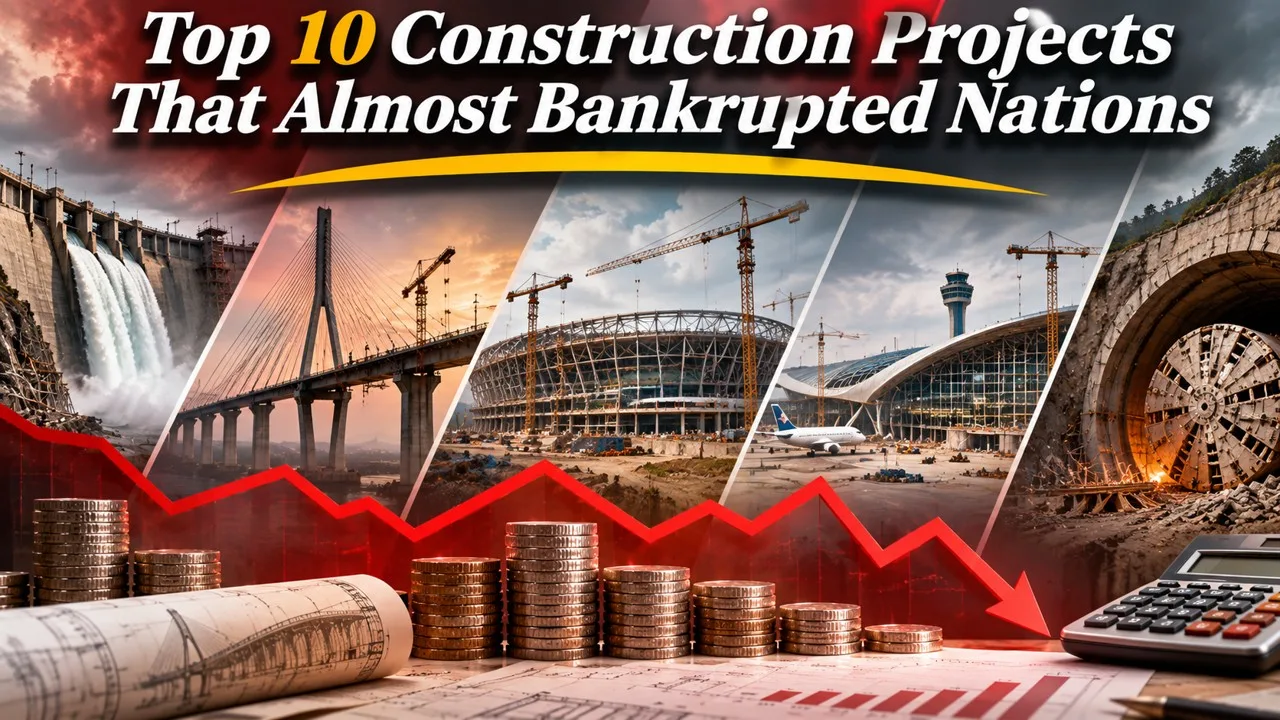
The Darien scheme drained Scottish capital, and later prestige projects have strained treasuries; a costly airport is not always what bankrupts a state. A list of construction projects that "almost bankrupted nations" has to keep its verbs honest [1][8]. Some of the ten cases below did consume a ruinous share of a small country's capital, or helped push a weak treasury over a line. Others were expensive, wasteful, or infamous, and still only one chapter in a wider fiscal crisis [1][10]. This is not a remake of a companion list of the most expensive megaprojects in history, which is a ranking by cost, not a study of national strain [2]. The question here is what the bill did to a government, a kingdom, or a public, not how the object would look on a global price tag.
Where the "debt-trap" story has become a slogan, as around a Sri Lankan port, the entry stays with the documented money and the lease, not with a morality play [6].
Key Facts
Fiscal strain is a share of revenue, a debt that cannot be serviced, or a loss of capital that a small economy cannot absorb. It is not the same as a large headline cost in a large country.
Ten Projects at a Glance
| Rank | Project | The fiscal fact, carefully |
|---|---|---|
| 1 | Athens Olympic venues, 2004 | A heavy bill for a small state, later empty or underused venues; the later Greek crisis had many causes, of which the Games were only one |
| 2 | Palace of the Parliament, Romania | A colossal late-communist palace built at huge cost to a poor country, with neighborhoods demolished |
| 3 | The Darien scheme, Scotland | A late-1690s colonial venture that absorbed a large share of Scotland's liquid capital and failed |
| 4 | Ryugyong Hotel, North Korea | A vast, long-unfinished prestige hotel, a drain in a closed and already strained economy |
| 5 | Hambantota Port, Sri Lanka | A costly port, weak early traffic, heavy borrowing, and a later long lease; "debt-trap" as a single cause is contested |
| 6 | Bokassa's coronation works, Central African Empire | A short, extreme burst of ceremonial spending in a poor state |
| 7 | Infrastructure and debt in Zambia | Recurring cycles in which large borrowed projects and commodity swings have met debt distress |
| 8 | The Newfoundland railway | A line a small dominion struggled to carry, in a wider interwar financial collapse |
| 9 | The French Panama Canal | A private company disaster and a national financial scandal, not a formal bankruptcy of the French state |
| 10 | Spanish "ghost" airports | Empty or barely used airports from the boom years, waste in a larger property and fiscal crisis |
1. Olympic Concrete, and a Wider Crisis
Greece spent heavily on the 2004 Summer Olympics, including venues that later stood underused or expensive to maintain, a familiar Olympic aftertaste [1]. The bill mattered in a smallish economy, and it became part of later arguments about public waste. It did not, by itself, "bankrupt" the country. The crisis that erupted at the end of the decade had deeper roots in public debt, statistics, the euro, and a global crash [1]. A list that puts all of that on a stadium is doing the easy version of the history.
The useful fact is still sharp: a festival of construction can leave a state with objects it cannot easily afford to keep, long after the guests have gone.
2. A Palace That Ate a Neighborhood
The Palace of the Parliament in Bucharest, begun under Nicolae Ceaușescu, is one of the largest administrative buildings on Earth, raised at enormous cost in a country that was already short of heat, food, and freedom [2]. Whole areas of the city were demolished for the civic axis. The project did not go through a Western-style insolvency court, because the state was not that kind of state, but it is a textbook case of a prestige pile that strained a poor treasury and a poorer public [2]. The building still stands, in use, which is not the same as a justification of the price.
Related: Top 10 Largest Palaces in the World
Fiscal strain, here, is measured in a winter and a demolished street, not only in a bond yield.
3. Scotland's Venture, and a Hole in the Capital
In the late 1690s the Company of Scotland tried to plant a colony at Darien, on the Isthmus of Panama, and failed through disease, Spanish opposition, English hostility, and bad planning [3]. A very large share of Scotland's available liquid capital had been subscribed. The loss was national in the small-country sense: it hurt the political class, the treasury's room for maneuver, and the argument, soon afterward, about union with England [3]. Among the ten, this is one of the cleaner "almost ruined us" stories, because the economy was small enough for a single failed venture to be felt everywhere that money was counted.
A colony that never took hold can still leave a ledger that does.
4. A Pyramid of Empty Floors
The Ryugyong Hotel in Pyongyang, a vast pyramid begun in the 1980s, stood for decades as an unfinished or unopened shell, a monument to a prestige plan that outran a closed economy [4]. Conventional bankruptcy language does not map cleanly onto North Korea. Opportunity cost does: concrete, labor, and foreign exchange poured into a hotel that did not, for a generation, do the work of a hotel, in a country that could not easily spare them [4]. Later attempts to clad and revive the tower do not erase that long, expensive pause.
A skyline can be a fiscal fact even when no court is allowed to say so.
5. A Port, a Loan, and a Lease
Hambantota Port, on Sri Lanka's southern coast, was built with large borrowed sums, including Chinese financing, and handled less traffic in its early years than its advocates had promised [5]. In 2017 a long lease of a controlling stake went to a Chinese-state company, a deal that entered global politics as a supposed "debt trap." Specialists still argue about how much of Sri Lanka's later debt distress should be loaded onto this one port, and how much onto other borrowing, policy, and shocks [5]. The careful version is already serious: a costly harbor, weak early returns, and a loss of control under debt pressure. The careless version treats one quay as the whole of a national crisis.
Related: Top 10 Most Expensive Megaprojects in History
A port can be a strain and still not be a parable that explains every later default.
6. A Crown, and a Treasury Turned into Theater
In 1977 Jean-Bédel Bokassa crowned himself in the Central African Empire in a ceremony modeled, at staggering relative cost, on Napoleonic pomp, with new and temporary works, uniforms, and imported display [6]. The state was poor; the bill was not. France was entangled in the politics of the event, which does not make the spending less real for the people who lived under it [6]. This is not a dam or a port. It is infrastructure and construction in the ceremonial sense, and it belongs here because the fiscal shock of a short spectacle can be as sharp, in a small budget, as a slower megaproject.
A coronation is a day. The debt, and the shame of the price, last longer.
7. Borrowed Projects, and a Commodity State
Zambia has repeatedly combined ambitious infrastructure, often financed abroad, with a copper-dependent budget that can fall when prices fall [7]. In recent years the country entered formal debt distress, and large road, power, and other projects sat in the argument about how the bills had piled up [7]. No single "megaproject of Zambia" is the whole story, and this entry will not pretend that one dam or one road bankrupted a republic. The pattern is the fact: construction that looks like development can, if the loans and the commodity cycle line up badly, become a national servicing problem.
A project can be useful and still be part of a dangerous stack of obligations.
8. A Railway a Small Dominion Could Hardly Carry
The Newfoundland Railway, built and rebuilt across a thinly populated island, was a stubborn, costly line for a dominion whose finances were never deep [8]. In the 1930s Newfoundland's wider financial collapse ended responsible government, a crisis with many causes, of which the railway's chronic burden was one honest chapter [8]. The later transfer of the island into Canada is a different story, but the line remains a classic of a small treasury married to a large piece of engineering.
Related: Top 10 Most Bizarre Phobias: Strange Fears That Exist
A railroad can bind a country and still be too expensive for the country it binds.
9. A Canal That Broke a Company, and Shook a Republic
Ferdinand de Lesseps's French attempt to cut a sea-level canal through Panama in the 1880s failed of disease, rain, money, and a wrong technical idea, and the Compagnie Universelle collapsed in a scandal that reached the French parliament [9]. Investors lost heavily. The French state was not formally bankrupted, and the later American canal is a different enterprise. The "almost" in this case belongs to a national financial and political shock, the Panama affair, rather than to a treasury that ceased to pay its soldiers [9]. That is still a construction story with a fiscal crater in the middle.
A failed isthmus can ruin a company and stain a government without ending a state.
10. Airports with Almost No Planes
In the years before the 2008 crash, Spain built or expanded airports that later had little traffic, Ciudad Real and Castellón among the names that became shorthand for "ghost" infrastructure [10]. They were a waste of public and cajas money, and they sat inside a property and construction boom that, when it burst, did serious harm to Spanish banks and public finances [10]. The airports did not, alone, bankrupt the kingdom. They are exhibits in a larger fiscal drama, which is why they belong on a strain list and not on a list that pretends one empty runway is a unique national doom.
Related: Top 10 Oldest Buildings in the World
An unused terminal is a precise kind of folly: you can photograph the silence, and you can still have to pay for it.
Conclusion
Some of these projects came close, in a small country, to a genuine capital or treasury disaster: Darien for Scotland, a palace for late-communist Romania, a railway for Newfoundland, a burst of ceremonial cement in Bangui. Others are better told as expensive chapters in a wider crisis: Athens, Hambantota, Spanish airports, Zambian loans. The French Panama failure is a scandal and a company collapse. The Ryugyong is a closed-economy opportunity cost.
The honest list is therefore not a set of ten bankruptcies. It is a set of ten ways a construction dream can take more from a public than the public can comfortably give, and of the need to say when that is the whole story and when it is only a visible part of it.
- ^ [1] Public-finance and historical accounts of the 2004 Athens Olympics and of Greece's later debt crisis, kept distinct. Britannica: Athens 2004 Olympic Games
- ^ [2] Histories of the Palace of the Parliament in Bucharest and of its cost to late-communist Romania. Britannica: Bucharest
- ^ [3] The Darien scheme and its effect on Scottish capital and later union politics. Britannica: Darien Scheme
- ^ [4] Accounts of the Ryugyong Hotel's long unfinished period and of opportunity cost in the North Korean economy. Britannica: Pyongyang
- ^ [5] Reporting and research on Hambantota Port, its early traffic, associated borrowing, and the 2017 lease, including debate over "debt-trap" claims. Britannica: Sri Lanka
- ^ [6] Histories of Bokassa's 1977 coronation and of its cost to the Central African Empire. Britannica: Jean-Bédel Bokassa
- ^ [7] Analyses of Zambian debt distress and of infrastructure borrowing in a copper-dependent budget. Britannica: Zambia
- ^ [8] The Newfoundland Railway and the dominion's interwar financial collapse. Britannica: Newfoundland and Labrador
- ^ [9] The French Panama Canal company, its collapse, and the Panama scandal in France. Britannica: Panama Canal
- ^ [10] Reporting on underused Spanish airports after the pre-2008 boom, in the context of the wider property and fiscal crisis. Britannica: Spain





















Discussion
Log in with