






 By
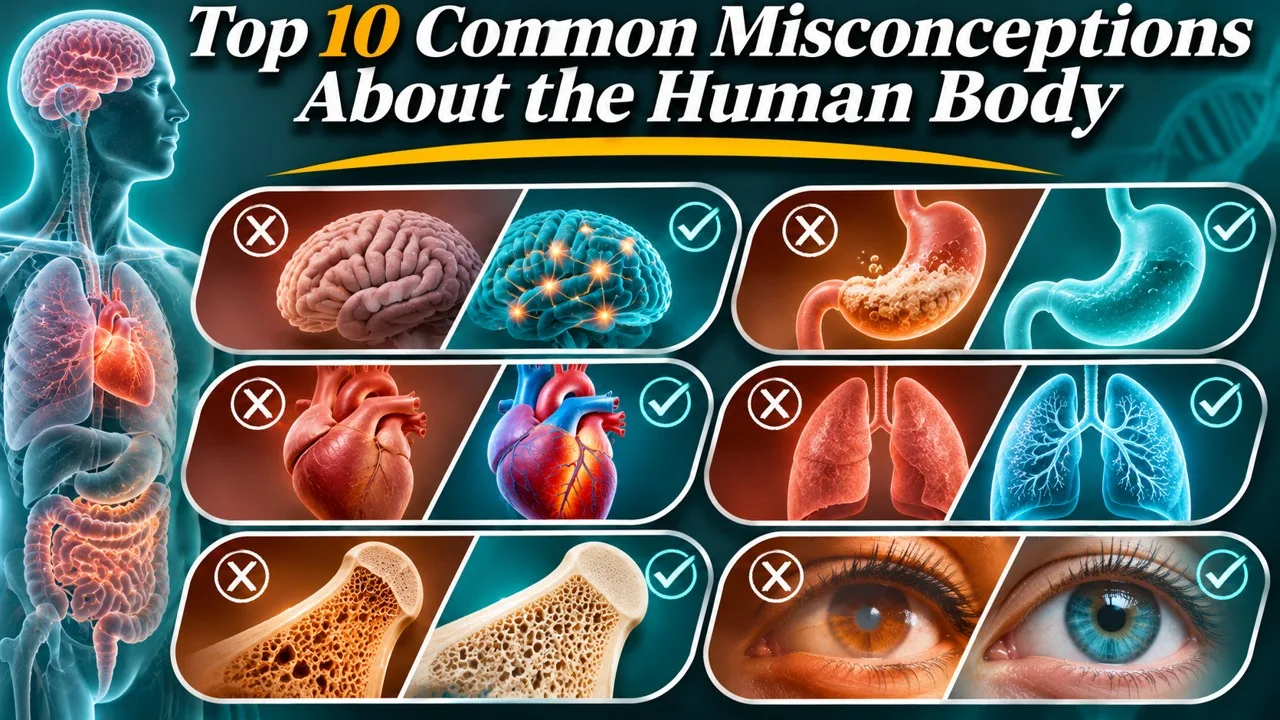
Sweat is not a toxin-purge, and knuckle cracking has not been shown to cause arthritis; several everyday body tips are folklore dressed as hygiene. Advice about the body travels faster than the papers that test it, and a list of misconceptions is only useful if it does not become a second set of medical instructions [2][6]. Nothing below is a diagnosis, a treatment plan, or a reason to ignore a clinician. The ten items are everyday claims that fall down when they are measured, from toxin-sweat folklore to the idea that a wound must be left open to the air in order to heal [2][9].
A companion caution: "fluoride is poison" and "all fat is unhealthy" are both too blunt for the evidence, which is about dose, type, and context, not about a single villain in the diet or the tap [3][8]. The same caution applies to wounds, ears, and flakes: a folk rule can be the opposite of a current first-aid or dermatology habit, and still sound like common sense.
Key Facts
A misconception can start as a half-truth: sweat does carry some waste, fat is calorie-dense, earwax is a substance people want to remove. The error is in the leap.
Ten Claims at a Glance
| Rank | Claim | What the evidence supports |
|---|---|---|
| 1 | A lost eyelash is bad luck | It is folklore, not physiology |
| 2 | Sweat flushes toxins and melts fat | Sweat is mainly for cooling; fat is not excreted as a liquid through the skin in any useful sense |
| 3 | Fluoride, at ordinary water-treatment levels, is a general hazard | High doses can harm; recommended community fluoridation is supported by dental authorities as a cavity-prevention measure |
| 4 | Only women get varicose veins | Men develop them too, though women are more often diagnosed |
| 5 | Cracking knuckles causes arthritis and makes joints grow | Long-running observations have not shown that habitual cracking causes arthritis |
| 6 | Ears need routine digging out | Earwax usually migrates on its own; cotton swabs can injure |
| 7 | Dandruff is simply a dry scalp | It is often an inflammatory, yeast-associated condition and can occur with oiliness |
| 8 | Fat, as such, is unhealthy | Some fats are essential; type and amount matter more than the word "fat" |
| 9 | A wound will not heal unless it is left open to the air | Moist, protected healing is often better; "let it breathe" is not a general law |
| 10 | We have only one nose | Two nasal cavities, with a cycle of congestion, do much of the work somewhat independently |
1. Luck Is Not an Organ
The idea that a lost eyelash should be wished on, or that it is a bad omen, belongs to folklore, not to anatomy [1]. Eyelashes fall and regrow as part of a normal cycle. They can also fall more than usual in some medical conditions, which is a reason to see a clinician, not a reason to read the future [1]. This entry is on the list because it shows how quickly a body fact, a hair on a cheek, can be recruited into a superstition.
Physiology does not owe anyone a fortune. It owes them a follicle, and a calendar of ordinary shedding that needs no omen to explain it.
2. Sweat Cools; It Does Not Launder
Sweat is a cooling system. It is mostly water, with salt and small amounts of other compounds [2]. The liver and kidneys do the serious work of handling metabolic waste. A hard workout can look "detoxifying" because it is wet and effortful, but the weight that vanishes in the locker room is mostly water, and it returns when you drink [2]. Fat is lost, when it is lost, through a slower metabolic process, not as a bead of grease on the skin. "Sweat out toxins" and "sweat off fat" are marketing sentences, not a measured route around physiology.
Exercise is still good for many people. It does not need a myth about a toxin tap, and a scale that drops after a workout should be read as water until a slower trend says otherwise.
Related: Top 10 Most Bizarre Phobias: Strange Fears That Exist
3. A Dose, Not a Demon
Fluoride in high doses can be harmful, and there are real debates about implementation, about dental fluorosis, and about what concentration belongs in a public supply [3]. That is not the same as the claim that fluoride, at the levels used in recommended community water fluoridation, is a general poison being hidden in the tap [3]. Major dental and public-health bodies support those recommended levels as a way to reduce cavities, especially in children. A reader who has a local, medical, or dental question should take it to a professional, not to a list of misconceptions.
The myth is the leap from "a compound can be harmful at high dose" to "this public measure is a hazard by nature." Chemistry is full of substances of which that leap would be true and false at once, depending on the amount.
4. Varicose Veins Are Not a Women's Tax
Varicose veins are more often discussed, and more often treated, in women, which has helped a popular idea that they are a female condition [4]. Men develop them too. Risk rises with age, with standing work, with family history, and with other factors that do not respect a gender line [4]. Leaving men out of the picture can delay recognition. The veins themselves are enlarged, often uncomfortable, and sometimes a medical issue; they are not a verdict on vanity.
A misconception can be a missing patient as much as a wrong mechanism.
5. A Noise That Has Been Studied
The pop of a knuckle is, in the usual account, a bubble in joint fluid, not a bone grinding itself down [5]. The fear that habitual cracking causes arthritis, or permanently enlarges the joints, is old and testable. Studies, including long informal self-experiments and more formal comparisons, have not shown that cracking, by itself, produces arthritis [5]. It may annoy the people who have to hear it. Annoyance is not a disease process. Anyone with pain, swelling, or a sudden change in a joint should still get advice, because pain is a different fact from a habit.
The myth is useful to parents who want a medical-sounding reason to stop a noise. It is not useful as anatomy, and it should not be used to dismiss a joint that actually hurts.
Related: Top 10 Oldest Buildings in the World
6. Wax That Knows the Way Out
Earwax is not simply dirt. It is a protective, self-moving substance, and in many ears it travels outward on its own with the motion of the jaw [6]. Routine digging with cotton swabs can push wax back, irritate the canal, or, in the worst cases, injure the eardrum [6]. That is not a command to never treat a blockage; impacted wax is a real problem and a reason to see a professional. It is a command to stop treating the ear as a room that must be emptied daily.
"Clean" is not always healthier. In the canal, it is often just deeper.
7. Not Always a Dry Scalp
Dandruff is widely blamed on dryness, and dry skin can flake [7]. Much of what people call dandruff, though, is related to seborrheic dermatitis and to a yeast, Malassezia, that lives on the scalp; it can appear on skin that is oily rather than tight and dry [7]. Treatments that only add moisture may therefore miss the point, and harsh stripping can make matters worse. This is still not a prescription. It is a reason not to trust the first shop-aisle story about a dry December.
Flakes are a sign on the scalp. They are not a simple weather report about simple winter dryness.
8. Fat Is a Word with Subtypes
Dietary fat is energy-dense, and some eating patterns that are heavy in certain fats are associated with worse health [8]. It does not follow that "fat is unhealthy" as a blanket rule. The body needs certain fatty acids; fat helps absorb some vitamins; and the type of fat, the pattern of the diet, and the rest of a person's health all matter more than the four-letter scare [8]. Public advice has shifted more than once, which is itself a reason to be modest, and to take personal questions to a clinician or a registered dietitian rather than to a slogan.
Related: 10 Sikh Gurus: The Pillars of Sikhism Who Shaped Faith, Equality, Courage, and Humanity
A nutrient can be necessary, excessive, or badly chosen. The myth is the single adjective.
9. Air Is Not a Dressing
A folk rule says that a wound will not heal unless it can "breathe" [9]. In ordinary first aid and in clinical practice, a clean, appropriately covered, slightly moist environment is often better for healing than a dried, open scab, which can slow epithelial repair [9]. Serious, deep, dirty, or worsening wounds need professional care, not a theory of ventilation. The misconception is the general law, not the idea that air is dirty or clean. A bandage is not a betrayal of nature.
Let the evidence, and a clinician when the wound is more serious, not a proverb, decide whether a particular injury should be covered.
10. Two Airways, One Face
We speak of "the nose" as if it were a single tube [10]. Inside, a septum divides two nasal cavities, and a well-known nasal cycle often leaves one side more open than the other for a time, then switches [10]. Smell and airflow are therefore not a single pipe. The misconception "we have only one nose" is a trick of ordinary language, and it is a useful one to correct because it leads into real physiology: two chambers, a cycle, and a sense of smell that also uses the back of the mouth.
Related: Top 10 Tallest Buildings in the World
The face shows one shape. The airway keeps two books, and a stuffed cold that seems to "switch sides" overnight is often that cycle made obvious, not a mystery illness all by itself.
Conclusion
The body's folklore has a pattern. A real process, sweat, wax, fat, a flake, a pop, a scab, is asked to do a job it does not do, or to obey a rule that was never measured. Luck, toxins, a poison in the tap, a women's-only vein, an arthritis curse, a daily swab, a dry-scalp story, a fat ban, an open wound, a single nose: each claim is simpler than the organ it describes.
The useful correction is usually modest. Dose matters. Sex is not a perfect filter. Moisture can help a wound. A professional should be in the room when the problem is personal. A list can retire a myth. It cannot replace a clinic, and it should not be quoted as if it had examined the person who is reading it.
- ^ [1] Dermatology overviews of normal eyelash shedding and of when hair loss warrants clinical advice. Britannica: Eyelash
- ^ [2] Physiology of sweating as thermoregulation, and of fat loss as a metabolic process, not a skin excretion. Britannica: Sweat
- ^ [3] Public-health and dental statements on community water fluoridation at recommended levels, and on fluoride toxicity at high dose. CDC: Community water fluoridation
- ^ [4] Clinical overviews of varicose veins in women and men. Britannica: Varicose vein
- ^ [5] Studies and reviews of knuckle cracking and the absence of a demonstrated link to arthritis. Britannica: Joint
- ^ [6] Clinical guidance on earwax as a normal, usually self-clearing substance, and on the risks of cotton swabs. Britannica: Earwax
- ^ [7] Dermatological accounts of dandruff and seborrheic dermatitis, including the role of Malassezia. Britannica: Dandruff
- ^ [8] Nutrition reviews of dietary fats, essential fatty acids, and why type and amount matter. Britannica: Fat
- ^ [9] Wound-care discussions of moist healing versus leaving a wound open to dry. Britannica: Wound
- ^ [10] Anatomy of the nasal cavities and descriptions of the nasal cycle. Britannica: Nose






















Discussion
Log in with