






 By
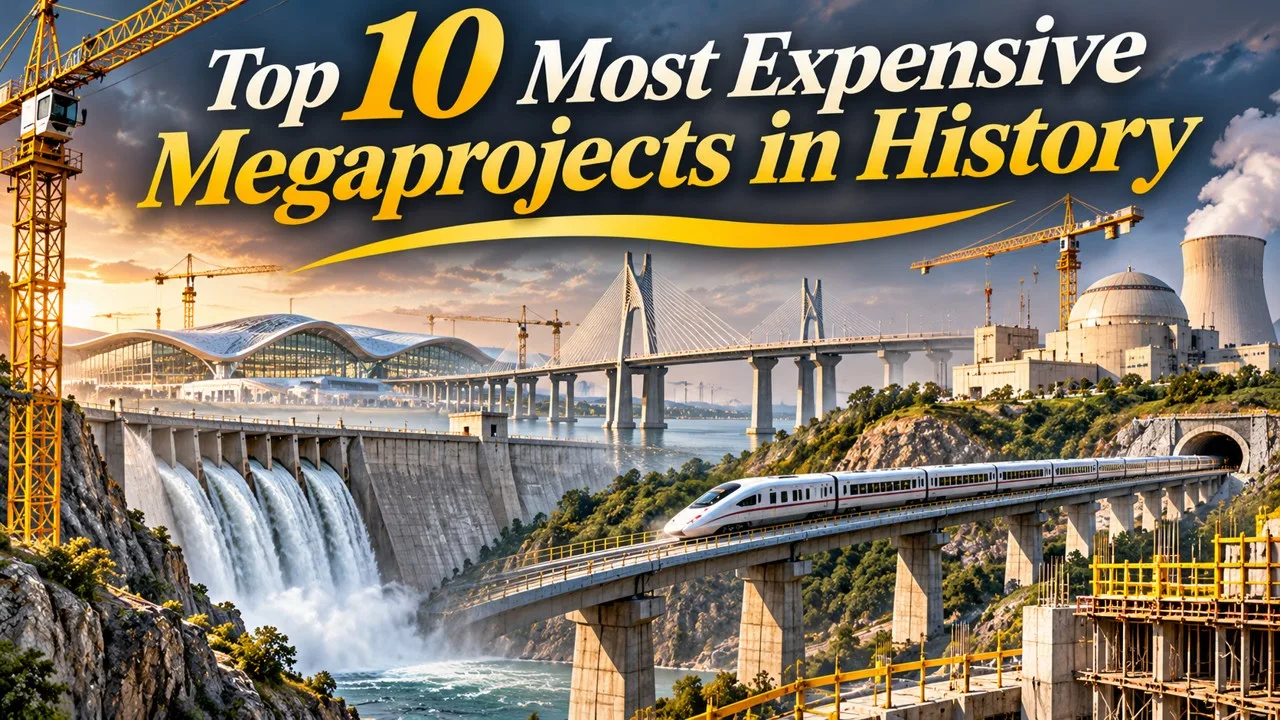
Ten of the costliest modern megaprojects are listed here with documented figures, from the International Space Station to the Large Hadron Collider. A single, official ranking of "the most expensive projects in history" does not exist. Costs are published in different currencies, in different years, and with different definitions: some figures are construction only, some include interest, and some include years of operations [1][6][9]. The order below is a curated guide based on commonly cited total program or construction costs, with the basis stated in each entry. It is not a claim that every older wonder, or every inflation-adjusted pyramid or wartime program, would fall behind these ten.
The list is limited to large, modern, well-documented projects that often appear in megaproject tallies: a space station, a fusion experiment, a dam, a high-speed railway, a highway tunnel, a channel tunnel, an airliner program, a hotel complex, a space telescope, and a particle collider. A figure given in euros or yuan is left in that currency first, with an approximate dollar sense only where a cited source provides one.
Key Facts
Figures are not adjusted to one base year unless a source says so. "With interest" and "including operations" are larger than "construction only." ITER's cost is still moving.
Ten Costly Megaprojects at a Glance
| Rank | Project | Type | A documented cost | What the figure includes |
|---|---|---|---|---|
| 1 | International Space Station | Orbital laboratory | About €100 billion (ESA) | Development, assembly, and 10 years of operations, shared among partners |
| 2 | ITER | Fusion experiment, France | Multi-decade, still rising; 2014-era totals around $21 billion, later additions | International construction and in-kind contributions |
| 3 | Beijing–Shanghai high-speed railway | High-speed line, China | 220.9 billion yuan (about $33 billion at opening, Reuters) | Construction of the 1,318 km line, opened 2011 |
| 4 | Three Gorges Dam | Hydropower, China | About 203.9 billion yuan, official project figure | Official static investment of the water project |
| 5 | The Big Dig | Highway tunnels, Boston | $14.6–14.8 billion construction; $24.3 billion including interest | Central Artery/Tunnel Project |
| 6 | Channel Tunnel | Rail tunnel, UK–France | About $21 billion in commonly cited 1990s tallies | Construction of the undersea rail link, opened 1994 |
| 7 | Airbus A380 | Airliner program | About $25 billion in compiled program figures | Development and production program, not one building |
| 8 | The Clock Towers (Abraj Al-Bait) | Hotel complex, Mecca | About $15 billion, widely reported | The seven-tower complex |
| 9 | James Webb Space Telescope | Space observatory | $9.7 billion NASA lifecycle (Planetary Society, from NASA budgets) | NASA development plus early operations; partners extra |
| 10 | Large Hadron Collider | Particle accelerator, CERN | About $4.75–6 billion in commonly cited construction figures | Machine construction, not all later upgrades and running costs |
1. International Space Station
The International Space Station is a laboratory in low Earth orbit, built and run by NASA, Roscosmos, ESA, JAXA, and the Canadian Space Agency. It has been occupied continuously since 2 November 2000 and is the largest human-made spacecraft yet flown [1]. Because it was assembled over many years and is still operated, its cost is a program cost, not a single construction invoice.
The European Space Agency has stated that the cost of the station, including development, assembly, and running costs over ten years, comes to about €100 billion, shared among the partners over a period of almost 30 years, with Europe's share around €8 billion [2]. Other public tallies of lifetime costs, especially those that add later years of operations, run higher. Either way, among the projects on this list the station is the most expensive in the sense of a multi-decade, multi-partner program.
The figure is large because the work is done in orbit, because the partners built unique modules, and because a crewed laboratory has to be supplied and staffed every day of its life [1][2]. It is not comparable, without adjustment, to a dam or a railway that has a clearer opening date and a sharper end to capital spending.
2. ITER
ITER is an international fusion experiment under construction at Cadarache in southern France, with the European Union as host and China, India, Japan, Russia, South Korea, and the United States as partners [3]. The machine is designed to study burning plasma at a scale larger than existing tokamaks. Construction has been under way since 2013, and the timetable for first plasma and later full operation has slipped more than once [3][4].
Cost estimates have slipped with the timetable. A U.S. Congressional Research Service review notes that early figures around $10–12 billion were later revised; a 2014-era estimate of about $21 billion (in then-year or inflation-adjusted forms depending on the table) has been followed by further additions, including a 2024 announcement of more delay and more money [4]. The U.S. share alone has been re-baselined, with a total project cost for American contributions on the order of $6.5 billion in 2023 dollars [4]. Some compiled lists now float still higher euro totals.
ITER therefore cannot be given a single final price in the way a completed railway can. It belongs near the top of a cost list because even the mid-range official estimates already rival other entries, and because the project is not finished. Any ranking that treats ITER as a settled number is out of date by design.
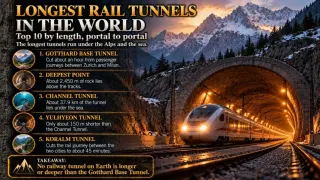
Related: Top 10 Longest Rail Tunnels in the World
3. Beijing–Shanghai High-Speed Railway
The Beijing–Shanghai high-speed railway is a 1,318-kilometre line linking two of China's main economic regions. Construction began on 18 April 2008, and the line opened to commercial service on 30 June 2011. It has been described as the longest high-speed line built in a single phase [5].
Reuters, reporting at the opening, gave the cost as 220.9 billion yuan, about $33 billion at the exchange rates then used in that report [6]. That is a construction-and-project figure for a completed railway, not a lifetime operations cost, and it is one of the clearer official-scale numbers on this list. The line was a centerpiece of China's high-speed rail build-out, and its budget was discussed in public at the time as both an achievement and a financing concern [6].
Unlike the space station or ITER, the Beijing–Shanghai line has a defined route, a defined opening date, and a published price in yuan. That is why it is useful as a comparison point, provided the comparison keeps currency and year in view.
4. Three Gorges Dam
The Three Gorges Dam, on the Yangtze River near Sandouping in Hubei, is a concrete gravity dam and the world's largest power station by installed capacity, at 22,500 megawatts [7]. Construction was a national project with a long design history, a start in the 1990s, and later official completion formalities. The dam changed navigation, flood control, and electricity supply on a large stretch of the river, and it also required the relocation of a large population and the flooding of many places upstream [7].
Official Chinese figures have put the project's cost on the order of 200 billion yuan. An official English-language government site has cited a total of about 203.9 billion yuan; later completion reporting has spoken of more than 200 billion yuan [8][9]. Converted to dollars, that official total is smaller than some Western compilations that quote figures around $59 billion, a gap that usually means different items, different years, or different exchange rates are being lumped together. This entry follows the official yuan figure and treats the larger dollar tallies as a warning, not as a second official price.
On any of those measures, Three Gorges is one of the costliest single civil-engineering works of the past half-century, and it is a reminder that a dam's budget includes more than concrete.
5. The Big Dig
Boston's Big Dig, officially the Central Artery/Tunnel Project, moved the elevated Central Artery of Interstate 93 into the O'Neill Tunnel, built the Ted Williams Tunnel to extend Interstate 90 to Logan Airport, and added the Zakim Bunker Hill Bridge and the Rose Fitzgerald Kennedy Greenway [10]. Planning began in the early 1980s; construction ran from 1991 to 2006, and the project was concluded in December 2007 [10].
Related: Top 10 Most Dangerous Science Experiments in History
The construction cost is usually given at about $14.6 to $14.8 billion. A later official Massachusetts estimate put the total at $24.3 billion once interest was included, which would make it the most expensive highway project in U.S. history in that accounting [10][11]. The gap between the two numbers is the point: a megaproject's "cost" can mean the construction contracts or the long bill to finance them.
The Big Dig is smaller than a national high-speed line or a space station, but it is a textbook of urban civil-engineering cost, delay, and political argument, and it belongs on a list that is honest about how figures are built.
6. Channel Tunnel
The Channel Tunnel is a 50.46-kilometre railway tunnel under the English Channel, between Folkestone in the United Kingdom and Coquelles in France. It opened in 1994 and remains the only fixed link between Great Britain and the European mainland [12]. The work combined bored running tunnels, a service tunnel, and terminal works on both sides of the water.
Commonly cited tallies from the 1990s put the cost around $21 billion, after a large overrun against earlier estimates [11][12]. As with other entries, later writers sometimes inflate or convert that number without saying how. The useful facts are that the tunnel was privately financed to a degree unusual for a work of its size, that it cost more than first advertised, and that the finished link is still the physical standard of comparison for undersea rail.
A tunnel's cost is mostly in the digging, the lining, the safety systems, and the terminals, not in decades of orbital operations. That is why the Channel Tunnel and the ISS can both be "expensive" without being the same kind of bill.
7. Airbus A380
The Airbus A380 is the world's largest passenger airliner, a full-length double-deck jet developed and produced by Airbus from 2003 until production ended in 2021 [13]. It is a product program rather than a single building or a single civil site, but compiled megaproject lists include it because the development bill was in the same range as major public works.
Figures vary with what is counted. A compiled list of megaprojects has put the program at about $25 billion; an older comparison in the U.S. press used a lower "final cost" of about $15 billion [11][13]. The higher compiled figure is the safer one to quote as a program total, with the lower one as a reminder that "cost of the A380" is not a single audited line. The plane's commercial life was shorter and less profitable than Airbus had hoped, which is part of why the program is now closed [13].
Related: Top 10 Fastest Trains in the World
Including an airliner on a list with dams and tunnels is a category stretch, but it is a useful one. Some of the largest cheques of the modern era were written for a type certificate and an assembly line, not for a reservoir.
8. The Clock Towers in Mecca
The Clock Towers, formerly known as Abraj Al-Bait, are a government-owned complex of seven hotel skyscrapers in Mecca, Saudi Arabia, built as part of a project to house pilgrims near the Grand Mosque. The central Mecca Royal Clock Tower is among the tallest buildings in the world and holds a Guinness record as the tallest clock tower; the clock faces are the largest of their kind [14].
The complex is widely reported to have cost about $15 billion, a figure that has appeared in mainstream business reporting, and it has been described as the world's second most expensive building complex in Guinness-related accounts [14][15]. Unlike a railway, the towers are a dense piece of real estate in one of the most constrained religious precincts on earth, which is why the cost per site is so high.
The buildings are hotels and related facilities, not a science machine. They are on this list because a single urban complex can, at that site and that scale, rival the budget of a national infrastructure line.
9. James Webb Space Telescope
The James Webb Space Telescope is the largest telescope in space, built to observe the universe in infrared with a deployable segmented mirror. It is a joint project of NASA, ESA, and the Canadian Space Agency, and it is designed to see objects too faint, distant, or cool for Hubble in that role [16].
A Planetary Society analysis of NASA budget requests put NASA's lifecycle cost at about $9.7 billion over 24 years: $8.8 billion for spacecraft development between 2003 and 2021, and $861 million planned for five years of operations, or about $10.8 billion in 2020 dollars [9]. Partner contributions sit on top of that NASA total. The observatory was originally pitched at a much lower cost and an earlier launch; technical problems and management failures drove both the delay to 2021 and the higher bill [9].
Related: Top 10 Most Futuristic Transportation Inventions
Among science machines that have actually been finished and launched, Webb is in the same conversation as the LHC, at a higher NASA program cost, and still well below the multi-decade cost of the ISS.
10. Large Hadron Collider
The Large Hadron Collider is the world's largest and highest-energy particle accelerator, built by CERN in a 27-kilometre tunnel under the France–Switzerland border near Geneva. Construction of the machine took place between the late 1990s and 2008, with thousands of scientists and many countries taking part [17]. It has been the site of the discovery of the Higgs boson and of a wide program of proton and heavy-ion physics.
Construction-cost figures commonly cited in public comparisons are about $4.75 billion to $6 billion, depending on the year of the article and what is included [11][17]. Later upgrades, electricity, and operations are extra. The LHC is therefore cheaper to build than Webb was for NASA, and much cheaper than the ISS, even though it is often called the most expensive scientific instrument on Earth in a narrower sense: a single laboratory machine, in a tunnel, built to a completion date.
That narrower sense is worth keeping. A collider, a telescope, and a space station are all science megaprojects, but they do not buy the same thing, and they should not be treated as one number with different logos.
Conclusion
The ten projects above are all expensive, and they are not expensive in the same way. The ISS and ITER are long international programs whose totals include, or will include, years of work after assembly starts. Three Gorges and the Beijing–Shanghai railway are national civil works with large official yuan prices. The Big Dig and the Channel Tunnel are transport tunnels whose published totals may or may not include financing. The A380 is an industrial program. The Clock Towers are a dense hotel complex. Webb and the LHC are scientific machines with clearer, if still imperfect, price tags.
Anyone who wants a single ranking in 2026 dollars, covering every empire and every war, will have to do a different and more speculative study. This list has a smaller aim: to put ten documented modern megaprojects on one page, with their figures, their years, and their caveats attached.
- ^ [1] "International Space Station." Wikipedia. Wikipedia: International Space Station
- ^ [2] "How much does it cost?" European Space Agency, on the ISS program cost of about €100 billion. ESA: How much does the ISS cost?
- ^ [3] "ITER." Wikipedia. Wikipedia: ITER
- ^ [4] "ITER—An International Nuclear Fusion Research and Development Facility." Congressional Research Service. CRS report on ITER costs
- ^ [5] "Beijing–Shanghai high-speed railway." Wikipedia. Wikipedia: Beijing–Shanghai high-speed railway
- ^ [6] "China unveils landmark rail line, shrugs off financing worries." Reuters, 13 June 2011, citing a cost of 220.9 billion yuan. Reuters: Beijing–Shanghai line
- ^ [7] "Three Gorges Dam." Wikipedia. Wikipedia: Three Gorges Dam
- ^ [8] "China Yangtze Three Gorges Project Introduction." China Internet Information Center, official cost figure around 203.9 billion yuan. china.org.cn: Three Gorges Project
- ^ [9] "How much does the James Webb Space Telescope cost?" The Planetary Society, from NASA budget requests. The Planetary Society: JWST cost
- ^ [10] "Big Dig." Wikipedia. Wikipedia: Big Dig
- ^ [11] "7 Things That Cost Less Than The Big Dig." WBUR, 12 July 2012, citing a $24.3 billion official total including interest, and comparison figures for the Channel Tunnel, A380, and LHC. WBUR: Big Dig comparisons
- ^ [12] "Channel Tunnel." Wikipedia. Wikipedia: Channel Tunnel
- ^ [13] "Airbus A380." Wikipedia. Wikipedia: Airbus A380
- ^ [14] "The Clock Towers." Wikipedia, including the former Abraj Al-Bait name. Wikipedia: The Clock Towers
- ^ [15] "Higher purpose." South China Morning Post, reporting a cost of about $15 billion for the Mecca clock-tower complex. South China Morning Post: Clock Towers cost
- ^ [16] "James Webb Space Telescope." Wikipedia. Wikipedia: James Webb Space Telescope
- ^ [17] "Large Hadron Collider." Wikipedia. Wikipedia: Large Hadron Collider





















Discussion
Log in with