






 By
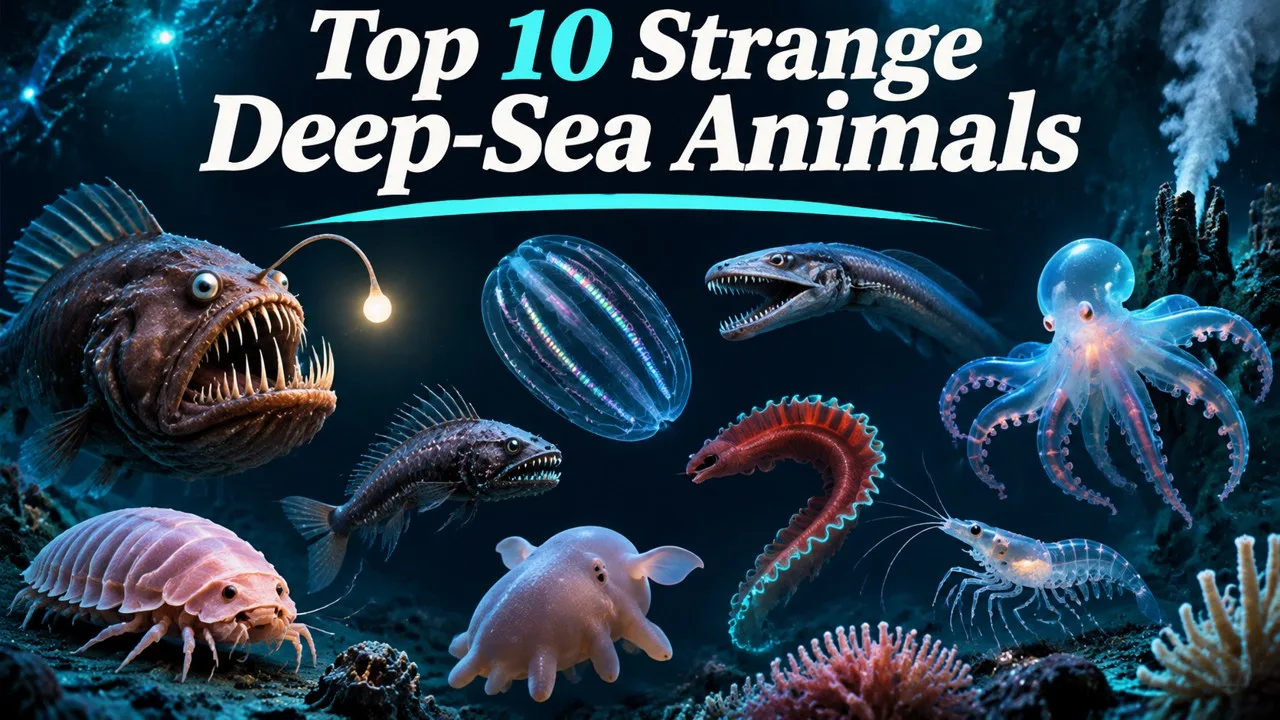
Barreleyes, bone-eating worms, yeti crabs and a scaly-foot snail are among the deep-sea animals that look invented until the expedition reports are opened. This list is a curated set of ten documented species, or small groups, from the midwater and the seafloor, not a mixed bag of coastal animals and microbes [2][6]. Several popular candidates sit in the wrong habitat, or in the wrong kingdom, for a list of strange deep-sea animals: a tiny coastal dolphin, a leopard-shark mating story, the surface-living blue dragon nudibranch, a climbing catfish, a colonial Portuguese man-of-war, and giant marine viruses [1]. They are left out here, and replaced by animals that actually belong in the dark water.
The ten below can be checked in expedition imagery, taxonomic papers, and standard zoological overviews [3][8][10].
Key Facts
The deep sea, in ordinary oceanographic use, begins below the sunlit surface layers and includes midwater and abyssal habitats. Many of its best-known "strange" animals were filmed or collected only in recent decades.
Ten Deep-Sea Animals at a Glance
| Rank | Animal | Typical place | The documented surprise |
|---|---|---|---|
| 1 | The barreleye, Macropinna microstoma | Midwater of the North Pacific | A transparent shield over tubular, rotating eyes |
| 2 | Bone-eating worms, Osedax | Whale falls on the deep seafloor | Worms that bore into bone and live on its fats |
| 3 | Supergiant amphipods | Hadal and abyssal trenches and plains | Shrimp-like crustaceans the size of a forearm |
| 4 | The glass octopus, Vitreledonella richardi | Tropical and subtropical midwater | A nearly transparent pelagic octopus |
| 5 | Deep-sea anglerfishes | Midwater, especially in the dark zone | A lure, and, in some species, a tiny attached male |
| 6 | The vampire squid, Vampyroteuthis infernalis | Oxygen-minimum midwater | A living link-like cephalopod that is neither squid nor octopus |
| 7 | Giant isopods, Bathynomus | Deep seafloors, especially in low-latitude waters | A huge relative of the familiar woodlouse |
| 8 | Yeti crabs, Kiwa | Hydrothermal vents and methane seeps | Crabs with bacterial gardens on long, pale setae |
| 9 | The frilled shark, Chlamydoselachus anguineus | Deep slopes and canyons | An eel-like shark with rows of trident teeth |
| 10 | The scaly-foot snail, Chrysomallon squamiferum | Indian Ocean vents | A snail with iron-mineralized scales on its foot |
1. The Barreleye
Macropinna microstoma, the barreleye, is a midwater fish with tubular eyes that point, in living animals, through a transparent, fluid-filled shield over the head [1]. For decades, museum specimens with damaged shields left the eyes looking fixed and upward; later remotely operated-vehicle footage, including work associated with the Monterey Bay Aquarium Research Institute, showed that the eyes can rotate and that the shield is part of the living anatomy [1]. The fish seems to hover in dim water and to steal, or at least to take, food from siphonophore stinging tentacles in some observations.
The animal looks like a drawing of an idea. It is a documented teleost, with a published range and a functional explanation for the green, tubular eyes: gathering faint light, and protecting the eyes from stings, in a habitat where both problems are real.
2. Bone-Eating Worms
Osedax, the "bone-eating" or "zombie" worms, were described from whale skeletons on the deep seafloor, where females bore into bone and rely on symbiotic bacteria to extract lipids [2]. They lack a conventional mouth and gut in the adult female, and they have an extreme sexual system in which dwarf males live in large numbers in the female's tube [2]. Whale falls are ephemeral habitats; the worms are specialists on a short-lived island of bone.
The common names are theatrical. The biology is not: a worm, a bacterium, and a skeleton, mapped by submersible and by DNA, in a food web that begins only after a large animal has died and sunk. No further grimness is required to see why the genus startled zoologists.
Related: Top 10 Strangest Deep-Sea Creatures
3. Supergiant Amphipods
Amphipods are usually small, laterally flattened crustaceans. In the deep sea, some species, including Alicella gigantea and certain Hirondellea, grow to tens of centimeters, a size that has earned them the informal label "supergiant" [3]. Baited cameras and traps in trenches and on abyssal plains have recorded animals the length of a human hand or longer, scavengers in a food-poor world [3]. Gigantism in the deep is not limited to amphipods, but these are among the most striking arthropod examples.
A "shrimp" the size of a burrowing pet is unexpected only if one knows the ordinary garden amphipod. In the hadal water, the same body plan has simply been scaled up, with all the physiological questions that scaling raises.
4. The Glass Octopus
Vitreledonella richardi, the glass octopus, is a pelagic species whose tissues are largely transparent, with visible optic nerves and a delicate, almost insect-like silhouette in midwater photographs [4]. It is a true octopus, not a nickname for a glass squid, and it lives in deep, open water rather than on a reef [4]. Most of what the public knows of it comes from rare in-situ footage, which is why it can seem more legendary than a coastal octopus.
Transparency is a midwater habit shared with other gelatinous animals. The glass octopus is unusual because the habit is applied so completely to a cephalopod that people think of as a den-living, colored hunter.
5. Deep-Sea Anglerfishes
Deep-sea anglerfishes, in several families of the suborder Ceratioidei, include some of the most frequently illustrated animals of the dark zone: a lure derived from a dorsal-fin ray, a large mouth, and, in a number of species, a reproductive system in which a tiny male may attach, temporarily or permanently, to a much larger female [5]. The lure can bear bioluminescent bacteria. The attached-male story is true for some species and should not be spread, as a single rule, to every anglerfish [5].
Related: Top 10 Remarkable Jellyfish of the World
The group is diverse, and it is well documented in trawl collections and in later imaging. The surprise that remains, after the textbook figure is set aside, is how many different ways a midwater fish has built a light, a mouth, and a meeting between the sexes in a vast, dark volume of water.
6. The Vampire Squid
Vampyroteuthis infernalis, despite its name, is neither a true squid nor an octopus, but the sole surviving member of its own cephalopod order, living in midwater oxygen-minimum zones [6]. It can raise a webbed, cape-like arm crown, it has photophores, and it feeds, at least in part, by gathering "marine snow" with two retractile filaments rather than by hunting large prey in the popular vampire sense [6]. The name is a nineteenth-century flourish; the animal is a detritivore of a low-oxygen habitat.
That correction makes it stranger, not tamer. A deep-sea cephalopod that farms the slow rain of particles, in water that would stress many fishes, is a better fact than a monstrous nickname.
7. Giant Isopods
Giant isopods of the genus Bathynomus live on deep continental slopes and basins, especially in the tropical and subtropical Atlantic and Indo-Pacific, and can exceed 30 centimeters in length [7]. They are scavengers and predators of the seafloor, close relatives of the familiar terrestrial woodlouse, scaled into a cold, dark, often food-poor habitat [7]. Video from baited cameras has made them a public face of the deep, sometimes too public, as if one genus were the whole abyss.
The zoological point is still simple and strong. A body plan that also lives under a plant pot can, in the deep sea, become a heavy, pale animal the size of a platter, with the same articulated armor and the same basic isopod design. Fisheries and cameras have made that comparison easy to check, and hard to forget.
Related: Top 10 Longest-Living Animals on Earth
8. Yeti Crabs
Yeti crabs, genus Kiwa, were described from hydrothermal vents and later from methane seeps, where they carry dense, pale setae on their claws and arms that host chemosynthetic bacteria [8]. Some species appear to farm or graze those bacteria, a living that depends on chemical energy rather than on sunlight [8]. The first formal description, in the mid-2000s, made a new family as well as a new genus, and later expeditions added species in the Southern Ocean and elsewhere.
The "yeti" is a press name for the hair. The serious fact is a crab that has turned a bacterial coat into a vent-floor livelihood, in water that would scald or starve a coastal relative.
9. The Frilled Shark
Chlamydoselachus anguineus, the frilled shark, is a deep-slope shark with an eel-like body, six gill slits, and rows of three-pointed teeth in a long mouth [9]. It is sometimes called a "living fossil," a phrase that should be used carefully: the species is living, and it retains features that look archaic compared with typical reef sharks, but it has its own long evolutionary history [9]. Specimens are rare in shallow water; most biological knowledge comes from deep-set fisheries and from occasional stranded or hauled animals.
The unusual silhouette — a shark that swims like an eel and bites with a trident row — is enough. It does not need a prehistoric costume to belong on a deep-sea list.
Related: Top 10 Most Dangerous Fish in the World
10. The Scaly-Foot Snail
Chrysomallon squamiferum, the scaly-foot snail or "sea pangolin," lives on hydrothermal vents in the Indian Ocean and carries rows of sclerites on its foot that can be mineralized with iron sulfides, a kind of armor unknown in this form in other living snails [10]. The species has become a symbol of vent endemism and of the mining debate on the mid-ocean ridges, and it is listed as endangered in conservation assessments that take that threat into account [10]. The shell and the scales are both part of a documented, extreme adaptation to a metal-rich, unstable habitat.
A snail that grows iron-bearing scales sounds like an invention. It is a published gastropod, with a type locality, a genome of interest to materials science, and a conservation file. That combination is as strange as any midwater portrait.
Conclusion
The deep sea does not need coastal oddities or microscopic viruses to look unfamiliar. A fish with a transparent forehead, a worm that lives in bone, a forearm-length amphipod, a glass octopus, an anglerfish, a vampire squid that is neither, a giant isopod, a yeti crab, a frilled shark, and an iron-scaled snail are all on the record, in the right habitat.
The substitutions on this list are a form of accuracy. A strange animal still has to live where the title says it lives. Once that rule is kept, the expedition footage is already stranger than a mixed coastal cabinet. New species will keep arriving in the same dark habitats, and they will still have to pass that simple test of place before they earn an honest spot on a deep-sea list of living animals. Habitat, in the end, is part of the definition.
- ^ [1] Robison, B.H. and Reisenbichler, K.R., and MBARI accounts of living Macropinna microstoma. MBARI: Barreleye
- ^ [2] Rouse, G.W., Goffredi, S.K. and Vrijenhoek, R.C., 2004, and later Osedax reviews. Wikipedia: Osedax
- ^ [3] Accounts of Alicella gigantea and other "supergiant" deep-sea amphipods. Wikipedia: Alicella
- ^ [4] "Vitreledonella richardi." Taxonomic and midwater-imaging overviews. Wikipedia: Glass octopus
- ^ [5] "Anglerfish" and ceratioid reproductive biology. Encyclopaedia Britannica. Britannica: Anglerfish
- ^ [6] "Vampire squid." Encyclopaedia Britannica and MBARI overviews. Britannica: Vampire squid
- ^ [7] "Giant isopod" (Bathynomus). Zoological overviews. Wikipedia: Giant isopod
- ^ [8] Macpherson, E., Jones, W. and Segonzac, M., 2005, description of Kiwa, and later species accounts. Wikipedia: Kiwa
- ^ [9] "Frilled shark." Encyclopaedia Britannica. Britannica: Frilled shark
- ^ [10] Chen, C. and colleagues, and IUCN accounts of Chrysomallon squamiferum. IUCN: Scaly-foot snail





















Discussion
Log in with