






 By
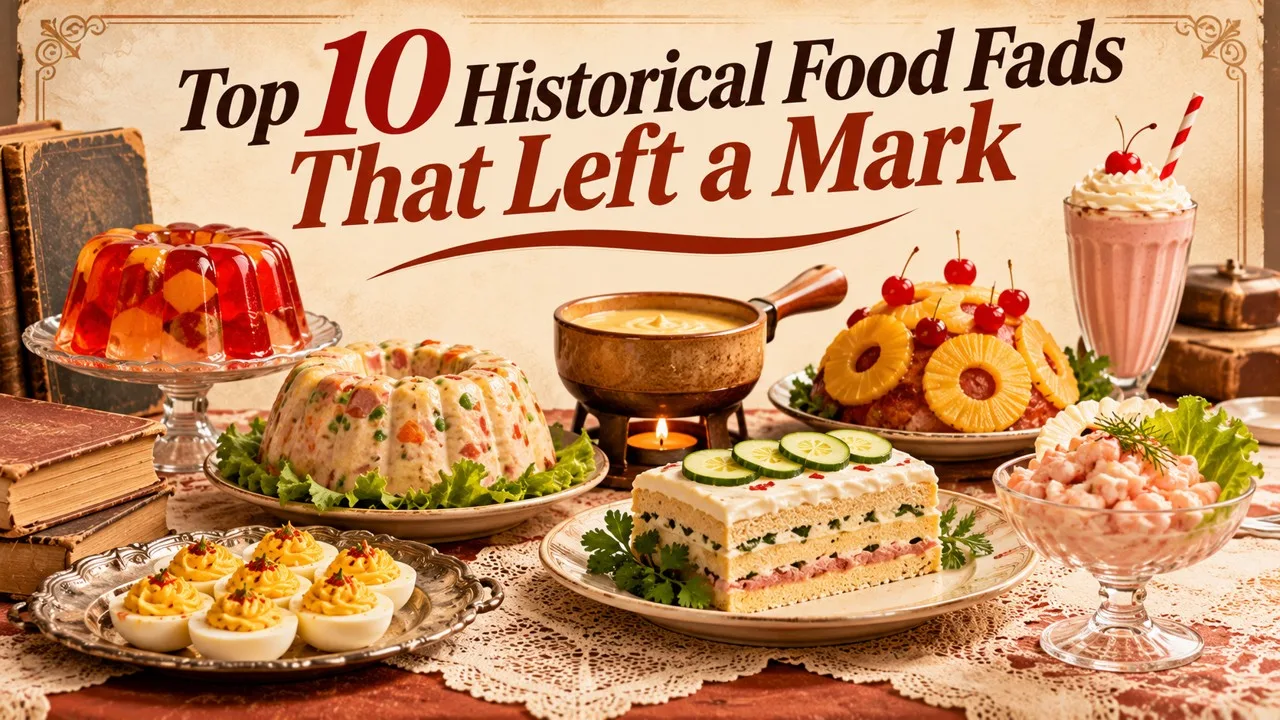
Some food crazes fade in a decade, but others — farming, sugar, coffeehouses and fast food — reorganized trade, kitchens and daily time. Calling every one of them a "fad" is a stretch. The Neolithic shift to farming was not a diet trend, and the Columbian Exchange was not a restaurant fashion [1][2]. They belong here because they changed what large numbers of people learned to want, grow, and eat, and because later, shorter fashions — vegetarian societies, Jell-O molds, peanut-butter sandwiches, space-age convenience food, Paleo marketing, and the fast-food system — sat on top of those deeper changes [4][5][10].
This list is a curated set of ten episodes, not a ranking of importance, and not a nutrition guide. Each entry is written from food history and from readily checked sources, not from a diet advertisement [3][8].
Key Facts
A food fashion can be a centuries-long taste, a medical or moral campaign, or a short-lived party dish. The ten below left a mark on trade, labor, or everyday meals, even when the peak of the fashion passed.
Ten Food Shifts at a Glance
| Rank | Episode | Rough period | What lasted |
|---|---|---|---|
| 1 | The agricultural transition | Beginning in the Neolithic, in several regions | Settled farming, surplus, and a grain-heavy diet for much of humanity |
| 2 | The Columbian Exchange | After 1492 | Staple crops and animals moving between the Americas and the rest of the world |
| 3 | Coffeehouses | 16th–18th centuries, then global | A public room organized around a stimulant drink and conversation |
| 4 | Victorian vegetarianism | 19th century, especially Britain | Organized meatless societies and a moral language for diet |
| 5 | Jell-O and gelatin salads | Early to mid-20th-century United States | A packaged dessert that also became a savory showpiece |
| 6 | Peanut butter and jelly | 20th-century United States | A cheap, portable sandwich that became a childhood staple |
| 7 | Space-age convenience foods | 1950s–1970s, with later echoes | TV dinners, freeze-dried novelties, and the glamour of the laboratory kitchen |
| 8 | Sugar's rise | Early modern Atlantic world to the present | A once-costly flavor that became a structural ingredient |
| 9 | The Paleo diet | Early 21st century, with older ancestors | A marketed return-to-the-Stone-Age eating style |
| 10 | Fast-food industrialization | Mid-20th century onward | Standardized kitchens, franchising, and a new pace of eating |
1. The Agricultural Transition
Beginning more than ten thousand years ago, in several independent regions, people shifted from a life based mainly on hunting and gathering to one based on cultivated plants and herded animals [1]. Archaeologists argue about pace, motive, and health costs, but they do not argue about the outcome: cereals, pulses, tubers, and livestock became the base of most cuisines, and surplus made cities and states possible [1]. That is not a "fad" in the magazine sense. It is the longest food change on this list.
What it left behind is almost everything later fashions take for granted: granaries, bread, porridge, beer, cheese, and the idea that a meal should be built on a staple. When a modern diet book promises to undo farming, it is still arguing with this transition. The mark is not a recipe. It is a settlement pattern and a pantry that later fashions can only rearrange.
2. The Columbian Exchange
After 1492, food plants and animals moved, often with people and pathogens, between the Americas and Africa, Europe, and Asia [2]. Potatoes, maize, tomatoes, chiles, cassava, and cacao changed Old World farming and cooking; wheat, rice, sugarcane, cattle, pigs, and horses changed New World landscapes and diets [2]. Alfred Crosby's name for this transfer, the Columbian Exchange, is now standard in world history.
The "fashion" here was not a year of novelty recipes. It was the speed with which new staples were adopted, and the way they then looked as if they had always been local. Irish potatoes, Italian tomatoes, and Indian chiles are all post-contact. A food history that skipped this transfer would misread almost every later cuisine.
Related: Top 10 Most Popular Food Rivalries in the World
3. Coffeehouses
Coffee spread from Ethiopia and the Yemeni trade into the Ottoman world and, in the seventeenth century, into European cities, where the coffeehouse became a new kind of public room [3]. London, Amsterdam, Paris, and later colonial cities used these rooms for news, bargains, scientific talk, and political argument. Rulers sometimes tried to police them; merchants and writers made them a habit [3].
The drink was a stimulant with little food value, and that was part of the point. A house organized around coffee was not a tavern. It offered sobriety, or at least a different intoxication, and a table at which strangers could sit with a paper. Modern cafés are descendants of that fashion, even when the coffee is takeaway and the conversation is on a phone.
4. Victorian Vegetarianism
Organized vegetarianism in Britain took institutional form in the 1840s, with the Vegetarian Society, and it had counterparts in the United States and elsewhere [4]. The arguments mixed health, economy, temperance, and animal welfare, and they were often tied to other reform movements. Meatless eating is ancient in many religious traditions; what was new was a secular, campaigning society that treated diet as a public cause [4].
The Victorian societies did not make Britain vegetarian. They did leave a vocabulary, a set of recipes, and an organizational model that later vegan and vegetarian campaigns still resemble. When a restaurant today lists a "vegetarian option" as a moral as well as a culinary choice, it is in a line that runs through those nineteenth-century rooms.
5. Jell-O Salads
Gelatin desserts had a long, expensive history at elite tables. In the early twentieth century, packaged gelatin, especially the brand Jell-O, made the wobbling mold an ordinary American kitchen project [5]. From the 1930s through the 1960s, sweet and savory "salads" of gelatin, fruit, vegetables, and sometimes meat or cheese appeared in community cookbooks, advertisements, and magazine photography as signs of skill and modernity [5].
Related: Top 10 Famous Foods Born from Kitchen Mistakes
The fashion looks easy to mock, and later generations have mocked it. It also shows how a manufactured ingredient can reorganize a course, a color scheme, and a idea of what counts as a salad. The molds have mostly left everyday menus, but the company, the pantry packet, and the memory of the buffet table have not. A food can leave a mark as a joke and still have changed what a celebration looked like.
6. Peanut Butter and Jelly
Peanut butter, industrial jelly, and sliced bread all became widely available in the United States in the early twentieth century; in combination they produced a sandwich that was cheap, shelf-stable, and easy for a child to eat [6]. Commercial peanut butter had nineteenth-century predecessors, and the sandwich's rise is often linked to school lunches and to wartime and Depression habits of thrift. By mid-century it was a standard American packed lunch [6].
The "fad" became a default. That is the mark it left: not a year of novelty, but a sandwich so ordinary that it can seem to have no history. Food writers still use it as a shorthand for childhood, convenience, and a particular national pantry.
7. Space-Age Convenience Foods
From the 1950s through the 1970s, American and other industrial food companies sold convenience as a futuristic virtue: the frozen TV dinner, freeze-dried coffee, Tang and other breakfast drinks, and a general promise that the laboratory could shorten kitchen time [7]. Some of these products had genuine links to military or aerospace research; many only borrowed the glamour. The frozen tray meal, associated with Swanson in the mid-1950s, is the most famous everyday example [7].
The fashion's lasting effect was not that everyone dined like an astronaut. It was that a meal could be bought already plated, stored in a freezer, and heated with little skill. Later microwave culture, airline food, and a large part of the supermarket's prepared aisle still live in that idea, even when the packaging no longer mentions space.
Related: Top 10 Modern Dishes That Began as Poor Man's Food
8. Sugar Becomes a Staple
Cane sugar, once a luxury in Europe, became a mass commodity through plantation agriculture in the Atlantic world, at a terrible human cost in enslaved labor, and later through beet sugar and still more industrial refining [8]. Historians, notably Sidney Mintz, have shown how a rare flavor entered tea, baked goods, and then almost every category of processed food, until sweetness was no longer a special occasion [8].
To call sugar a "fad" understates it. The craving was cultivated, the supply was political, and the result was a structural change in calories and in taste. Modern debates about soft drinks and hidden sugars are arguments with this older victory, not a sudden new weakness.
9. The Paleo Diet
In the early twenty-first century, "Paleo" eating — a marketed attempt to copy a supposed hunter-gatherer plate, usually heavy on meat and vegetables and hostile to grains, dairy, and refined sugar — became a global diet brand [9]. It had earlier popularizers and a loose debt to evolutionary speculation, but the commercial peak, with books, blogs, and packaged "Paleo" snacks, was recent [9]. Anthropologists and nutrition researchers have repeatedly pointed out that Paleolithic diets were diverse, that farming is not a brief interruption, and that a supermarket Paleo bar is not a Ice Age meal.
The fashion left a mark even among people who never used the name: a suspicion of grains, a prestige of "ancestral" eating, and a template for later lifestyle diets. It is a reminder that a historical story, even a shaky one, can sell a menu.
Related: Top 10 Most Bizarre Phobias: Strange Fears That Exist
10. Fast-Food Industrialization
The mid-twentieth-century fast-food system — standardized kitchens, a limited menu, franchising, and a service speed designed around the car — is often dated in the United States to the McDonald brothers' rebuilt shop and to Ray Kroc's franchising, with many rivals close behind [10]. The model spread worldwide. It changed wages, agriculture (especially beef, potatoes, and oil), urban space, and the expectation that a meal can be in a bag in minutes [10].
This is less a fad than an industrial system that made a certain kind of food fashionable by making it convenient and constant. Later health campaigns, "slow food" movements, and gourmet burger fashions all define themselves in relation to it. The mark is not a discontinued product. It is a pace of eating that now seems ordinary.
Conclusion
Some of these episodes lasted a decade and lives on as a joke or a brand. Others reorganized continents. What they share is a change in what people learned to regard as a normal meal: a staple grain, a New World crop, a cup of coffee in public, a meatless moral plate, a molded salad, a sweet sandwich, a frozen tray, a spoonful of sugar, an "ancestral" plate, or a bag over a steering wheel.
Food history is full of shorter crazes that left almost no trace. The ten above are the other kind. They altered farms, trade, or the clock, and later kitchens are still working inside those alterations.
- ^ [1] "Origins of agriculture." Encyclopaedia Britannica. Origins of agriculture
- ^ [2] Crosby, A.W., The Columbian Exchange; overview at Encyclopaedia Britannica. Britannica: Columbian Exchange
- ^ [3] "Coffeehouse." Encyclopaedia Britannica. Britannica: Coffeehouse
- ^ [4] "Vegetarianism" and the Vegetarian Society. Encyclopaedia Britannica and society histories. Britannica: Vegetarianism
- ^ [5] "Jell-O." Smithsonian and company histories; overview at Wikipedia. Wikipedia: Jell-O
- ^ [6] "Peanut butter and jelly sandwich." Histories of peanut butter and American school lunches. Wikipedia: Peanut butter and jelly sandwich
- ^ [7] "TV dinner" and mid-century convenience-food marketing. Smithsonian and Wikipedia. Wikipedia: TV dinner
- ^ [8] Mintz, S.W., Sweetness and Power; "Sugar" in Encyclopaedia Britannica. Britannica: Sugar
- ^ [9] "Paleolithic diet." Scientific and historical overviews. Wikipedia: Paleolithic diet
- ^ [10] "Fast food" and the history of McDonald's franchising. Encyclopaedia Britannica. Britannica: Fast food



















Discussion
Log in with