






 By
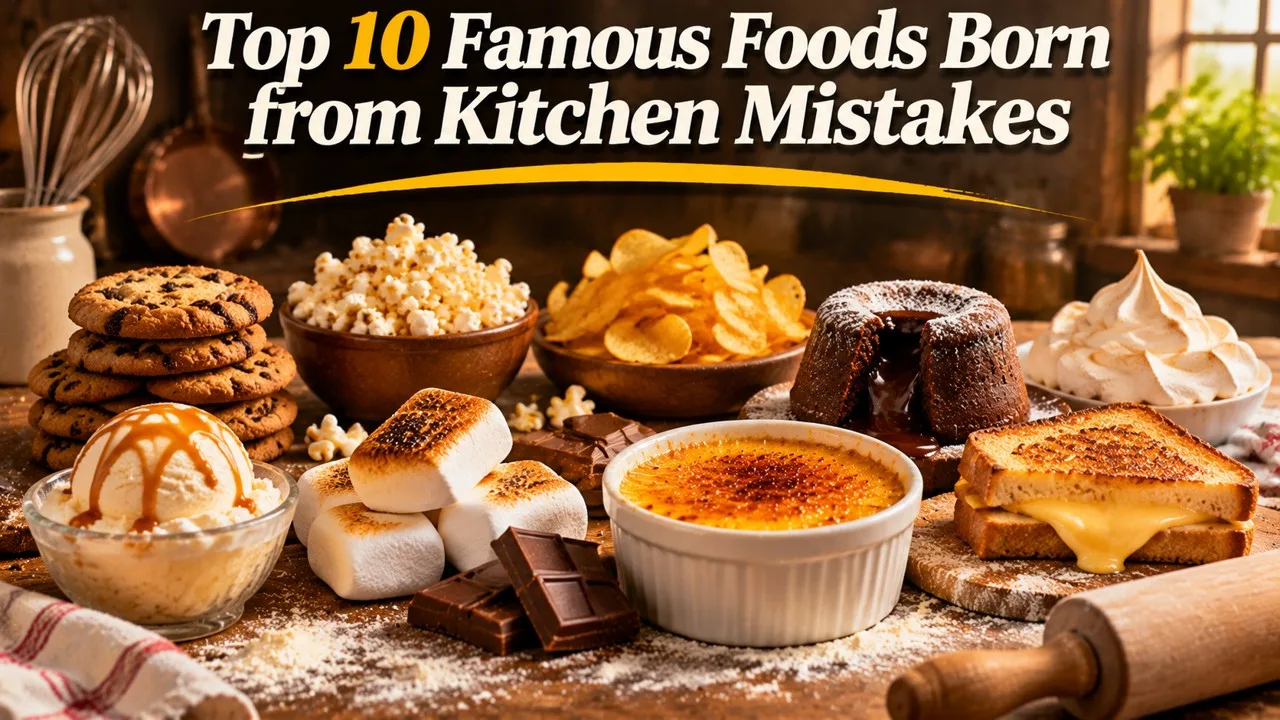
Some famous dishes have genuine accident stories; others are later tales, so a careful list has to separate kitchen luck from good marketing. Chocolate-chip cookies, nachos, and a frozen ice pop have relatively clear inventors and dates, even when the "accident" part is argued [1][4][2]. Tarte Tatin, Worcestershire sauce, Buffalo wings, Caesar salad, the ice-cream cone, and a "molten" chocolate cake come with stronger later legends, and they are treated here as traditions to be handled with care [5][8][10]. This list is a curated set of ten origin stories, not a row of official certificates.
Four popular anecdotes are not used as headline facts. Corn flakes and graham crackers were products of health and moral reform, not kitchen slips. The Earl of Sandwich gambling tale is a later anecdote. The patriotic Margherita pizza story has been seriously questioned by food historians [3]. Substitutes with a better documentary or a clearer "accident" claim stand in their place.
Key Facts
A kitchen accident can be real, embellished, or invented after a dish is already famous. Company lore and a surviving recipe card are not the same kind of evidence.
Ten Origin Stories at a Glance
| Rank | Food | What can be documented | How strong the "accident" is |
|---|---|---|---|
| 1 | Chocolate-chip cookies | Ruth Wakefield, Toll House, late 1930s | Often told as a slip; she may have planned the result |
| 2 | The Popsicle | Frank Epperson, early twentieth century | A frozen-drink accident is the standard, plausible origin |
| 3 | Potato chips | Mid-nineteenth-century fried potatoes | The Saratoga "angry cook" tale is weak as evidence |
| 4 | Nachos | Ignacio "Nacho" Anaya, Piedras Negras, 1940s | A last-minute snack for customers is well attested |
| 5 | Tarte Tatin | The Tatin sisters, Lamotte-Beuvron | A famous overturned-tart story, not a signed laboratory note |
| 6 | Worcestershire sauce | Lea & Perrins, Worcester, nineteenth century | The firm itself told a "forgotten barrel" story |
| 7 | Buffalo wings | Anchor Bar, Buffalo, 1960s | Several family and rival stories compete |
| 8 | Caesar salad | Caesar Cardini, Tijuana, 1920s | A "what we had on hand" tale, later retold |
| 9 | The ice-cream cone | World's fairs, especially 1904 | Several people claimed an on-the-spot invention |
| 10 | Molten chocolate cake | Late-twentieth-century restaurant desserts | Sometimes told as an underbaked error, also claimed as a plan |
1. Chocolate-Chip Cookies
Ruth Graves Wakefield, who ran the Toll House restaurant in Whitman, Massachusetts, published a chocolate-chip cookie recipe in the late 1930s and later reached an agreement that put her recipe on Nestlé's chocolate packages [1]. A later popular story says she invented the cookie when chopped chocolate failed to melt into the dough as planned. Food writers have also argued that Wakefield was too skilled a baker for the result to have been a sheer accident, and that she may have wanted a studded cookie all along [1].
The documented core is solid: a named baker, a restaurant, a recipe, and a commercial afterlife. The "happy accident" is optional, and a careful list should mark it as a maybe, not as a courtroom fact.
2. The Popsicle
Frank Epperson, in the standard company and patent history, left a drink with a stirring stick out in the cold as a child or a young man, found it frozen, and later patented a "frozen confection on a stick," commercially known as the Popsicle [2]. The dates in popular retellings sometimes drift, but a patent and a later business are on the record, and a frozen-cup accident is a physically ordinary way to discover the form [2]. This entry stands in for breakfast cereals that were not mistakes at all.
An ice pop is almost the ideal case of a kitchen slip that became a product: a drink, a cold night, a stick, and then a lawyer. Even here, later marketing has polished the memory. The outline is still more believable than most "eureka" food tales.
Related: Top 10 Most Popular Food Rivalries in the World
3. Potato Chips
Thin fried potatoes were being cooked in the nineteenth century on both sides of the Atlantic. The most famous American origin story sets the potato chip at a Saratoga Springs resort, with the cook George Crum supposedly slicing potatoes ever thinner to annoy a customer, often named as Cornelius Vanderbilt [3]. Documentary support for that exact quarrel is thin, and historians have treated the tale as later publicity more than as a proven event [3]. This entry replaces a graham-cracker story that was about reform, not accident.
Chips exist. The angry-cook parable may not. That is a useful lesson for the whole list: a crisp food can be real, and its cleverest story can still be a tourist brochure.
4. Nachos
In 1940s Piedras Negras, in the Mexican state of Coahuila, Ignacio Anaya is widely credited with serving toasted tortillas, cheese, and pickled jalapeños to American customers as a last-minute snack, a dish that took his nickname, Nacho [4]. The story has been repeated by family members, local commemorations, and food historians in a much tighter way than the Saratoga chip tale [4]. It is still a remembered event, not a laboratory log, but it has a person, a place, and a plausible kitchen motive: visitors arrived, and the regular menu was not ready.
If any dish on this list deserves the phrase "born from a kitchen save," nachos do. The later stadium versions, with industrial cheese, are a different career.
5. Tarte Tatin
Tarte Tatin, an upside-down caramelized apple tart, is tied to the Tatin sisters, Stéphanie and Caroline, and to their hotel in Lamotte-Beuvron, in the late nineteenth or early twentieth century [5]. The usual story is that a tart was overcooked or assembled backward, then inverted and served anyway. French food history has not produced a contemporary signed confession; it has produced a later house tradition, a name, and a dessert that spread through Paris restaurants [5].
Related: Top 10 Historical Food Fads That Left a Mark
The tart is not in doubt. The stumble is traditional. A careful writer can say that an accident is the story the region tells, without promoting the story to a notarized fact.
6. Worcestershire Sauce
Lea & Perrins, in Worcester, England, created the commercial Worcestershire sauce in the nineteenth century, and the company itself long told a story of a fish-and-spice mixture that tasted wrong at first and was left in barrels until it had mellowed [6]. That is origin-by-forgetting, a cousin of kitchen accident, and it may have a core of truth in a fermented, anchovy-heavy sauce that needs time [6]. It is also exactly the sort of tale a firm would keep, because it makes the wait part of the brand.
Readers should treat the forgotten barrels as company memory. The sauce's ingredient logic — fermented fish, spices, vinegar — is well attested even if the eureka day is not.
7. Buffalo Wings
Buffalo wings, chicken wing sections fried and tossed in a cayenne-butter sauce, are tied to the Anchor Bar in Buffalo, New York, in the 1960s, and to Teressa Bellissimo in the most often repeated version [7]. Other claimants and slightly different family stories exist, including a version in which the wings were an unloved part that had to be used, and another in which a late delivery of parts was improvised into a late-night plate [7]. The city, the bar, and the decade are fairly solid. The single "unwanted parts" accident is not the only account.
The honest version is a local invention with a disputed minute. That is still more than a myth, and less than a courtroom timeline.
Related: Top 10 Most Bizarre Phobias: Strange Fears That Exist
8. Caesar Salad
Caesar salad is generally credited to Caesar Cardini, an Italian American restaurateur, at a restaurant in Tijuana in the 1920s, on a busy Fourth of July or a similar rush when supplies were short [8]. Tableside preparation of romaine, cheese, egg, citrus or vinegar, oil, and Worcestershire became part of the dish's theater. Competing claims, including from family members, have always traveled with the story [8]. The "work with what he had" theme is classic kitchen-accident folklore, and it may describe a real rush, or a later neatening of a recipe that was already being developed.
Tijuana and Cardini are the documentary anchors. The rest should be told in the conditional.
9. The Ice-Cream Cone
Edible cones and wafer cups for ice cream existed in several forms before 1904, but the St. Louis World's Fair that year produced a cluster of claims that a waffle or a zalabia was rolled on the spot when a vendor ran out of dishes [9]. Several men later said they had been the one to improvise the cone, and the surviving evidence is a tangle of later interviews, patents, and fair memory [9]. This entry stands in for the Earl of Sandwich story, which is even thinner as kitchen history.
The cone, as a fair invention, is probably a real convergence: a crowd, melting ice cream, and nearby waffles. Naming a single hero is the doubtful step, not the idea that someone improvised a holder.
Related: Top 10 Oldest Buildings in the World
10. Molten Chocolate Cake
Individual chocolate cakes with a liquid centre became a restaurant fashion in the late twentieth century, associated with more than one chef, including Jean-Georges Vongerichten in New York and earlier or parallel work in France [10]. A common telling is that a cake was pulled from the oven too soon, cut open, and then kept as a style. Chefs have also described the runny centre as an intended contrast, a planned underbaking [10]. This entry replaces the Margherita pizza legend, which is a political story more than a kitchen slip.
The dessert is real and datable as a fashion. The accident is optional, again. When two famous kitchens can tell a plan and a mistake with equal confidence, the historian's job is to record the disagreement, not to pick a cute ending.
Conclusion
Some dishes really do look like saves: a frozen drink on a stick, a plate of tortillas and cheese for unexpected guests, perhaps a tart inverted after a scare. Others have been given accident stories because the stories sell, or because a company, a city, or a restaurant needed a beginning. Chocolate chips, chips, Worcestershire, wings, Caesar salad, cones, and lava cakes all sit somewhere on that scale.
The substitutions on this list are the point of the title. A "kitchen mistake" that was actually a moral campaign, a gambling anecdote, or a royal publicity legend does not earn its place. What remains, once those are set aside, is a shorter, more interesting history of luck, memory, and later publicity around real food. A good origin story can still be told. It just has to survive a second, less sentimental look at the sources and the dates. That cautious habit is itself a kind of historical recipe that is always worth keeping nearby.
- ^ [1] Histories of Ruth Wakefield, the Toll House cookie, and later debates about intention. Wikipedia: Chocolate chip cookie
- ^ [2] Accounts of Frank Epperson and the Popsicle patent and trademark history. Wikipedia: Ice pop
- ^ [3] Critical discussions of the Saratoga / George Crum potato-chip story. Wikipedia: Potato chip
- ^ [4] Accounts of Ignacio Anaya and the origin of nachos in Piedras Negras. Wikipedia: Nachos
- ^ [5] Histories of tarte Tatin and the Tatin sisters of Lamotte-Beuvron. Wikipedia: Tarte Tatin
- ^ [6] Lea & Perrins company histories of Worcestershire sauce. Britannica: Worcestershire sauce
- ^ [7] Competing origin accounts of Buffalo wings and the Anchor Bar. Wikipedia: Buffalo wing
- ^ [8] Accounts of Caesar Cardini and the Tijuana origin of Caesar salad. Wikipedia: Caesar salad
- ^ [9] World's Fair and patent histories of the ice-cream cone, especially 1904. Wikipedia: Ice cream cone
- ^ [10] Reporting on molten chocolate cake and competing chef attributions. Wikipedia: Molten chocolate cake





















Discussion
Log in with