






 By
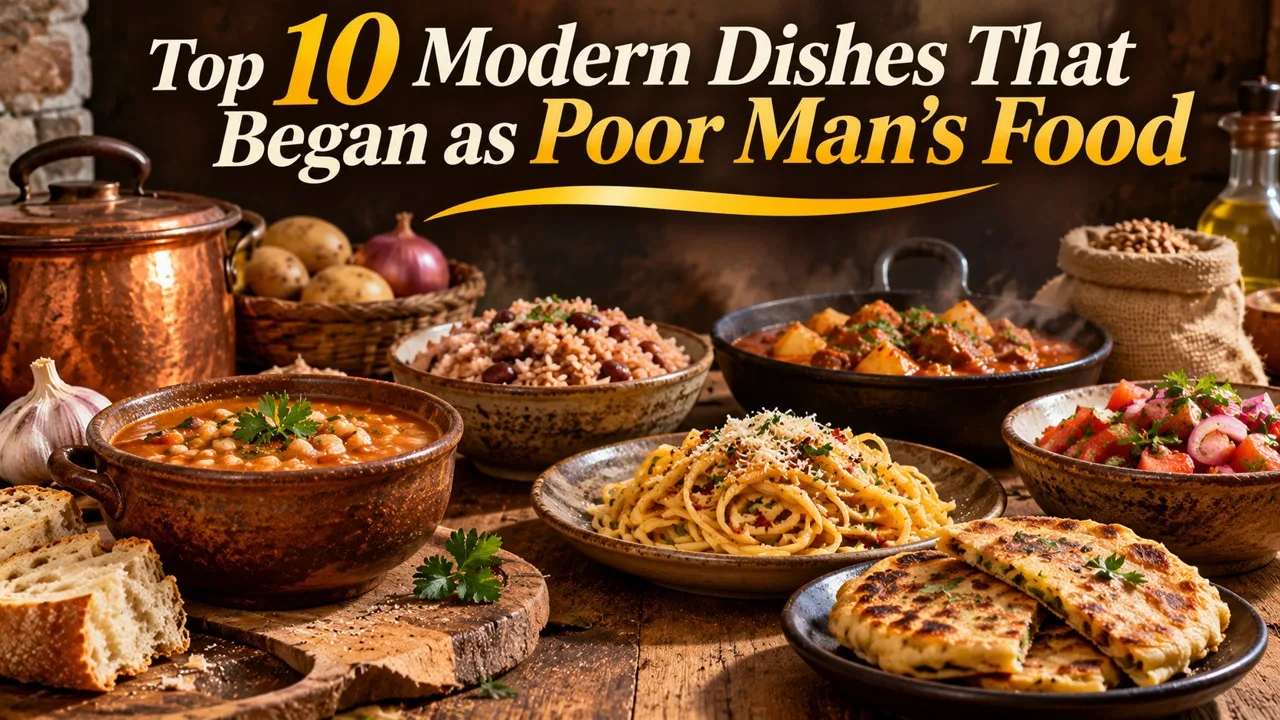
Several dishes now served as luxuries began as cheap, plentiful, or leftover food, from cornmeal porridge to tuna once sold for little. A food can change class for many reasons: a new cooking style, a restaurant fashion, a collapse in supply, or a distant market that suddenly wants the same ingredient [1][6][10]. This list is a curated set of ten well-documented examples, not a claim that every luxury plate was once a hardship ration, and not a ranking by price.
A few of these stories are often over-told. Lobster in coastal New England was cheap when it was abundant, but not every popular tale about it is easy to pin down. Bird's nest soup, by contrast, has a long record as a prized ingredient in Chinese cuisine, so it does not belong on a list of poverty foods. It is replaced here by pizza, a Neapolitan street food that later became a global restaurant staple [2][7]. Where the history is mixed, the entry says so.
Key Facts
"Poor man's food" means an ingredient or dish that was once cheap, abundant, leftover, or a regional staple before it became expensive or fashionable. Prices and status vary by place and period.
Ten Dishes at a Glance
| Rank | Dish or ingredient | Earlier role | Later status | A key caution |
|---|---|---|---|---|
| 1 | Bluefin tuna | Low-value or canned fish in some mid-20th-century markets | Auction luxury for sushi | The change was uneven by country |
| 2 | Oysters | Cheap urban protein in 19th-century Atlantic cities | Premium shellfish | Overharvest and pollution mattered |
| 3 | Lobster | Abundant and inexpensive in coastal New England | Restaurant luxury | Some anecdotes are better than others |
| 4 | Caviar | More ordinary in sturgeon regions when the fish were plentiful | Global luxury good | Status followed scarcity and branding |
| 5 | Escargot | Gathered protein and Lenten food in parts of Europe | French restaurant classic | Snails were eaten long before fine dining |
| 6 | Polenta | Northern Italian maize staple | Restaurant side or main | A maize diet had nutritional costs when poorly processed |
| 7 | Sushi | Preservation method, later Edo street food | High-end dining worldwide | "Sushi" is a family of dishes, not one recipe |
| 8 | Bouillabaisse | Provençal fishermen's stew from mixed rockfish | Restaurant specialty | Formal versions added rules and price |
| 9 | Quinoa | Andean staple grain | Global health-food ingredient | Export demand changed local prices |
| 10 | Pizza | Neapolitan working people's flatbread | Worldwide casual and gourmet food | The luxury end is only one branch |
1. Bluefin Tuna
Atlantic, Pacific, and southern bluefin tunas are now among the most valuable fish in the sushi trade, with single specimens making headlines at Japanese New Year auctions [1]. That status is recent in some markets. In the mid-twentieth century, especially in parts of North America, large tuna were often worth far less than they are today. Much tuna went into cans. Bluefin, a fat, warm-blooded fish that later became prized for toro, was not automatically treated as a jewel [1].
The change came with the global rise of sushi, improved cold transport, and demand for specific cuts in Japan and then abroad. As prices rose, so did fishing pressure. Several bluefin stocks have been the subject of international catch limits because the same animal cannot be both an almost leftover and an endlessly harvested luxury [1].
The story is not that nobody ever valued tuna. It is that a fish can move, in a few decades, from a cheap protein to a scarce commodity, and that the move is a market fact, not a timeless law of taste.
2. Oysters
In the nineteenth century, oysters were a common food in cities such as New York and London. Beds in the Chesapeake, New York Harbor, and European estuaries produced huge quantities, and oysters were sold from stalls, in cellars, and as everyday protein, not only as a rare starter [2]. Writers of the period treated them as abundant, sometimes almost as a default cheap seafood.
That abundance did not last. Overharvesting, habitat destruction, silt, and pollution wrecked many of the old beds. As supply tightened and remaining oysters were farmed or shipped farther, the oyster became a more expensive item, served with ceremony that would have looked odd in a packed 1850s oyster cellar [2]. Some cities are now trying to restore reefs for ecology as well as for harvest, which is a reminder that the luxury price is partly a bill for earlier extraction.
An oyster is still, biologically, a filter-feeding bivalve that can be grown in large numbers. The "poor to prized" arc is a history of beds, waste, and marketing, not a change in the animal.
Related: Top 10 Most Popular Food Rivalries in the World
3. Lobster
The American lobster, Homarus americanus, was once far more plentiful along the northeast Atlantic coast of North America than it is in the popular imagination of a scarce luxury [3]. In the eighteenth and nineteenth centuries, coastal communities ate lobster often, and the animal was cheap enough to be sold in large quantities, packed in cans, and used as a practical protein rather than as a special-occasion food [3]. Later, canning, rail transport, restaurants, and shifts in supply and taste turned lobster into a high-priced dish.
Some of the most repeated stories — that lobster was served to prisoners at every meal, or that it was used only as fertilizer — are hard to document in the sweeping form they usually take, and they should be treated with care [3]. What is solid is the direction of travel: a locally abundant crustacean became a luxury as more people wanted it and as the fishery and the restaurant trade reorganized around that want.
The shells still turn red when cooked. The price, and the social meaning, did not stay still.
4. Caviar
Caviar, the salted roe of sturgeon, is now a symbol of expense. In the regions where large sturgeon were once common, especially around the Caspian and the Volga, the roe was a local product long before it became a global luxury brand [4]. When the fish were abundant, the eggs were a way to use a catch, not automatically a jewel to be rationed by the spoon.
Overfishing, damming of rivers, and later trade in a small number of prestigious types (beluga, osetra, sevruga) changed the economics. As wild sturgeon declined, prices rose, and aquaculture tried to fill the gap [4]. The word "caviar" was also stretched to other fish roes, which is itself a sign of how strongly the original product had been marked as elite.
The honest version of the story is not that peasants invented a delicacy for later aristocrats to steal. It is that a regional fish product became scarce and then was sold, worldwide, as a scarce thing.
5. Escargot
Eating land snails is much older than the French restaurant course called escargot. Shells in archaeological sites show that people have gathered snails for food for thousands of years, and classical sources already mention them [5]. In parts of rural Europe they were a free or cheap protein, collected after rain, and in Christian dietary rules they could be eaten at times when some meats were restricted.
Related: Top 10 Historical Food Fads That Left a Mark
The modern restaurant dish — usually Helix or related snails served in the shell with garlic-and-herb butter — is a later packaging of that habit [5]. Once a food has a specialized plate, a special fork, and a place on a formal menu, its price and its social meaning change, even if the animal is still a snail.
Escargot is a clear case of presentation and scarcity doing the work. The luxury is not that snails became a new species. It is that a foraged animal entered haute cuisine and left the category of "whatever was available."
6. Polenta
Polenta, in its familiar northern Italian form, is a porridge or cake of ground maize, cooked slowly with water or stock and then enriched, or not, with cheese, butter, or meat sauces [6]. After maize arrived from the Americas, it became a staple in parts of northern Italy because it grew well and filled a pot at low cost. For poorer rural households, polenta could be the everyday cereal, eaten far more often than wheat bread or pasta [6].
A maize-heavy diet, when the grain is not treated in a way that makes niacin readily available, is associated historically with pellagra, a deficiency disease that was once a serious problem in some maize-eating regions of Europe and the Americas [6]. That medical history is part of why polenta was not a romantic dish for the people who depended on it. In later restaurant cooking, the same porridge is served in small, rich portions, often with expensive accompaniments, and the hardship has been edited out of the plate.
Polenta is still inexpensive at the grocery store. The "luxury" version is a matter of what is poured over it, and of who is doing the pouring.
7. Sushi
Sushi did not begin as a luxury omakase meal. Early forms in Japan, related to narezushi, used fermented rice as a way to preserve fish; the rice was a medium, and the process took time [7]. Later, in the Edo period, quicker styles appeared, including nigiri sold at street stalls as a convenient food for workers in a growing city. Vinegared rice and fresh or lightly cured fish made a portable meal, not a ceremony [7].
Only in the twentieth century, with refrigeration, global trade, and the international fashion for sushi, did some versions become expensive dining, priced by the quality of the fish and by the theatre of the counter [7]. Cheap sushi exists alongside the luxury kind, which is a reminder that the word now covers a whole range of status and price.
Related: Top 10 Most Bizarre Phobias: Strange Fears That Exist
The useful history is therefore double: a preservation method and a street food that, in some restaurants, became a luxury brand, without erasing the cheaper forms that still feed people at lunch.
8. Bouillabaisse
Bouillabaisse is a fish stew associated with Marseille and the Provençal coast. In its older, working form it was a way for fishermen to cook the bony, less marketable rockfish that were harder to sell as whole fish, together with olive oil, garlic, and local herbs, often with a broth poured over bread [8]. It was a harbor dish before it was a restaurant ritual.
As the stew became famous, restaurants in Marseille and beyond developed a more formal service, sometimes with a particular set of fish, a separate broth, and a rouille, and with a price to match the new reputation [8]. Arguments about what counts as a "true" bouillabaisse are themselves a sign of that rise in status. A leftover pot does not need a charter.
The bones and the odd fish are still the point. The luxury is the setting, the selection, and the idea that a fishermen's stew is now something to travel for.
9. Quinoa
Quinoa (Chenopodium quinoa) has been a staple seed crop in the Andes for thousands of years, cooked as a grain, used in soups, and valued for growing at altitude where other crops fail [9]. For Andean households it was everyday food, not an imported health product. In the late twentieth and early twenty-first centuries, quinoa was marketed abroad as a high-protein "superfood," and export demand rose sharply [9].
That boom had mixed effects. Farmers could earn more from a crop that outsiders suddenly wanted, but prices in producing regions also rose, and the politics of who benefits from a traditional staple turned into a public debate [9]. The seed did not change its biology. Its place in the world market did.
Related: Top 10 Oldest Buildings in the World
Quinoa is a case of a poor region's ordinary food becoming, elsewhere, a premium grocery item, with consequences that run back along the supply chain.
10. Pizza
Pizza, in the form that made Naples famous, was a flatbread with simple toppings — tomato, oil, garlic, sometimes cheese or anchovy — sold to working people as cheap, fast food [10]. The Margherita story, the city of Naples, and later Italian-American versions are all parts of a long move from street and neighborhood ovens to a worldwide trade [10].
Today pizza is both one of the most ordinary inexpensive meals on earth and, at the other end of the same word, a gourmet product with named flour, long-fermented dough, and expensive toppings. The luxury end did not abolish the cheap end. It split the dish into classes [10]. That is a different arc from caviar or bluefin, where the cheap version often disappeared as the prestige version took over.
Pizza belongs on this list because its prestige forms grew out of a poor-city food, not because a slice has become rare. The history is still visible every time the same word names a foldable street lunch and a reserved restaurant course.
Conclusion
Foods change class when supply, fashion, and technology change, not when an ingredient acquires a new soul. Tuna, oysters, lobster, and caviar became expensive as they became scarcer or more widely desired. Escargot, polenta, sushi, bouillabaisse, quinoa, and pizza kept their older, cheaper lives in some places while restaurants and export markets built dearer versions in others. A honest list has to keep those two paths distinct, and it has to drop a romantic item, such as bird's nest soup, when the record does not support a poverty origin.
The next time a menu presents a "humble" dish at a high price, the humble part is usually in the past tense, and it is worth asking which past, and whose.
- ^ [1] "Pacific bluefin tuna" and related bluefin articles. Wikipedia. Wikipedia: Pacific bluefin tuna
- ^ [2] "Oyster." Wikipedia, including historical harvests and later scarcity in once-rich beds. Wikipedia: Oyster
- ^ [3] "American lobster." Wikipedia. Wikipedia: American lobster
- ^ [4] "Caviar." Wikipedia. Wikipedia: Caviar
- ^ [5] "Escargot." Wikipedia. Wikipedia: Escargot
- ^ [6] "Polenta." Wikipedia. Wikipedia: Polenta
- ^ [7] "Sushi." Wikipedia, including narezushi and Edo-period street forms. Wikipedia: Sushi
- ^ [8] "Bouillabaisse." Wikipedia. Wikipedia: Bouillabaisse
- ^ [9] "Quinoa." Wikipedia. Wikipedia: Quinoa
- ^ [10] "Pizza." Wikipedia, including Neapolitan origins as a working people's food. Wikipedia: Pizza





















Discussion
Log in with