






 By
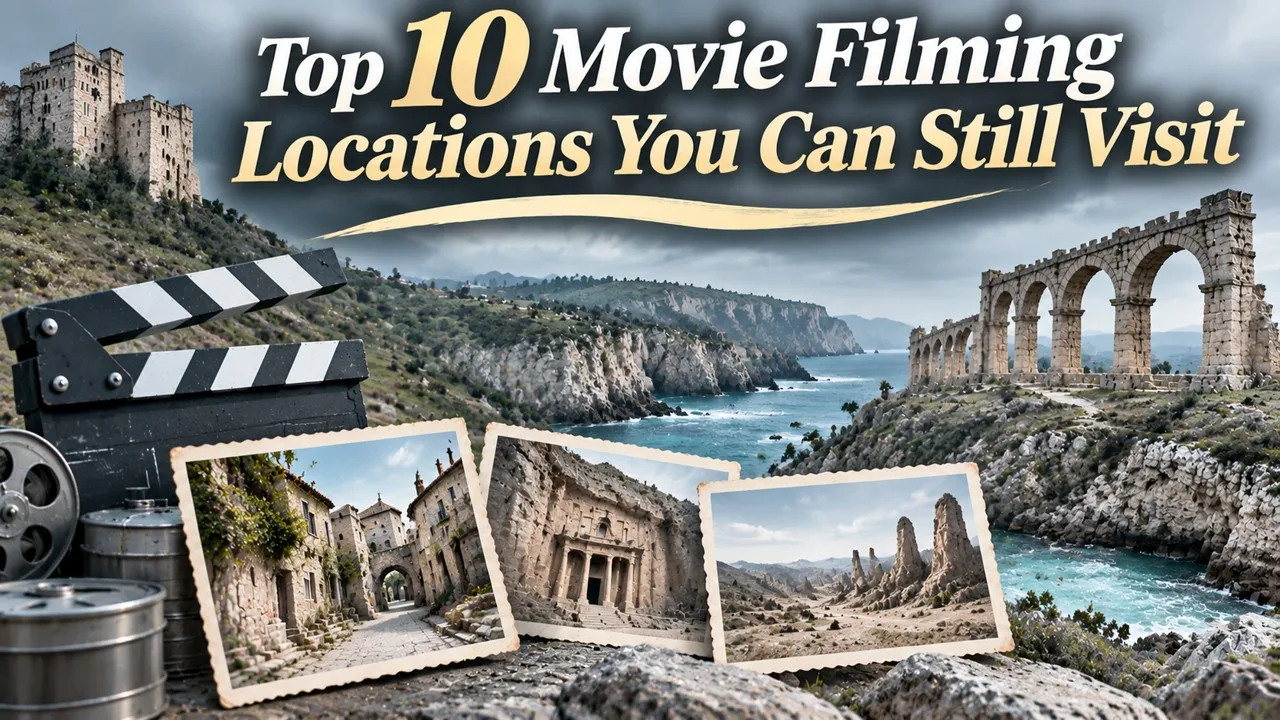
From a New Zealand sheep farm to a restored Spanish cemetery, ten film locations remain open as parks, tours, or working sites you can actually walk. This is not a list of every famous backdrop, and it is not a gallery of studio lots that are closed to the public. Each place below has a documented filming history and a current, or at least recently maintained, way for visitors to see the ground itself [1][6][9]. Hours, tickets, and access rules change, so a traveller should check the site's own page before setting out.
The ten were chosen for a mix of geography and of how the sets survived: some were purpose-built and then kept as attractions, some were real villages or parks that a production borrowed, and one cemetery was rebuilt by volunteers decades after the cameras left [6]. Film titles are used only to identify the shoot. No plot is retold at length.
Key Facts
A filming location can outlast a production if a community, a parks service, or a private owner decides to keep it. The entries below are places, not memorabilia, and visitor conditions should be read as subject to change.
Ten Visitable Film Locations at a Glance
| Rank | Place | Film or series | Visitor status, in brief |
|---|---|---|---|
| 1 | Hobbiton, near Matamata, New Zealand | The Lord of the Rings and The Hobbit films | A commercial tour of a retained rural set |
| 2 | Hotel Sidi Driss, Matmata, Tunisia | Star Wars (first film) | A working troglodyte hotel on a historic site |
| 3 | Popeye Village, Anchor Bay, Malta | Popeye (1980) | The film's timber village, run as a family attraction |
| 4 | Jackson Lake Island, Millbrook, Alabama | Big Fish | Remaining streets of the fictional town of Spectre, with paid public access |
| 5 | Henry River Mill Village, near Hickory, North Carolina | The Hunger Games | A historic mill village with admission and guided tours |
| 6 | Sad Hill, near Santo Domingo de Silos, Spain | The Good, the Bad and the Ugly | A fan-restored cemetery landscape, open as a memorial site |
| 7 | Eastern State Penitentiary, Philadelphia | 12 Monkeys, among other films | A preserved prison, open as a historic site |
| 8 | Malibu Creek State Park, California | M*A*S*H | A state park that still marks the series' outdoor set |
| 9 | Field of Dreams, Dyersville, Iowa | Field of Dreams | The farm diamond, run as a visitor site |
| 10 | Cypress Gardens, Moncks Corner, South Carolina | The Patriot | A county park of swamps and footbridges used on screen |
1. Hobbiton, New Zealand
On a family sheep farm in the Waikato, near Matamata, Peter Jackson's team built a rural village for The Lord of the Rings, returned to enlarge it for The Hobbit films, and left a durable set that is now run as the Hobbiton Movie Set tours [1]. The official attraction takes visitors through the fields, the facades, and a reconstructed inn interior on a ticketed tour. The farm itself is still a working farm; the tour is a second use of the same land [1].
The site is one of the clearest cases of a purpose-built film set that was not struck after the last shot. Because it is a commercial tour, it is also one of the easiest to visit in a formal way, with published hours and transport from nearby towns. The landscape is ordinary New Zealand pasture made famous by a camera. Visitors see buildings and gardens, not a licensed character, and that is all a location list needs to promise.
2. Hotel Sidi Driss, Matmata
Hotel Sidi Driss, in Matmata, Tunisia, is a troglodyte complex of courtyards and rooms dug into the soft ground, a building type long used in this part of the south [2]. In the mid-1970s it was used as the homestead of the Lars family in the first Star Wars film. The hotel has continued to receive guests, and the courtyards remain a documented stop for travellers who want to see a real dwelling that once stood in for a desert farm [2].
Matmata's underground and semi-underground houses were not invented for the screen. They are a local response to heat and wind. The film added a layer of international fame, and with it a stream of visitors, but the architecture is older than the production. A visit is a visit to a working hotel and a historic settlement, not to a studio planet, and no costume or character is required to understand the place.
Related: Top 10 Most Haunted Places in America
3. Popeye Village, Malta
Sweethaven, the timber coastal village built in 1979–1980 for Robert Altman's film Popeye, was constructed at Anchor Bay on Malta's northwest coast and was not dismantled when shooting ended [3]. It is now run as Popeye Village, a family attraction around the original painted houses, the water, and later additions such as shows and play areas [3]. The official site presents the village as both a film set and a day out.
Unlike a reused real town, this place exists because a production needed a complete streetscape and the island then found a second life for the carpentry. The bay setting is genuine; the architecture is theatrical. That mix — a real shoreline with a built village on it — is why the site still photographs so easily, and why it belongs on a list of sets you can walk without a studio pass.
4. Jackson Lake Island, Alabama
Jackson Lake Island, in Millbrook, Alabama, was dressed as the town of Spectre for Tim Burton's film Big Fish [4]. After production, some of the false facades, a street, and a row of trees remained on the island, weathering into a half-abandoned film town. Local tourism pages and later reporting describe a modest paid admission, with walking access to the remaining set, and other uses of the island such as camping and fishing [4].
The site is not a polished theme park, and storms have damaged parts of the original dressing over the years. That unfinished quality is part of what visitors now come to see. Access is through the island's own gate and rules, which can change, but the place has remained a public curiosity rather than a demolished set. It is a good example of a private landscape that kept a film's leftovers in view.
5. Henry River Mill Village, North Carolina
Henry River Mill Village, just south of Hildebran and administered with a Hickory postal address, is a historic cotton-mill settlement whose surviving houses and store were used as District 12 in the first Hunger Games film [5]. The mill itself burned in 1977; the village later entered the National Register of Historic Places. Under later private ownership it has been opened with general admission, guided historic tours, and some overnight lodging in restored houses, with tour fees directed to a preservation fund [5].
Related: Charlie Chaplin: Master of Comedy and Tragedy in Film
The attraction is a real textile village as well as a filming site. Official materials put the mill history first and the film second, which is the right order for a preservation project. Visitor hours have varied by season, and any traveller should use the village's own site for current tickets. The point for this list is simply that the streets and store still stand, and that the public can, under published rules, walk them.
6. Sad Hill, Burgos
The circular cemetery built in 1966 for the final shoot of The Good, the Bad and the Ugly, in the hills near Santo Domingo de Silos and Contreras in the province of Burgos, was left to decay after the production [6]. Decades later a local association, the Sad Hill Cultural Association, reconstructed the stone rings, the central plot, and the name markers, work that was itself later documented in a film about the restoration [6]. The site is now a destination for walkers and film travellers.
Sad Hill is unusual because the "set" was a landscape architecture of graves, not a street of shops, and because volunteers, not a studio, put it back. There is no ticketed theme park. What you visit is a reconstructed outdoor set in a real valley, maintained as a cultural site. It is one of the clearest cases of fans and neighbours deciding that a temporary film construction was worth making permanent.
7. Eastern State Penitentiary, Philadelphia
Eastern State Penitentiary, opened in 1829 and closed as a prison in 1971, is a radial penitentiary whose stone corridors and decaying cellblocks have been used by a number of film and television productions, including 12 Monkeys in the mid-1990s [7]. The building is now a historic site with regular public hours, audio tours, and seasonal events, run as a preserved ruin rather than a rebuilt prison [7]. Visitors come for the architecture and the history of incarceration as much as for the camera angles.
This entry is on the list because a major, still visitable landmark happens to be a film location, not because a set was built and saved. The penitentiary's fame is older than any shoot. What the films added is a second map: people who first saw a corridor on screen can now walk the real one, under the same roof, with the site's own interpretation in their ears.
Related: Amitabh Bachchan: Life, Films and Legacy
8. Malibu Creek State Park
Malibu Creek State Park, in the Santa Monica Mountains, contains the outdoor site used for the television series M*A*S*H, including the hillside and pad where the 4077th's camp was built [8]. California State Parks maintains the land as a public park, with trails, a visitor center, and signage that points walkers toward the former set. After the series ended, the remaining structures were largely removed; what survives is the landscape, some traces, and a later commemorative display, including a vehicle placed at the site [8].
The park is the opposite of a retained village: almost everything that was carpentry is gone, and almost everything that was geography is still there. That is still a filming location you can visit. It is also a reminder to keep expectations in line. You are hiking a state park that once held a set, not entering a standing studio camp.
9. Field of Dreams, Dyersville
The baseball diamond built beside a farmhouse near Dyersville, Iowa, for the 1989 film Field of Dreams was left in place and has been run for decades as a visitor site, with the field, the house, and later additions such as events and a larger complex nearby [9]. The official site invites the public to walk onto the grass, and the place has hosted high-profile exhibition games, including a Major League Baseball game at an adjacent purpose-built park in 2021, with later follow-on events [9].
Few film locations are so literally still doing the thing they were built to represent. The diamond is not a facade; it is a field. Ownership and programming have changed over time, as farm attractions often do, but the core promise has remained unusually stable: the movie's lawn is still a lawn, and it is still open to visitors who want to stand on it.
Related: Robert Downey Jr.: From Child Actor to Box Office Titan
10. Cypress Gardens, South Carolina
Cypress Gardens, at Moncks Corner, South Carolina, is a swamp garden of bald cypress, black water, and footbridges that was used as a principal outdoor location for The Patriot [10]. The site is operated as a public garden and park, with boats on the water, walking paths, and a nature-centre side that has nothing to do with cinema [10]. Productions have used the same flooded forest more than once because it already looks like a composed shot.
Here, again, the "set" is a real landscape that a county has chosen to keep open. Visitors who have never seen the film still have a reason to go. Visitors who have seen it will recognize particular stretches of water and bridge. Either way, the place is a park first, and that is why it still exists to be listed.
Conclusion
A film location survives only if someone keeps the land available: a farm family and a tour company, a hotel, a Maltese attraction, an Alabama island owner, a North Carolina preservation project, a Spanish volunteer association, a historic-site nonprofit, a state park, an Iowa farm business, or a county garden. The ten places above are a sample of those arrangements, not a ranking of famous shots.
If you go, go for the ground. Check opening days, and do not expect a character, a poster, or a full standing set in every case. Some of these sites are almost unchanged. Some are landscapes with a plaque. All of them are real places that a camera once borrowed and that the public can, under local rules, still enter.
- ^ [1] "The Hobbiton Movie Set Tour." Official site. Hobbiton Movie Set
- ^ [2] "Hotel Sidi Driss." Wikipedia. Wikipedia: Hotel Sidi Driss
- ^ [3] "Popeye Village." Official site. Popeye Village, Malta
- ^ [4] "Jackson Lake Island." Experience Montgomery and local reporting. Experience Montgomery: Jackson Lake Island
- ^ [5] "Henry River Mill Village." Official site. Henry River Mill Village
- ^ [6] "Sad Hill Cemetery." Wikipedia. Wikipedia: Sad Hill Cemetery
- ^ [7] "Eastern State Penitentiary." Official historic site. Eastern State Penitentiary
- ^ [8] "Malibu Creek State Park." California State Parks. California State Parks: Malibu Creek
- ^ [9] "Field of Dreams Movie Site." Official site. Field of Dreams Movie Site
- ^ [10] "Cypress Gardens." Berkeley County, South Carolina. Cypress Gardens, Berkeley County



















Discussion
Log in with