





 By
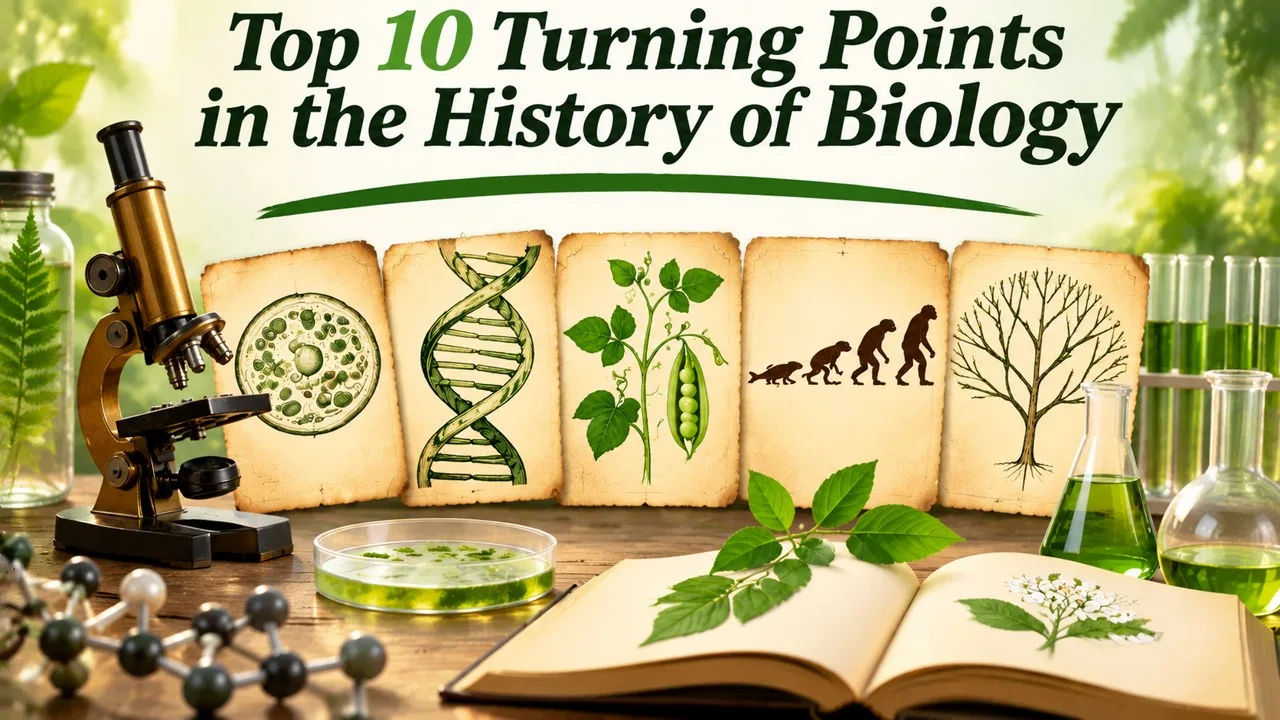
From delayed notebooks of anatomy to the Human Genome Project, ten turning points show biology becoming a public, experimental and eventually molecular science. The list is a curated set of episodes, not a complete history, and not a ranking of genius [5][9]. Some of the most beautiful work, including Leonardo da Vinci's anatomical drawings, did not circulate as a printed system in its own century; later entries, such as Mendel's laws, also had a delayed public life [1][7]. A turning point, in this sense, is a change that later biologists could actually use.
The dates below follow standard histories of science. Independent sources, not a single popular list, are cited for each episode [2][8][10]. Where credit is shared or delayed, that is part of the entry, not a side detail to tidy away.
Key Facts
Biology became modern in stages: description, instruments, classification, a theory of cells, a theory of evolution, a theory of inheritance, a chemical therapy, a structure for DNA, and a sequence for a genome.
Ten Turning Points at a Glance
| Rank | Episode | Usual dating | Why it turned the field |
|---|---|---|---|
| 1 | Leonardo da Vinci's anatomical drawings | c. 1485–1515 | Extraordinary observation, with limited contemporary circulation |
| 2 | The compound microscope | 17th century | A tool that made tissues and "cells" visible |
| 3 | Microorganisms observed | 1670s onward | Leeuwenhoek showed a living world below ordinary sight |
| 4 | Classification of living things | 1735 onward, Linnaeus | A shared naming system for a global inventory |
| 5 | Cell theory | 1830s–1850s | Plants and animals framed as cellular, with later emphasis on division |
| 6 | Evolution by natural selection | 1858–1859 | A common explanation for adaptation and diversity |
| 7 | Mendel's laws | 1866, widely used after 1900 | Inheritance as countable factors |
| 8 | Antibiotics, beginning with penicillin | 1928–1940s | A microbial product used as a medical drug |
| 9 | The double helix of DNA | 1953 | A structure that suggested a copying mechanism |
| 10 | The Human Genome Project | 1990–2003 | A reference sequence for one species, including our own |
1. Leonardo's Anatomical Drawings
Leonardo da Vinci dissected human cadavers and produced drawings of bones, muscles, vessels, and organs that, in accuracy and in the ambition to understand function, stand among the most remarkable anatomical images of the Renaissance [1]. He intended, at times, a systematic treatise. He did not publish one. The sheets remained in private collections, and their broad influence on teaching came late compared with printed books such as Andreas Vesalius's De humani corporis fabrica of 1543 [1].
That delay is part of the historical point. A turning point in a science is not only a private achievement. Leonardo belongs on this list because he shows how far observation could go, and because later anatomists and historians treated the drawings as a standard of what the period could see. Vesalius, whose book actually reached students, is the public complement, not a rival footnote.
2. The Compound Microscope
The compound microscope, developed in the seventeenth century from earlier experiments with stacked lenses, associated in tradition with makers in the Low Countries and then with a rapid English and continental culture of demonstration, changed what counted as a biological object [2]. Robert Hooke's Micrographia (1665) made the word "cell," from the tiny rooms of cork, famous, even though Hooke was looking at walls, not at living protoplasm in the later sense [2]. The instrument, more than any single image, is the turning point: once tissues could be magnified routinely, anatomy was no longer only what a knife and an eye could show.
Later achromatic lenses in the nineteenth century made the microscope a workhorse of physiology and pathology. The first century of the tool already mattered. It opened a scale.
Related: Albert Einstein: The Theoretical Physicist Who Redefined Science
3. The Discovery of Microorganisms
Antonie van Leeuwenhoek, a careful amateur with single-lens microscopes of his own making, wrote to the Royal Society in the 1670s and after about "animalcules" in water, in scrapings, and in other samples: protozoa, bacteria, sperm cells, and more [3]. He was not the first person to look through a lens, but he was the first to make a sustained, letter-by-letter case that a populated world existed below the threshold of unaided sight [3].
Biology after Leeuwenhoek had to include organisms with no obvious place in the older bestiaries. Disease, fermentation, and later germ theory all sit downstream of that enlarged inventory, even though Leeuwenhoek himself did not supply those later theories.
4. The Classification of Life
Carl Linnaeus, beginning with Systema Naturae in 1735 and in later, expanded editions, gave naturalists a practical hierarchical system and a binomial naming habit that could be shared across languages and collections [4]. He did not invent classification, and his own implicit ideas of fixed species were later overturned. He did make a global cataloguing project possible, so that a plant from Japan and a plant from Sweden could be argued about under the same rules [4].
Modern taxonomy has changed its tools, its codes, and its theory. It still lives in a Linnaean infrastructure of names. That is why a book of lists and ranks is a turning point in biology, not only in librarianship. A shared name is a claim that two workers, far apart, are talking about the same organism.
5. Cell Theory
In the late 1830s, Matthias Schleiden and Theodor Schwann argued, in related ways, that plants and animals are composed of cells and that the cell is a basic unit of structure [5]. In 1855, Rudolf Virchow gave the later slogan that cells come from cells, pushing aside looser ideas of spontaneous cellular origin in ordinary tissues [5]. The dates and the credit have been refined by historians, and other microscopists belong in a fuller story. The shift remains clear: the organism was recast as a society of cells, and pathology could be recast as a cellular science.
Related: Top 10 Inventions That Changed the World
Once that frame was in place, fertilisation, development, and eventually chromosomes had a place to happen.
6. The Theory of Evolution
In 1858, papers by Charles Darwin and Alfred Russel Wallace were presented together in London; in 1859 Darwin's On the Origin of Species made natural selection a public, detailed argument for how species change and diverge [6]. The idea that life has a history was not invented in that year, and many of Darwin's readers already lived with older transformationist or geological ideas. What turned the field was a mechanism, tied to variation, heredity as then understood, and a vast biological and biogeographical documentation [6].
Later genetics, and later work on cooperation, drift, and development, have modified the toolkit. They have not removed the central historical claim: living diversity is genealogical. Biology after 1859 is, in that sense, a historical science as well as an experimental one. Later disputes have been about how selection works, not about whether life has a branching history.
7. Mendel's Laws of Inheritance
Gregor Mendel's 1866 paper on pea crosses, read to a society in Brno and then largely neglected by the wider field, described inheritance in terms of discrete, countable factors that segregate and recombine in predictable ratios [7]. Around 1900, several botanists and biologists independently returned to those results and recognized their general importance [7]. The turning point, then, has two dates: an experiment, and a reception.
Without something like Mendel's factors, Darwin's variation had no clear currency. With them, and with the later chromosome theory, evolution and breeding became quantitative. The delay is a warning about how a result can sit in plain print and still miss its moment.
Related: Top 10 Facts About Art Made with Microbes
8. The Discovery of Antibiotics
Alexander Fleming's 1928 observation that a Penicillium mold could clear nearby bacteria, and the later purification and clinical work by Howard Florey, Ernst Chain, and colleagues in the late 1930s and wartime 1940s, turned a laboratory curiosity into a medicine [8]. Others had seen microbial antagonism before. The turning point was a usable drug, produced at scale, that changed the outcome of infections and of surgery [8].
Antibiotics did not abolish infectious disease, and resistance was recognized early. They did reset the baseline of what a bacterial infection had to mean, and they taught biology a practical lesson: the chemical ecology of microbes could be borrowed as a therapy. Hospitals, battlefields, and later livestock agriculture all felt the change, for better and, in the last of those settings, sometimes for worse.
9. The Double Helix
In 1953, James Watson and Francis Crick proposed a double-helix structure for DNA, drawing on X-ray diffraction work by Rosalind Franklin and Maurice Wilkins, and on the chemistry of the bases [9]. The model mattered not only as a shape but as a suggestion for how genetic information could be copied: two complementary strands [9]. Franklin's contribution, long under-credited in popular retellings, is now a standard part of the documented story.
Molecular biology had already begun. The helix made the gene a physical object with a readable architecture. Almost every later sequence project, including the one that closes this list, assumes that architecture. A structure, in this case, was also a research program.
Related: Top 10 Most Bizarre Phobias: Strange Fears That Exist
10. The Human Genome Project
The Human Genome Project, formally organized in 1990 and declared complete, in its first full public sense, in April 2003, produced a reference sequence of human DNA, with parallel and sometimes competing work by a public consortium and by Celera Genomics [10]. It did not, by itself, explain development, disease, or "what a gene is" in every useful sense. It did give biology a map of unprecedented scale, and it forced the field to deal with data, sharing, and the ethics of readable genomes [10].
Later, cheaper sequencing has made the first human reference look like a beginning. That is what a turning point should look like: not a final word, but a new kind of ordinary work. Laboratories now sequence as a routine, which is a measure of how thoroughly the project changed the floor of the field.
Conclusion
These ten episodes do not exhaust the history of biology. They mark a path from private drawing and new lenses, through names, cells, evolution, and inheritance, to a drug, a molecule, and a genome. Some of the results were delayed. Some were collective. All of them can be dated from published work and from a later, independent consensus about why the work mattered.
A field changes when later researchers cannot go back to the old assumptions. After the microscope, invisibility was no longer an argument. After Darwin, fixity was no longer the default. After the helix and the genome, life is also information, in a literal, chemical sense. That is a short list of debts, and it is still a good one. Other episodes could be added; these ten are enough to show the shape of the change.
- ^ [1] "Leonardo da Vinci" and Renaissance anatomy, including the later reception of the drawings; "Andreas Vesalius." Encyclopaedia Britannica. Britannica: Leonardo da Vinci
- ^ [2] "Microscope" and Hooke, Micrographia. Encyclopaedia Britannica. Britannica: Microscope
- ^ [3] "Antonie van Leeuwenhoek." Encyclopaedia Britannica. Britannica: Antonie van Leeuwenhoek
- ^ [4] "Carolus Linnaeus." Encyclopaedia Britannica. Britannica: Carolus Linnaeus
- ^ [5] "Cell theory" and the work of Schleiden, Schwann, and Virchow. Encyclopaedia Britannica. Britannica: Cell
- ^ [6] Darwin, C., On the Origin of Species (1859), and the 1858 Darwin–Wallace papers. Encyclopaedia Britannica. Britannica: Charles Darwin
- ^ [7] "Gregor Mendel" and the early-twentieth-century rediscovery. Encyclopaedia Britannica. Britannica: Gregor Mendel
- ^ [8] "Alexander Fleming" and the development of penicillin. Encyclopaedia Britannica. Britannica: Alexander Fleming
- ^ [9] Watson, J.D. and Crick, F.H.C., 1953, and later historical accounts of Franklin and Wilkins. Nature and Encyclopaedia Britannica. Britannica: DNA
- ^ [10] "Human Genome Project." National Human Genome Research Institute. NHGRI: Human Genome Project




















Discussion
Log in with