








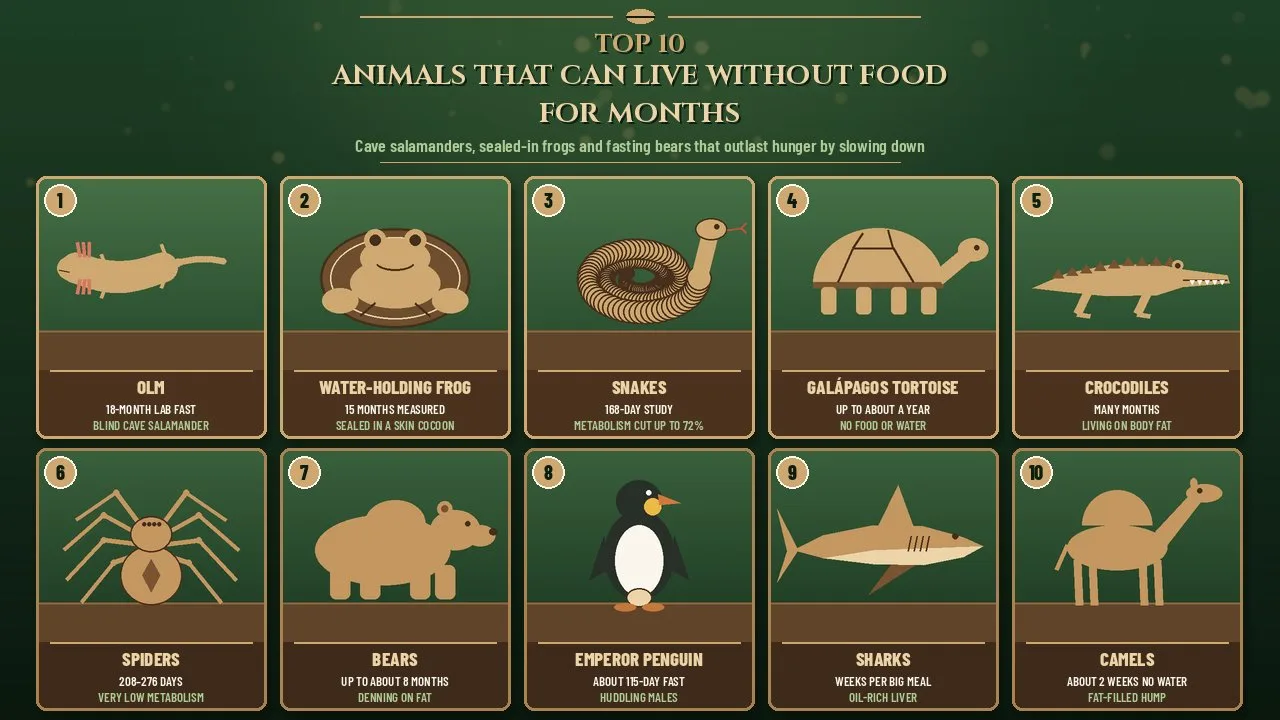
Animals that can live without food for months, from the cave-dwelling olm to bears and emperor penguins, survive by slowing metabolism and burning fat.
Most mammals, people included, start to run into serious trouble after a few weeks with no meals. A surprising number of other creatures treat a long fast as an ordinary part of life. Some wait out droughts sealed underground, some sleep through winters in dens, and some simply live in places where a meal might arrive once in a very long while.
This list brings together ten animals with the best-documented records of going without food, and explains how each one does it. Durations come from peer-reviewed studies, national park services, zoos and museums. Where a popular figure is an estimate, an anecdote or a stretch of the evidence, the article says so. The order below is Finepedia's own and is based on how long each animal can credibly go without eating, not on how unusual it looks.
Animals That Can Live Without Food at a Glance
| Rank | Animal | Best-documented example | Longest credible fast | Main survival strategy |
|---|---|---|---|---|
| 1 | Olm | Proteus anguinus | 18 months in lab tests; older reports of several years | Extreme low metabolism, protein sparing |
| 2 | Water-holding frog | Cyclorana platycephala | 15 months measured; years in the wild | Estivation inside a skin cocoon |
| 3 | Snakes | Western diamondback rattlesnake, ball python | 6 months measured; up to about 2 years reported | Metabolic depression, fat burning |
| 4 | Galápagos giant tortoise | Chelonoidis species | Up to about a year without food or water | Slow metabolism, water stored in the bladder |
| 5 | Crocodiles | Saltwater crocodile, American alligator | Many months; over a year claimed for large adults | Ectothermy, rapid drop to starvation-level metabolism |
| 6 | Spiders | Southern house spider, Lycosa lenta wolf spider | Averages of 208 to 276 days in lab tests | Very low resting metabolism |
| 7 | Bears | Polar bear, American black bear | Up to about 8 months (pregnant polar bears) | Hibernation and denning on fat reserves |
| 8 | Emperor penguin | Aptenodytes forsteri | About 115 days for breeding males | Fat stores plus huddling |
| 9 | Sharks | White shark | Weeks between large meals (estimates vary) | Oil-rich liver as an energy tank |
| 10 | Camels | Dromedary camel | About 2 weeks without water in heat; hump fat for lean spells | Fat hump, water-saving physiology |
How the Ranking Works
A small cold-blooded salamander needs a fraction of the energy a polar bear burns each day, so comparing them takes care. Four questions were asked of each animal.
- Documented duration: how long has the animal been shown, in studies or careful field records, to survive without eating?
- Quality of evidence: is the figure measured, estimated from energy budgets, or based on anecdote?
- Natural relevance: does the animal fast routinely in the wild, or only under extreme or captive conditions?
- Strategy: what does the body actually do to stretch its reserves?
Longest credible fast carried the most weight; where a famous number proved shaky, the supported figure was used instead.
It also helps to separate two ideas. Facultative fasting is a planned, seasonal break from eating that the animal is built for, such as a bear in its den or a penguin on its egg. True starvation is an unplanned shortage of food, which an olm or a spider may face when prey simply fails to turn up. Both appear on this list, and both rely on similar tricks: cutting energy use, burning fat first and protecting muscle and organ protein for as long as possible.
How Animals Survive Without Food: The Main Strategies
Biologists use several terms for the slowed-down states that make long fasts possible, and they are often mixed up.
| Strategy | What it means | Typical animals on this list |
|---|---|---|
| Hibernation | A long seasonal state of reduced metabolism and activity, usually in winter | Bears (in a specialised form), some snakes |
| Brumation | The reptile equivalent of winter dormancy, driven by cold temperatures | Snakes, alligators, tortoises |
| Estivation | Dormancy during hot, dry periods, often underground | Water-holding frog |
| Torpor | A short-term or shallow drop in body temperature and metabolism | Olm, some bears |
| Lipid reserves | Fat stored in the body, liver, tail or hump and burned for energy | Sharks, camels, penguins, bears |
| Protein sparing | Using fat and carbohydrate first so that muscle and organ protein last longer | Olm, snakes, penguins |
Most animals that can live without food combine several of these at once. A frog sealed in clay, for example, is estivating, burning fat and holding water all at the same time.
1. Olm
| Attribute | Details |
|---|---|
| Scientific name | Proteus anguinus |
| Where it lives | Flooded limestone caves of the Dinaric Karst: Slovenia, Croatia, Bosnia and Herzegovina, and north-east Italy |
| Best-documented fast | 18 months of controlled food deprivation; older reports of 18 to 96 months |
| Predicted lifespan | About 100 years (2011 study) |
| Conservation status | Vulnerable (IUCN) |
The olm takes first place because no other vertebrate here combines such a low-energy lifestyle with such long, repeatedly observed fasts. It is a pale, eel-like salamander that spends its whole life in total darkness, in water that stays cold all year.
Biology and Habitat
Olms grow to roughly 25 to 30 centimetres long, have pinkish-white skin and keep feathery red gills throughout adult life. Their eyes are covered by skin and do not work, so they find small crustaceans, snails and insect larvae through smell, touch and sensitivity to vibrations and weak electric fields. Local people once called them "human fish" because their skin colour resembles that of a person.
The cave waters they live in carry very little food. Prey washes in irregularly with floods, and long stretches can pass with almost nothing to eat. In a 2001 study published in the Journal of Experimental Biology, French researchers kept olms without food for 18 months. The animals cut their activity and oxygen use sharply, burned glycogen first, then fat, and only late in the fast started to draw on protein. When food returned, they recovered remarkably fast. The same research summarised earlier records of olms surviving food deprivation for between 18 and 96 months.
Key Features
- Resting metabolism far below that of most surface-dwelling amphibians
- Large energy stores of glycogen and fat, held mainly in the liver
- A three-step fuel sequence: carbohydrate, then fat, then protein
- Long periods of near-total stillness that save energy
- Fast rebuilding of reserves once prey becomes available again
Significance
The olm has become a model for how animals adapt to food-poor environments. Its life runs at a slow pace in every sense. A 2011 study in Biology Letters estimated a maximum lifespan of about 102 years, with females maturing at around 15.6 years and laying eggs only about once every 12.5 years. Biologists see the same slow metabolism behind both the long fasts and the long life.
The widely repeated claim that an olm can go "up to ten years" without food, quoted by several conservation groups, is best read as an estimate built on these low energy needs. Controlled experiments have run for 18 months, and older reports reach about eight years. Either way, no other animal on this list has shown anything comparable.
Interesting Facts
- An eight-year tagging study in Bosnia and Herzegovina, published in 2020, found one olm in exactly the same spot after 2,569 days, about seven years
- In 1689 the naturalist Johann Weikhard von Valvasor wrote that people believed olms washed out of caves after floods were baby dragons
- A dark-skinned subspecies, the black olm, lives in a small area of south-east Slovenia
- The olm is Europe's only cave-adapted vertebrate living entirely in the dark
2. Water-Holding Frog
| Attribute | Details |
|---|---|
| Scientific name | Cyclorana platycephala (also placed in Ranoidea) |
| Where it lives | Arid woodland, grassland and claypans of inland Australia |
| Best-documented fast | 15 months of estivation measured in a laboratory study |
| In the wild | Can stay buried "for years" between rains, according to the Australian Museum |
| Size | Up to about 7.5 centimetres long |
Frogs in general are better at going hungry than many people expect, but the water-holding frog of inland Australia is the champion. Where the reference figures for frogs are often vague, this species has measured data behind it.
Biology and Habitat
This plump, flat-headed frog lives in some of the driest parts of Australia, where rain can fail for long periods. When pools dry up, it digs backwards into soft clay and settles into a chamber below the surface. There it sheds layer after layer of skin, which builds up into a thin, waterproof cocoon around the body, leaving only the nostrils open.
Inside, the frog enters estivation, a dormant state that slows its metabolism to a crawl. It lives on stored fat and on water held in its bladder and tissues. A study published in Physiological and Biochemical Zoology in 2008 followed cocooned frogs for 15 months. They lost up to 36 percent of their body mass and drew on bladder water to keep their blood volume steady. The Australian Museum's FrogID project says the species can live underground for years in this way, and some popular sources mention up to five years, a figure that is plausible but has not been tested in a controlled study.
Key Features
- A cocoon made from repeatedly shed skin that sharply cuts water loss
- A large bladder that acts as an internal water tank
- Metabolism that drops to a small fraction of normal during estivation
- Rapid emergence when heavy summer rain soaks the soil
- Fast breeding: tadpoles can turn into frogs in about a month
Significance
The water-holding frog shows that an animal can survive without food or open water for longer than most mammals live through a single winter. It also corrects a common error. Generic claims that "frogs" can go 16 months without food mix up very different species and conditions.
The best laboratory figures for other frogs support long fasts but stay species-specific. Studies have kept the edible frog of Europe alive through 12 months without food, and the African clawed frog through 18 months. These are captive results under controlled temperatures, not proof that every frog can do the same in the wild.
Interesting Facts
- Calling and breeding peak in summer after heavy rain, when temporary pools appear
- Traditional knowledge in parts of Aboriginal Australia includes digging up water-holding frogs during drought
- There are separate eastern and northern colour forms with different ranges
- Its IUCN status is Least Concern despite its extreme habitat
3. Snakes
| Attribute | Details |
|---|---|
| Best-studied species | Western diamondback rattlesnake (Crotalus atrox), ball python (Python regius), ratsnake (Elaphe obsoleta) |
| Measured fast | 168 days (about six months) in a 2007 study of 62 snakes |
| Reported maximum | Some snakes are known to survive periods of up to about 2 years without food |
| Metabolic drop | Resting metabolism cut by up to 72 percent in rattlesnakes |
| Main fuel | Body fat, with protein spared where possible |
Snakes are built around the idea of eating big and eating rarely. A single large meal can fuel a snake for weeks, and many species routinely go months between prey items in the wild.
Biology and Habitat
Snakes live on every continent except Antarctica. Many ambush hunters wait in one spot for days, and in cold regions snakes also brumate through winter, gathering in dens and barely moving until spring warms the ground.
In 2007 the biologist Marshall McCue, then at the University of Arkansas, published one of the most detailed studies of snake starvation in the journal Zoology. He withheld food from ball pythons, ratsnakes and western diamondback rattlesnakes for 168 days. All three species survived. Rattlesnakes lowered their resting energy needs by up to 72 percent and ratsnakes by about 45 percent, while all of them burned fat and tried to protect structural protein. An earlier study on 16 young rattlesnakes found rising blood ketones during the fast, a sign the body had switched to fat-based fuel.
Key Features
- Very low resting metabolism compared with mammals and birds of the same weight
- The ability to swallow prey much larger than the snake's head
- Digestive organs that shrink between meals and rapidly rebuild after eating
- Fat stores packed in the body cavity and tail
- Metabolic depression that deepens as a fast continues
Significance
The researchers noted that some snakes were already known to survive gaps of up to two years, but that the mechanisms behind this had barely been studied. The work showed that snakes save energy on both sides of the equation: they reduce demand and manage their reserves carefully. That may help explain why snakes have spread into so many low-energy habitats over their long evolutionary history.
Keepers see the same thing in captivity: healthy ball pythons often refuse food for weeks or months in the breeding season or cooler months.
Interesting Facts
- After a large meal, a Burmese python's metabolic rate soars and organs such as the heart, liver and intestines grow temporarily
- Rattlesnakes in the 2007 study lost about a quarter of their body mass over the 168 days
- Venomous species are covered in more depth in Finepedia's list of the most venomous snakes in the world
4. Galápagos Giant Tortoise
| Attribute | Details |
|---|---|
| Scientific name | Chelonoidis niger complex (several island species) |
| Where it lives | Galápagos Islands, Ecuador |
| Best-documented fast | Up to about a year without food or water (National Geographic, San Diego Zoo) |
| Typical daily rest | Around 16 hours a day |
| Lifespan | Often more than 100 years |
The giant tortoises of the Galápagos are famous for two things: their size and their staying power. Their ability to go without eating or drinking for many months shaped both their survival and, sadly, their history with people.
Biology and Habitat
Galápagos tortoises graze on grasses, leaves, flowers and prickly pear cactus, which also supplies much of their water. Large males can weigh well over 250 kilograms. They spend most of the day resting, basking or wallowing in mud pools, and move slowly between dry lowlands and greener highlands with the seasons.
Their slow metabolism means they burn energy at a fraction of a mammal's rate. They can also store large amounts of water in the bladder and draw on it during dry spells. National Geographic and San Diego Zoo Wildlife Alliance both state that these tortoises can survive up to a year without eating or drinking. That figure reflects their known physiology and historical observations rather than a formal laboratory test.
Key Features
- A very slow metabolism, even for a reptile
- Water stored in the bladder and tissues for dry periods
- Heavy fat and energy reserves in a large body
- Long resting periods that cut energy use
- Seed-spreading grazing that helps shape island plant life
Significance
From the 1600s to the 1800s, pirates, naval ships and especially whalers visiting the islands loaded tortoises into their holds as living food supplies. Because the animals could survive so long without care, crews could keep fresh meat on board for months. Logbooks and memoirs of the period describe tortoises surviving five or six months, fourteen months and even longer without being fed, though these claims come from sailors rather than scientists.
The cost was huge. Historians estimate that between 100,000 and 200,000 tortoises were removed from the islands, and several island populations were wiped out. Today conservation groups and the Galápagos National Park run breeding and rewilding programmes to rebuild numbers.
Interesting Facts
- The Spanish word galápago refers to a tortoise or turtle, and the islands were named after them
- Lonesome George, the last known tortoise from Pinta Island, died in 2012
- The tortoises spot food mainly by sight and are drawn to red colours
- Different islands have tortoises with dome-shaped or saddle-shaped shells
5. Crocodiles
| Attribute | Details |
|---|---|
| Best-studied species | Saltwater (estuarine) crocodile, Crocodylus porosus; American alligator, Alligator mississippiensis |
| Fasting metabolism | 46 to 70 percent of the expected rate for their size (1986 study) |
| Reported maximum | Large crocodiles can reportedly go over a year without eating (PBS Nature) |
| Main fuel | Body fat |
| Seasonal fasting | Alligators stop feeding during cool months |
Crocodiles and alligators look like eating machines, but they are also masters of doing without. As cold-blooded predators that spend much of their time lying still, they burn very little energy between meals.
Biology and Habitat
Crocodilians live in tropical and subtropical rivers, swamps, estuaries and coasts around the world. The saltwater crocodile, the largest living reptile, ranges from India and Southeast Asia to northern Australia. The American alligator lives in the south-eastern United States, where winters can be cool.
In a 1986 study in the Journal of Zoology, the Australian researcher Stephen Garnett measured the metabolism of young saltwater crocodiles that were not eating. Their oxygen use fell to between 46 and 70 percent of what would be expected for animals of their weight, and they burned fat as their main fuel. Hatchlings that never started feeding survived until they had lost about 27 percent of their starting weight. The study described them as inactive predators able to drop their metabolism to starvation levels quickly and therefore withstand long fasts.
Key Features
- Ectothermy: no food energy is spent keeping the body warm
- Long periods of motionless basking and waiting
- Fat reserves in the tail and body
- A strongly acidic stomach that digests bone and shell, getting the most from each meal
- Seasonal fasting in cooler climates when water temperatures drop
Significance
Popular accounts often say that big crocodiles can live a year or more without food. PBS Nature repeats this for larger crocodiles, though it is not a measured figure for any one species and should be treated as an estimate. What is clear is that crocodilians can go many months between meals, especially when temperatures are low and they are barely active.
American alligators show the seasonal version of this. When water temperatures fall in winter, they largely stop feeding and become sluggish, a reptile dormancy known as brumation. In very cold snaps, alligators have even been seen holding their snouts above freezing water to keep breathing.
Interesting Facts
- Crocodilians belong to a lineage that has survived since the age of dinosaurs
- Saltwater crocodiles can travel long distances at sea using ocean currents
- Even with long fasts possible, wild crocodiles in good habitat feed regularly when prey is available
6. Spiders
| Attribute | Details |
|---|---|
| Best-studied species | Southern house spider (Filistata hibernalis, now Kukulcania hibernalis) and the wolf spider Lycosa lenta |
| Measured fast | Average survival of 276 days and 208 days respectively without food (1974 study) |
| Metabolic drop | About 30 to 40 percent lower during starvation |
| Resting metabolism | Unusually low for animals of their size |
| Variation | Some species survive only weeks; age, temperature and humidity matter |
Spiders are sit-and-wait or roaming hunters that depend on prey wandering past. Because meals are unpredictable, many species are built to endure long gaps.
Biology and Habitat
There are more than 50,000 described spider species, found in almost every land habitat. Web builders and burrowing hunters may wait days or weeks for a single insect. They digest food outside the body using enzymes, then suck up the liquid, and can store reserves in the abdomen.
The classic study on spider starvation was published in the journal Ecology in 1974 by J. F. Anderson. Adult southern house spiders survived an average of 276 days with no food, and Lycosa lenta wolf spiders an average of 208 days. Both species already had very low resting metabolic rates, and both cut them a further 30 to 40 percent while starving, apparently without losing normal function. Survival time was linked to metabolism: the lower the rate, the longer the spider lasted.
Key Features
- Low resting metabolism compared with insects and other cold-blooded animals of similar size
- Further metabolic suppression once food runs out
- Energy reserves stored in a stretchy abdomen
- Ability to survive on water alone for long periods
- Sit-and-wait hunting that spends little energy
Significance
The spider results put a solid number on a common claim. Rather than a vague "three to four months" or "a year", the measured averages for these two species fall between about seven and nine months. Other spiders are less hardy. A study of the wolf spider Pardosa astrigera found starving males survived around 29 days and females about 54 days, showing how much species, sex and size matter.
Tarantulas are often said to go many months without eating, especially around moulting, when they may refuse food for weeks. Long fasts in captive tarantulas are well known to keepers, but published, controlled figures are scarce, so headline claims of years should be treated with care.
Interesting Facts
- In Anderson's study, survival time fell as metabolic rate rose, a clear link between energy use and endurance
- Spiders can rebuild body mass quickly once prey becomes available again
- Juvenile tarantulas in a 2009 study stayed stable when fed only once every 30 days
7. Bears
| Attribute | Details |
|---|---|
| Best-studied species | American black bear, brown bear (grizzly), polar bear |
| Black bear fast | Up to about 6 months; around 7 months in Alaska, without eating, drinking or passing waste (NPS) |
| Brown bear denning | About 5 to 8 months in the coldest parts of Alaska (NPS) |
| Polar bear fast | Pregnant females in Western Hudson Bay may go up to about 8 months without food |
| Weight loss | Up to about a third of body weight over winter |
Bears are the most familiar animals that can live without food for months. Their winter sleep is so efficient that doctors and biologists study it for clues to human health.
Biology and Habitat
Black and brown bears spend late summer and autumn eating as much as possible, a stage often called hyperphagia, to build thick fat reserves. When food becomes scarce, they enter dens and slip into a long, deep sleep. According to the US National Park Service, black bears can go up to six months without eating, drinking, urinating or defecating, and about seven months in colder Alaska. Brown bears in the coldest areas may stay in dens for five to eight months.
Polar bears follow a different pattern. In regions where sea ice melts each summer, such as Western Hudson Bay in Canada, bears are forced ashore where they can find little to eat. Pregnant females then go straight into maternity dens to give birth and nurse their cubs. Combined, the summer fast and the denning period can last up to about eight months, one of the longest fasts of any large mammal.
Key Features
- Body temperature falls only several degrees, so bears can wake fairly quickly
- Heart rate and breathing slow dramatically
- Urea from the body is recycled back into protein instead of being passed as urine
- Muscle and bone are largely preserved despite months of inactivity
- Cubs are born and nursed in the den while the mother is still fasting
Significance
Biologists often describe bear hibernation as a special form of torpor rather than the deep, cold hibernation seen in ground squirrels. Even so, it is one of the most impressive long fasts in the animal world. A bear stays alive on fat while avoiding the bone loss and muscle wasting that would affect a person confined to bed for months.
Because of this, bear hibernation is studied for insights into conditions such as osteoporosis, kidney disease and obesity. The long polar bear fast is also a warning sign. As Arctic sea ice melts earlier and forms later, many polar bears spend longer ashore without food, which researchers link to falling body condition in some populations.
Interesting Facts
- Katmai National Park in Alaska holds an online Fat Bear Week contest each autumn, celebrating its heaviest brown bears before winter
- Not all bears hibernate; in mild climates some black bears stay active through winter
- A hibernating bear burns mostly fat, producing water as a by-product of fat metabolism
8. Emperor Penguin
| Attribute | Details |
|---|---|
| Scientific name | Aptenodytes forsteri |
| Where it lives | Sea ice and coasts around Antarctica |
| Best-documented fast | About 115 days for breeding males: roughly 45 days of courtship plus 65 to 75 days of incubation |
| Weight loss | About 40 to 50 percent of body mass |
| Key survival trick | Tight huddles that cut heat loss and save energy |
The emperor penguin is the only bird that breeds in the depth of the Antarctic winter, and the male carries out one of the hardest fasts in nature to make that possible.
Biology and Habitat
Emperor penguins gather at colonies on sea ice in autumn, often far from open water. Males arrive weighing roughly 36 to 38 kilograms. After courtship, the female lays a single egg in May or June, passes it to her mate and walks back to the sea to feed for around two months.
The male balances the egg on his feet under a fold of skin called a brood pouch and stands through storms and darkness until it hatches 65 to 75 days later. Including the courtship period, he goes about four months without eating, living almost entirely on body fat built up the previous summer. By the time the female returns with food for the chick, he has lost close to half his body weight. Studies at the Pointe Géologie colony in Adélie Land, starting with French researcher Jean Prévost in the 1950s, established the figure of about 115 days.
Key Features
- Thick layers of fat laid down during the summer feeding season
- Dense, overlapping feathers that trap heat
- Huddles of thousands of birds that rotate so each penguin takes turns at the windy edge
- Ability to eat snow for water during the fast
- A protein-sparing phase that keeps vital muscle intact until fat runs low
Significance
Research published in the Journal of Experimental Biology found that huddling is critical. Birds packed into tight groups lost noticeably less weight each day than birds standing loosely, because they spent less energy keeping warm. Without huddles, many males would run out of fuel before the egg hatched.
Penguin chicks have their own endurance records. King penguin chicks on the sub-Antarctic Crozet Islands can go up to about five months with little or no food during winter, losing well over half their body mass. Like the adults, they rely on a long phase of fat burning that spares protein for as long as possible.
Interesting Facts
- Emperor penguins are the tallest and heaviest penguins alive
- Partners recognise each other by voice among thousands of calling birds
- Adults also fast while moulting, when they cannot swim until new feathers grow in
- Loss of stable sea ice is a major threat to emperor penguin colonies
9. Sharks
| Attribute | Details |
|---|---|
| Best-studied species | White shark, Carcharodon carcharias |
| Classic estimate | 30 kilograms of whale blubber could keep a 943-kilogram white shark in energy balance for about 44 days (1982 study) |
| Revised estimate | About 12 to 15 days for the same meal at active swimming rates (2013 study) |
| Energy store | An oily liver that can make up about a quarter of body weight |
| Migration fuel | Liver oil used during long ocean crossings |
Sharks are often said to survive weeks or even months without food. The truth depends on the species, its size and how active it is, so this entry focuses on the white shark, where the numbers have been studied in detail.
Biology and Habitat
Sharks lack the fat layers of mammals. Instead, many species store energy in a huge, oil-rich liver, which also helps them stay buoyant. In a large white shark, the liver can account for up to about 28 percent of body weight, and most of it is lipid. That makes it a built-in fuel tank for times between meals.
In 1982, a team led by Francis Carey tracked a white shark off the north-east United States and used muscle temperature to estimate its metabolism. They calculated that a 943-kilogram shark could live for about one and a half months on a single 30-kilogram meal of whale blubber. For decades that figure was quoted widely. A 2013 study in Scientific Reports, which measured swimming speeds in white sharks off South Australia, concluded that their energy needs are much higher and that the same meal would last only about 12 to 15 days of active swimming.
Key Features
- A large, lipid-filled liver that stores energy and provides lift
- Cold-blooded or partly warm-blooded bodies, depending on the species
- The ability to eat very large meals when prey is plentiful
- Slow cruising that can stretch energy reserves
- Long migrations between feeding areas powered partly by stored oil
Significance
White sharks make some of the longest migrations of any fish, crossing open ocean between coastal feeding grounds and remote offshore areas. A 2013 study in Proceedings of the Royal Society B found that migrating white sharks gradually became less buoyant on such journeys, consistent with burning liver oil as they travelled.
The lesson is that sharks can go weeks between big meals, and some may stretch reserves further at cold temperatures or low activity, but there is no single reliable figure that applies to "sharks" in general. The common claim of eight to ten weeks is not backed by species-specific studies.
Interesting Facts
- The Greenland shark has an extremely slow metabolism and is estimated to live for at least 272 years
- Smaller, more active sharks generally need to feed more often than large, slow ones
10. Camels
| Attribute | Details |
|---|---|
| Best-studied species | Dromedary or one-humped camel, Camelus dromedarius |
| Hump contents | Fat, not water: up to about 36 kilograms (80 pounds) |
| Without water | About 2 weeks in hot conditions; studies have run dehydration trials of 17 to 20 days |
| Water-loss tolerance | Can survive losing around 30 percent of body water |
| Refill rate | Can drink about 100 litres in roughly 10 minutes |
Camels close the list because they are often misunderstood. They are the world's best-known survivors of thirst, but claims that they go without water for 40 days, or that the hump is a water tank, overstate what the science shows.
Biology and Habitat
Dromedaries live across the deserts of North Africa, the Middle East and South Asia, and a large feral population roams inland Australia. Bactrian camels, with two humps, live in the cold deserts of Central Asia. Both feed on dry, thorny plants that most grazing animals avoid.
The hump stores fat that the camel can burn when grazing is poor. As the fat is used, the hump shrinks and may flop to one side, then rebuilds when food improves. Because the fat is concentrated in one place rather than spread under the skin, it also lets heat escape more easily from the rest of the body. When it comes to water, studies show dromedaries can last around two weeks without drinking in hot weather and survive losing about 30 percent of their body water, far more than most mammals could tolerate.
Key Features
- A fat-filled hump that acts as an energy reserve during lean grazing
- Body temperature that can rise several degrees during the day to reduce sweating
- Oval red blood cells that keep flowing even when the camel is dehydrated
- Kidneys and intestines that recover a great deal of water before waste leaves the body
- Nostrils that trap moisture from exhaled air
Significance
The camel ranks tenth because its real speciality is water, not food. It can certainly live off its hump during lean spells, but published research mostly measures how long camels go without drinking rather than how long they go without eating. In cool seasons, when plants hold more moisture, camels may go much longer between drinks.
That is still extraordinary. When water is finally available, a thirsty camel can drink around 100 litres in about ten minutes and replace much of its lost weight quickly, something that would be dangerous for most animals.
Interesting Facts
- Camels have been domesticated for several thousand years and remain vital working animals in desert regions
- Bactrian camels can survive cold winters as well as hot summers
- Thick lips and a tough mouth lining let camels eat thorny plants
Comparison of Fasting Strategies
| Animal | Warm or cold-blooded | Why it fasts | Main fuel | Evidence level |
|---|---|---|---|---|
| Olm | Cold-blooded | Food-poor cave water | Glycogen, fat, then protein | Lab study plus older records |
| Water-holding frog | Cold-blooded | Drought | Fat and stored water | Lab study plus museum field knowledge |
| Snakes | Cold-blooded | Irregular prey, winter | Fat | Controlled studies |
| Galápagos giant tortoise | Cold-blooded | Dry seasons | Fat and bladder water | Zoo and field knowledge, historical records |
| Crocodiles | Cold-blooded | Irregular prey, cool seasons | Fat | Metabolic study plus estimates |
| Spiders | Cold-blooded | Irregular prey | Fat and stored reserves | Controlled studies |
| Bears | Warm-blooded | Winter, sea-ice loss | Fat | Long-term field research |
| Emperor penguin | Warm-blooded | Breeding on the ice | Fat | Long-term field research |
| Sharks | Mostly cold-blooded | Gaps between large meals, migration | Liver oil | Energy-budget estimates |
| Camels | Warm-blooded | Desert grazing and water shortage | Hump fat | Controlled water studies |
Cold-blooded animals dominate the top of the list because they do not spend energy keeping warm. The warm-blooded fasters, bears and penguins, make up for this with enormous fat reserves and clever ways of reducing heat loss.
Frequently Asked Questions
Which animal can live the longest without food?
Among well-studied vertebrates, the olm, a blind cave salamander from south-eastern Europe, holds the record. Researchers kept olms without food for 18 months, and older reports describe survival for several years. The often-quoted ten-year figure is an estimate based on the animal's very low metabolism rather than a direct experiment.
How do animals survive without food for so long?
They lower their metabolism, stay inactive and burn stored energy, mainly fat and glycogen. Many also spare protein so that muscles and organs keep working. Depending on the species, this can happen through hibernation, brumation, estivation or simple metabolic slowdown, often in places where little energy is lost to cold or heat.
Can bears really go months without eating or drinking?
Yes. The US National Park Service says black bears can spend up to six months, and about seven in Alaska, without eating, drinking or passing waste. Pregnant polar bears in Western Hudson Bay may go up to around eight months without food when the summer ashore and the denning period are combined.
Does a camel's hump store water?
No. A camel's hump stores fat, up to about 36 kilograms in a dromedary, which can be burned for energy. Camels survive without water thanks to efficient kidneys, tolerance of large water losses and a body temperature that can rise during the day. In hot weather they typically go about two weeks without drinking.
How long can a snake go without eating?
It varies by species, size and temperature. In a 2007 study, ball pythons, ratsnakes and rattlesnakes all survived 168 days without food, and researchers noted that some snakes are known to survive up to about two years. Healthy pet snakes may skip meals for weeks or months, but steady weight loss needs a vet check.
Why do emperor penguins stop eating for four months?
Male emperor penguins fast through courtship and then incubate the egg on their feet for 65 to 75 days while the female feeds at sea. The colony is too far from open water to commute, so the male lives on his fat reserves for about 115 days, losing close to half his body weight.
Conclusion
The animals that can live without food for months show how flexible life can be when meals are scarce. Cold-blooded specialists such as the olm, the water-holding frog, snakes, tortoises, crocodiles and spiders win on sheer duration by living slowly and spending almost no energy. Warm-blooded fasters like bears and emperor penguins rely on huge fat stores, careful protein use and behaviour such as denning and huddling. Sharks and camels, often given exaggerated reputations, still show remarkable endurance when the evidence is read carefully. Together they reveal that going hungry is not always a crisis; for some species, it is simply part of the plan.
- Hervant, F., Mathieu, J. and Durand, J. (2001). Behavioural, physiological and metabolic responses to long-term starvation and refeeding in a blind cave-dwelling (Proteus anguinus) and a surface-dwelling (Euproctus asper) salamander. Journal of Experimental Biology 204: 269–281.
- Voituron, Y. et al. (2011). Extreme lifespan of the human fish (Proteus anguinus): a challenge for ageing mechanisms. Biology Letters 7: 105–107.
- Balázs, G. et al. (2020). Extreme site fidelity of the olm (Proteus anguinus) revealed by a long-term capture–mark–recapture study. Journal of Zoology.
- EDGE of Existence (Zoological Society of London), Olm species profile.
- Australian Museum FrogID, Cyclorana platycephala species profile; Physiological and Biochemical Zoology (2008), Water balance and arginine vasotocin in the cocooning frog Cyclorana platycephala.
- McCue, M. D. (2007). Snakes survive starvation by employing supply- and demand-side economic strategies. Zoology 110: 318–327; University of Arkansas news release, August 2007.
- National Geographic and San Diego Zoo Wildlife Alliance, Galápagos tortoise fact pages; C. H. Townsend, The Galapagos Tortoises in Their Relation to the Whaling Industry (1925).
- Garnett, S. T. (1986). Metabolism and survival of fasting estuarine crocodiles. Journal of Zoology; PBS Nature, Crocodile Secrets of Survival (2011).
- Anderson, J. F. (1974). Responses to starvation in the spiders Lycosa lenta Hentz and Filistata hibernalis (Hentz). Ecology 55: 576–585.
- US National Park Service, black bear, brown bear and Katmai bear hibernation pages; Polar Bears International and San Diego Zoo polar bear fact sheets.
- Australian Antarctic Program, Emperor penguin breeding cycle; Gilbert, C. et al. (2008). Energy saving processes in huddling emperor penguins. Journal of Experimental Biology; Cherel, Y. and Le Maho, Y., studies of fasting king penguin chicks (The Auk, 1987).
- Carey, F. G. et al. (1982). Temperature and activities of a white shark. Copeia; Semmens, J. M. et al. (2013). Feeding requirements of white sharks may be higher than originally thought. Scientific Reports; Del Raye, G. et al. (2013). Travelling light. Proceedings of the Royal Society B.
- Cleveland Zoological Society, Truth or Tail: A camel's hump (2021); published dromedary dehydration studies (Frontiers in Veterinary Science, 2023; PLOS One).
- Reference topic awareness only: 10MostToday, 10 Most Unique Animals That Can Live Without Food for Months (original ranking, structure and wording throughout; vague or unverifiable claims replaced with species-specific figures).

















Log in with