

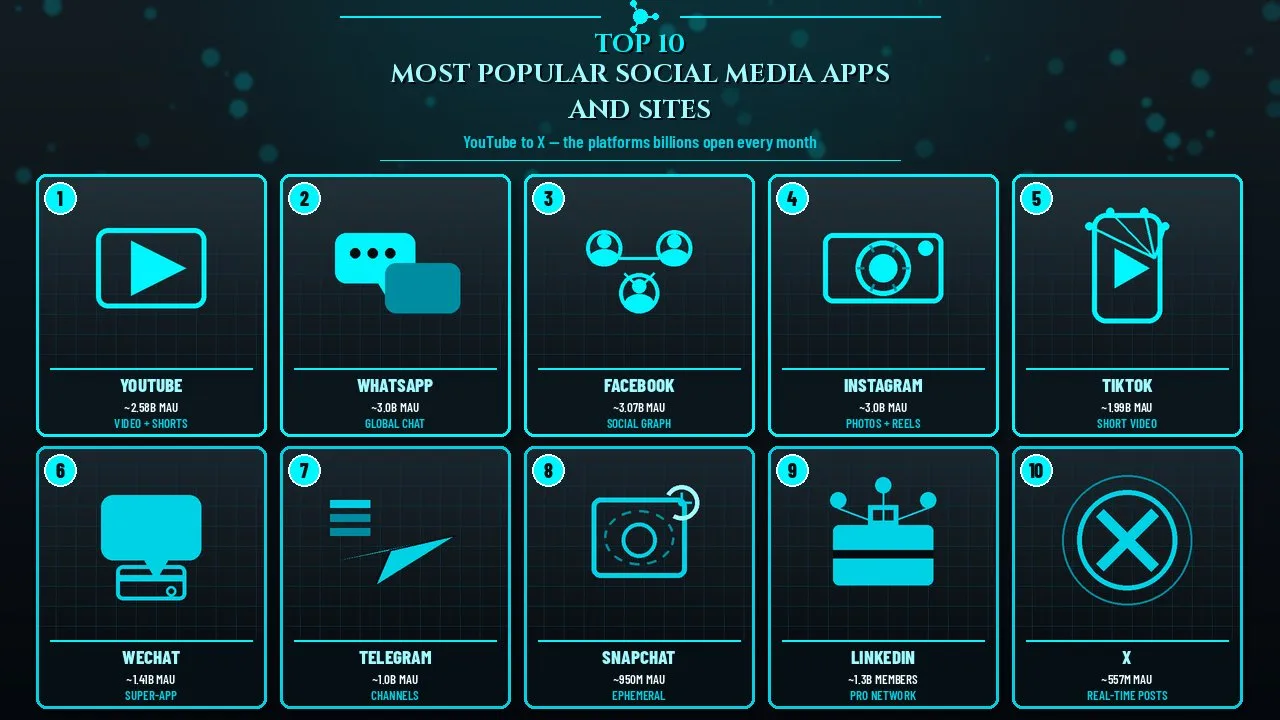
The most popular social media apps and sites in 2026, from YouTube and WhatsApp to TikTok and WeChat, reach billions of monthly active users worldwide.
Billions of people open a social or messaging app every day to watch a clip, send a voice note, scroll a feed or look for work. The platforms that hold those habits have changed since the late 2010s: short video and encrypted chat now sit beside classic profile networks, and Chinese super-apps matter as much as Silicon Valley brands when the ranking is truly global.
This Finepedia list ranks ten of the most popular social media apps and sites by how widely they are used in everyday life. Figures are monthly active users (MAU) or the closest published metric, drawn from DataReportal Digital 2025 reports, Similarweb app intelligence, company earnings and widely cited Statista compilations through late 2025 and early 2026. Where a number is an advertising-reach estimate or a membership total rather than MAU, the article says so. The order below is Finepedia's own and deliberately differs from older "most popular" lists that still put Tumblr or Flickr in the top ten.
Most Popular Social Media Apps at a Glance
| Rank | Platform | Owner / parent | Approx. scale (as of) | Main use |
|---|---|---|---|---|
| 1 | YouTube | Google (Alphabet) | ~2.58 billion MAU (compilations, Oct 2025); Similarweb app index 100 (Jul 2025) | Long- and short-form video |
| 2 | Meta Platforms | ~3.0 billion MAU (compilations, Oct 2025); Similarweb index 87.6 | Messaging and groups | |
| 3 | Meta Platforms | ~3.07 billion MAU (compilations, Oct 2025); Similarweb index 76.2 | Social network and Groups | |
| 4 | Meta Platforms | ~3.0 billion MAU (compilations, Oct 2025); Similarweb index 71.7 | Photos, Reels and Stories | |
| 5 | TikTok | ByteDance | ~1.99 billion MAU (compilations, Oct 2025); Similarweb index 53.8 | Short-form video |
| 6 | Tencent | ~1.41 billion combined WeChat/Weixin MAU (Q3 2025) | Chat, payments and mini-programs | |
| 7 | Telegram | Telegram FZ-LLC | ~1.0 billion MAU (compilations, Oct 2025) | Messaging and large channels |
| 8 | Snapchat | Snap Inc. | ~932–956 million MAU (late 2025–Q1 2026) | Ephemeral snaps and Stories |
| 9 | Microsoft | ~1.3 billion members (2025–2026; membership, not MAU) | Professional networking | |
| 10 | X (Twitter) | xAI / X Corp. | ~557 million MAU (compilations, 2025–2026) | Public short posts and news |
How the Ranking Works
"Most popular" can mean several different things. Self-reported surveys, phone-app telemetry, website traffic and advertising-reach tools do not always agree on which service sits at number one. DataReportal's Digital 2025 July Global Statshot shows the gap clearly: GWI survey respondents put Facebook first by past-month use, while Similarweb's App Intelligence puts YouTube first by measured mobile active users, with WhatsApp second and Facebook third.
This list follows measured and company-backed scale rather than nostalgia or brand fame. Four questions were asked of each platform.
- Documented reach: what is the best recent MAU, membership or advertising-reach figure from a reputable source?
- Evidence quality: company earnings and DataReportal/Similarweb compilations outrank vague marketing claims.
- Global relevance: is the platform used across many countries, or mainly in one region with outsized local power?
- Role in daily life: does it function as a primary social or messaging hub, not only as a niche tool?
YouTube takes first place on Similarweb's July 2025 mobile-app index (score 100), even though some MAU compilations still list Facebook slightly higher. WhatsApp, Facebook and Instagram follow on that same index. TikTok closes the measured top five. WeChat, Telegram, Snapchat, LinkedIn and X fill the rest of the ten on company-reported or compilation scale. Tumblr and Flickr, which appeared on many 2010s lists, are left out because they are no longer top-tier by global reach.
Meta Platforms owns Facebook, Instagram and WhatsApp (and Messenger, which is not listed separately here to avoid double-counting the same family of apps). Google owns YouTube. Microsoft owns LinkedIn. Those ownership facts matter for privacy, advertising and product strategy, but the ranking itself is about people opening the apps.
Reading Social Media Metrics
| Metric | What it counts | Watch-outs |
|---|---|---|
| Monthly active users (MAU) | Unique accounts that used the service in a month | Definitions differ by company; bots and multi-accounts inflate totals |
| Daily active users / people (DAU / DAP) | Use on a typical day | Meta's "Family DAP" deduplicates across Facebook, Instagram, Messenger and WhatsApp |
| Members | Registered accounts (LinkedIn) | Not the same as monthly actives |
| Ad reach | People an advertiser can potentially reach | Can differ from MAU; some markets are excluded |
| App index | Relative MAU vs the top app (Similarweb) | Good for ranking; not an absolute headcount |
As of July 2025, DataReportal estimated about 5.41 billion social media user identities worldwide, roughly 65.7 percent of the global population. People also use several platforms at once: the same reports put average use near seven platforms per month among connected adults. A high rank here means mass daily habit, not that every user prefers that app as a favourite.
1. YouTube
| Attribute | Details |
|---|---|
| Launched | February 2005 (public); acquired by Google October 2006 |
| Owner | Google LLC (Alphabet Inc.) |
| Approx. scale | ~2.58 billion MAU in late-2025 compilations; Similarweb app index 100 (Jul 2025); ~2.54 billion potential ad reach in 88 countries (DataReportal Jul 2025) |
| Core product | User-uploaded and partner video, Shorts, live streams, YouTube Music and Premium |
| HQ roots | San Mateo / San Bruno, California, United States |
YouTube sits at number one on this list because measured mobile use puts it ahead of every other social or messaging app in Similarweb's mid-2025 App Intelligence snapshot. It is both a search engine for video and a social layer of channels, comments, subscriptions and creator communities.
Origins and History
Chad Hurley, Steve Chen and Jawed Karim launched YouTube in 2005 after working at PayPal. Google bought the site in 2006 for about $1.65 billion in stock, a figure widely reported at the time. Over the next two decades the product moved from short amateur clips to long-form education, music, news, gaming and podcast-style shows. YouTube Shorts brought vertical short video into the same app that still hosts hour-long lectures and live concerts.
Key Features
- Free ad-supported video at global scale, with optional Premium and Music subscriptions
- Creator monetisation through ads, Super Chat, channel memberships and shopping
- Shorts feed for vertical clips alongside the classic home and subscriptions tabs
- Strong search and recommendation systems that treat video as a primary way to learn and be entertained
- Connected TV and mobile apps that keep the same account across devices
Significance
For many people, YouTube has replaced linear television for how-to content, music discovery and niche hobbies. DataReportal's July 2025 analysis noted that online video time now rivals or exceeds traditional TV time among connected adults, and YouTube is the largest single vehicle for that shift outside China. Marketers treat its ad reach as the widest among major social video platforms in the markets where Google publishes planner data.
Interesting Facts
- The first YouTube video, "Me at the zoo," was uploaded by Jawed Karim on 23 April 2005
- YouTube is often described as the world's second-largest search engine after Google Search, though that claim is informal rather than a single audited ranking
- Similarweb's July 2025 index put YouTube's mobile active base about 14 percent ahead of WhatsApp
- Shorts competes directly with TikTok and Instagram Reels inside an app that still rewards long watch time
2. WhatsApp
| Attribute | Details |
|---|---|
| Launched | 2009 |
| Owner | Meta Platforms (acquired 2014) |
| Approx. scale | ~3.0 billion MAU in Oct 2025 compilations; Similarweb app index 87.6 (Jul 2025); Meta has cited more than 1.5 billion daily actives visiting WhatsApp Updates |
| Core product | End-to-end encrypted messaging, voice and video calls, Status, Channels and business tools |
| HQ roots | Mountain View, California, United States (founders from Ukraine / United States) |
WhatsApp is the world's default messaging app in large parts of Latin America, Africa, South Asia, Europe and the Middle East. On this ranking it places second because Similarweb's measured app use puts it immediately behind YouTube, and company-adjacent compilations put its MAU near three billion.
Origins and History
Brian Acton and Jan Koum founded WhatsApp in 2009 as a simple status and messaging tool tied to phone numbers. Facebook (now Meta) acquired it in 2014 for about $19 billion in cash and stock, one of the largest consumer-tech deals of that decade. End-to-end encryption later became a central product promise for personal chats. Status updates, Communities, Channels and business messaging expanded the app beyond one-to-one text.
Key Features
- Phone-number identity instead of public usernames for most personal accounts
- End-to-end encryption for personal messages and calls
- Group chats, voice notes, document sharing and multi-device support
- Status and Channels for broadcast-style updates
- WhatsApp Business tools for catalogues, labels and official business accounts
Significance
In many countries WhatsApp is the primary way families, schools and small businesses communicate. Meta's 2025 earnings commentary has highlighted WhatsApp as a major driver of Meta AI queries and as a future surface for limited ads in Status and Channels. Because it is owned by Meta alongside Facebook and Instagram, its user base overlaps heavily with those apps, which is why Meta emphasises deduplicated "Family" people metrics in earnings.
Interesting Facts
- WhatsApp does not use a public follower graph the way Facebook or Instagram does; contact lists and groups define the social graph
- GWI survey data cited by DataReportal in 2025 showed WhatsApp past-month use above 98 percent among online adults in countries such as Morocco and Nigeria
- Voice notes are a cultural default on WhatsApp in several regions where typing on small screens is less convenient
- The 2014 acquisition price is still one of the reference points when journalists discuss messaging-app valuations
3. Facebook
| Attribute | Details |
|---|---|
| Launched | February 2004 (as TheFacebook) |
| Owner | Meta Platforms |
| Approx. scale | ~3.07 billion MAU in Oct 2025 compilations; Similarweb app index 76.2 (Jul 2025); Meta Family DAP ~3.48 billion (Jun 2025 average) |
| Core product | Profiles, News Feed, Groups, Marketplace, Reels and Events |
| HQ roots | Menlo Park, California, United States |
Facebook remains the largest single social network by many MAU compilations and the top self-reported social platform in GWI's Q1 2025 survey wave (56.6 percent of online adults). On Similarweb's measured mobile ranking it places third, which is the position used here so the list stays consistent with phone-app telemetry.
Origins and History
Mark Zuckerberg and co-founders launched TheFacebook at Harvard in 2004. The service opened to other universities, then to the general public, and became Facebook, Inc. The company rebranded to Meta Platforms in 2021 while keeping Facebook as the name of the core app. Over two decades the product absorbed photo albums, a news-style feed, Reactions, Watch, Marketplace and Reels. Acquisitions of Instagram (2012) and WhatsApp (2014) built the wider Family of Apps.
Key Features
- Profile-based social graph with friends, Pages and Groups
- Algorithmic News Feed mixing friends, Groups and recommended content
- Marketplace for local buying and selling
- Reels short video and Stories-style ephemeral posts
- Events, Fundraisers and community tools used heavily outside the United States
Significance
Facebook is still the default social network for many adults over 30 and for community organising in Groups. Claims that "Facebook is dying" conflict with both MAU compilations near three billion and Meta's continued Family DAP growth (3.48 billion average daily people in June 2025, up 6 percent year over year). The app's advertising system remains one of the largest digital ad businesses in the world.
Interesting Facts
- Meta no longer emphasises Facebook-only MAU in every earnings release; Family DAP is the headline people metric
- GWI data summarised by DataReportal in July 2025 still ranked Facebook first by self-declared past-month use among online adults
- Marketplace turns the social graph into a classifieds network in many towns
- Reels is Meta's answer to TikTok inside both Facebook and Instagram
4. Instagram
| Attribute | Details |
|---|---|
| Launched | October 2010 |
| Owner | Meta Platforms (acquired April 2012) |
| Approx. scale | ~3.0 billion MAU in Oct 2025 compilations; Similarweb app index 71.7 (Jul 2025); ~1 billion unique monthly visitors to the website (Similarweb, May 2025) |
| Core product | Photo and video sharing, Stories, Reels, Direct messages and shopping |
| HQ roots | San Francisco / Menlo Park, California, United States |
Instagram is Meta's visual network and, in many youth surveys, the favourite social app even when Facebook still leads on raw adult reach. Similarweb's July 2025 index places it fourth among social apps by measured mobile actives.
Origins and History
Kevin Systrom and Mike Krieger launched Instagram in 2010 as a photo app with filters and a square format. Facebook acquired it in 2012 for about $1 billion in cash and stock when the app had tens of millions of users. Stories (2016), shopping tags, Reels and broadcast channels later turned it into a full media and messaging surface. Threads, Meta's text-focused companion app, launched in 2023 and is counted separately from Instagram MAU.
Key Features
- Feed posts, Stories and Reels as three complementary formats
- Direct messaging that often replaces SMS among younger users
- Creator tools, live video and professional accounts
- Shopping and brand discovery; DataReportal cites Instagram as a top channel for brand research
- Close Friends and granular audience controls for Stories
Significance
Instagram shapes fashion, travel, food and creator careers. Finepedia readers who browse Most Instagrammable Places to Visit: Top 10 are looking at destinations that became famous partly through Instagram photography culture. For advertisers, the app's younger skew and high brand-research intent make it a core buy alongside TikTok and YouTube.
Interesting Facts
- The 2012 acquisition is still cited as one of the best-timed social deals in tech history
- Instagram head Adam Mosseri publicly reported Threads crossing 300 million and then 320 million MAU in early 2025
- Reels compete with TikTok while living inside the same app as polished photo posts
- The website alone drew just over one billion unique monthly visitors in May 2025, per Similarweb figures cited by DataReportal
5. TikTok
| Attribute | Details |
|---|---|
| Launched | International app 2017–2018 (Douyin in China, 2016) |
| Owner | ByteDance |
| Approx. scale | ~1.99 billion MAU in Oct 2025 compilations; Similarweb app index 53.8 (Jul 2025); ~1.94 billion potential ad reach ages 18+ (platform tools, mid-2025) |
| Core product | Algorithmic short-form video, live streams and shopping features in some markets |
| HQ roots | ByteDance founded in Beijing; TikTok operated with regional entities |
TikTok is the short-video network that forced every major platform to add a vertical feed. It ranks fifth on Similarweb's July 2025 social-app index and fifth in many MAU compilations behind the Meta trio and YouTube.
Origins and History
ByteDance launched Douyin in China in 2016 and rolled out TikTok internationally after acquiring Musical.ly in 2017–2018. The For You feed, built on aggressive personalisation, made previously unknown creators famous in days. Regulatory reviews in the United States, Europe and elsewhere have repeatedly focused on data security and ownership; this article notes those disputes as facts of the business environment without taking a political side.
Key Features
- For You recommendation feed as the primary discovery surface
- Easy creation tools, effects, sounds and duets
- Live streaming and creator funds or creativity programs that vary by country
- In-app search that increasingly rivals web search for how-to and product queries among younger users
- Shopping and affiliate features in selected markets
Significance
Average time spent on TikTok is among the highest of any major social app in industry demographic summaries for 2025–2026. Brands treat it as essential for Gen Z reach. YouTube Shorts, Instagram Reels and Facebook Reels exist largely because TikTok proved the format. DataReportal has also flagged rising use of TikTok for brand research over recent years.
Interesting Facts
- Douyin and TikTok share a parent company but are separate products with different content libraries
- Platform ad planners reported about 1.94 billion potential reach for adults 18+ in mid-2025 compilations summarised by DataReportal
- Sounds and trends travel from TikTok into mainstream music charts and television
- Similarweb still recorded hundreds of millions of unique visitors to tiktok.com in May 2025 despite the app-first design
6. WeChat
| Attribute | Details |
|---|---|
| Launched | 2011 |
| Owner | Tencent |
| Approx. scale | ~1.41 billion combined WeChat and Weixin monthly active accounts (around Q3 2025) |
| Core product | Messaging plus payments, Moments, mini-programs and official accounts |
| HQ roots | Shenzhen, China |
WeChat (Weixin in Chinese) is China's everyday super-app. It is not the global default outside Chinese-speaking communities, but its absolute user base clears a billion accounts and shapes how social platforms are designed when chat, pay and services live in one place.
Origins and History
Tencent launched Weixin in 2011 under Allen Zhang's team. The English-facing WeChat brand followed for users outside mainland China. Payments, Moments (a friends-only feed), mini-programs and city services turned the messenger into infrastructure for daily life in China. International users often keep WeChat mainly to stay in touch with contacts in China.
Key Features
- Chat, voice and video calls as the base layer
- WeChat Pay for in-person and online payments inside China
- Moments social feed limited to approved contacts
- Mini-programs that act like lightweight apps inside WeChat
- Official Accounts for media, brands and government services
Significance
No Western messaging app matches WeChat's breadth inside its home market. For a global "most popular" list, ignoring WeChat would understate how people in the world's second-largest economy socialise online. Tencent's quarterly disclosures on combined WeChat/Weixin MAU are the usual source for the ~1.4 billion figure used by Statista-style rankings.
Interesting Facts
- Mini-programs let users open services without installing separate apps
- Moments is deliberately less public than a Facebook or Instagram feed
- WeChat IDs and QR codes function as social contact cards across China
- Red packets (digital money gifts) around Lunar New Year drive huge seasonal payment spikes
7. Telegram
| Attribute | Details |
|---|---|
| Launched | 2013 |
| Owner | Telegram FZ-LLC (Dubai); founded by Pavel Durov |
| Approx. scale | ~1.0 billion MAU in Oct 2025 compilations |
| Core product | Cloud messaging, large channels, groups, bots and optional secret chats |
| HQ roots | Founded by the Durov brothers after VK; current corporate base in Dubai |
Telegram combines personal messaging with broadcast channels that can reach millions of subscribers. Compilations around October 2025 place it near one billion monthly active users, which earns seventh place on this list behind WeChat.
Origins and History
Pavel Durov and Nikolai Durov launched Telegram in 2013 after leaving Russia's VKontakte. The app marketed speed, cloud sync and, for secret chats, device-to-device encryption. Channels became a major distribution tool for news, finance communities and public figures. The company has faced legal and regulatory pressure in several countries over illegal content and moderation practices; again, those are noted as operational facts rather than argued here.
Key Features
- Generous cloud storage for chats and media across devices
- Channels and supergroups that scale far beyond typical WhatsApp groups
- Bots for automation, payments experiments and mini-apps
- Optional secret chats with end-to-end encryption
- Username-based discovery in addition to phone contacts
Significance
Telegram is especially strong among younger men in some GWI country samples and among communities that want large public channels without building a full social network. It competes with WhatsApp for private chat and with X for one-to-many text updates. Crossing roughly one billion MAU put it firmly into the global top tier of messaging apps.
Interesting Facts
- Telegram Premium adds extras such as higher limits and exclusive stickers
- Channels can be public and searchable, which blurs messaging and media
- The app is often used for file sharing because of high size limits compared with SMS-era messengers
- GWI data cited in DataReportal mid-2025 notes relatively high Telegram use among men aged 16 to 24 in several markets
8. Snapchat
| Attribute | Details |
|---|---|
| Launched | 2011 (as Picaboo, then Snapchat) |
| Owner | Snap Inc. |
| Approx. scale | ~932 million MAU in late-2025 compilations; ~956 million MAU in Q1 2026 company reporting summarised by industry press |
| Core product | Ephemeral snaps, Stories, Snap Map, Spotlight and AR Lenses |
| HQ roots | Santa Monica / Los Angeles, California, United States |
Snapchat invented Stories and normalising disappearing photos years before Instagram copied the format. It ranks eighth here on recent MAU near the high-900-million range, behind Telegram's round billion.
Origins and History
Evan Spiegel, Bobby Murphy and Reggie Brown developed the product at Stanford; Spiegel and Murphy built Snapchat into Snap Inc. The camera-first design, Bitmoji avatars and AR Lenses kept the app culturally central for teenagers in North America and parts of Europe even as TikTok took short-video mindshare. Spotlight is Snap's public short-video surface.
Key Features
- Snaps that disappear by default after viewing
- Stories and private Streaks that reward daily contact
- Snap Map for optional location sharing among friends
- AR Lenses and Spectacles hardware experiments
- Spotlight feed for public entertainment content
Significance
Snapchat remains a daily communication layer for many teens and young adults even when they also use Instagram and TikTok. Advertisers buy Snap for that age skew and for AR lens campaigns. Company quarterly reports in 2025–2026 have continued to show MAU growth into the mid-to-high 900 millions.
Interesting Facts
- Instagram Stories launched in 2016 and accelerated Snapchat's need to expand beyond ephemeral chat
- Snapchat daily active users are often cited near half of MAU in company materials, a high engagement ratio
- Lenses turned face filters into a mainstream camera feature across the industry
- Snap Map popularity rises during concerts, protests and extreme weather when people check local activity
9. LinkedIn
| Attribute | Details |
|---|---|
| Launched | May 2003 |
| Owner | Microsoft (acquired 2016) |
| Approx. scale | ~1.3 billion members (2025–2026 company and industry figures; membership metric, not MAU) |
| Core product | Professional profiles, feed, Jobs, Learning and company Pages |
| HQ roots | Sunnyvale / Mountain View, California, United States |
LinkedIn is the professional network on this list. It is ranked ninth because its published scale is usually given as members rather than monthly actives, which makes a pure MAU comparison to Snapchat or Telegram imperfect even when the member total is larger.
Origins and History
Reid Hoffman and co-founders launched LinkedIn in 2003. The site grew as a digital CV and recruiting database before adding a full social feed, publishing tools and video. Microsoft acquired LinkedIn in 2016 for about $26.2 billion. Integration with Microsoft 365 and Azure advertising followed, while the consumer product stayed under the LinkedIn brand.
Key Features
- Resume-style profiles with experience, skills and recommendations
- Jobs marketplace and recruiter tools
- Feed posts, newsletters and live video for thought leadership
- LinkedIn Learning courses tied to skills on the profile
- Company Pages and Showcase Pages for brands
Significance
No other top-ten platform is as closely tied to hiring and B2B marketing. For knowledge workers, LinkedIn often replaces industry conferences as the place to announce jobs, raise funding or share research. That professional focus is why it belongs on a popularity list even though leisure time spent per visit is usually shorter than on TikTok or YouTube.
Interesting Facts
- Microsoft's 2016 deal remains one of the largest social acquisitions on record
- LinkedIn's own materials emphasise members and unique visitors more often than a single global MAU
- "Open to Work" and creator-mode features pushed the product beyond static resumes
- Average visit duration in third-party demographic summaries is often only a few minutes, reflecting task-based use
10. X (Twitter)
| Attribute | Details |
|---|---|
| Launched | 2006 (as Twitter); rebranded to X in 2023 |
| Owner | X Corp. (acquired 2022 by Elon Musk; later associated with xAI) |
| Approx. scale | ~557 million MAU in 2025–2026 compilations |
| Core product | Public short posts, Spaces audio, long-form posts and real-time search |
| HQ roots | San Francisco, California, United States |
X, still widely called Twitter in everyday speech, closes the list. Its MAU in recent compilations sits well below Snapchat and Telegram, but its role in news, politics, sports and real-time conversation keeps it culturally oversized relative to raw user counts.
Origins and History
Jack Dorsey, Noah Glass, Biz Stone and Evan Williams launched Twitter in 2006 as a status-update service with a 140-character limit (later raised). Hashtags, retweets and Moments turned it into a public square for breaking news. Elon Musk completed a takeover in 2022; the company rebranded the app to X in 2023 and changed verification, moderation and monetisation rules. User counts and advertiser spend have been debated heavily since the takeover; this ranking uses mid-500-million MAU figures common in 2025–2026 compilations rather than older pre-acquisition peaks.
Key Features
- Public short posts and replies in a real-time timeline
- Communities, Spaces audio rooms and longer posts
- Lists, bookmarks and advanced search for news monitoring
- Creator subscriptions and advertising products that have changed frequently since 2022
- Cross-posting cultural role still used by journalists and public figures
Significance
Even with fewer monthly users than LinkedIn's member base or Snapchat's MAU, X remains a hub where politicians, athletes and media accounts post first. That amplifying effect is why it stays in a global top ten of socially important apps while Tumblr and Flickr do not. Engagement time per user in demographic summaries is often modest compared with TikTok, which underscores that influence and session length are different metrics.
Interesting Facts
- The original 140-character limit came from SMS constraints
- The bird logo was retired with the X rebrand in 2023
- GWI samples cited by DataReportal show relatively high X use among young men in some countries
- Advertising reach and MAU estimates for X vary more between analysts than for Meta's apps
Frequently Asked Questions
Which social media app is the most popular in 2026?
It depends on the metric. Similarweb's mid-2025 mobile-app data put YouTube first by active users. GWI surveys summarised by DataReportal put Facebook first by self-reported past-month use. MAU compilations often list Facebook, WhatsApp and Instagram near three billion each. This Finepedia list follows measured app use for the top five, which places YouTube first.
How many people use social media worldwide?
DataReportal's Digital 2025 July Global Statshot estimated about 5.41 billion social media user identities, roughly 65.7 percent of the world population. That count can include people with more than one identity, so it is not a perfect unique-human total.
Is WhatsApp considered social media?
Yes in most industry reports. Messaging apps such as WhatsApp, WeChat and Telegram are counted alongside profile networks because they carry status updates, channels, communities and group social life. Pure SMS is not usually counted.
Why is Tumblr or Flickr not on this list?
Both still have fans, but they no longer rank among the global leaders by monthly active users. A 2026 popularity list based on reach therefore drops them in favour of TikTok, WeChat, Telegram and other platforms that grew after older 2010s rankings were written.
Does Meta own more than one app on the list?
Yes. Meta Platforms owns Facebook, Instagram and WhatsApp. Messenger is another Meta app with large reach but is omitted here so the Meta messaging audience is not counted twice beside WhatsApp.
How often do these rankings change?
Top five places are relatively stable year to year, but gaps narrow. WhatsApp and Instagram have closed in on Facebook's MAU, TikTok disrupted short video after 2018, and Telegram's climb toward one billion MAU is recent. Always check the "as of" date on any chart.
What is the difference between MAU and ad reach?
MAU counts accounts that used the product. Ad reach counts people an advertiser can target in planning tools. The two can differ when ages, countries or logged-out users are included or excluded. YouTube's published ad reach, for example, covers a subset of countries even when global use is higher.
Conclusion
The most popular social media apps and sites of the mid-2020s are video platforms, Meta's family of apps, ByteDance's TikTok, Tencent's WeChat and a short list of messaging and professional networks that cleared roughly half a billion users or more. YouTube leads this Finepedia ranking on measured mobile use; WhatsApp, Facebook, Instagram and TikTok complete a clear top five; WeChat, Telegram, Snapchat, LinkedIn and X round out a global ten that looks very different from late-2010s lists built around Tumblr and Flickr.
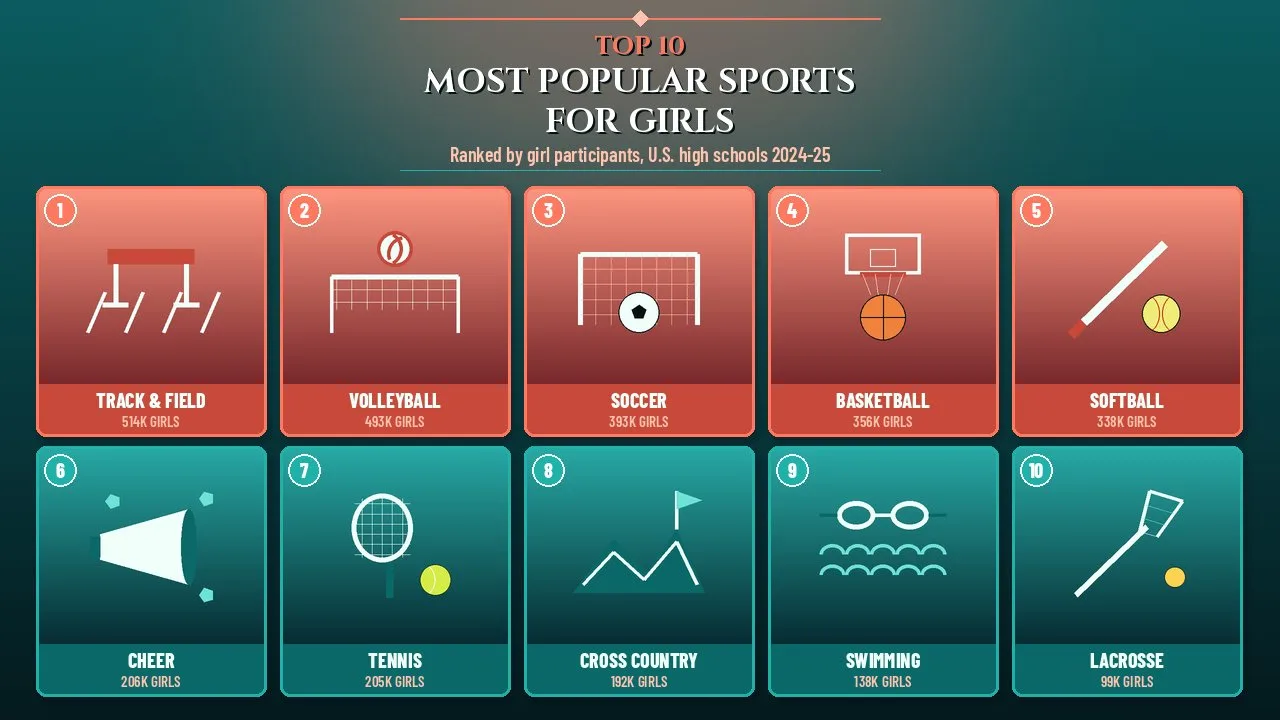
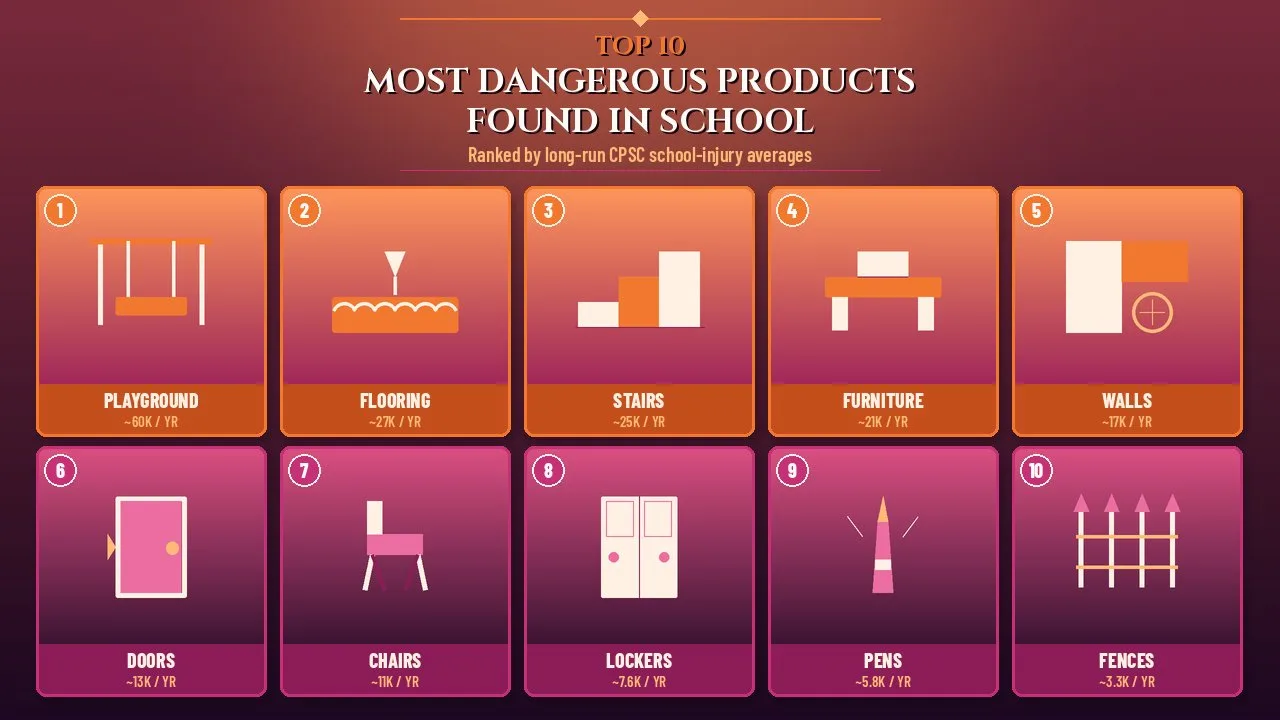
User counts will keep moving with every earnings season. What changes more slowly is the habit itself: people still open these apps to watch, talk, trade and belong. For related Finepedia reading on how platforms shape culture and commerce, see Largest Malls in the World: Top 10, Most Popular Sports for Girls: Top 10 and Most Dangerous Products Found in School: Top 10.
- DataReportal — Digital 2025 Global Overview Report; Digital 2025 top social platforms; Digital 2025 July Global Statshot (Similarweb App Intelligence indices, GWI survey shares, ad-reach summaries)
- Statista — global social networks ranked by monthly active users (October 2025 update cycle and related 2025–2026 charts)
- Meta Platforms — Q2 2025 earnings materials (Family DAP 3.48 billion average for June 2025; WhatsApp Updates daily-active commentary)
- Company and industry summaries for Snapchat MAU (late 2025 ~932 million; Q1 2026 ~956 million), WeChat/Weixin combined MAU (~1.41 billion around Q3 2025), LinkedIn membership (~1.3 billion), Telegram (~1.0 billion MAU) and X (~557 million MAU)
- Historical acquisition and founding facts widely reported for YouTube (Google, 2006), Instagram (Facebook, 2012), WhatsApp (Facebook, 2014) and LinkedIn (Microsoft, 2016)
- Reference awareness only (not copied): https://10mosttoday.com/10-most-popular-social-media-apps-and-sites-nowadays/



















Log in with