










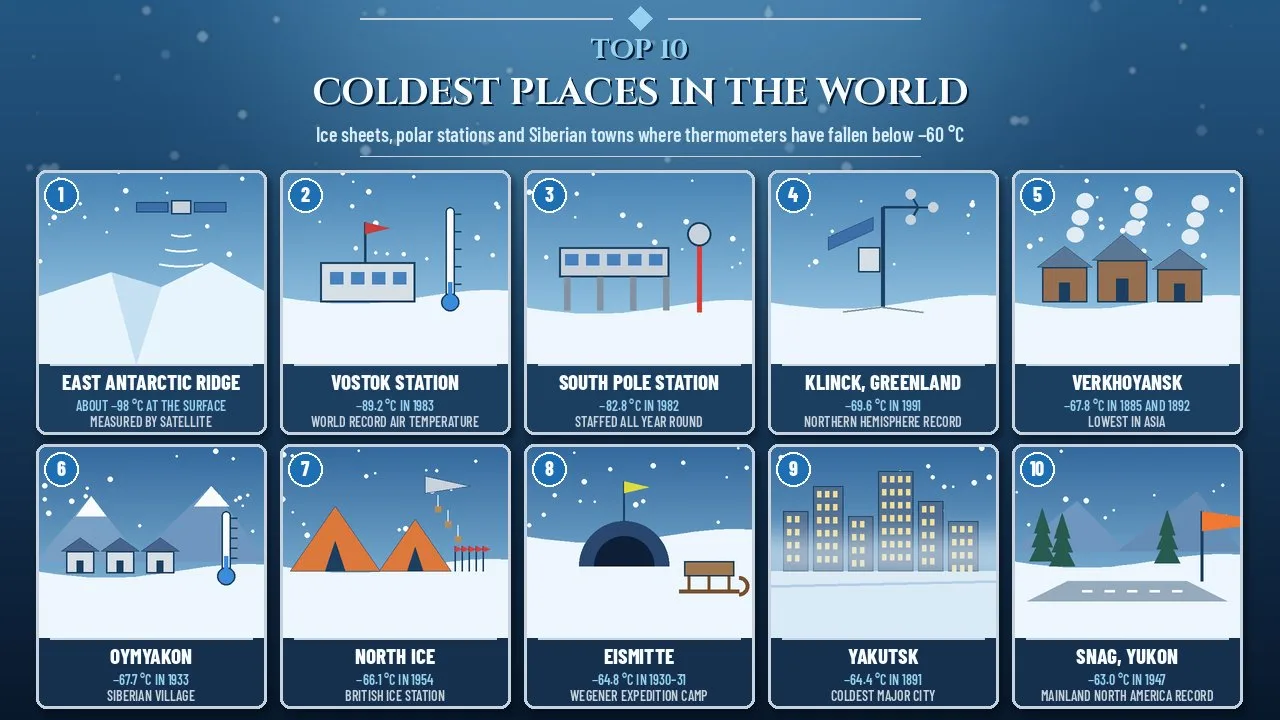
The coldest places in the world, from East Antarctica's high ice ridges to Siberia's Oymyakon and Verkhoyansk, have recorded temperatures below −60 °C.
Cold is relative for most of us. A winter morning at −10 °C feels harsh, and −20 °C makes headlines in many cities. The places on this list live in a different category altogether. Here, thermometers have dropped below −60 °C, breath can freeze into ice crystals almost as it leaves the mouth, and ordinary materials such as rubber, plastic and steel behave in unfamiliar ways.
This list ranks ten locations by the lowest temperature reliably measured there. It mixes high polar ice sheets, where only scientists and automatic instruments spend the winter, with real towns and cities where families go to school, work and shop through months of deep cold. The order and selection are Finepedia's own, and every record below is checked against national weather services, the World Meteorological Organization (WMO) or published research.
Coldest Places in the World at a Glance
| Rank | Place | Region | Lowest recorded temperature | Year | Type of place |
|---|---|---|---|---|---|
| 1 | East Antarctic Plateau ridge (Dome A to Dome Fuji) | Antarctica | About −98 °C (surface, by satellite) | 2004–2016 data | Uninhabited ice ridge |
| 2 | Vostok Station | Antarctica | −89.2 °C | 1983 | Research station |
| 3 | Amundsen–Scott South Pole Station | Antarctica | −82.8 °C | 1982 | Research station |
| 4 | Klinck weather station | Greenland | −69.6 °C | 1991 | Automatic weather station |
| 5 | Verkhoyansk | Sakha Republic, Russia | −67.8 °C | 1885 and 1892 | Town |
| 6 | Oymyakon | Sakha Republic, Russia | −67.7 °C | 1933 | Village |
| 7 | North Ice | Greenland | −66.1 °C | 1954 | Former research station |
| 8 | Eismitte | Greenland | −64.8 °C | 1930–31 | Former research station |
| 9 | Yakutsk | Sakha Republic, Russia | −64.4 °C | 1891 | Major city |
| 10 | Snag | Yukon, Canada | −63.0 °C | 1947 | Former airfield and village |
How the Ranking Works
Comparing a remote ice ridge with a city of more than 350,000 people needs clear rules, so the ranking follows three principles.
- Each place is ranked by its lowest reliably recorded temperature, not by its average or by how cold it feels in the wind.
- Ground thermometer readings are preferred. The one exception is the top entry, where the record comes from satellite measurements of the snow surface, and that difference is explained in full.
- Unofficial or disputed readings are mentioned in the text but do not decide a place's position.
Average temperatures matter too, especially for the towns where people live all year, so the Quick Facts for each entry include typical winter conditions where reliable figures exist.
Why Some Places Get So Cold
The coldest places on Earth share a handful of ingredients. Most of them combine at least three.
| Factor | How it lowers temperatures | Examples on this list |
|---|---|---|
| High latitude | Weak or absent winter sunlight, including weeks or months of polar night | All Antarctic and Greenland entries, Verkhoyansk |
| High elevation | Thin, dry air holds less heat and the ground radiates warmth straight into space | East Antarctic Plateau, Vostok, Klinck, Eismitte |
| Distance from the sea | Oceans release stored heat in winter, so inland sites miss that warming | Vostok, Oymyakon, Yakutsk |
| Valley inversions | Dense cold air drains downhill and pools in basins on calm nights | Oymyakon, Verkhoyansk, Snag |
| Clear, still skies | Without clouds or wind, heat escapes quickly from snow-covered ground | Every entry on still winter nights |
Antarctica is colder than the Arctic largely because it is a high continent buried under ice several kilometres thick, while the Arctic is mostly a frozen ocean that keeps leaking heat from the water below. Siberia reaches extreme lows for a different reason: in winter a vast area of high pressure, the Siberian High, settles over the region, bringing clear skies and calm air that let valleys fill with intensely cold air.
1. East Antarctic Plateau Ridge (Dome A to Dome Fuji)
| Attribute | Details |
|---|---|
| Location | A high ice ridge running between Dome Argus (Dome A) and Dome Fuji, East Antarctica |
| Elevation | About 3,800 to 4,000 metres above sea level |
| Lowest temperature | About −98 °C at the snow surface, measured by satellite |
| Estimated air temperature | About −94 °C just above the surface |
| Inhabitants | None; reached only by occasional scientific traverses |
The coldest place in the world is not a town or even a station. It is a series of shallow hollows along a broad ice ridge high on the East Antarctic Plateau, the highest and driest part of the continent. No one lives here, and for most of the year no one visits.
Origins and History
For decades, scientists suspected that parts of the plateau were colder than Vostok Station, but there were no instruments to prove it. Satellites changed that. In 2013, a team led by Ted Scambos of the US National Snow and Ice Data Center reported a surface temperature of about −93 °C, measured from orbit on 10 August 2010 at a point between Dome Argus and Dome Fuji.
A follow-up study published in 2018 in the journal Geophysical Research Letters re-analysed satellite data from 2004 to 2016. It found that dozens of small pockets along the ridge regularly fall to around −98 °C at the snow surface during the long polar night. Because the air cools less than the snow, the researchers estimated the air temperature a short distance above the ground at roughly −94 °C.
Key Features
- The extreme lows form in small dips in the ice surface, a few metres deep, where cold, dense air collects on still nights
- These conditions need clear skies, very light winds and extremely dry air for several days in a row
- Dome A itself, at about 4,087 metres, is the highest ice feature in Antarctica
- China has operated a summer research station, Kunlun Station, near Dome A since 2009
- The record is a surface measurement from satellites, so it is not listed as the official lowest air temperature
Significance
The ridge shows how close Earth comes to a natural physical limit. The study's authors suggested that around −98 °C may be close to the lowest temperature the planet's surface can reach, because even in the clearest, driest air, the atmosphere still sends some heat back down. Astronomers are also interested in the area: the dry, still air above the dome makes it one of the best places on Earth to observe the sky.
Interesting Facts
- The region receives so little snow that it counts as one of the driest deserts on Earth.
- The coldest pockets are spread along a ridge hundreds of kilometres long rather than at a single point.
2. Vostok Station
| Attribute | Details |
|---|---|
| Location | Central East Antarctica, near the southern geomagnetic pole |
| Elevation | 3,488 metres above sea level |
| Lowest temperature | −89.2 °C, recorded on 21 July 1983 |
| Typical winter temperature | About −66 °C (April to September average) |
| Founded | 16 December 1957 by the Soviet Union |
Vostok Station holds the official record for the lowest air temperature ever measured on Earth with a thermometer. The World Meteorological Organization recognises the −89.2 °C reading from 21 July 1983 as the world record low.
Origins and History
The Soviet Union founded Vostok during the International Geophysical Year of 1957 to 1958, a global scientific effort that also produced the first permanent station at the South Pole. The site was chosen partly for its science value: it sits deep inside the continent, more than 1,000 kilometres from the nearest coast, on top of some of the thickest ice in Antarctica. Today the station is run by Russia.
The record day came in the middle of the 1983 winter, during a long period of calm, clear weather. The reading beat the station's earlier record of −88.3 °C. An unconfirmed reading of around −91 °C was reported in 1997, but it has never been officially accepted.
Key Features
- The warm season, from October to March, averages around −44 °C
- The warmest temperature ever recorded at the station is only −14.0 °C
- Its high elevation makes the air thin, so new arrivals often struggle with altitude sickness
- Supplies arrive by long overland traverses from the coast and by aircraft in summer
- A small winter crew stays on through the polar night
Significance
Vostok is famous beneath the ice as well as above it. Under nearly four kilometres of ice lies Lake Vostok, the largest known subglacial lake in Antarctica. Ice cores drilled at the station have also provided one of the longest climate records on Earth, revealing how temperatures and greenhouse gases changed over several hundred thousand years.
Interesting Facts
- Vostok means east in Russian, and the station was named after one of the ships of the explorer Fabian von Bellingshausen.
- The station is often called the southern Pole of Cold.
- The coldest month in its records, August 1987, averaged −75.4 °C.
3. Amundsen–Scott South Pole Station
| Attribute | Details |
|---|---|
| Location | The geographic South Pole, Antarctica |
| Elevation | About 2,835 metres above sea level |
| Lowest temperature | −82.8 °C, recorded on 23 June 1982 |
| Population | About 150 people in summer and about 50 in winter |
| Operated by | The United States, through the National Science Foundation |
The South Pole station is the most famous cold place on Earth and one of the most continuously staffed. It has been occupied year-round since 1957, making it a rare place where people have spent every winter for decades in temperatures well below −60 °C.
Origins and History
The first station was built by US Navy Seabees in November 1956, ahead of the International Geophysical Year. It was named after Roald Amundsen and Robert Falcon Scott, the two explorers who reached the pole in December 1911 and January 1912. The original buildings were slowly buried by drifting snow, and they were replaced by a geodesic dome in the 1970s and later by the current elevated station, completed in 2008.
The station's lowest reading, −82.8 °C, came in June 1982, close to midwinter. Because it sits several hundred metres lower than Vostok, the South Pole is on average about 5 to 10 °C warmer.
Key Features
- The sun rises and sets only once a year, giving six months of daylight and six months of darkness
- The modern station stands on adjustable stilts so wind can blow snow underneath rather than burying it
- Winter crews are cut off for months, as flights are normally too dangerous in the extreme cold
- The ice beneath the station is about 2,700 metres thick and moves roughly 10 metres a year
Significance
The station is a major centre for astronomy and physics. Its dry air and long nights suit telescopes that study the faint afterglow of the Big Bang, and the IceCube Neutrino Observatory uses a cubic kilometre of ice beneath the station to detect high-energy particles from space. Long-running measurements of air quality and carbon dioxide at the pole help scientists track the global atmosphere far from local pollution.
Interesting Facts
- The marker for the geographic pole has to be moved every year because the ice sheet beneath it slides.
- Winter staff have reported a tradition called the 300 Club, which involves a sauna session followed by a brief dash outside at around −73 °C or colder.
- Exposed skin can suffer frostbite within minutes at the temperatures recorded here.
4. Klinck Weather Station, Greenland
| Attribute | Details |
|---|---|
| Location | Near the summit of the Greenland Ice Sheet |
| Elevation | About 3,105 metres above sea level |
| Lowest temperature | −69.6 °C, recorded on 22 December 1991 |
| Type of site | Automatic weather station |
| Officially recognised | 2020, by the World Meteorological Organization |
Klinck is an unstaffed automatic weather station on the Greenland Ice Sheet, and it holds the record for the lowest temperature ever measured in the Northern Hemisphere. The reading was taken in 1991 but lay unnoticed in the data for almost three decades.
Origins and History
The station was part of a network of automatic instruments set up on the ice sheet to study Greenland's climate. On 22 December 1991, close to the winter solstice, it recorded −69.6 °C. The value sat in archived data until researchers reviewing old records noticed it. After a detailed check of the instruments and weather conditions, the WMO confirmed it as the official Northern Hemisphere record in September 2020.
The confirmation took the record away from the Siberian towns of Verkhoyansk and Oymyakon, which had shared the Northern Hemisphere title for most of the twentieth century.
Key Features
- The site sits high on the central ice sheet, far from the moderating influence of the sea
- Record cold on the ice sheet needs long, clear and calm winter nights
- Automatic stations like Klinck can work for years without people on site
Significance
Klinck shows how much scientists still learn from archived data. As more old records are digitised and checked, other surprises may follow. The station's record also highlights Greenland's role in global climate: the ice sheet stores enough water to raise world sea levels by about seven metres if it ever melted completely.
Interesting Facts
- The WMO record was confirmed nearly 29 years after the measurement was made.
- Klinck is not a place anyone visits in winter; the reading was logged entirely by machine.
- Greenland's ice sheet is the second largest body of ice on Earth after Antarctica.
5. Verkhoyansk, Russia
| Attribute | Details |
|---|---|
| Location | Sakha Republic (Yakutia), northeastern Siberia, north of the Arctic Circle |
| Population | About 1,300 (2010 census) |
| Lowest temperature | −67.8 °C, recorded in January 1885 and again in February 1892 |
| Highest temperature | 38.0 °C, recorded on 20 June 2020 |
| Claim to fame | One of the two Siberian Poles of Cold, and the lowest official temperature recorded in Asia |
Verkhoyansk is a small town that holds two astonishing records at once. It shares the title of coldest permanently inhabited place in the Northern Hemisphere with Oymyakon, and it has also recorded one of the highest temperatures ever measured north of the Arctic Circle.
Origins and History
Russian Cossacks built a fort in the area in 1638, about 90 kilometres from the modern town, as they expanded across Siberia in search of furs. Between the 1860s and 1917 the town was a place of political exile. Its weather station began recording in the 1880s, and it measured −67.8 °C in January 1885 and twice more in February 1892, still the lowest official temperature recorded in Asia.
In June 2020, during a severe Siberian heatwave, Verkhoyansk reached 38.0 °C. The WMO later recognised this as the highest temperature ever recorded in the Arctic, giving the town a range of more than 100 degrees between its coldest and hottest readings.
Key Features
- Average January temperatures sit around −45 °C
- The town lies in a basin where cold air pools under strong winter temperature inversions
- Summers are short but can be surprisingly warm
- The ground is permanently frozen, so buildings are often raised on piles
Significance
Verkhoyansk is a living laboratory for how people, buildings and infrastructure cope with extreme seasonal swings. Its 2020 heat record also drew global attention to rapid warming in the Arctic, which is heating several times faster than the world average.
Interesting Facts
- The record low has been matched three times: once in 1885 and twice within three days in 1892.
- In the coldest months, average daily minimum temperatures can fall below −50 °C.
- The town shares its region with Oymyakon, and the two have competed for the cold title for over a century.
6. Oymyakon, Russia
| Attribute | Details |
|---|---|
| Location | Sakha Republic (Yakutia), in a valley of the Indigirka River basin |
| Elevation | About 750 metres above sea level |
| Population | Fewer than 900 people (2018) |
| Lowest temperature | −67.7 °C, recorded on 6 February 1933 |
| Typical winter | Average daily lows below −50 °C in the coldest months |
Oymyakon is often called the coldest village on Earth, and it is the place most people picture when they imagine life in extreme cold. Its official record is just a tenth of a degree warmer than Verkhoyansk's.
Origins and History
The village lies along the Indigirka River, about 30 kilometres northwest of Tomtor on the Kolyma Highway, close to the historic Road of Bones. At its peak it had around 2,500 residents. The population has since fallen to fewer than 900.
The official record of −67.7 °C was set in February 1933. A monument in the village centre commemorates a much lower, unofficial reading of −71.2 °C said to have been taken in January 1924, but that figure has never been accepted by meteorologists.
Key Features
- The village sits in a deep valley surrounded by mountains about 1,100 metres high, which trap cold air
- In winter, temperatures can rise by up to 10 °C with height on the surrounding slopes because of inversions
- The ground is permanent frost, which makes digging graves, foundations and pipes very difficult
- Local schools close when temperatures fall below −55 °C
- Daylight in midwinter lasts only a few hours
Significance
Oymyakon has become a symbol of human resilience in the cold. Its residents rely on traditional diets rich in meat and fish, heavy fur clothing and well-insulated homes heated by wood or coal. In recent years the village has also drawn adventure travellers who want to experience a true Siberian winter.
Interesting Facts
- Oymyakon and Verkhoyansk are often said to be the only permanently inhabited places where temperatures below −60 °C have been recorded on every day of January across their records.
- The old Kolyma road nearby is nicknamed the Road of Bones because many prisoners died building it.
- The village reached 34.6 °C on 28 July 2010, giving it one of the largest annual temperature ranges on Earth.
7. North Ice, Greenland
| Attribute | Details |
|---|---|
| Location | Northern Greenland Ice Sheet |
| Elevation | About 2,341 metres above sea level |
| Lowest temperature | −66.1 °C, recorded in January 1954 |
| Active | 1952 to 1954 |
| Operated by | The British North Greenland Expedition |
North Ice was a British research station built high on the Greenland Ice Sheet in the early 1950s. For decades its −66.1 °C reading was the lowest temperature recorded in North America, until the Klinck record was confirmed in 2020.
Origins and History
The British North Greenland Expedition ran from 1952 to 1954 to study the ice sheet, its weather and its thickness. North Ice was its inland base, supplied by air drops from Royal Air Force aircraft. A small team of scientists spent two winters there, taking regular weather measurements in some of the harshest conditions on the planet.
The station's coldest reading came in January 1954, during its second winter. The name was a deliberate contrast with South Ice, a British station in Antarctica.
Key Features
- Located at a latitude of about 78° North, far inside the ice sheet
- Measurements included temperature, wind, snowfall and the depth of the ice
- Supplies and fuel arrived by parachute drop
Significance
The expedition's ice-depth soundings and weather records were among the first detailed scientific data from the heart of Greenland. They helped scientists understand how the ice sheet is built up by snowfall and how it flows towards the coast.
Interesting Facts
- North Ice held the North American cold record for more than 60 years.
- The station was used for only about two years before it was abandoned.
- Its coldest reading was taken during the team's second winter on the ice.
8. Eismitte, Greenland
| Attribute | Details |
|---|---|
| Location | Centre of the Greenland Ice Sheet, about 400 kilometres from the west coast |
| Elevation | About 3,010 metres above sea level |
| Lowest temperature | −64.8 °C, recorded during the 1930 to 1931 winter |
| Annual mean temperature | About −30 °C |
| Active | 1930 to 1931, during the German Greenland Expedition |
Eismitte, German for ice middle, was a meteorological station set up in the middle of the Greenland Ice Sheet. It produced some of the first year-round weather records from the heart of the ice and became known for one of the most dramatic stories in polar science.
Origins and History
The station was established by the German Greenland Expedition of 1930 to 1931, led by the meteorologist and geophysicist Alfred Wegener, who is best known for proposing the theory of continental drift. The expedition ran three stations along the same line of latitude to compare the coast with the interior.
Supplying Eismitte proved extremely difficult. In late 1930, Wegener led a sledge party to deliver supplies to the station. He died on the return journey in early November 1930, and his body was found the following spring. The scientists at Eismitte, including Ernst Sorge and Johannes Georgi, survived the winter in a snow cave and kept up their measurements.
Key Features
- The winter crew lived in a cave dug into the snow
- Ernst Sorge hand-dug a pit about 15 metres deep to study the layers of snow
- The station recorded temperatures every day through the winter of 1930 to 1931
- Its records showed how much colder the interior is than the Greenland coast
Significance
Eismitte's records were among the first proof of just how cold the Greenland interior is. Sorge's snow-pit work was also an early step towards using snow and ice layers to read past climate, an idea that later led to the deep ice cores drilled in Greenland and Antarctica.
Interesting Facts
- Eismitte lies in the Northern Hemisphere yet has an annual average close to −30 °C.
- Wegener's continental drift theory was widely rejected during his lifetime and accepted only decades later.
- The expedition used both dog sledges and propeller-driven snow vehicles.
9. Yakutsk, Russia
| Attribute | Details |
|---|---|
| Location | Capital of the Sakha Republic, on the Lena River, about 450 kilometres south of the Arctic Circle |
| Population | 355,443 (2021 census) |
| Lowest temperature | −64.4 °C, recorded on 5 February 1891 |
| Typical winter | Midwinter monthly averages below −35 °C |
| Founded | 1632, as a Cossack fort |
Yakutsk is widely described as the coldest major city in the world. It is the largest city on Earth where average winter temperatures stay below −30 °C, and one of very few large cities built on continuous permafrost.
Origins and History
A detachment of Cossacks led by Pyotr Beketov founded a fort on the Lena River in 1632, originally at a site some distance from the modern city. It became a base for collecting fur tribute and for expeditions further east across Siberia. Over the centuries the settlement grew into the administrative capital of the vast Yakutia region.
The city's lowest temperature, −64.4 °C, was recorded in February 1891. In recent decades, mining of diamonds, gold and other resources across the Sakha Republic has fuelled the city's growth.
Key Features
- Most buildings stand on concrete piles driven into the permafrost so their warmth does not thaw the ground
- Winter fog often forms from car exhaust, heating plants and human breath in the still, frozen air
- The Lena River freezes solid in winter and has traditionally been used as an ice road
- Summers are short but warm, with temperatures that can top 30 °C
Significance
Yakutsk proves that a modern city with universities, theatres, an airport and hundreds of thousands of residents can function in some of the harshest winters on the planet. It is home to the Melnikov Permafrost Institute, which studies frozen ground and how to build on it safely, an area of growing importance as the Arctic warms.
Interesting Facts
- Yakutsk and Norilsk are the only large cities built on continuous permafrost.
- The city sits on the western bank of the Lena, and crossings have long relied on ferries in summer and the frozen river in winter.
- Its coldest month on record, January 1900, averaged −51.4 °C.
10. Snag, Yukon, Canada
| Attribute | Details |
|---|---|
| Location | Southwestern Yukon, near the border with Alaska |
| Lowest temperature | −63.0 °C, recorded on 3 February 1947 |
| Record status | Lowest official temperature ever recorded in continental North America |
| Population in 1947 | About eight to ten First Nations residents and fur traders, plus airfield staff |
| Today | The airfield closed in 1968 and the site is largely abandoned |
Snag is a tiny, now-abandoned community and former airfield in the Yukon. In February 1947 it recorded the lowest official temperature ever measured in mainland North America, a record that still stands.
Origins and History
During the Second World War, Snag became part of the Northwest Staging Route, a chain of airfields used to fly aircraft from North America to the Soviet Union. A small weather office was set up at the airfield. On 2 February 1947, its thermometer dropped to −62.2 °C, already a North American record. The next day it fell further, to −63.0 °C.
The airfield closed in 1968. Another Yukon settlement, Fort Selkirk, about 180 kilometres to the northeast, claimed an even lower reading of −65 °C in the same cold spell, but that figure was never officially recognised.
Key Features
- The site lies in a low valley where cold air drains and collects
- The record was set on two days in a row, 2 and 3 February 1947
- A small weather office at the airfield took the readings
- The site is far from any ice sheet, which makes the record more striking
Significance
Snag's record shows that you do not need a polar ice sheet to reach extreme cold. A sheltered valley, a strong arctic air mass and a long winter night were enough to produce temperatures similar to those on the Greenland ice sheet.
Interesting Facts
- Weather observer Wilf Blezard reported that voices and dogs barking in the village could be heard at the airfield about four miles away.
- Observers said they could hear their own breath freezing into crystals.
- Snag's record of −63.0 °C has stood for almost 80 years.
Honourable Mentions
Several other places deserve a mention, even though their records fall outside the top ten.
- Prospect Creek, Alaska: the lowest temperature ever recorded in the United States, about −62 °C (−80 °F), on 23 January 1971, at a remote site later used as a camp for building the Trans-Alaska Pipeline.
- Rogers Pass, Montana: −57 °C (−70 °F) on 20 January 1954, the lowest temperature recorded in the contiguous United States. The pass lies at about 1,710 metres.
- Eureka, Nunavut, Canada: a research and weather station founded in 1947 that has the lowest annual average temperature of any weather station in Canada, about −18 °C.
- Ulaanbaatar, Mongolia: often described as the coldest national capital, with its coldest January nights reaching −36 to −40 °C.
- Fort Selkirk, Yukon: claimed −65 °C during the 1947 cold wave, but the reading was never made official.
Comparison: Coldest Inhabited Places vs Polar Stations
| Place | Permanent residents? | Lowest recorded | What makes it so cold |
|---|---|---|---|
| East Antarctic Plateau ridge | No | About −98 °C (surface) | Elevation near 4,000 metres, polar night, clear dry air |
| Vostok Station | Small winter crew | −89.2 °C | Elevation, distance from the sea, polar night |
| South Pole Station | About 50 in winter | −82.8 °C | Elevation, six months of darkness |
| Klinck | No | −69.6 °C | High central ice sheet |
| Verkhoyansk | About 1,300 | −67.8 °C | Siberian High, valley inversions |
| Oymyakon | Under 900 | −67.7 °C | Mountain valley that traps cold air |
| North Ice | No (closed) | −66.1 °C | High ice sheet, far north |
| Eismitte | No (closed) | −64.8 °C | Centre of the ice sheet |
| Yakutsk | About 355,000 | −64.4 °C | Continental interior, Siberian High |
| Snag | Largely abandoned | −63.0 °C | Sheltered valley, arctic air mass |
How People Survive Extreme Cold
Living through a winter at −50 °C or lower takes careful planning. Residents and polar scientists rely on similar strategies.
- Layered clothing, often with fur or down outer layers, covering every patch of skin
- Buildings with thick insulation, triple glazing and heating that runs all winter
- Foundations raised on piles so heat from homes does not melt the frozen ground
- High-energy diets, with plenty of fat and protein
- Short trips outdoors in extreme cold, with careful attention to frostbite on the face and hands
- Vehicles kept in heated garages, or engines run for long periods so they do not freeze
At these temperatures, frostbite can develop on exposed skin within minutes, and breathing very cold air can irritate the lungs. Polar stations limit outdoor work during the coldest periods and often require people to work in pairs.
Frequently Asked Questions
What is the coldest place in the world?
The coldest place in the world is a high ice ridge on the East Antarctic Plateau between Dome Argus and Dome Fuji. Satellites have measured snow surface temperatures of about −98 °C there. The lowest air temperature measured with a thermometer is −89.2 °C, recorded at Vostok Station in Antarctica on 21 July 1983.
What is the coldest inhabited place on Earth?
The coldest permanently inhabited places are the Siberian villages of Oymyakon and Verkhoyansk in Russia's Sakha Republic. Verkhoyansk recorded −67.8 °C in 1885 and 1892 and Oymyakon −67.7 °C in 1933. Research stations in Antarctica are colder, but their staff rotate rather than living there permanently.
What is the coldest city in the world?
Yakutsk, the capital of the Sakha Republic in Russia, is widely regarded as the coldest major city. It has more than 350,000 residents, midwinter monthly averages below −35 °C and a record low of −64.4 °C. It is the largest city in the world with an average winter temperature below −30 °C.
What is the coldest temperature ever recorded in the Northern Hemisphere?
The coldest temperature recorded in the Northern Hemisphere is −69.6 °C, measured by the Klinck automatic weather station on the Greenland Ice Sheet on 22 December 1991. The World Meteorological Organization confirmed the record in 2020, after the reading had sat unnoticed in archived data for almost 30 years.
Why is Antarctica colder than the Arctic?
Antarctica is a continent covered by ice several kilometres thick, so much of it sits at high elevation, where the air is thin and dry. The Arctic is mostly a frozen ocean, and the water beneath the sea ice keeps releasing heat. Antarctica is also isolated by strong winds and ocean currents that limit warmer air from reaching it.
What is the coldest place in North America?
The lowest official temperature in mainland North America is −63.0 °C, recorded at Snag in Canada's Yukon on 3 February 1947. Including Greenland, which is geographically part of North America, the coldest reading is −69.6 °C at the Klinck weather station. In the United States, the record is about −62 °C at Prospect Creek, Alaska, in 1971.
Conclusion
The coldest places in the world fall into two groups. The most extreme, from the East Antarctic Plateau to Vostok, the South Pole and the Greenland ice sheet, owe their cold to great height, long polar nights and distance from the sea, and only scientists or machines stay there through winter. The second group, led by Verkhoyansk, Oymyakon and Yakutsk, shows that ordinary communities can live through temperatures below −60 °C with the right homes, clothing and habits.
These records also tell a changing story. The same Arctic that produced some of these lows is now warming quickly, as Verkhoyansk's 38 °C heat record showed. To learn more about the frozen south, see Finepedia's guides to interesting facts about Antarctica and Lake Vostok, the largest lake hidden beneath the Antarctic ice.
- World Meteorological Organization, World Weather and Climate Extremes Archive (lowest temperature, world; lowest temperature, Northern Hemisphere).
- World Meteorological Organization (2020). WMO verifies −69.6 °C Greenland temperature as Northern Hemisphere record.
- Scambos, T. A. et al. (2018). Ultralow surface temperatures in East Antarctica from satellite thermal infrared mapping: the coldest places on Earth. Geophysical Research Letters 45.
- National Snow and Ice Data Center, reports on the coldest places on Earth (2013 and 2018).
- US National Science Foundation, Amundsen–Scott South Pole Station facts and history.
- Environment and Climate Change Canada, records for Snag, Yukon (1947).
- National Oceanic and Atmospheric Administration, state climate extremes (Prospect Creek, Alaska; Rogers Pass, Montana).
- Russian Federal Service for Hydrometeorology (Roshydromet) records for Verkhoyansk, Oymyakon and Yakutsk.
- Reference topic awareness only: 10MostToday, 10 Coldest Places in the World (original ranking, structure and wording throughout; claims verified against the sources above).

















Log in with