









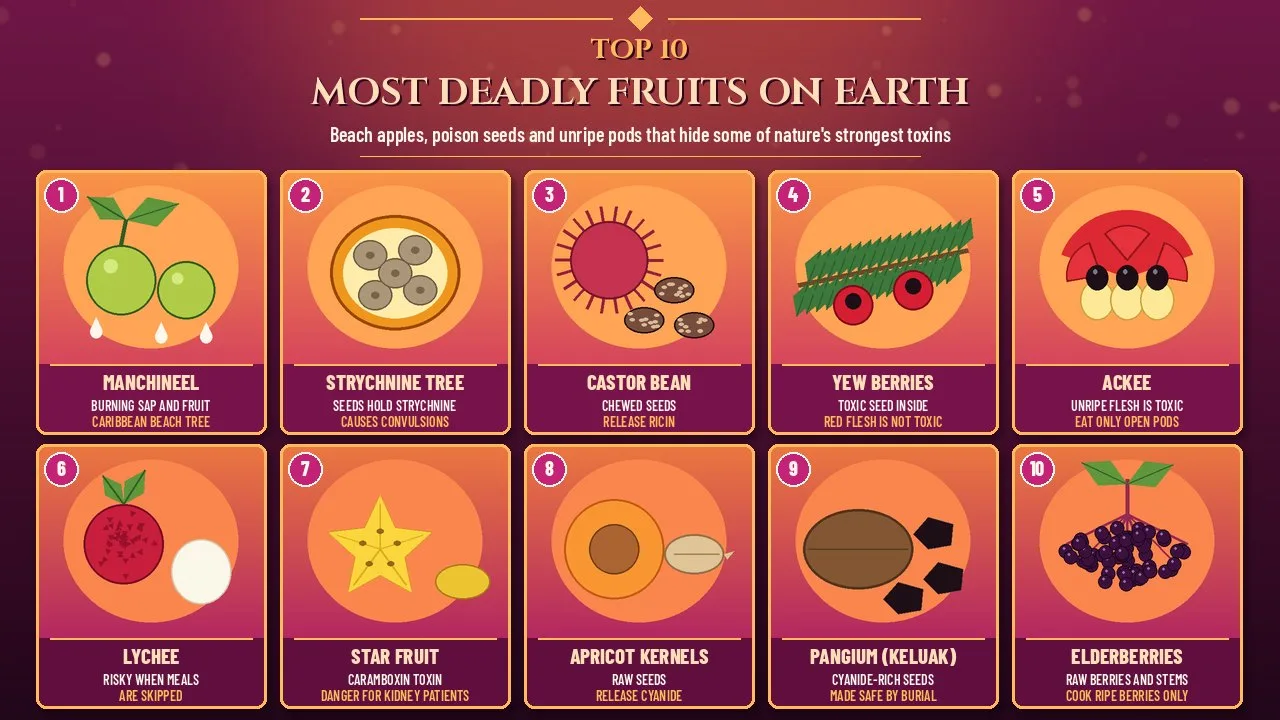
The most deadly fruits on Earth, from the manchineel beach apple to strychnine seeds and unripe ackee, carry natural toxins that can harm or even kill.
Fruit has a healthy reputation, and almost all of it deserves one. Plants, however, did not evolve fruit for our benefit. A fruit exists to spread seeds, and many plants protect those seeds, or the whole fruit until it is ripe, with chemical defences strong enough to deter animals that would eat them at the wrong time. Some of those chemicals are mild irritants. A few are among the most potent natural poisons known.
This list brings together ten fruits, and fruit seeds, with the best-documented record of poisoning people. It draws on medical case reports, public health investigations, food safety agencies and botanical references. The order is Finepedia's own and is based on how dangerous each fruit is to a person who meets it in ordinary life, not on how strange it sounds. Several of these fruits are eaten safely every day by millions of people, and the article explains exactly what makes them safe or unsafe.
This article is for general knowledge only. If you think someone has eaten a poisonous fruit, contact your local poison centre or emergency services straight away.
Most Deadly Fruits at a Glance
| Rank | Fruit | Scientific name | Main toxin | Dangerous part | Where found |
|---|---|---|---|---|---|
| 1 | Manchineel | Hippomane mancinella | Phorbol esters and other irritants | Fruit, sap, smoke from burning wood | Caribbean, southern Florida, Central America |
| 2 | Strychnine tree | Strychnos nux-vomica | Strychnine, brucine | Seeds | India, Sri Lanka, Southeast Asia |
| 3 | Castor bean | Ricinus communis | Ricin | Chewed seeds | Worldwide in warm regions |
| 4 | Yew berries | Taxus baccata and relatives | Taxine alkaloids | Seeds, leaves, bark (not the red flesh) | Europe, North America, Asia |
| 5 | Ackee | Blighia sapida | Hypoglycin A | Unripe flesh, seeds | West Africa, Jamaica, Caribbean |
| 6 | Lychee | Litchi chinensis | Hypoglycin A, MCPG | Large amounts on an empty stomach, unripe fruit, seeds | China, India, Southeast Asia |
| 7 | Star fruit | Averrhoa carambola | Caramboxin, oxalate | Whole fruit and juice (kidney patients) | Southeast Asia, tropics worldwide |
| 8 | Apricot kernels | Prunus armeniaca | Amygdalin (releases cyanide) | Raw seed inside the stone | Worldwide |
| 9 | Pangium edule (keluak) | Pangium edule | Cyanogenic glycosides | Fresh, unprocessed seeds | Southeast Asia, New Guinea |
| 10 | Elderberries | Sambucus nigra and relatives | Cyanogenic glycosides | Raw or unripe berries, seeds, leaves, stems | Europe, North America |
How the Ranking Works
Comparing a tropical beach tree with a kitchen apricot takes care, so each fruit was judged on four questions.
- Potency: how small a dose can cause serious illness or death?
- Accessibility: how likely is an ordinary person, child or traveller to come into contact with it?
- Evidence: is the danger documented by case reports, outbreak investigations or official risk assessments, rather than folklore?
- Preventability: can simple preparation make the fruit safe, or is every part dangerous?
Fruits that are extremely potent and easy to stumble on rank highest. Fruits that are only dangerous when prepared wrongly or eaten in unusual quantities sit lower, even though they still cause real poisonings each year.
Why Some Fruits Are Poisonous
Most toxic fruits rely on a handful of chemical strategies. Knowing them makes the list easier to understand.
| Toxin type | How it harms the body | Fruits on this list |
|---|---|---|
| Cyanogenic glycosides | Release hydrogen cyanide when the seed is crushed or chewed, blocking the body's use of oxygen | Apricot kernels, elderberries, Pangium edule |
| Alkaloids | Act on nerves, muscles or the heart | Strychnine tree, yew |
| Toxic proteins (lectins) | Shut down protein production inside cells | Castor bean |
| Unusual amino acids | Disrupt how the body makes glucose and burns fat, or overstimulate the brain | Ackee, lychee, star fruit |
| Irritant esters | Burn and blister skin, mouth and eyes | Manchineel |
A common thread is that the most dangerous part is often the seed. A plant wants animals to eat the flesh and spread the seeds intact, so it may make the flesh harmless while loading the seed with poison. Birds that swallow yew arils whole, for example, pass the seeds out unharmed. People who chew or grind seeds release the toxins that swallowing would have left locked away.
1. Manchineel
| Attribute | Details |
|---|---|
| Scientific name | Hippomane mancinella |
| Plant family | Spurge family (Euphorbiaceae) |
| Where it grows | Coasts of the Caribbean, southern Florida, the Bahamas, Mexico, Central America and northern South America |
| Common names | Beach apple, manzanilla de la muerte (little apple of death) |
| Main danger | Toxic milky sap and fruit; smoke from burning wood harms the eyes |
The manchineel earns first place because every part of it is hostile, it grows on exactly the kind of beach tourists love, and its fruit looks like a small, harmless green apple. Guinness World Records lists it as the most dangerous tree in the world.
Origins and History
Spanish explorers in the Caribbean named the tree manzanilla de la muerte, the little apple of death, after encountering its effects in the early sixteenth century. Popular accounts claim that Indigenous Caribbean peoples used its sap on arrows and that the explorer Juan Ponce de León died in 1521 after being wounded by such an arrow in Florida. Historians treat the arrow story as tradition rather than established fact, but it shows how long the tree has been feared.
A modern, well-documented case came in 2000, when British radiologist Nicola Strickland described in the BMJ how she and a friend bit into fallen fruit on a beach in Tobago. The first taste was pleasantly sweet. Within minutes it turned into a peppery burning, then a raw, tightening pain in the throat that made swallowing difficult. She reported that the fruit had caused ulceration and swelling in the mouth and throat, and that the pain spread to the lymph nodes in her neck before slowly easing.
Key Features
- Small, round green to yellowish fruit, roughly the size of a tangerine
- Milky sap that blisters skin on contact and can damage the eyes
- Rainwater dripping from the leaves can carry sap, so sheltering under the tree in a storm is risky
- Smoke from burning the wood can cause severe eye injury
- Irritant phorbol esters are considered the main cause of the reactions
Significance
The manchineel is ecologically useful. Its dense thickets help hold sand in place and act as a natural windbreak along coastlines, which is why it was sometimes planted deliberately. It is protected as an endangered plant in Florida. On some Caribbean islands, trees near beaches are marked with painted red bands or warning signs so visitors know to keep their distance.
Interesting Facts
- Caribbean carpenters have long used the timber for furniture, but only after cutting it carefully and drying it in the sun to neutralise the sap.
- The tree belongs to the same family as the poinsettia and cassava, both of which also have irritant milky sap.
- Doctors advise anyone who touches the sap to wash it off immediately and to seek medical help if it reaches the eyes.
2. Strychnine Tree
| Attribute | Details |
|---|---|
| Scientific name | Strychnos nux-vomica |
| Where it grows | India, Sri Lanka and Southeast Asia |
| Fruit | Hard-shelled orange berry with jelly-like pulp and flat, disc-shaped seeds |
| Main toxins | Strychnine and brucine, concentrated in the seeds |
| Main danger | Violent muscle spasms and convulsions; small amounts can be fatal |
The strychnine tree ranks second because its seeds contain one of the best-known poisons in history. The fruit looks like a small orange, but the flat, velvety seeds inside are the commercial source of strychnine.
Origins and History
The seeds, often called nux vomica, poison nuts or Quaker buttons, have been traded as a medicine and poison for centuries. French chemists Pierre-Joseph Pelletier and Joseph Bienaimé Caventou first isolated strychnine in 1818. It went on to be widely used as a rat and pest poison and, for a time, as a so-called tonic and stimulant.
One of the most famous episodes came at the 1904 Olympic marathon in St. Louis, where winner Thomas Hicks was given small doses of strychnine mixed with egg white and brandy during the race as a stimulant. He collapsed after crossing the line. Today strychnine is banned or tightly restricted as a pesticide in many countries.
Key Features
- Strychnine blocks glycine receptors in the spinal cord, which normally calm muscle signals
- Symptoms usually begin within an hour: agitation, muscle stiffness, then painful spasms
- Victims often stay fully conscious during the spasms
- Death usually results from exhaustion of the breathing muscles
- Processed seeds appear in some traditional medicine systems, and mistakes in preparation have caused poisonings
Significance
Strychnine is a landmark in the history of toxicology and chemistry. Its complicated molecular structure took decades to work out and was finally synthesised in a laboratory by Robert Burns Woodward in 1954, a milestone in organic chemistry. It also features in countless classic crime novels, which helped make it the poison most people recognise by name.
Interesting Facts
- The pulp around the seeds is less toxic than the seeds themselves, and some birds and animals eat it.
- Brucine, the second alkaloid in the seeds, is weaker than strychnine but intensely bitter.
- There is no specific antidote; treatment focuses on controlling spasms and supporting breathing.
3. Castor Bean
| Attribute | Details |
|---|---|
| Scientific name | Ricinus communis |
| Where it grows | Thought to originate in northeast Africa; now grown and naturalised in warm regions worldwide |
| Fruit | Spiny capsule holding glossy, mottled seeds |
| Main toxin | Ricin, a protein that stops cells from making new proteins |
| Main danger | Chewed or crushed seeds; ricin is not destroyed in the gut |
The castor bean is not a true bean. It is the seed of a spiny fruit capsule on a fast-growing shrub that gardeners prize for its dramatic red and bronze leaves. Its seeds contain ricin, one of the most toxic natural substances known, which places this plant firmly near the top of the list.
Origins and History
Castor has been cultivated for thousands of years for its oil, which ancient Egyptians burned in lamps. Today the large majority of the world's castor seed is grown in India, and the oil is used in lubricants, paints, cosmetics and medicines. Pressing the seeds leaves the ricin in the solid seed cake, so properly processed castor oil does not contain it.
Ricin became notorious in 1978, when the Bulgarian dissident writer Georgi Markov was fatally poisoned in London with a tiny ricin-filled pellet, an attack widely attributed to an umbrella that fired the pellet into his leg.
Key Features
- Ricin enters cells and disables ribosomes, the machinery that builds proteins
- Seeds swallowed whole often pass through without releasing much toxin, but chewed seeds are far more dangerous
- Symptoms after eating include vomiting, diarrhoea, dehydration and, in severe cases, organ failure
- Symptoms may be delayed by several hours
- The plant also produces allergens that can affect people who handle the seeds
Significance
The castor plant is a good example of how a deadly plant can also be an important crop. Castor oil has been used as a laxative for centuries and remains a valuable industrial raw material. At the same time, the striking seeds have been strung into bracelets and necklaces, which health agencies warn against because damaged seeds can expose wearers and children to ricin.
Interesting Facts
- Each seed has a small bump called a caruncle, which attracts ants that help disperse it.
- Castor plants are often grown as ornamentals in parks, so many people pass them without knowing.
- The plant's scientific name, Ricinus, means tick in Latin, because the seeds look like engorged ticks.
4. Yew Berries
| Attribute | Details |
|---|---|
| Scientific name | Taxus baccata (European yew) and related species |
| Where it grows | Europe, North Africa, western Asia; related species in North America and East Asia |
| Fruit | A soft red cup (aril) around a single dark seed |
| Main toxins | Taxine alkaloids |
| Main danger | Seeds, needles and bark affect the heart; the red flesh itself is the only part not considered toxic |
The yew is one of the most familiar poisonous plants in Europe and North America, planted in gardens, hedges, parks and churchyards. Its bright red berry is technically an aril, a fleshy cup that wraps around the seed. That red flesh is the one part of the plant not considered poisonous, which makes the yew a classic trap. The seed it holds, like the needles and bark, is highly toxic.
Origins and History
Yews are slow-growing and can live for many centuries. They are closely linked with churchyards in Britain and Ireland, and the Fortingall Yew in Perthshire, Scotland, is often cited as one of the oldest living trees in Europe, though age estimates vary widely. Yew wood was also the favoured timber for the English longbow.
Poisoning of livestock has been recorded for centuries, often after animals ate clippings thrown over a hedge. Human poisonings are less common but can be severe, and some have occurred after people deliberately ate needles or seeds.
Key Features
- Taxine alkaloids interfere with the heart's electrical signalling
- Symptoms can include dizziness, nausea, dilated pupils, a slow or irregular pulse and collapse
- Severe poisoning can cause sudden cardiac arrest, sometimes with little warning
- Birds eat the arils and pass the hard seeds unharmed, spreading the tree
- Needles stay toxic when dried, so clippings remain dangerous to animals
Significance
The yew is also a life-saver. In the 1960s and 1970s, US researchers isolated paclitaxel from the bark of the Pacific yew, Taxus brevifolia. Marketed as Taxol, it was approved by the US Food and Drug Administration in 1992 for ovarian cancer and has since become a widely used chemotherapy drug, now produced through semi-synthetic and cell-culture methods rather than by stripping bark from wild trees.
Interesting Facts
- Yews are conifers, so the red berry is not a true fruit at all; botanists call the fleshy cup an aril.
- Yew hedges are a traditional feature of formal gardens and topiary.
- Horses and cattle are especially vulnerable, and a small amount of foliage can kill them.
5. Ackee
| Attribute | Details |
|---|---|
| Scientific name | Blighia sapida |
| Plant family | Soapberry family (Sapindaceae) |
| Where it grows | Native to West Africa; grown widely in Jamaica and the Caribbean |
| Main toxin | Hypoglycin A, highest in unripe flesh and in the seeds |
| Main danger | Toxic hypoglycaemic syndrome, also called Jamaican vomiting sickness |
Jamaicans treat ackee as a national symbol: it is the island's official national fruit and the star of its national dish, ackee and saltfish. It is perfectly edible when handled correctly, yet it ranks fifth because eating it unripe or eating the wrong part can cause a sudden, dangerous drop in blood sugar.
Origins and History
The tree is native to West Africa and was brought to Jamaica in the eighteenth century. Its scientific name honours Captain William Bligh of HMS Bounty fame, who carried specimens from Jamaica to the Royal Botanic Gardens at Kew in 1793.
The illness linked to unripe ackee was described in Jamaica long before its cause was understood and became known as Jamaican vomiting sickness. Researchers later identified hypoglycin A, an unusual amino acid, as the culprit. Outbreaks have also been reported in West Africa, where ackee grows wild.
For decades the United States barred imports of ackee. Since 2000 it has allowed canned and frozen ackee from approved processors that meet strict ripeness and safety controls.
Key Features
- The fruit is a red to yellow pod that splits open naturally when ripe, revealing three shiny black seeds
- Only the creamy yellow flesh (arils) of naturally opened pods is eaten, after cooking
- Unripe flesh and the seeds contain high levels of hypoglycin A
- Hypoglycin A stops the body from burning fat for energy and making new glucose
- Symptoms include vomiting, drowsiness, seizures and coma, especially in children and undernourished people
Significance
Ackee shows how local knowledge keeps a risky food safe. Jamaican cooks wait for pods to open on the tree, remove the seeds and the pinkish membrane, discard the cooking water and never force a closed pod open. Those rules turn a potentially deadly fruit into a beloved breakfast.
Interesting Facts
- Ackee is a close botanical relative of lychee and longan, both of which also belong to the soapberry family.
- Ripe ackee cooked with salted cod has a mild, buttery taste and a texture often compared to scrambled egg.
- Jamaica exports canned ackee, mostly to communities of the Jamaican diaspora.
6. Lychee
| Attribute | Details |
|---|---|
| Scientific name | Litchi chinensis |
| Plant family | Soapberry family (Sapindaceae) |
| Where it grows | Native to southern China; major crops in India, Vietnam, Thailand and elsewhere |
| Main toxins | Hypoglycin A and methylenecyclopropylglycine (MCPG) |
| Main danger | Severe low blood sugar in undernourished children who eat many lychees and skip meals |
Lychee is a surprising entry, because ripe lychees are eaten safely by hundreds of millions of people. It earns its place because of one of the most important food toxicology discoveries of recent years, which solved a long-running mystery illness in India.
Origins and History
Lychees have been cultivated in southern China for more than two thousand years and were prized at the imperial court. India is now one of the world's largest producers, and the Muzaffarpur district of Bihar is famous for its orchards.
For years, Muzaffarpur saw outbreaks of a sudden brain illness in young children every May and June, during the lychee harvest. Many children woke in the early morning with seizures and confusion, and many died. Investigators from India's National Centre for Disease Control and the US Centers for Disease Control and Prevention studied the 2014 outbreak and published their findings in The Lancet Global Health in 2017.
They reported that 390 children were admitted to the two main referral hospitals between late May and mid-July 2014, and 122 of them died. Most had very low blood sugar on admission. The illness was strongly associated with eating lychees and with skipping the evening meal, and toxin breakdown products linked to hypoglycin A and MCPG were found in the urine of affected children. Both toxins were detected in lychee fruit from local orchards.
Key Features
- Lychee contains hypoglycin A and MCPG, related to the toxin in its cousin, the ackee
- The toxins block the body's ability to make glucose from fat overnight
- Children with small energy reserves are most at risk when they eat many lychees and then go to bed hungry
- Unripe fruit and the seeds carry more of the toxins
- Prompt treatment with glucose can be life-saving
Significance
The investigation led to simple, effective advice: make sure children eat an evening meal, limit how many lychees young children eat, and check and correct blood sugar quickly in any child who falls ill during the season. It is a powerful example of how a common, healthy fruit can become dangerous through a combination of poverty, fasting and quantity rather than through the fruit alone.
Interesting Facts
- Shahi litchi from Muzaffarpur received a Geographical Indication tag, recognising its regional quality.
- Lychee, ackee, longan and rambutan all belong to the same plant family.
- For healthy, well-fed people, ripe lychees in normal amounts are considered safe.
7. Star Fruit
| Attribute | Details |
|---|---|
| Scientific name | Averrhoa carambola |
| Also known as | Carambola |
| Where it grows | Native to Southeast Asia; grown across the tropics |
| Main toxins | Caramboxin (a neurotoxin) and oxalate |
| Main danger | Poisoning in people with kidney disease; kidney injury after very large amounts of juice |
Star fruit is crisp, juicy and shaped like a five-pointed star when sliced, which makes it a favourite garnish. For most people it is harmless. For people with chronic kidney disease, it can be deadly, which is why it earns seventh place.
Origins and History
Doctors in Brazil, Taiwan and elsewhere began reporting star fruit poisoning in dialysis patients in the 1980s and 1990s. Patients developed persistent hiccups, vomiting, confusion and seizures after eating the fruit or drinking its juice, and some died. The responsible chemical remained unknown until 2013, when a team at the University of São Paulo reported in the journal Angewandte Chemie that it had isolated a new neurotoxin and named it caramboxin.
Key Features
- Healthy kidneys clear caramboxin; in kidney disease it builds up and can reach the brain
- Caramboxin overstimulates glutamate receptors, triggering seizures
- Common warning signs include intractable hiccups, vomiting, weakness and mental confusion
- Star fruit is also rich in oxalate, which can damage kidneys when consumed in large amounts
- In serious cases, dialysis is the main treatment
Significance
Star fruit is now on the avoid list given to many kidney patients, and the case shows why food advice must sometimes be personal. The same fruit that is a healthy snack for one person is a medical emergency for another.
Interesting Facts
- Sour varieties tend to contain more oxalate than sweet ones.
- Cases of kidney injury have been reported in people with previously normal kidneys after drinking large quantities of sour star fruit juice, especially on an empty stomach.
- The fruit's name in Portuguese, carambola, is the source of its English alternative name.
8. Apricot Kernels
| Attribute | Details |
|---|---|
| Scientific name | Prunus armeniaca |
| Where it grows | Temperate regions worldwide |
| Dangerous part | The raw kernel inside the stone, especially bitter varieties |
| Main toxin | Amygdalin, which releases cyanide when crushed or chewed |
| Official guidance | EFSA (2016): more than three small raw kernels, or less than half a large one, can exceed the safe level for an adult |
Apricot flesh is safe and nutritious. The danger lies in the almond-like kernel inside the hard stone, which some websites and shops have promoted as a health food. That promotion, and how easily the kernels can be bought, is why they appear on this list.
Origins and History
In the twentieth century, a substance derived from amygdalin was marketed as a cancer treatment under the names laetrile and vitamin B17. It is not a vitamin, and reviews of the evidence, including a 2015 Cochrane review, found no reliable proof that it treats cancer. Cases of cyanide poisoning have been reported in people taking it or eating large numbers of raw kernels.
In 2016 the European Food Safety Authority set a safe level for a single exposure to cyanide of 20 micrograms per kilogram of body weight. Based on the highest levels found in kernels, it estimated that adults could exceed that level by eating more than three small raw kernels, or even less than half of a large one, in one sitting. For toddlers, even one small kernel could be too much.
Key Features
- Amygdalin is harmless until the kernel is chewed or ground, which lets plant enzymes release hydrogen cyanide
- Cyanide prevents cells from using oxygen
- Symptoms include nausea, headache, dizziness, confusion and falling blood pressure; severe cases can be fatal
- Bitter kernels contain far more amygdalin than sweet ones
- Seeds of related fruits, such as cherries, peaches and plums, contain smaller amounts of the same compound
Significance
Apricot kernels are a reminder that natural does not mean safe. Many food safety agencies now warn consumers against eating raw kernels, and some products sold as health supplements have been recalled.
Interesting Facts
- Bitter almonds contain the same family of compounds, which is why the sweet almonds sold in shops come from different varieties.
- The smell often described as bitter almond is linked to benzaldehyde, which forms alongside cyanide when amygdalin breaks down.
- Apple seeds also contain amygdalin, but swallowing a few whole seeds by accident is not considered dangerous.
9. Pangium Edule (Keluak)
| Attribute | Details |
|---|---|
| Scientific name | Pangium edule |
| Common names | Kepayang, kluwak, keluak, football fruit |
| Where it grows | Southeast Asia and New Guinea, often near rivers and mangroves |
| Main toxin | Cyanogenic compounds that release hydrogen cyanide |
| Main danger | Fresh, unprocessed seeds and fruit |
Pangium edule is a tall tropical tree with large brown fruit about the size of a rugby or American football. Its fresh seeds are loaded with cyanide-producing compounds and are poisonous. Yet after a long traditional treatment, the same seeds become a prized ingredient. That makes it one of the best examples of how human ingenuity tamed a deadly fruit.
Origins and History
Communities across Indonesia, Malaysia, Singapore and New Guinea learned long ago how to make the seeds edible. The usual method is to boil them, then wrap them with ash in banana leaves and bury them in the ground for around forty days. During this fermentation the creamy white kernel turns dark brown to black and much of the cyanide is lost. A 2024 study of burial depth and duration found that longer burial removed even more cyanide, suggesting the traditional forty days is a minimum rather than a guarantee.
Key Features
- Fresh seeds and fruit contain high levels of cyanogenic compounds
- Boiling, burying and fermentation break the toxins down
- Processed seeds have an earthy, slightly bitter, chocolate-like flavour
- Poorly processed seeds can still cause cyanide poisoning
- Fresh seeds can cause dizziness and vomiting if eaten without processing
Significance
Processed keluak is central to famous dishes such as rawon, a black beef soup from East Java, and ayam buah keluak, a Peranakan chicken stew from Singapore and Malaysia. It shows how cuisine can turn a toxic seed into a cultural treasure, provided the old preparation rules are followed.
Interesting Facts
- Ground processed keluak gives rawon its distinctive dark colour.
- The Malay phrase mabuk kepayang, literally drunk on kepayang, recalls the dizziness the raw fruit can cause and is used today to mean being madly in love.
- Commercially sold keluak has already been processed, but cooks still soak and clean it before use.
10. Elderberries
| Attribute | Details |
|---|---|
| Scientific name | Sambucus nigra and related species |
| Where it grows | Europe, North America and parts of Asia and North Africa |
| Dangerous parts | Raw or unripe berries, seeds, leaves, stems and bark |
| Main toxins | Cyanogenic glycosides, including sambunigrin |
| Safe use | Ripe berries that are properly cooked, with stems and leaves removed |
Elderberries are used in jams, pies, syrups and wine, and elderberry syrup is a popular home remedy. They take the final place because the danger is real but easily avoided: cooking ripe berries and leaving out the green parts makes them safe.
Origins and History
Elder shrubs have been part of European folklore and herbal medicine for centuries, with their flowers used for cordials and their berries for food and dyes. The best-documented modern poisoning came in August 1983 in Monterey County, California, reported by the US Centers for Disease Control. At a gathering of 25 people, juice had been made by crushing wild elderberries together with their leaves and branches. Eleven people became ill with nausea and vomiting soon after drinking it, and eight of the sickest were flown by helicopter to hospital. All of them recovered, and those who had drunk only tea stayed well.
Key Features
- Raw and unripe berries can cause nausea, vomiting and diarrhoea
- Leaves, stems, bark and seeds contain the highest levels of toxic compounds
- Cooking breaks down the glycosides and makes ripe berries safe to eat
- Red-fruited elder species are generally considered riskier than black elderberry
- Elderflowers are widely used in cordials and are not the main concern
Significance
Elderberries show that dose and preparation matter as much as the plant itself. Public health advice is simple: use ripe berries only, strip off every stem and leaf, and cook them before eating or juicing.
Interesting Facts
- The CDC report noted that severity of illness matched how much juice each person drank.
- Elderberries are an important food for birds, which eat the raw berries without harm.
- The hollow young stems were once used to make whistles and pipes, which is one explanation offered for the plant's old name, pipe tree.
Honourable Mentions
Several other fruits and seeds are also dangerous but missed the top ten because poisonings are rarer, the toxin is weaker, or they are seldom mistaken for food.
| Fruit | Scientific name | Why it is dangerous |
|---|---|---|
| Physic nut (jatropha) | Jatropha curcas | Seeds contain curcin and irritant phorbol esters; children have been poisoned after eating them |
| European spindle | Euonymus europaeus | Bright pink capsules with orange seeds act as a strong purgative and affect the heart |
| Jerusalem cherry | Solanum pseudocapsicum | Ornamental orange berries contain toxic alkaloids, risky for children and pets |
| Raw cashew shell | Anacardium occidentale | The shell around the nut contains a skin-burning oil related to poison ivy; shop cashews are heat-treated |
| Nutmeg in large amounts | Myristica fragrans | The seed is a common spice, but large doses cause nausea, confusion and hallucinations |
Comparison: How Dangerous Is Each Fruit?
| Fruit | Can preparation make it safe? | Most at-risk group | Typical onset |
|---|---|---|---|
| Manchineel | No | Beachgoers and tourists | Minutes |
| Strychnine tree | No | Accidental or deliberate ingestion | Within about an hour |
| Castor bean | No (seeds) | Children, jewellery handlers | Several hours |
| Yew berries | Only the red flesh is non-toxic | Children, livestock | Within hours |
| Ackee | Yes, ripe flesh only, cooked | Children, undernourished people | Hours |
| Lychee | Yes, eat ripe fruit with regular meals | Undernourished young children | Overnight to early morning |
| Star fruit | No, for kidney patients | People with kidney disease | Hours |
| Apricot kernels | Avoid raw kernels | Supplement users, children | Within an hour |
| Pangium edule | Yes, long traditional processing | Anyone eating fresh seeds | Hours |
| Elderberries | Yes, cook ripe berries, remove stems | Foragers and home cooks | Minutes to hours |
How to Stay Safe
- Never eat a wild fruit or seed unless you are certain what it is and how it should be prepared.
- Teach children not to put berries or seeds from gardens, parks or beaches in their mouths.
- On Caribbean and Florida beaches, avoid trees with small green apple-like fruit, and never shelter under them in rain.
- Follow traditional preparation rules for ackee, keluak and elderberries exactly.
- Avoid star fruit entirely if you have kidney disease, and check with your doctor.
- Treat raw apricot kernels sold as health products with great caution.
- If poisoning is suspected, contact a poison centre or emergency services, keep a sample of the fruit, and do not try to make the person vomit unless a professional tells you to.
Frequently Asked Questions
What is the most deadly fruit in the world?
The manchineel is widely regarded as the most dangerous fruit tree, and Guinness World Records lists it as the most dangerous tree on Earth. Its small green fruit burns the mouth and throat, its sap blisters skin, and smoke from its wood can injure the eyes. In terms of pure toxin strength, the seeds of the strychnine tree and the castor plant are also extremely dangerous.
Can you die from eating apricot seeds?
Yes, in large enough amounts. Raw apricot kernels contain amygdalin, which releases cyanide when chewed. The European Food Safety Authority advises that more than three small raw kernels, or less than half of a large one, can exceed the safe level for an adult in a single sitting. Severe cyanide poisoning can be fatal, and children are at much higher risk.
Is ackee poisonous?
Ripe ackee that has opened naturally on the tree is safe once the seeds and membrane are removed and the flesh is cooked. Unripe ackee and the seeds contain high levels of hypoglycin A, which can cause a dangerous drop in blood sugar known as Jamaican vomiting sickness. That is why cooks never force open a closed pod.
Why is star fruit dangerous for kidney patients?
Star fruit contains caramboxin, a neurotoxin that healthy kidneys remove from the blood. In people with kidney disease it builds up and can reach the brain, causing hiccups, confusion, seizures and sometimes death. The fruit is also high in oxalate, which can harm kidneys when large amounts of juice are consumed.
Are lychees safe to eat?
For healthy, well-fed people, ripe lychees eaten in normal amounts are considered safe. Problems arise when undernourished young children eat large quantities and skip meals, because toxins in the fruit block the body's ability to make glucose overnight. Health authorities in Bihar now advise ensuring children eat an evening meal during the lychee season.
Are yew berries poisonous?
The red flesh of the yew berry is the only part of the plant not considered toxic, but the seed inside it is highly poisonous, as are the needles and bark. The toxins affect the heart and can cause sudden collapse. Because it is hard to eat the flesh without the seed, yew berries should never be eaten.
Conclusion
The most deadly fruits on Earth are not exotic curiosities hidden in remote jungles. Several grow in gardens, parks and beaches, and some are eaten every day by people who know how to prepare them. The manchineel and the strychnine tree are dangerous in every circumstance. Ackee, keluak and elderberries are safe only when old preparation rules are followed. Lychee, star fruit and apricot kernels become hazardous through quantity, health conditions or misleading health claims.
The common lesson is simple: identify a fruit with certainty before eating it, respect traditional preparation methods, and remember that seeds are often where plants hide their strongest defences. For more on nature's hidden dangers, see Finepedia's guides to the most venomous snakes in the world and houseplants toxic to dogs.
- Strickland, N. H. (2000). Eating a manchineel beach apple. BMJ 321: 428.
- Guinness World Records, Most dangerous tree (manchineel, Hippomane mancinella).
- Shrivastava, A. et al. (2017). Association of acute toxic encephalopathy with litchi consumption in an outbreak in Muzaffarpur, India, 2014: a case-control study. The Lancet Global Health 5: e458–e466.
- Garcia-Cairasco, N. et al. (2013). Elucidating the neurotoxicity of the star fruit. Angewandte Chemie International Edition 52: 13067–13070.
- European Food Safety Authority (2016). Acute health risks related to the presence of cyanogenic glycosides in raw apricot kernels and products derived from raw apricot kernels. EFSA Journal 14(4): 4424.
- Centers for Disease Control (1984). Poisoning from elderberry juice, California. Morbidity and Mortality Weekly Report 33(13): 173–174.
- Milazzo, S. and Horneber, M. (2015). Laetrile treatment for cancer. Cochrane Database of Systematic Reviews.
- National Library Board Singapore, Buah keluak; published studies on cyanide reduction in Pangium edule seeds (2024).
- US Food and Drug Administration, import guidance on ackee; published reviews of hypoglycin A toxicity.
- Reference topic awareness only: 10MostToday, 10 Most Deadly Fruits on Earth (original ranking, structure and wording throughout; claims verified against the sources above).


















Log in with