










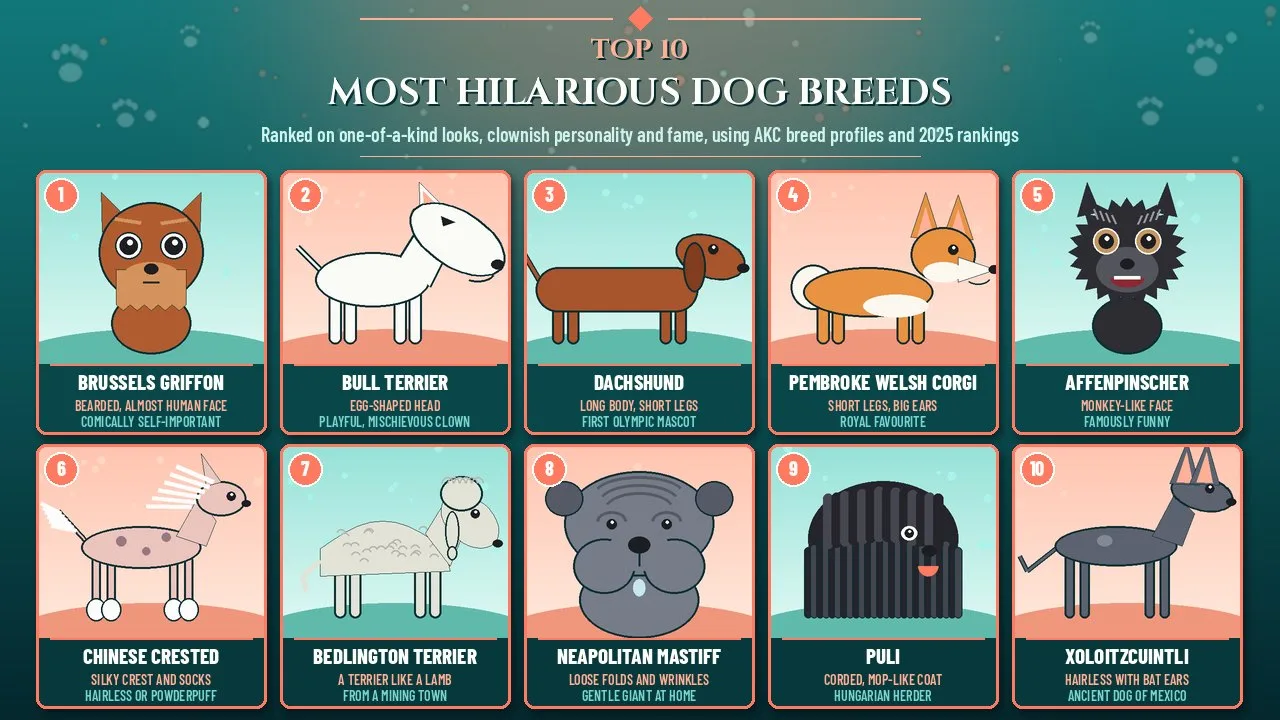
The most hilarious dog breeds pair one-of-a-kind looks with clownish personalities, from the bearded Brussels Griffon to the egg-headed Bull Terrier.
Some dogs make people grin before they have done anything at all. A face that looks almost human, a coat that hangs in ropes, legs that seem far too short for the body above them: these features stop people in the street and fill social media feeds. Add a playful or bossy character and the result is a breed that owners describe, with real affection, as a born comedian.
This list celebrates those breeds. It is not an "ugly dog" ranking, and every breed here is loved for exactly the features that make it unusual. Each of those features also has a story, because almost all of them were shaped by an old job, whether that was catching rats in a stable, herding cattle in Wales or guarding sheep on the Hungarian plains. The order is Finepedia's own, built from American Kennel Club (AKC) breed profiles, the AKC's 2025 popularity rankings published in March 2026, and well-documented moments in film, sport and history.
Most Hilarious Dog Breeds at a Glance
| Rank | Breed | Origin | What makes people smile | AKC popularity (2025) |
|---|---|---|---|---|
| 1 | Brussels Griffon | Belgium | Bearded, almost human face and a self-important attitude | 82nd |
| 2 | Bull Terrier | England | Egg-shaped head, tiny triangular eyes and a clownish streak | 86th |
| 3 | Dachshund | Germany | Very long body on very short legs, with a big bark | 5th |
| 4 | Pembroke Welsh Corgi | Wales | Short legs, huge upright ears and a fluffy, tailless rear | 16th |
| 5 | Affenpinscher | Germany | Shaggy monkey-like face and a serious air that makes its antics funnier | 153rd |
| 6 | Chinese Crested | China (traditionally) | Mostly hairless body with a silky crest, socks and plumed tail | 72nd |
| 7 | Bedlington Terrier | England | A terrier that looks like a lamb | 147th |
| 8 | Neapolitan Mastiff | Italy | Huge frame covered in loose folds and wrinkles | 119th |
| 9 | Puli | Hungary | Coat of natural cords that looks like a walking mop | 177th |
| 10 | Xoloitzcuintli | Mexico | Hairless skin, bat-like ears and a famously tricky name | 123rd |
How We Ranked the Most Hilarious Dog Breeds
Humour is personal, so this ranking uses three criteria that can be checked against published sources rather than one writer's taste.
- The shortlist: 16 breeds that regularly appear in round-ups of funny or funny-looking dogs. These were the ten above plus the Chinese Shar-Pei, Löwchen, Bergamasco Sheepdog, Dandie Dinmont Terrier, Komondor and Basenji.
- Look (1 to 5 points): 5 points for a feature that sets the breed apart from almost every other breed at a glance, 4 points for a striking feature that is shared with other breeds or created by grooming, and 3 points for distinctive details on a fairly typical dog outline.
- Personality (1 to 5 points), based on the words the AKC uses in each breed profile: 5 points when the AKC calls the breed comic, funny or amusing, 4 points for lively, spunky, frolicking or mischievous wording, 3 points for calm, sweet or sociable wording, and 2 points when the profile stresses independence, reserve or a challenging nature.
- Recognition (1 to 5 points): based on the AKC's 2025 popularity ranking of 202 breeds. A breed in the top 25 earns 4 points, ranks 26 to 100 earn 3, ranks 101 to 150 earn 2, and lower ranks earn 1. One extra point goes to breeds with a starring role in a widely seen film or advertising campaign, an Olympic role, or a Best in Show win at the Westminster Kennel Club Dog Show.
The three scores are added together. When two breeds tie, the one with the higher personality score goes first, then the one with the higher look score, then the one that is more popular in the AKC rankings.
The Scorecard
| Rank | Breed | Look | Personality | Recognition | Total |
|---|---|---|---|---|---|
| 1 | Brussels Griffon | 5 | 5 | 4 | 14 |
| 2 | Bull Terrier | 5 | 5 | 4 | 14 |
| 3 | Dachshund | 5 | 4 | 5 | 14 |
| 4 | Pembroke Welsh Corgi | 4 | 4 | 5 | 13 |
| 5 | Affenpinscher | 5 | 5 | 2 | 12 |
| 6 | Chinese Crested | 5 | 4 | 3 | 12 |
| 7 | Bedlington Terrier | 5 | 4 | 2 | 11 |
| 8 | Neapolitan Mastiff | 5 | 3 | 3 | 11 |
| 9 | Puli | 5 | 4 | 1 | 10 |
| 10 | Xoloitzcuintli | 4 | 3 | 3 | 10 |
The scores are Finepedia's editorial judgement, applied with the same rules to every breed. The six shortlisted breeds that missed the top ten are covered in the Honourable Mentions section.
1. Brussels Griffon
| Attribute | Details |
|---|---|
| Origin | Brussels, Belgium, in the early 1800s |
| AKC group | Toy Group, first registered in 1910 |
| Size | 7 to 10 inches (18 to 25 cm) tall, 8 to 10 pounds (about 4 kg) |
| Signature look | Short face, prominent chin and beard, and large expressive eyes that give an almost human expression |
| AKC popularity (2025) | 82nd of 202 breeds |
The Brussels Griffon earns first place because it scores top marks for both look and personality. Its face, with a jutting chin, whiskery beard and wide, watchful eyes, often looks like a tiny, grumpy person, and the AKC describes the breed as smart, devoted and "comically self-important". Few small dogs carry themselves with so much dignity, and that dignity is a large part of the joke.
Origins and History
The breed's story begins in the stables of Brussels. The city's coachmen kept small, wiry terrier-type dogs to control rats, and these "stable griffons" sometimes rode beside the driver on horse-drawn cabs. Breeders later crossed them with other small dogs, which are thought to have included the Pug and English toy spaniels, giving the breed its short face and rounder head.
Royal attention changed everything. In the 1870s Queen Marie Henriette of Belgium took a liking to the little dogs, and they soon became fashionable at court. The breed spread to Britain and the United States, and it survived the two world wars largely thanks to devoted breeders outside Belgium.
Key Features
- Comes in a rough, wiry coat and a smooth coat; some registries outside the United States treat the types as separate breeds
- Accepted colours include red, belge (a mix of reddish-brown and black), black and tan, and solid black
- The beard and moustache frame a short muzzle and an undershot jaw
- Very attached to its people and sensitive to their moods
- Often wary of strangers until it has had time to size them up
Significance
The Griffon shows how a dog's appearance and character can work together to create comedy. Its serious, almost offended expression contrasts with its small size and eager affection, so ordinary moments, such as a stare across the breakfast table, become funny. It is also a reminder that toy breeds were often working animals first, valued for catching vermin long before they became lap dogs.
In Popular Culture
The breed won millions of new fans in 1997, when a Brussels Griffon named Verdell shared the screen with Jack Nicholson and Helen Hunt in the film As Good as It Gets. Several trained Griffons played the part, with a dog called Jill as the main performer.
Interesting Facts
- The name refers to the city of Brussels, not the vegetable.
- The AKC traces a griffon-type ancestor back to the small dog in Jan van Eyck's painting the Arnolfini Portrait of 1434.
- Smooth-coated Griffons are known as Brabançons.
- The AKC notes that the Griffon is not a typical pampered toy dog, describing it as highly intelligent and sensitive.
2. Bull Terrier
| Attribute | Details |
|---|---|
| Origin | England, standardised in the 1860s |
| AKC group | Terrier Group, recognised in 1885 |
| Size | 21 to 22 inches (53 to 56 cm) tall, 50 to 70 pounds (23 to 32 kg) |
| Signature look | Long, oval "egghead" profile with small, deep-set triangular eyes |
| AKC popularity (2025) | 86th of 202 breeds |
The Bull Terrier has one of the most recognisable heads in the dog world, and a personality to match. The AKC calls it one of the most comical and mischievous breeds, and lists its temperament as playful, charming and mischievous. It finishes just behind the Brussels Griffon only because the tiebreak goes to the breed that is slightly more popular in the AKC rankings.
Origins and History
The breed has a hard past. Its ancestors were bulldog and terrier crosses used in blood sports in nineteenth-century Britain. After those sports were banned, breeders worked to soften both the look and the temperament of the dogs. In the early 1860s an English breeder named James Hinks refined the type into the modern Bull Terrier, a white dog with a smooth, curved face that soon became a fashionable companion for young gentlemen.
Coloured Bull Terriers appeared in the early twentieth century, when breeders added brindle Staffordshire bloodlines. Today the AKC shows two varieties, White and Colored, and the smaller Miniature Bull Terrier is treated as a separate breed.
Key Features
- A long, strong head that is oval when seen from the front, with a profile that curves smoothly from skull to nose
- Small, dark, triangular eyes set close together, which give a knowing look
- A muscular, compact body and a short, glossy coat that needs little grooming
- Loves ball games, toys and outdoor play
- Can be stubborn, so it does best with consistent, patient training
Significance
The Bull Terrier is a striking example of how a breed's image can change. A dog developed from fighting stock is now best known as an affectionate, energetic clown. Its unusual head has also made it one of the easiest breeds for artists, cartoonists and advertisers to draw, which helps explain why it keeps appearing in popular culture.
In Popular Culture
A Bull Terrier called Spuds MacKenzie fronted a beer advertising campaign that launched during the 1987 Super Bowl, and the Target retail chain's mascot, Bullseye, is also a Bull Terrier. In animation, Sid's dog Scud in Toy Story (1995) is one of the best-known cartoon examples. In 2006 a coloured Bull Terrier named Rufus won Best in Show at Westminster.
Interesting Facts
- General George S. Patton owned a white Bull Terrier named Willie.
- The AKC notes that Bull Terriers rarely bark without a good reason.
- The early white dogs earned the breed the nickname "White Cavalier".
- An old rhyme credits James Hinks with turning a "battered old bum" into a dog fit for a gentleman.
3. Dachshund
| Attribute | Details |
|---|---|
| Origin | Germany, with badger-hunting ancestors dating back several centuries |
| AKC group | Hound Group, recognised in 1885 |
| Size | Standard 8 to 9 inches (20 to 23 cm) tall and 16 to 32 pounds (7 to 15 kg); miniature 5 to 6 inches and 11 pounds or less |
| Signature look | A long, low "sausage" body on short legs |
| AKC popularity (2025) | 5th of 202 breeds |
The Dachshund is the most popular breed on this list and the only one in the AKC's top five. Its shape is a gift to cartoonists, and its character is just as lively: the AKC lists its temperament as curious, friendly and spunky. In 2025 it entered the AKC's top five for the first time since 2003.
Origins and History
Dachshund means "badger dog" in German. The breed was developed to follow badgers into their underground tunnels, and its long, low body and strong front legs were ideal for digging. Its surprisingly deep bark also had a purpose, allowing hunters above ground to locate a dog working below.
Breeders produced three coat types for different conditions: smooth, wirehaired for thorny undergrowth, and longhaired for colder weather. By the late 1800s the breed was being standardised by size, coat and colour. It became so closely linked with Germany that, during the First World War, some American owners renamed it the "liberty hound".
Key Features
- Three coat types (smooth, wirehaired and longhaired) and two sizes (standard and miniature)
- A long back and short legs, so owners are advised to limit jumping from furniture
- A loud bark that sounds as if it belongs to a much bigger dog
- Brave and determined, sometimes to the point of stubbornness
- Strong digging and hunting instincts that remain in many family pets
Significance
The Dachshund shows that a body shaped for a specific job can become a beloved symbol. Its outline is instantly recognisable, which is why the breed appears on everything from greeting cards to fashion prints.
In Popular Culture
A colourful Dachshund named Waldi was the first official mascot of the Olympic Summer Games, created for Munich 1972. According to the International Olympic Committee, the route of the 1972 Olympic marathon was laid out to follow Waldi's outline, with the dog's head facing west.
Interesting Facts
- Nicknames include "wiener dog" and "sausage dog", both inspired by the breed's shape.
- Wiener dog races, in which Dachshunds sprint short distances, are popular charity events in several countries.
- Pablo Picasso was often photographed with a Dachshund named Lump.
- Between 1930 and 1940 the breed climbed from 28th to sixth in American registrations, according to the AKC.
4. Pembroke Welsh Corgi
| Attribute | Details |
|---|---|
| Origin | Pembrokeshire, Wales |
| AKC group | Herding Group, recognised in 1934 |
| Size | 10 to 12 inches (25 to 30 cm) tall, up to 30 pounds (about 14 kg) |
| Signature look | Short legs, a fox-like face, large upright ears and a fluffy rear |
| AKC popularity (2025) | 16th of 202 breeds |
The Pembroke Welsh Corgi is a cattle dog in a compact body. Its very short legs, big pointed ears and bouncy, rolling walk make it one of the most cheerful-looking dogs anywhere, and the AKC calls it one of the most agreeable of all small house dogs. Its look score is slightly lower only because its short-legged shape is shared with its close cousin, the Cardigan Welsh Corgi.
Origins and History
According to breed tradition recorded by the AKC, the Pembroke's ancestors arrived in south-west Wales with Flemish weavers whom Henry I invited to settle there in 1107. Low, sturdy herding dogs helped Welsh farmers drive cattle by nipping at their heels, and their short height made it easier to avoid kicks.
The Pembroke and the Cardigan were bred together for a time, but Britain's Kennel Club recognised them as separate breeds in 1934, the same year the first Pembrokes were registered with the AKC. The easiest way to tell them apart is by the ears and tail: the Pembroke's ears are pointed, and its tail is naturally short or docked, while the Cardigan has rounder ears and a long tail.
Key Features
- Strong, athletic and quick despite its low build
- A thick, weather-resistant double coat that sheds heavily
- Alert, affectionate and smart, according to the AKC
- A strong herding instinct that may show up as nudging people or chasing moving objects
- Bright and trainable, which makes it a regular competitor in dog sports
Significance
The Corgi shows how fame can boost a breed. Royal ownership made it world famous, and its photogenic proportions made it a favourite of the internet age. Its popularity has climbed steadily, from 50th in AKC registrations in 1968 to 16th in 2025.
In Popular Culture
Queen Elizabeth II received her first Pembroke, Susan, for her 18th birthday in 1944 and owned more than 30 during her life, according to the AKC. Three of her corgis, Monty, Willow and Holly, appeared with her and Daniel Craig as James Bond in the short film shown at the opening ceremony of the London 2012 Olympics.
Interesting Facts
- The Queen's first family corgi, Dookie, arrived in 1933, before she owned one of her own.
- The Pembroke is the more popular of the two Corgi breeds in the United States.
- The AKC notes that the Pembroke's ancestry is closer to spitz-type dogs than to the Dachshund.
- Welsh folklore describes corgis as the steeds of fairies, a legend linked to the saddle-like markings on some dogs' backs.
5. Affenpinscher
| Attribute | Details |
|---|---|
| Origin | Germany, in the stables of the 1600s |
| AKC group | Toy Group, recognised in 1936 |
| Size | 9 to 11.5 inches (23 to 29 cm) tall, 7 to 10 pounds (3 to 4.5 kg) |
| Signature look | A shaggy, monkey-like face with bushy eyebrows and a beard |
| AKC popularity (2025) | 153rd of 202 breeds |
Affenpinscher means "monkey terrier" or "ape terrier" in German, and one look at its whiskery face explains the name. The AKC lists its temperament as confident, famously funny and fearless, and notes that, like all great comedians, the breed seems completely serious about everything it does. Only its rarity keeps it out of the top three.
Origins and History
The Affenpinscher began as a working ratter in the stables and kitchens of seventeenth-century Germany. Over time it moved further into the household, catching mice by day and keeping its owners company in the evening. Breed clubs formed in Germany and France in the late 1800s, and the AKC accepted the breed in 1936.
Breed historians believe the Affenpinscher helped shape other small European breeds, including the Brussels Griffon and the Miniature Schnauzer. That shared ancestry explains why the top-ranked Griffon and the Affenpinscher are often mistaken for each other.
Key Features
- A wiry, rough coat that sheds little and is often described as low-allergen
- Black is the preferred colour, but silver-grey, red and black-and-tan dogs also occur
- Bold well beyond its size and often unaware that it is small
- Usually better suited to homes with older children, as many dislike being squeezed or chased
- Its ratting history means it may not be a safe companion for pet rodents
Significance
The Affenpinscher proves that a breed does not need to be common to be famous. Its expressive face and confident manner made it a star of the show ring, and its humour comes from attitude as much as appearance.
In Popular Culture
In 2013 an Affenpinscher named Banana Joe won Best in Show at the Westminster Kennel Club Dog Show in New York, the first win for the breed and a moment that introduced it to millions of television viewers.
Interesting Facts
- The AKC calls the breed rare and warns that buyers may need to join a waiting list.
- The breed's nickname in the AKC profile is simply "Affen" or "Monkey Dog".
6. Chinese Crested
| Attribute | Details |
|---|---|
| Origin | Traditionally linked to China, though its exact origin is unknown |
| AKC group | Toy Group, entered the AKC Stud Book in 1991 |
| Size | 11 to 13 inches (28 to 33 cm) tall, 8 to 12 pounds (3.5 to 5.5 kg) |
| Signature look | Mostly bare skin with a silky crest on the head, furry "socks" and a plumed tail |
| AKC popularity (2025) | 72nd of 202 breeds |
The Chinese Crested looks as though it has been styled for a party. The hairless variety has smooth, often spotted skin, with long silky hair only on its head, feet and tail. The AKC describes the breed as alert, lively and affectionate, and its lively, cuddly personality wins over people who expect a delicate show dog.
Origins and History
The breed's history is uncertain. The AKC explains that hairless dogs may have been brought to China in ancient times and gradually reduced in size. Small Cresteds are said to have travelled on Chinese trading ships as rat catchers, which may explain why similar dogs were recorded in ports around the world.
In the United States the breed was promoted from the late 1800s by journalist Ida Garrett and breeder Debra Woods. The American Chinese Crested Club formed in 1979, and the breed entered the AKC Stud Book in 1991.
Key Features
- Two varieties: Hairless and Powderpuff, which has a full, soft coat
- Both varieties can appear in the same litter
- Bare skin needs protection from strong sun and cold weather
- Affectionate and attached to its owners, often following them from room to room
- Lightweight and well suited to smaller homes
Significance
The Chinese Crested shows how a single gene can change a dog's whole appearance, since the hairless trait and the coated Powderpuff come from the same breed. Its unusual look has given it a strong presence in dog shows and online, and it challenges the idea that a dog must be fluffy to be cuddly.
Interesting Facts
- Its many nicknames include the "Chinese Ship Dog" and the "Dr. Seuss dog", the second a reference to the fanciful creatures in the author's books.
- A purebred Chinese Crested named Sam won the light-hearted World's Ugliest Dog Contest at California's Sonoma-Marin Fair three years in a row, from 2003 to 2005, and became a much-loved media celebrity.
- Cresteds began appearing in European paintings and prints in the nineteenth century.
7. Bedlington Terrier
| Attribute | Details |
|---|---|
| Origin | Bedlington, Northumberland, England |
| AKC group | Terrier Group, first registered in 1886 |
| Size | 15 to 17.5 inches (38 to 44 cm) tall, 17 to 23 pounds (8 to 10 kg) |
| Signature look | A pear-shaped head, topknot and curly coat that resemble a lamb |
| AKC popularity (2025) | 147th of 202 breeds |
The Bedlington Terrier is a terrier dressed as a lamb. Its rounded, narrow head, soft topknot and arched back make it look more like a farm animal than a hunter, and the AKC calls it a graceful terrier "in sheep's clothing". Its temperament is listed as loyal, charming and frolicking.
Origins and History
The breed takes its name from the mining town of Bedlington in north-east England. In the 1800s it was a working dog for miners and nail makers, used to catch rats and other pests and valued for its speed and grit. It was also favoured by travelling communities as a quiet hunting companion, which gave it the nickname "Gypsy Dog".
The first dog known as a Bedlington Terrier, named Piper, was born in 1825. A national breed club formed in England in 1877, and the AKC registered its first Bedlington nine years later.
Key Features
- An arched back and long legs that suggest Whippet ancestry and give real speed
- A coat that mixes soft and harder hair and is trimmed to show the lamb-like outline
- Colours include blue, liver and sandy
- Gentle and affectionate at home but alert as a watchdog
- Active and athletic, enjoying running and play
Significance
The Bedlington is the clearest example on this list of a breed whose look and history surprise people. Its soft, sheep-like appearance hides the speed and determination of a working terrier. That contrast is exactly why it delights people who meet one for the first time.
Interesting Facts
- An early nickname was "Rothbury's Lamb", after a local lord who championed the breed.
- The AKC reports that Piper was still hunting badgers in old age.
- The town of Bedlington has installed park benches shaped like its famous terrier.
- Its possible relatives include the Dandie Dinmont, Kerry Blue and Soft Coated Wheaten Terriers.
8. Neapolitan Mastiff
| Attribute | Details |
|---|---|
| Origin | Southern Italy, with roots in ancient Roman guard dogs |
| AKC group | Working Group, recognised in 2004 |
| Size | 24 to 31 inches (61 to 79 cm) tall, about 110 to 150 pounds (50 to 68 kg) |
| Signature look | A massive head with heavy wrinkles, loose skin and a large dewlap |
| AKC popularity (2025) | 119th of 202 breeds |
The Neapolitan Mastiff is the giant of this list. Its loose skin, deep facial folds and slow, rolling walk give it a look that is both impressive and endearing. The AKC describes it as wary with strangers but sweet, placid and steady with its family, and many owners say its gentle, lumbering manner at home is what makes them laugh.
Origins and History
Large mastiff-type dogs were used across the ancient world as guardians and war dogs, and the AKC says the breed's line may reach back to around 700 BC. In Italy, dogs of this type survived for centuries around Naples as guardians of homes and farms.
The modern breed was rediscovered and standardised in Italy in the 1940s. In Italian it is called the Mastino Napoletano, and the AKC granted it full recognition in 2004, when it became eligible for the Working Group.
Key Features
- Loose skin over the whole body and heavy folds on the head
- A voluminous dewlap under the jaw
- A strong guarding instinct, so early socialisation and experienced handling are important
- Calm and affectionate with its own family
- A short life expectancy of about 7 to 9 years, according to the AKC
Significance
The Neapolitan Mastiff shows that a dog bred to look intimidating can still be loved for its gentle side. Its features were deliberately exaggerated to deter intruders, yet those same folds and jowls now make it one of the most recognisable giant breeds.
In Popular Culture
Hagrid's dog Fang in the Harry Potter films was played by several Neapolitan Mastiffs, even though the books describe Fang as a boarhound. The AKC noted that the films brought the breed new attention shortly before its full recognition.
Interesting Facts
- The AKC's breed nicknames are Mastino and Neo.
- Adult males can weigh around 150 pounds (68 kg).
- The breed was originally developed to guard its owner and property rather than to herd or hunt.
9. Puli
| Attribute | Details |
|---|---|
| Origin | Hungary |
| AKC group | Herding Group, accepted in 1936 |
| Size | 16 to 17 inches (41 to 43 cm) tall, 25 to 35 pounds (11 to 16 kg) |
| Signature look | A dense coat that forms natural cords from head to tail |
| AKC popularity (2025) | 177th of 202 breeds |
The Puli looks like a mop that has decided to go for a run. Its coat forms long cords as it matures, and when the dog moves, the cords bounce and swing. The AKC calls the Puli an agile, faithful little dynamo and lists its temperament as loyal, smart and home-loving.
Origins and History
The Puli's ancestors are thought to have arrived in Hungary around a thousand years ago with the Magyars. On the Hungarian plains, these small, quick dogs herded large flocks of sheep, while the corded coat protected them from harsh winters.
The breed came close to disappearing as it was mixed with other dogs, but in 1912 a Hungarian enthusiast, Emil Raitsits, began work to restore it, and the first breed standard followed in 1915. The AKC accepted the Puli in 1936.
Key Features
- A soft, woolly undercoat and a longer outer coat that cords naturally after puppyhood
- The cords need regular separation by hand and take a long time to dry after bathing
- Quick, agile and responsive, a true herding dog
- Very attached to its people and often wary of strangers
- Accepted colours include black, rusty black, grey and white
Significance
The Puli is proof that a working feature can look like a fashion statement. Its cords were practical protection from weather and predators, yet they give the dog a cartoon-like look that stops people in their tracks. The breed is also part of Hungary's rich heritage of herding and guarding dogs.
Interesting Facts
- The plural of Puli is Pulik.
- The AKC says a Puli may try to herd almost anything, including birds, other dogs and even toddlers.
- The Puli Club of America was founded in 1951.
- The Puli is often compared with the much larger Komondor, another corded Hungarian breed listed in the Honourable Mentions.
10. Xoloitzcuintli
| Attribute | Details |
|---|---|
| Origin | Mexico, with a history of at least 3,000 years |
| AKC group | Non-Sporting Group, fully recognised in 2011 |
| Size | Three sizes, from 10 inches (25 cm) for toys to 23 inches (58 cm) for standards; 10 to 55 pounds (4.5 to 25 kg) |
| Signature look | Smooth hairless skin, large upright ears and an elegant, slim outline |
| AKC popularity (2025) | 123rd of 202 breeds |
The Xoloitzcuintli, usually called the Xolo, rounds out the top ten. Its smooth, bare skin and bat-like ears give it a striking, almost sculptural look, and its name is a famous tongue-twister: the AKC gives the pronunciation as "show-low-eats-QUEENT-lee". The AKC describes the breed as alert, loyal and calm.
Origins and History
The Xolo is one of the oldest breeds in the Americas. The Aztecs named it after Xolotl, a god linked with lightning and death, and believed the dogs could guide the souls of their owners into the afterlife. European explorers, including Columbus, recorded seeing strange hairless dogs in the region.
The breed's modern history has had ups and downs. A Mexican import was registered with the AKC in 1887, but the breed was dropped from the stud book in 1959 because so few were registered. Mexican experts rebuilt it from dogs found in remote villages in the 1950s, and the AKC recognised it again in 2011 as its 170th breed.
Key Features
- Three sizes (toy, miniature and standard) and two varieties (hairless and coated)
- Hairless dogs need protection from sun and cold
- Calm and attentive at home, but a watchful guardian
- Bonds closely with its family
Significance
The Xolo connects modern dog lovers with ancient Mexican culture. Once treated as a sacred animal, it is now a national symbol, and in 2016 the government of Mexico City declared it part of the city's cultural heritage. Its unusual appearance is not a novelty but a living link to thousands of years of history.
In Popular Culture
Mexican artists Frida Kahlo and Diego Rivera kept Xolos and featured them in their work. In 2017 the Pixar film Coco introduced the breed to a global audience through Dante, the loyal, goofy street dog who follows the hero Miguel on his journey.
Interesting Facts
- The breed is also known as the Mexican Hairless.
- A dog named Chinito Jr. became the breed's first AKC champion in 1940.
- All three Xolo sizes compete together in AKC conformation shows.
Honourable Mentions
These six shortlisted breeds also have unforgettable looks or habits but finished outside the top ten on the scorecard.
| Breed | Origin | Why it stands out | Score |
|---|---|---|---|
| Chinese Shar-Pei | China | Deep wrinkles and a blue-black tongue, a feature it shares with the Chow Chow | 10 |
| Löwchen | Europe | Its name means "little lion" in German, and it is often groomed in a lion-style trim | 9 |
| Bergamasco Sheepdog | Italy | A coat of flat, felted "flocks" and very long eyelashes that help keep hair out of its eyes | 9 |
| Dandie Dinmont Terrier | Scotland and England border | A fluffy topknot, long low body and the only AKC breed named after a fictional character, from Walter Scott's 1815 novel Guy Mannering | 9 |
| Komondor | Hungary | A large flock guardian covered in heavy white cords | 8 |
| Basenji | Central Africa | Known as the "barkless dog", it makes yodel-like sounds instead | 8 |
The Shar-Pei missed the top ten on the tiebreak because the AKC describes it as independent and challenging rather than playful.
Funny Looks and the Jobs Behind Them
Most of the features that make these breeds look funny today were once practical tools. This table links each look to the job it supported.
| Breed | Feature | Original purpose |
|---|---|---|
| Brussels Griffon | Wiry beard and coat | Hard-wearing coat for a stable ratter |
| Bull Terrier | Strong, curved head | Developed from powerful bulldog and terrier crosses |
| Dachshund | Long, low body | Following badgers into tunnels |
| Pembroke Welsh Corgi | Short legs | Herding cattle while staying below kicking hooves |
| Affenpinscher | Rough, wiry coat | Catching rats in stables and kitchens |
| Chinese Crested | Small, light body | Catching rats on ships, according to breed tradition |
| Bedlington Terrier | Arched back and long legs | Speed for hunting vermin around mining towns |
| Neapolitan Mastiff | Loose skin and huge head | Guarding homes and intimidating intruders |
| Puli | Corded coat | Protection from harsh weather on the Hungarian plains |
| Xoloitzcuintli | Hairless skin | A natural trait of an ancient breed held sacred in Aztec culture |
Choosing a Funny Dog Breed
A funny face is never a good enough reason on its own to bring a dog home. Each breed on this list has practical needs that matter far more than its looks.
| If you want... | Consider | Keep in mind |
|---|---|---|
| A tiny companion for an apartment | Brussels Griffon, Affenpinscher, Chinese Crested | Toy dogs are fragile and may not suit homes with very young children |
| An active playmate | Bull Terrier, Pembroke Welsh Corgi, Bedlington Terrier | These breeds need daily exercise and consistent training |
| A low-shedding coat | Affenpinscher, Bedlington Terrier, Chinese Crested (Hairless), Xoloitzcuintli (hairless) | No dog is completely allergy-free |
| A gentle giant | Neapolitan Mastiff | Needs space, experienced handling and a budget for a very large dog |
| An unusual coat | Puli | Cords need regular hands-on care |
Prospective owners should always speak to responsible breeders or rescue groups, meet adult dogs of the breed, and ask about health testing. Long-backed, flat-faced and giant breeds can have breed-specific health concerns that are worth understanding before choosing.
Frequently Asked Questions
What is the most hilarious dog breed?
On Finepedia's scorecard, the Brussels Griffon is the most hilarious dog breed, tied on points with the Bull Terrier and Dachshund and placed first on the tiebreak. Its bearded, almost human face and what the AKC calls a "comically self-important" personality make it a natural comedian, and it starred in the 1997 film As Good as It Gets.
Which dog breeds does the AKC describe as funny?
The AKC lists the Affenpinscher's temperament as "famously funny", calls the Bull Terrier one of the most comical and mischievous breeds, and describes the Brussels Griffon as comically self-important. Many other breeds are described as playful, lively or mischievous, including the Dachshund and the Bedlington Terrier.
Why do some dog breeds look so unusual?
Most unusual looks began as working tools. The Dachshund's long body helped it hunt badgers underground, the Puli's cords protected it from harsh weather, and the Corgi's short legs helped it herd cattle without being kicked. Later breeders often exaggerated these features, and some also have health effects that owners should understand.
Are funny-looking dog breeds good family pets?
Many are. The Pembroke Welsh Corgi, Bull Terrier and Bedlington Terrier are affectionate with their families, though all need exercise and training. Toy breeds such as the Brussels Griffon and Affenpinscher usually do better with older children, and the Neapolitan Mastiff needs experienced handling because of its size and guarding instinct.
Is the Xoloitzcuintli completely hairless?
Not always. The Xoloitzcuintli comes in two varieties, hairless and coated, and both can be born in the same litter. Hairless Xolos may have a little short hair on the head, feet or tail. Their bare skin needs protection from strong sun and cold, while coated Xolos have a short, flat coat.
Which hilarious dog breed is the most popular?
The Dachshund is the most popular breed on this list. It ranked fifth of 202 breeds in the AKC's 2025 registration statistics, published in March 2026, its first time in the top five since 2003. The Pembroke Welsh Corgi was the next most popular, in 16th place.
Conclusion
The most hilarious dog breeds are funny for very different reasons. The Brussels Griffon and Affenpinscher make people laugh with their serious little faces, the Bull Terrier and Dachshund with their unmistakable shapes and big personalities, and the Puli and Bedlington Terrier with coats that make them look like mops and lambs. Behind almost every quirky feature is a working history that deserves as much attention as the smile it brings.
Choosing one of these dogs should start with its needs, not its looks. To explore more breed rankings, see Finepedia's guides to the fastest dog breeds in the world, the cheapest dog breeds to own and the best dog breeds for different homes, and read about foods dogs should never eat before bringing a new companion home.
- American Kennel Club (2026). Breed profiles: Brussels Griffon, Bull Terrier, Dachshund, Pembroke Welsh Corgi, Affenpinscher, Chinese Crested, Bedlington Terrier, Neapolitan Mastiff, Puli, Xoloitzcuintli, Chinese Shar-Pei, Löwchen, Bergamasco Sheepdog, Dandie Dinmont Terrier, Komondor and Basenji (temperament, size, history and "Did you know" notes).
- American Kennel Club (March 2026). Most Popular Dog Breeds of 2025, and press release on the French Bulldog's fourth year at No. 1 and the Dachshund's rise to fifth.
- American Kennel Club. Breeds by Year Recognized (updated January 2026); press releases on the Neapolitan Mastiff (2004) and Xoloitzcuintli (2011) gaining full recognition.
- American Kennel Club. Queen Elizabeth II's Royal Pembroke Welsh Corgis; Pembroke Welsh Corgi History; Xoloitzcuintli History.
- International Olympic Committee. Munich 1972: The Mascot (Waldi).
- BBC. Coverage of the London 2012 Olympic opening ceremony film Happy and Glorious and the Queen's corgis.
- Westminster Kennel Club Dog Show Best in Show records (2006 Bull Terrier, 2013 Affenpinscher).
- Sonoma-Marin Fair contest records and CBS News coverage of Sam the Chinese Crested (2003 to 2005).
- Reference topic awareness only: 10MostToday, World's 10 Most Hilarious Dog Breeds (2019). Ranking, method, structure and wording here are original, and all facts were checked against the sources above.


















Log in with