









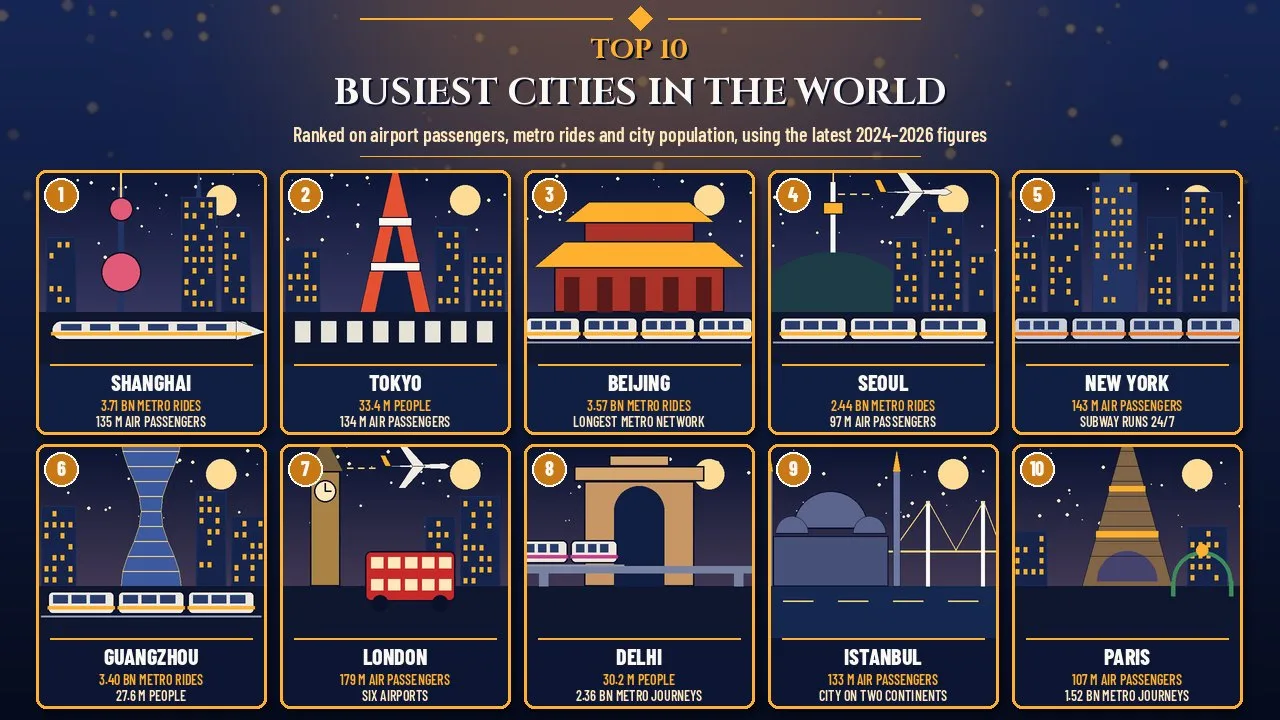
The busiest cities in the world in 2026, led by Shanghai, Tokyo and Beijing, move billions of metro riders and over 100 million air passengers a year.
Calling a city "busy" usually means crowded platforms, packed departure halls and streets that never seem to empty. Those impressions are real, but they are hard to compare from one continent to another. A city can feel frantic because its roads are jammed, or because its trains carry millions of people before breakfast, or because tens of millions of travellers pass through its airports every year.
This list puts numbers on that feeling. It compares major cities using three measurable signs of movement and crowding: how many passengers use their airports, how many rides their metro systems carry, and how many people live in them. The order is Finepedia's own, built mostly from data published between 2024 and 2026 by airport operators, transit agencies, Airports Council International (ACI World) and the United Nations.
Busiest Cities in the World at a Glance
| Rank | City | Country | Airport passengers (2025) | Metro rides per year | City population (UN, 2025) |
|---|---|---|---|---|---|
| 1 | Shanghai | China | 135.1 million | 3.71 billion (2025) | 29.6 million |
| 2 | Tokyo | Japan | 133.9 million | About 3.46 billion (FY2024) | 33.4 million |
| 3 | Beijing | China | 124.4 million | 3.57 billion (2025) | 17.0 million |
| 4 | Seoul | South Korea | 97.0 million | 2.44 billion (2025) | 22.5 million |
| 5 | New York | United States | 142.7 million | 1.28 billion (2025) | 13.9 million |
| 6 | Guangzhou | China | 83.6 million | 3.40 billion (2025) | 27.6 million |
| 7 | London | United Kingdom | 179.2 million | 1.22 billion (2024/25) | 10.4 million |
| 8 | Delhi | India | 78.1 million | 2.36 billion (2025) | 30.2 million |
| 9 | Istanbul | Türkiye | 132.9 million | 689 million (2024) | 15.0 million |
| 10 | Paris | France | 107.0 million | 1.52 billion (2025) | 9.4 million |
How We Ranked the Busiest Cities
There is no single official ranking of busy cities, so this list uses a transparent scoring method that anyone can check.
- Step 1, the shortlist: a city qualifies if its commercial airports handled at least 90 million passengers in 2025, or if its metro network carried at least 2 billion rides in its latest reported year. Eighteen cities met at least one of these thresholds.
- Step 2, three pillars: each shortlisted city is ranked separately on airport passengers (2025, the city's main commercial airports combined, grouped as airport operators or national aviation authorities report them where possible), metro ridership (latest full year published by the operator) and city population (UN World Urbanization Prospects 2025).
- Step 3, the score: the three pillar ranks are averaged. A lower average means a busier city. When two cities tie, the one with more airport passengers goes higher.
Each pillar captures a different kind of busyness. Airport traffic shows how strongly a city connects with the rest of its country and the world. Metro ridership shows how many daily trips happen inside the city. Population shows the sheer number of people who share the same streets, stations and services.
Two cautions apply. Metro operators count rides in slightly different ways, for example some count a change between lines as a new journey. The UN's 2025 city figures also use a new international method, called the Degree of Urbanisation, that measures continuous built-up areas, so they can differ from the population of a city's official boundaries.
The Scorecard
| Rank | City | Airport rank | Metro rank | Population rank | Average score |
|---|---|---|---|---|---|
| 1 | Shanghai | 3 | 1 | 3 | 2.33 |
| 2 | Tokyo | 4 | 3 | 1 | 2.67 |
| 3 | Beijing | 6 | 2 | 7 | 5.00 |
| 4 | Seoul | 11 | 6 | 5 | 7.33 |
| 5 | New York | 2 | 11 | 10 | 7.67 |
| 6 | Guangzhou | 15 | 4 | 4 | 7.67 |
| 7 | London | 1 | 12 | 12 | 8.33 |
| 8 | Delhi | 16 | 7 | 2 | 8.33 |
| 9 | Istanbul | 5 | 13 | 8 | 8.67 |
| 10 | Paris | 7 | 10 | 13 | 10.00 |
Ranks are positions among the 18 shortlisted cities. The cities that just missed the top ten, including Bangkok, Moscow and Shenzhen, appear in the Honourable Mentions section.
1. Shanghai
| Attribute | Details |
|---|---|
| Country | China |
| Airport passengers (2025) | 135.1 million (Pudong 85.0 million, Hongqiao 50.2 million) |
| Metro ridership | 3.71 billion rides in 2025, the most of any metro in the world |
| City population (UN, 2025) | 29.6 million |
| Pillar ranks | Airports 3rd, metro 1st, population 3rd |
Shanghai comes out as the busiest city in the world on this scorecard because it is the only city to finish in the top three on all three measures. Its metro carries more rides than any other network, its two airports together handle more than 135 million passengers, and its urban area is home to almost 30 million people.
Urban Context
Shanghai sits at the mouth of the Yangtze River, which gives it a natural role as a gateway between inland China and the sea. It grew into China's leading commercial and financial centre during the twentieth century, and since the 1990s the Pudong district on the east bank of the Huangpu River has turned from farmland and warehouses into a skyline of towers.
The metro is younger than many people expect. Line 1 opened in 1993, and the network has since grown to roughly 890 kilometres and more than 400 stations, which makes it one of the two largest metro systems on Earth alongside Beijing's.
Key Features
- Shanghai Metro recorded about 3.71 billion rides in 2025, ahead of every other metro network
- Pudong International Airport handled about 85.0 million passengers in 2025, up 10.7 percent, and rose from tenth to fifth in ACI World's global ranking
- Hongqiao International Airport passed 50 million passengers in a year for the first time in 2025
- Hongqiao airport sits next to Hongqiao Railway Station, so high-speed trains, the metro and flights meet in one transport hub
- The Port of Shanghai has been the world's busiest container port since 2010
Significance
Shanghai shows what busyness looks like when air, rail and sea traffic all concentrate in one place. Its airports serve both a huge domestic market and a growing number of international routes, while its metro moves an average of roughly ten million riders every day. Few other cities combine that much movement inside the city with that much traffic in and out of it.
Interesting Facts
- The Shanghai Maglev, opened to the public in 2004, links Pudong airport with the city's metro network in a ride of about eight minutes.
- International passengers at Pudong rose by about 21 percent in 2025, according to the airport operator's annual report.
- Shanghai's two airports together recorded about 839,000 flights in 2025.
- UN projections suggest Shanghai could become the world's third-largest city by 2050.
2. Tokyo
| Attribute | Details |
|---|---|
| Country | Japan |
| Airport passengers (2025) | 133.9 million (Haneda 91.7 million, Narita 42.3 million) |
| Metro ridership | About 3.46 billion rides on Tokyo Metro and Toei Subway (fiscal year 2024) |
| City population (UN, 2025) | 33.4 million, the third-largest city in the world |
| Pillar ranks | Airports 4th, metro 3rd, population 1st |
Tokyo finishes a very close second. It has the largest population of any shortlisted city, a subway network that carries billions of rides, and in Haneda one of the three busiest airports in the world.
Urban Context
Greater Tokyo has been one of the world's largest urban areas for decades. The UN's 2025 figures place it third, behind Jakarta and Dhaka, with about 33.4 million people. Despite that size, the city is known for orderly crowds and trains that run to tight timetables.
Tokyo opened the first subway in Asia in 1927, a short line between Ueno and Asakusa that is now part of the Ginza Line. Today two operators, Tokyo Metro and the city-run Toei Subway, share the underground network.
Key Features
- Haneda Airport handled about 91.7 million passengers in 2025, rising to third place in ACI World's global ranking
- Narita Airport added about 42.3 million passengers in calendar year 2025, most of them international travellers
- Tokyo Metro alone averaged about 7 million passengers a day in the year to March 2025
- Subways are only part of the picture, because JR East and private railway companies carry the majority of rail trips in the region
- Japan welcomed a record 42.7 million foreign visitors in 2025, the first year above 40 million, and Tokyo is the main gateway for many of them
Significance
If this ranking counted every commuter railway as well as the subway, Tokyo would almost certainly rank first. The metro pillar here uses only the two subway operators, so that Tokyo is compared on the same basis as other cities. Even on that narrower measure, it finishes near the top.
Interesting Facts
- Shinjuku Station is often cited by Guinness World Records as the busiest railway station in the world.
- The Shibuya Scramble Crossing, where traffic stops in every direction at once so pedestrians can cross diagonally, is one of the most photographed street scenes in the city.
- Haneda's 2025 traffic was about 7 percent higher than in 2019, before the pandemic.
- Tokyo hosted the Summer Olympics in 1964 and again in 2021.
3. Beijing
| Attribute | Details |
|---|---|
| Country | China |
| Airport passengers (2025) | 124.4 million (Capital 70.7 million, Daxing 53.6 million) |
| Metro ridership | 3.57 billion rides in 2025 |
| City population (UN, 2025) | 17.0 million |
| Pillar ranks | Airports 6th, metro 2nd, population 7th |
Beijing, the capital of China, has the longest metro network in the world and two very large airports. It ranks third because its population, while very large, is smaller than that of several Asian rivals under the UN's measure.
Urban Context
Beijing is China's political capital and a major centre for education, culture and technology. The first subway line began trial service in 1969 and opened to the general public in the early 1970s. Growth was slow for decades, then accelerated sharply before and after the 2008 Summer Olympics.
The airport picture changed in 2019, when Beijing Daxing International Airport opened in the south of the city. Its terminal, designed by Zaha Hadid Architects, is known for its star-shaped plan. Traffic has since been split between Daxing and the older Beijing Capital International Airport.
Key Features
- The Beijing Subway is the longest metro system in the world, at about 909 kilometres
- The network carried about 3.57 billion rides in 2025
- Beijing Capital handled about 70.7 million passengers in 2025 and Daxing about 53.6 million
- Daxing averaged roughly 147,000 passengers and about 947 flights a day in 2025
- International and regional passengers at Daxing rose by about 25 percent in 2025
Significance
Beijing shows why one airport figure can be misleading. Beijing Capital was the second-busiest airport in the world in 2019, with more than 100 million passengers. In 2025 it ranked only fifteenth, not because Beijing became quieter, but because much of its traffic moved to Daxing. Counted together, the two airports handled more passengers in 2025 than Beijing Capital did at its peak.
Interesting Facts
- Beijing is the only city to have hosted both the Summer Olympics (2008) and the Winter Olympics (2022).
- Capital Airports Holding reported that Beijing's two airports grew by 6.5 percent in 2025.
- Daxing won ACI's 2025 Airport Service Quality award for the best airport in Asia-Pacific in the over-40-million-passenger category.
- Around 38 percent of Daxing's passengers reached the airport by public transport in 2025.
4. Seoul
| Attribute | Details |
|---|---|
| Country | South Korea |
| Airport passengers (2025) | 97.0 million (Incheon 74.1 million, Gimpo 23.0 million) |
| Metro ridership | 2.44 billion rides on Seoul Metro Lines 1 to 8 in 2025 |
| City population (UN, 2025) | 22.5 million, the tenth-largest city in the world |
| Pillar ranks | Airports 11th, metro 6th, population 5th |
Seoul earns fourth place through balance. It is not the leader on any single pillar, but it ranks in the top half for metro use and population and only just outside it for airports, with a dense subway network, a large urban population and an airport system approaching 100 million passengers a year.
Urban Context
Seoul is the capital and economic heart of South Korea, and its wider metropolitan region holds about half of the country's people. The first subway line opened in 1974. Since then the network has spread across the capital and into neighbouring Gyeonggi Province and Incheon.
Incheon International Airport opened in 2001 on reclaimed land west of the city. It took over most international flights, while Gimpo Airport, closer to the centre, now focuses mainly on domestic routes and short international flights.
Key Features
- Seoul Metro Lines 1 to 8 carried about 2.44 billion passengers in 2025, an average of about 6.7 million a day
- Jamsil Station was the busiest station on the Seoul Metro network in 2025
- Incheon handled a record 74.1 million passengers in 2025
- Gimpo added about 23.0 million passengers, most of them on domestic flights
- Together, the two airports carried roughly 78 percent of all air passengers in South Korea in 2025
Significance
Seoul is a good example of a city that is busy in many ways at once. Commuters fill its trains, millions of travellers pass through its airports, and its population is concentrated in a relatively small area. That combination keeps it ahead of cities that lead on one measure but trail on the others.
Interesting Facts
- The air route between Seoul Gimpo and Jeju Island is regularly listed by aviation data firm OAG as one of the busiest air routes in the world.
- The Seoul Metro figures above do not include Line 9 or several other lines run by separate operators, so total rail use in the region is higher.
- Incheon was the third-busiest airport in the world for international passengers in 2025, according to ACI World.
5. New York
| Attribute | Details |
|---|---|
| Country | United States |
| Airport passengers (2025) | 142.7 million (JFK 62.6 million, Newark 47.0 million, LaGuardia 32.8 million) |
| Metro ridership | About 1.28 billion subway rides in 2025 |
| City population (UN, 2025) | 13.9 million |
| Pillar ranks | Airports 2nd, metro 11th, population 10th |
New York is the busiest city in the Americas on this scorecard. Its three main airports form the second-busiest city airport system on the shortlist, and its subway, which runs all day and all night, is one of the busiest metros in the Americas.
Urban Context
New York City's first subway line opened in 1904. The system now has 472 stations when each line's platforms are counted separately, or 424 when connected station complexes are counted once. Manhattan, where many of the city's jobs are concentrated, draws huge numbers of commuters by train, bus, ferry and car every weekday.
The airports are run by the Port Authority of New York and New Jersey. In 2025 they handled 142.7 million passengers, their third-busiest year on record, behind only 2024 and 2023.
Key Features
- The subway carried about 1.28 billion rides in 2025, up about 7 percent on 2024
- JFK served about 62.6 million passengers in 2025, its second-busiest year ever
- LaGuardia also had its second-busiest year, with about 32.8 million passengers
- New York City welcomed about 65.0 million visitors in 2025, including about 12.5 million from abroad
- In January 2025 the city began charging most vehicles to enter the busiest part of Manhattan, the first congestion pricing scheme in the United States
Significance
New York ranks fifth rather than higher because its metro ridership and population, though large, are smaller than those of the biggest Asian cities. Its strength is reach: few cities are as tightly linked by air to so many domestic and international destinations. The subway also never closes, which helps explain the city's reputation as a place that never sleeps.
Interesting Facts
- August 2025 was the busiest month ever for the Port Authority's airports, with about 13.8 million passengers.
- The Port Authority is carrying out a redevelopment of JFK valued at about 19 billion US dollars.
- Subway ridership in 2025 was about three-quarters of its 2019 level, as the system continued to recover from the pandemic.
6. Guangzhou
| Attribute | Details |
|---|---|
| Country | China |
| Airport passengers (2025) | 83.6 million at Baiyun International Airport |
| Metro ridership | 3.40 billion rides in 2025 |
| City population (UN, 2025) | 27.6 million, the sixth-largest city in the world |
| Pillar ranks | Airports 15th, metro 4th, population 4th |
Guangzhou, the historic trading city once known in English as Canton, is one of the most crowded metro cities on Earth. It ranks sixth because its single airport, though very busy, handles fewer passengers than the multi-airport systems of Shanghai, Tokyo or London.
Urban Context
Guangzhou is the capital of Guangdong Province and a core city of the Pearl River Delta, one of the most densely built-up regions in the world. The UN's 2025 estimate of about 27.6 million people reflects the continuous urban area that has grown around the city. Its metro opened in 1997 and now spans about 780 kilometres.
The city's long history as a trading port continues today. The China Import and Export Fair, better known as the Canton Fair, has been held in Guangzhou since 1957 and now takes place twice a year.
Key Features
- Guangzhou Metro carried about 3.40 billion rides in 2025, the third-highest total in China
- Its busiest day in 2025, with about 14.1 million rides, was the highest single-day total of any Chinese metro that year
- Baiyun International Airport handled about 83.6 million passengers in 2025, up 9.5 percent
- Baiyun returned to the world's top ten airports, ranking ninth in ACI World's 2025 list
- Guangzhou South Railway Station is one of the main hubs of China's high-speed rail network
Significance
Guangzhou's position shows the scale of urban travel in southern China. Its busiest metro days in 2025 topped those of Beijing and Shanghai, even though its annual total is slightly lower. That points to very intense rush-hour demand in one of the world's leading manufacturing and trading regions.
Interesting Facts
- Guangzhou Metro's Guangfo Line crosses into neighbouring Foshan, linking two large cities in one network.
- Baiyun handled about 550,000 flights in 2025.
- The Canton Fair is one of the oldest and largest trade fairs in China.
7. London
| Attribute | Details |
|---|---|
| Country | United Kingdom |
| Airport passengers (2025) | 179.2 million across six London-area airports |
| Metro ridership | About 1.22 billion London Underground journeys (financial year 2024/25) |
| City population (UN, 2025) | 10.4 million |
| Pillar ranks | Airports 1st, metro 12th, population 12th |
London has the busiest city airport system in the world. No other city comes close to its 179.2 million air passengers in 2025, spread across six airports. Its smaller population and metro ridership keep it in seventh place overall.
Urban Context
London opened the world's first underground railway in 1863, when the Metropolitan Railway began carrying passengers beneath the streets. The first deep electric tube line followed in 1890. Today the Underground has 272 stations and about 400 kilometres of route.
The city's airports grew in a different way from those of many rivals. Rather than one giant hub, London has Heathrow plus Gatwick, Stansted, Luton, London City and Southend, each serving different airlines and markets.
Key Features
- Heathrow handled about 84.5 million passengers in 2025, Gatwick 42.8 million, Stansted 29.8 million and Luton 17.8 million
- London City added about 3.7 million passengers and Southend about 0.7 million
- Heathrow recorded about 484,000 flights in 2025, an average of more than 1,300 a day
- The Underground carried about 1.22 billion journeys in 2024/25, up 3 percent on the previous year
- London received about 22.7 million international arrivals in 2025, the third-highest of any city, according to Euromonitor International
Significance
London stands out for international traffic and visitor numbers among the cities on this list, but its population is smaller than the giants of Asia. That is why it finishes in the middle of the top ten despite leading the airport pillar by a wide margin. For international travellers, however, it is one of the busiest places on the planet.
Interesting Facts
- The Elizabeth line, which opened in 2022, runs under central London and connects Heathrow with the City and Canary Wharf.
- In 2025 Heathrow and Istanbul Airport were separated by only tens of thousands of passengers in ACI World's ranking of Europe's busiest airports.
- The London Underground figure does not include the Docklands Light Railway, London Overground or national rail services, which carry hundreds of millions more trips.
8. Delhi
| Attribute | Details |
|---|---|
| Country | India |
| Airport passengers (2025) | 78.1 million at Indira Gandhi International Airport |
| Metro ridership | About 2.36 billion passenger journeys in 2025 |
| City population (UN, 2025) | 30.2 million, the fourth-largest city in the world |
| Pillar ranks | Airports 16th, metro 7th, population 2nd |
Delhi is the busiest city in India on this scorecard and one of the fastest-growing on the list. Its urban area has about 30 million people, and its metro, which opened only in 2002, already carries more than two billion journeys a year.
Urban Context
New Delhi is India's capital, and the wider Delhi region, often called the National Capital Region, includes fast-growing satellite cities such as Gurugram, Noida and Ghaziabad. The UN's 2025 figures rank Delhi fourth among the world's cities, behind Jakarta, Dhaka and Tokyo.
The Delhi Metro opened its first section in December 2002. It has since grown to about 376 kilometres and more than 240 stations, and it has changed how millions of residents travel across a city long known for heavy road traffic.
Key Features
- Delhi Metro recorded about 2.36 billion passenger journeys in 2025, a record, or about 6.5 million a day
- Indira Gandhi International Airport handled about 78.1 million passengers in 2025, the most of any airport in India
- The airport ranked eleventh in the world in ACI World's 2025 list
- The UN projects Delhi's urban population will reach almost 34 million by 2050
Significance
Delhi's high place comes mainly from its population and metro use, while its airport ranks lower than those of other top-ten cities. That balance may shift as air travel in India keeps growing. Delhi also illustrates the strain that comes with rapid growth, including congested roads and poor air quality during the winter months.
Interesting Facts
- The Delhi Metro network extends beyond the city's borders into neighbouring states of Haryana and Uttar Pradesh.
- Delhi's airport traffic in 2025 was about 14 percent higher than in 2019.
- Delhi is one of three Indian cities, with Kolkata and Mumbai, among the twelve largest cities in the world in the UN's 2025 figures.
9. Istanbul
| Attribute | Details |
|---|---|
| Country | Türkiye |
| Airport passengers (2025) | 132.9 million (Istanbul Airport 84.5 million, Sabiha Gökçen 48.4 million) |
| Metro ridership | About 689 million rides in 2024 |
| City population (UN, 2025) | 15.0 million |
| Pillar ranks | Airports 5th, metro 13th, population 8th |
Istanbul is the only city on the list that spans two continents, with districts in both Europe and Asia on either side of the Bosphorus strait. Its airports have grown faster than almost any others in the world since 2019, and it is one of the most visited cities on Earth.
Urban Context
Istanbul has been a crossroads of trade for more than two thousand years, first as Byzantium and later as Constantinople, capital of both the Byzantine and Ottoman empires. The Tünel, a short underground funicular railway that opened in 1875, is often described as the second-oldest underground urban railway in the world after London's.
The present airport system took shape recently. Istanbul Airport opened in 2018 on the city's Black Sea side and replaced the old Atatürk Airport for passenger flights in 2019. Sabiha Gökçen, on the Asian side, serves many low-cost and domestic routes.
Key Features
- Turkey's airport authority recorded about 84.5 million passengers at Istanbul Airport and 48.4 million at Sabiha Gökçen in 2025
- ACI World ranked Istanbul Airport eighth in the world in 2025, with traffic almost 62 percent above its 2019 level
- The Marmaray rail tunnel, opened in 2013, carries trains beneath the Bosphorus between Europe and Asia
- Istanbul received about 19.7 million international arrivals in 2025, the fifth-highest of any city, according to Euromonitor International
- The Bosphorus is also one of the world's busiest shipping straits
Significance
Istanbul's strength is its role as a meeting point. Its main airport is a global transfer hub, linking Europe, Asia, Africa and the Middle East. The city's metro ridership is lower than that of the other top-ten cities, which keeps it in ninth place, but new lines continue to open.
Interesting Facts
- In 2025 Istanbul Airport was within a few tens of thousands of passengers of Heathrow, making the two airports neck and neck for Europe's busiest.
- Istanbul's two airports together set a new passenger record in 2025.
- Bridges and the Eurasia road tunnel also link the European and Asian sides of the city.
10. Paris
| Attribute | Details |
|---|---|
| Country | France |
| Airport passengers (2025) | 107.0 million (Charles de Gaulle 72.0 million, Orly 34.9 million) |
| Metro ridership | About 1.52 billion Métro journeys in 2025 |
| City population (UN, 2025) | 9.4 million |
| Pillar ranks | Airports 7th, metro 10th, population 13th |
Paris completes the top ten. It is the busiest city in the European Union on this scorecard, with two major airports that together topped 100 million passengers in 2025 and one of the world's oldest and most heavily used metro networks.
Urban Context
The Paris Métro opened in 1900, in time for that year's World's Fair. Its stations are spaced closely together, so few places in the city centre are far from an entrance. The network has more than 300 stations and is complemented by the RER and suburban trains that link central Paris with the wider Île-de-France region.
The airports are run by Groupe ADP. Charles de Gaulle, north of the city, is a major hub for long-haul flights, while Orly, to the south, handles many domestic and European routes.
Key Features
- Charles de Gaulle handled about 72.0 million passengers in 2025 and Orly about 34.9 million
- Paris Aéroport's total of about 107.0 million passengers was 3.4 percent higher than in 2024
- The Métro carried about 1.52 billion journeys in 2025
- The RER and Transilien suburban networks carried about 1.44 billion more trips in 2025
- Paris topped Euromonitor International's Top 100 City Destinations Index for the fifth year in a row in 2025, with about 18.3 million international arrivals
Significance
Paris shows that a city does not need a huge population to be among the busiest. Its urban area is smaller than many on this list, yet its trains, airports and visitor numbers put it firmly in the top ten. If suburban rail were counted alongside the Métro, its rail traffic would nearly double.
Interesting Facts
- Metro Line 14 was extended to Orly airport in 2024, ahead of the Paris Olympics.
- The Grand Paris Express project is adding about 200 kilometres of new automated metro lines around the capital.
- Gare du Nord is widely described as the busiest railway station in Europe.
Honourable Mentions
Several other cities met the shortlist rules but finished outside the top ten. Others are famous for crowds but did not meet the thresholds.
| City | Why it stands out | Why it is not in the top ten |
|---|---|---|
| Bangkok | Top city in the world for international arrivals in 2025 (30.3 million, Euromonitor); airports handled 94.6 million passengers | Metro ridership (about 480 million on BTS and MRT in 2024) is much lower than its rivals |
| Moscow | Metro carried about 2.29 billion rides in 2023 | Its three main airports handled about 73 million passengers in 2025 |
| Shenzhen | Metro carried about 3.28 billion rides in 2025, the fourth-highest of any single metro system | Airport traffic (66.5 million) and population are lower than the leaders |
| Chengdu | Two airports handled about 90.2 million passengers in 2025; metro passed 2.2 billion rides | Smaller urban population under the UN measure |
| Atlanta | The world's busiest single airport, with 106.3 million passengers in 2025 | Small metro system and a population below 5 million under the UN measure |
| Dubai | Dubai International handled 95.2 million passengers in 2025 and is the busiest airport for international travel | Metro ridership (about 295 million) and population are lower |
| Hong Kong | About 23.2 million international arrivals in 2025 and an MTR network carrying about 1.77 billion rides | Airport (61 million) and metro fell below the shortlist thresholds; population is about 7.5 million |
| Mexico City | Ranked the most congested city in TomTom's 2025 Traffic Index | Did not meet the airport or metro thresholds |
Chicago and Dallas–Fort Worth also qualified through airport traffic, with about 104.1 million and 102.6 million passengers in 2025. Both have much smaller rail systems and populations than the leaders, so they finished in the bottom half of the shortlist.
What Has Changed Since Older Lists
Many "busiest city" lists online were written before the pandemic, and some contain figures that are now out of date or simply wrong.
- Hong Kong's population is about 7.5 million (mid-2025 estimate), not billions as some older lists claim.
- Beijing's air traffic is now split between two airports, so Beijing Capital's own ranking has fallen even though the city's total traffic has grown.
- New York City now records about 65 million visitors a year, higher than the round figure of 50 million often quoted in older lists.
- Moscow's metro has grown to more than 250 stations, well above the "180 stations" mentioned in some older articles.
- Istanbul, Delhi, Seoul and Guangzhou now rank above several cities that used to dominate these lists, reflecting fast growth in Asia and the Middle East.
Busiest by a Single Measure
Different measures crown different winners. This table shows which city leads each one.
| Measure | Leading city | Figure | Source and year |
|---|---|---|---|
| Busiest city airport system | London | 179.2 million passengers | UK Civil Aviation Authority, 2025 |
| Busiest single airport | Atlanta | 106.3 million passengers | ACI World, 2025 |
| Busiest metro | Shanghai | 3.71 billion rides | China Association of Metros, 2025 |
| Longest metro | Beijing | About 909 kilometres | Beijing Subway, 2025 |
| Largest city population | Jakarta | 41.9 million | UN World Urbanization Prospects, 2025 |
| Most international arrivals | Bangkok | 30.3 million | Euromonitor International, 2025 |
| Most congested roads | Mexico City | Ranked first | TomTom Traffic Index, 2025 |
Frequently Asked Questions
What is the busiest city in the world?
On Finepedia's scorecard, Shanghai is the busiest city in the world. It ranks in the top three for airport passengers, metro ridership and population, the only city to do so. Its metro carried about 3.71 billion rides in 2025, and its two airports handled about 135 million passengers.
Which city has the busiest airports?
London has the busiest city airport system, with about 179.2 million passengers across six airports in 2025. The busiest single airport is Hartsfield–Jackson Atlanta International, which handled about 106.3 million passengers. Dubai International is the busiest airport for international passengers, according to ACI World's 2025 rankings.
Which city has the busiest metro system?
Shanghai Metro carries more rides than any other metro, with about 3.71 billion in 2025. Beijing, Guangzhou and Shenzhen follow closely. If all commuter railways were included, Greater Tokyo would lead by a wide margin, because its private and JR railways carry far more trips than its subways.
What is the largest city in the world by population?
According to the UN's World Urbanization Prospects 2025, Jakarta is the world's largest city, with about 41.9 million people, followed by Dhaka with about 36.6 million and Tokyo with about 33.4 million. The UN now uses a common international definition of a city, so these figures differ from older rankings.
Which city has the worst traffic congestion?
TomTom's 2025 Traffic Index ranked Mexico City as the most congested city in the world, followed by Bengaluru in India and Dublin in Ireland. Congestion measures how much longer journeys take than in free-flowing traffic, so it is a different measure from airport or metro use.
Does New York still rank among the busiest cities?
Yes. New York ranks fifth on this scorecard and first in the Americas. Its three main airports handled about 142.7 million passengers in 2025, and its subway carried about 1.28 billion rides. The city also welcomed about 65 million visitors in 2025.
Conclusion
The busiest cities in the world in 2026 are mostly in Asia. Shanghai, Tokyo and Beijing lead because they combine huge populations, the largest metro systems on Earth and airport systems that each handle well over 100 million passengers a year. Seoul, Guangzhou and Delhi show how quickly Asian cities have grown in both size and travel demand.
The traditional giants still hold their place. New York and London lead the world for airport traffic, Istanbul has become a global transfer hub, and Paris remains one of the most visited and best-connected cities anywhere. To explore other city rankings, see Finepedia's guides to the most walkable cities in the world and the largest malls in the world.
- ACI World (2026). World's busiest airports 2025: passenger rankings (published April and July 2026).
- UK Civil Aviation Authority. UK airport data 2025, terminal passengers at London-area airports.
- Port Authority of New York and New Jersey. Airport Traffic Report 2025 and full-year 2025 facility volumes.
- Shanghai International Airport Co. 2025 Annual Report; Capital Airports Holding and Beijing Municipal Government, 2025 airport traffic releases.
- Narita International Airport Corporation, traffic statistics 2025; Tokyo International Air Terminal, Haneda passenger statistics 2025.
- Groupe ADP, December and full-year 2025 traffic figures; DHMI (Turkish State Airports Authority), 2025 passenger statistics; Yonhap News Agency on Incheon and Gimpo traffic, 2025.
- China Association of Metros (CAMET), 2025 urban rail transit statistics; MTA, subway ridership 2025; Transport for London, Annual Report 2024/25; Delhi Metro Rail Corporation, 2025 ridership; Seoul Metro, 2025 ridership; Tokyo Metro business statistics.
- United Nations, Department of Economic and Social Affairs (2025). World Urbanization Prospects 2025 and The World's Cities in 2025 data booklet.
- Euromonitor International (2025). Top 100 City Destinations Index 2025.
- JNTO (2026). Visitor arrivals to Japan, 2025; New York City Tourism and Conventions, 2025 visitation report; Hong Kong Census and Statistics Department, mid-2025 population.
- TomTom Traffic Index 2025.
- Reference topic awareness only: 10MostToday, The 10 Busiest Cities in the World (2019). Ranking, method, structure and wording here are original, and all figures were updated from the sources above.















Log in with