









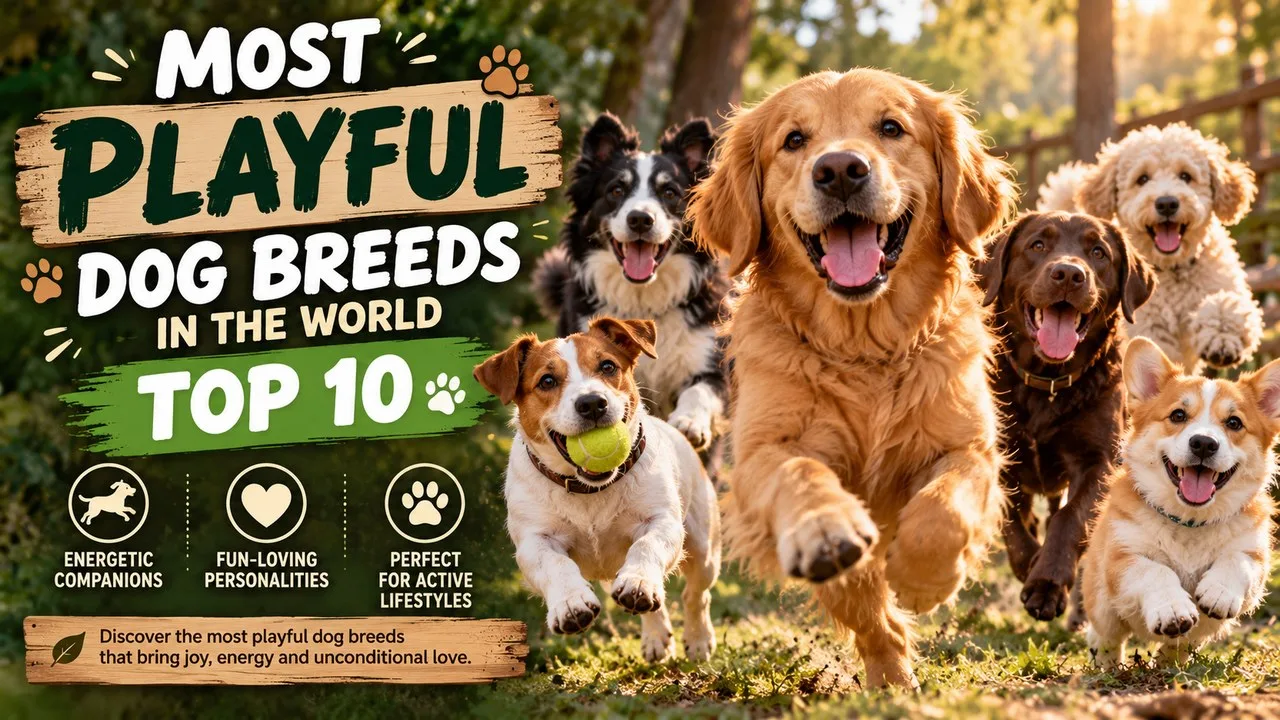
The most playful dog breeds in the world, led by the Labrador Retriever, Siberian Husky and Irish Setter, stay keen on games long after puppyhood ends.
Every puppy plays, but not every adult dog keeps asking for the ball. Some breeds settle into calm companionship by the age of two, while others will still be bringing a toy to the sofa at ten. That difference is not an accident. Many of the breeds known for lifelong playfulness were developed for jobs that rewarded stamina, curiosity and close teamwork with people, such as retrieving birds from cold water, pulling sleds, herding sheep or luring ducks within range.
This Finepedia listicle, written as of October 2026, ranks ten breeds using a published scorecard rather than personal opinion. It focuses on playful energy: how much a breed enjoys games, how much exercise it needs, and how well that enthusiasm fits a home with children or other dogs. Each entry covers the breed's origins, its typical style of play, and what living with it actually involves, so the list is as useful for choosing a dog as it is for browsing.
How We Ranked the Most Playful Dog Breeds
The American Kennel Club (AKC) rates every breed it recognises on a series of 1-to-5 traits. One of them, Playfulness Level, describes how enthusiastic about play a breed is likely to be even past puppyhood, from games of tug and fetch to general clowning. Finepedia used these ratings as the core of a simple, repeatable scorecard.
- Entry rule: only breeds with the top Playfulness rating of 5 were eligible
- Score: Playfulness plus Energy Level, Good With Young Children and Good With Other Dogs, for a maximum of 20 points
- Tiebreak: the breed's position in the AKC's 2025 popularity ranking, published in March 2026, because a more common breed is easier to find from a responsible breeder or rescue
- Shortlist: 42 breeds regularly described as playful, energetic or family-friendly were checked on their AKC pages in October 2026
- Freshness rule: the Vizsla and Weimaraner both qualified, but they already appear in Finepedia's fastest-breeds list, so they are covered under Honourable Mentions instead
Exercise guidance from the Royal Kennel Club in the United Kingdom is added to each entry as a second, independent view. Breed ratings describe tendencies, not guarantees. Individual dogs vary with genetics, training, age and health, and a well-bred dog of almost any breed can be a cheerful playmate.
Most Playful Dog Breeds at a Glance
| # | Breed | Origin | Score (of 20) | Typical play style |
|---|---|---|---|---|
| 1 | Labrador Retriever | Canada | 20 | Fetch, swimming and retrieving games |
| 2 | Siberian Husky | Siberia | 20 | Running, pulling and mischievous chasing |
| 3 | Irish Setter | Ireland | 20 | Long runs and boisterous games in open fields |
| 4 | Shetland Sheepdog | Scotland | 19 | Agility, herding games and tricks |
| 5 | Portuguese Water Dog | Portugal | 19 | Swimming, dock diving and retrieving |
| 6 | Nova Scotia Duck Tolling Retriever | Canada | 19 | Endless fetch, especially near water |
| 7 | Boston Terrier | United States | 18 | Short bursts of chasing and clowning |
| 8 | Havanese | Cuba | 18 | Indoor games, tricks and lap-to-floor zoomies |
| 9 | Russell Terrier | England and Australia | 18 | Digging, chasing and fast ball games |
| 10 | Standard Poodle | Germany and France | 17 | Water play, puzzle games and trick training |
Readers comparing dogs from other angles may also enjoy Fastest Dog Breeds in the World: Top 10, Most Hilarious Dog Breeds: Top 10, Top 10 Best Dog Breeds: Exploring Our Canine Companions and Cheapest Dog Breeds: Top 10 Affordable Dogs to Own.
1. Labrador Retriever
| Attribute | Details |
|---|---|
| Origin and AKC group | Newfoundland, Canada; Sporting Group |
| Size | 21.5 to 24.5 inches (55 to 62 cm); 55 to 80 pounds (25 to 36 kg) |
| Life expectancy | 11 to 13 years |
| Play score | 20 of 20: playfulness 5, energy 5, children 5, other dogs 5 |
| Daily exercise (Royal Kennel Club) | More than 2 hours |
Origins/History
Despite the name, the Labrador Retriever comes from Newfoundland, where St. John's water dogs worked beside fishermen, retrieving fish that came loose from the trawl lines. In the 1830s British sportsmen, including the 10th Earl of Home and the 5th Duke of Buccleuch, brought dogs of this type to Britain through ships trading with the port of Poole and refined them as gundogs.
The Kennel Club in England recognised the breed in 1903, and the AKC registered its first Labrador in 1917. Labs became America's most registered breed in 1991 and held the top spot for 31 straight years until the French Bulldog overtook them. In the AKC's 2025 ranking the Labrador sits second. Back in Newfoundland, the original population later faded away, partly because of a heavy local dog tax and British quarantine rules that cut off further exports, according to the AKC.
Key Features
- An otter-like tail that acts as a rudder in water
- Webbed paws and a short, dense, water-resistant coat
- Three recognised colours: black, yellow and chocolate
- A soft mouth that carries a ball or bird without damaging it
- A strong appetite, so food rewards work well in training but portions need watching
Significance
The Labrador tops this list because it scores the maximum on every trait in the scorecard. Its play is built around retrieving, so fetch is not just a game but an outlet for an instinct that breeders selected for over two centuries. A tired Lab is usually a calm Lab, while a bored one may chew, dig or invent its own entertainment. The same eagerness to work with people explains why the breed is one of the most widely used guide, assistance and search-and-rescue dogs in the world. Good games for a Lab include retrieving dummies from water, scent hunts for hidden toys and structured fetch with a sit before each throw, which builds self-control as well as fitness.
Interesting Facts
- The first yellow Labrador on record was born in 1899.
- Chocolate Labs were originally called liver-coloured.
- The breed standard describes the ideal temperament as kindly, outgoing and eager to please.
- The Kennel Club in England recognised the breed 14 years before the AKC did.
2. Siberian Husky
| Attribute | Details |
|---|---|
| Origin and AKC group | North-eastern Siberia; Working Group |
| Size | 20 to 23.5 inches (51 to 60 cm); 35 to 60 pounds (16 to 27 kg) |
| Life expectancy | 12 to 14 years |
| Play score | 20 of 20: playfulness 5, energy 5, children 5, other dogs 5 |
| Daily exercise (Royal Kennel Club) | More than 2 hours |
Origins/History
The Siberian Husky descends from sled dogs kept by the Chukchi people of the Chukchi Peninsula, who needed dogs that could haul light loads over huge distances in extreme cold while using very little energy. The dogs also lived close to their families, which helps explain the breed's sociable nature.
Siberian sled dogs reached Nome, Alaska, in 1908 and soon dominated races there. In 1910 a team of Siberians won the 400-mile All Alaska Sweepstakes, and dogs bred by Seppala went on to take most of the major Alaskan titles that decade. Their fame exploded in 1925 during the serum run to Nome, when about 20 mushers and some 150 dogs relayed diphtheria antitoxin 674 miles (1,085 km) in roughly five and a half days. Leonhard Seppala and his lead dog Togo covered the longest and most dangerous stretch, about 261 miles, while Gunnar Kaasen's team, led by Balto, ran the final leg into Nome. The AKC recognised the breed in 1930.
Key Features
- Erect ears, a thick double coat and a sickle-shaped, well-furred tail
- Eyes that may be brown, blue, one of each or particoloured
- A habit of howling rather than barking
- A strong urge to run, which makes off-lead recall unreliable for many Huskies
- Famous escape skills, including digging under or jumping over fences
Significance
Huskies earn their high score through tireless energy and a friendly attitude to people and other dogs. Their play tends to be physical and slightly mischievous: chasing, wrestling, racing around the garden and stealing whatever is left within reach. They are less interested in repetitive obedience games than retrievers are, which is why their AKC trainability rating is only 3. Owners who channel that drive into canicross, bikejoring or recreational sledding usually find a joyful, gentle companion. In the AKC's 2025 ranking the breed is 30th.
Interesting Facts
- A bronze statue of Balto has stood in New York's Central Park since December 1925.
- Togo's story was told in the 2019 Disney+ film Togo.
- Siberian Huskies served in an Arctic search-and-rescue unit during the Second World War.
- Exports of dogs from Siberia were halted in 1930, so the breed developed from the dogs already in North America.
3. Irish Setter
| Attribute | Details |
|---|---|
| Origin and AKC group | Ireland; Sporting Group |
| Size | 25 to 27 inches (64 to 69 cm); 60 to 70 pounds (27 to 32 kg) |
| Life expectancy | 12 to 15 years |
| Play score | 20 of 20: playfulness 5, energy 5, children 5, other dogs 5 |
| Daily exercise (Royal Kennel Club) | More than 2 hours |
Origins/History
Setters were bred to find game birds by scent and then crouch, or set, so the hunter knew where the birds were. Irish huntsmen of the 1800s wanted a fast, rangy dog that could cover open country quickly, and the result was the red setter. The breed is believed to have developed from a mix of English Setter, spaniel, pointer and Gordon Setter blood. The earliest Irish setters were often red and white, but the solid red coat became the fashion in the show ring, and the red-and-white type now survives as a separate breed, the Irish Red and White Setter.
The AKC recognised the Irish Setter in 1878, making it one of the oldest breeds in the club's stud book. Its looks made it a show-ring star almost from the start of organised dog shows in the 1870s.
Key Features
- A rich mahogany or chestnut coat with silky feathering
- Long legs and a free, ground-covering gait
- A sweet, outgoing temperament that greets strangers as friends
- Silky feathering on the ears, chest, legs and tail
- A need for space to run that a short lead walk cannot satisfy
Significance
The AKC breed standard describes the Irish Setter as having a rollicking personality, and that phrase captures its style of play: big, bouncy and joyful. Irish Setters love games that let them stretch out, such as long runs in a safe field, chasing a frisbee or joining a jogger. That exuberance can overwhelm toddlers through sheer size, even though the breed is rated highly with children. Because it was built to quarter wide fields at speed, a securely fenced space or a long training line is safer than open countryside, where an interesting scent can pull it far away. The breed rose from 85th to 73rd in the AKC's ranking between 2024 and 2025.
Interesting Facts
- Jim Kjelgaard's 1945 novel Big Red made an Irish Setter one of America's best-loved fictional dogs.
- President Richard Nixon's Irish Setter, King Timahoe, was a gift from his White House staff in 1969.
- Any black in the red coat is heavily faulted at shows.
- The English, Gordon and Irish setters are three separate breeds, not colour varieties of one breed.
4. Shetland Sheepdog
| Attribute | Details |
|---|---|
| Origin and AKC group | Shetland Islands, Scotland; Herding Group |
| Size | 13 to 16 inches (33 to 41 cm); 15 to 25 pounds (7 to 11 kg) |
| Life expectancy | 12 to 14 years |
| Play score | 19 of 20: playfulness 5, energy 4, children 5, other dogs 5 |
| Daily exercise (Royal Kennel Club) | Up to 1 hour |
Origins/History
The Shetland Sheepdog, or Sheltie, was developed on the windswept Shetland Islands, where farmers needed a small, hardy dog to herd sheep, ponies and poultry. Small size mattered: a little dog ate less in a place where food was scarce. Islanders once called the breed the Toonie dog, from a local word for farm.
The Sheltie is not simply a shrunken Rough Collie. Its ancestors were small island herding dogs, later crossed with collies from the Scottish mainland. The Kennel Club in England first recognised it in 1909 as the Shetland Collie, but objections from Collie breeders led to the name Shetland Sheepdog. The AKC registered its first Sheltie, a dog called Lord Scott, in 1911.
Key Features
- A long double coat and a mane that frames a wedge-shaped head
- Quick reflexes and tight turns inherited from herding work
- A very vocal nature, with the AKC giving it the top barking rating
- High trainability, rated 5 by the AKC
- Sensitivity to harsh handling, so gentle, reward-based training works best
Significance
The AKC lists the Sheltie's temperament as playful, energetic and bright, which makes it the only breed on this list with the word playful in its official three-word description. Shelties love games that use their brains as well as their legs: agility, herding balls, hide-and-seek and trick routines. In their size group they are consistently among the leading breeds in agility, obedience and flyball competitions. A moderate exercise need and a compact size let them fit into smaller homes than most herding breeds. Their bark is part of the package, since a Sheltie often announces the start of every game, so quiet-time training helps in shared buildings. The breed held 29th place in both 2024 and 2025.
Interesting Facts
- Shelties may try to herd running children, cats or other pets by circling them.
- The American Shetland Sheepdog Association was founded at the Westminster show in 1929.
- The original island herding dog of Shetland is now extinct there, replaced by the Border Collie.
- The English Kennel Club gave the Sheltie a classification separate from the Collie in 1914.
5. Portuguese Water Dog
| Attribute | Details |
|---|---|
| Origin and AKC group | Algarve coast, Portugal; Working Group |
| Size | 17 to 23 inches (43 to 58 cm); 35 to 60 pounds (16 to 27 kg) |
| Life expectancy | 11 to 13 years |
| Play score | 19 of 20: playfulness 5, energy 5, children 5, other dogs 4 |
| Daily exercise (Royal Kennel Club) | Up to 1 hour |
Origins/History
In Portuguese the breed is called cão de água, the dog of water. For centuries these dogs worked on fishing boats along Portugal's coast, herding fish into nets, diving for lost tackle and carrying messages between boats and shore. According to the AKC, the dogs rode trawlers from Portugal's warm Atlantic waters as far as the cold seas off Iceland. As fishing modernised, the job disappeared and the breed came close to extinction.
In the 1930s the shipping magnate Vasco Bensaude began seeking out fishermen's dogs to rebuild the breed. His stud dog Leão, who lived from 1931 to 1942, became one of the most influential ancestors of the modern breed. In the United States, 16 enthusiasts formed the Portuguese Water Dog Club of America in 1972, and the breed became a fully recognised AKC breed in January 1984.
Key Features
- Webbed feet and a strong, muscular build for swimming
- A low-shedding coat that may be curly or wavy
- Two accepted trims: the lion clip and the retriever clip
- A top AKC rating of 5 for mental stimulation needs
- A sturdy, athletic body built for long days at sea
Significance
The Portuguese Water Dog brings a working dog's stamina to play. Swimming, dock diving, retrieving toys from water and water-rescue training all suit it perfectly. It is also smart enough to get bored with repetitive games, so puzzle toys and new challenges keep it happy. The Royal Kennel Club's moderate exercise guideline understates how much mental work this breed wants. Porties are still used in water-rescue work, and for many of them a swim is the most satisfying outlet of all. The breed ranked 43rd in the AKC's 2025 list.
Interesting Facts
- President Barack Obama's family owned two Portuguese Water Dogs, Bo and Sunny.
- Bo, a gift from Senator Ted Kennedy, arrived at the White House in April 2009, and Sunny joined him in August 2013.
- The lion clip once kept the dog's chest warm while leaving the hindquarters free for swimming.
- Low shedding helps some allergy sufferers, but no dog is completely allergen-free.
6. Nova Scotia Duck Tolling Retriever
| Attribute | Details |
|---|---|
| Origin and AKC group | Yarmouth County, Nova Scotia, Canada; Sporting Group |
| Size | 17 to 21 inches (43 to 53 cm); 35 to 50 pounds (16 to 23 kg) |
| Life expectancy | 12 to 14 years |
| Play score | 19 of 20: playfulness 5, energy 5, children 5, other dogs 4 |
| Daily exercise (Royal Kennel Club) | Up to 1 hour |
Origins/History
The Toller is the only breed on this list whose actual job is to play. It was developed in the 19th century around Little River Harbour in Yarmouth County, Nova Scotia, where hunters used it to toll, or lure, ducks. The dog frolics and fetches along the shoreline, and curious waterfowl swim closer to watch, much as they are drawn to a fox. Once the birds are in range, the Toller retrieves them from the water. Its exact ancestry is unknown, but spaniel, setter, retriever and farm collie types, and possibly the extinct St. John's water dog, are thought to have gone into the mix.
The Canadian Kennel Club recognised the breed in 1945, and Nova Scotia named it the provincial dog in 1995. The AKC admitted it in 2003 as its 150th breed. Only one other living breed, the Dutch Kooikerhondje, specialises in the same fox-like decoy technique.
Key Features
- The smallest of all the retriever breeds
- A red or orange coat, often with white markings, that resembles a fox
- A feathered tail that waves constantly during play
- A high-pitched, excited cry known as the toller scream
- An almost obsessive love of retrieving balls, sticks and toys
Significance
Tollers bring full commitment to everything. Breed experts quoted by the AKC say they throw themselves completely into whatever they do, whether that is chasing a ball, breaking ice to reach a bird or curling up on the couch. That intensity makes them superb partners for active owners who enjoy fetch, flyball, dock diving or agility. For quieter homes, the same drive can turn into restlessness. Because its hunting role depends on visible, animated play, the Toller's love of games is not a side effect of breeding but the point of it. The breed ranked 69th in the AKC's 2025 list.
Interesting Facts
- The word toll comes from a Middle English word meaning to lure or summon.
- At 35 characters including spaces, it was the longest breed name in the AKC stud book when admitted.
- Tollers are often mistaken for small Golden Retrievers.
- The breed was once called the Little River Duck Dog.
7. Boston Terrier
| Attribute | Details |
|---|---|
| Origin and AKC group | Boston, United States; Non-Sporting Group |
| Size | 12 to 25 pounds (5 to 11 kg), shown in three weight classes |
| Life expectancy | 11 to 13 years |
| Play score | 18 of 20: playfulness 5, energy 4, children 5, other dogs 4 |
| Daily exercise (Royal Kennel Club) | Up to 1 hour |
Origins/History
The Boston Terrier is one of the few breeds developed in the United States. Its founding dog, known as Hooper's Judge, was a Bulldog and white English Terrier cross bought around 1870 by Robert C. Hooper of Boston. Judge was bred to a small white female called Gyp. A breed historian described Judge as a strongly built dog of about 32 pounds, noticeably heavier than most modern Bostons. Over the following decades breeders reduced the size and softened the temperament of the old fighting type into a friendly companion.
Early fans called the breed the Round Head and later the American Bull Terrier. After objections from Bulldog and Bull Terrier breeders, the name was changed to Boston Terrier in 1891, and the AKC accepted the breed in 1893.
Key Features
- Tuxedo-like black, brindle or seal and white markings
- Large, round eyes and a short, square muzzle
- Short bursts of energy rather than long endurance
- A low barking rating of 2 from the AKC
- A flat-faced build that makes it sensitive to heat during play
Significance
The AKC sums up the Boston as friendly, bright and amusing, and its play reflects that: quick sprints around the living room, enthusiastic chasing games and plenty of clowning for attention. It suits city homes well, and the Royal Kennel Club lists a flat or apartment as suitable. Because the breed is brachycephalic, owners should keep games short in hot weather and watch for heavy breathing. Many Bostons enjoy fetch with soft toys, gentle tug and simple tricks, and their small size means a hallway or courtyard can host a real game. The breed has held 23rd place in the AKC ranking since 2023.
Interesting Facts
- The breed's markings and manners earned it the nickname the American Gentleman.
- Boston University has used a Boston Terrier named Rhett as its mascot since 1922.
- Massachusetts named the Boston Terrier its official state dog in 1979.
- Boston Terriers have very short tails, usually no longer than about 2 inches.
8. Havanese
| Attribute | Details |
|---|---|
| Origin and AKC group | Cuba; Toy Group |
| Size | 8.5 to 11.5 inches (22 to 29 cm); 7 to 13 pounds (3 to 6 kg) |
| Life expectancy | 14 to 16 years |
| Play score | 18 of 20: playfulness 5, energy 3, children 5, other dogs 5 |
| Daily exercise (Royal Kennel Club) | Up to 30 minutes |
Origins/History
The Havanese belongs to the bichon family of small companion dogs and is the national dog of Cuba. Its ancestors probably arrived with Spanish settlers and traders, and the island's aristocrats and wealthy planters prized the little dogs for centuries. The breed was once known as the Blanquito de la Habana, the little white dog of Havana.
The Cuban Revolution of 1959 nearly ended the breed in its homeland. Some families who fled to the United States brought dogs with them, and American breeders later rebuilt the breed from a very small population. During roughly three centuries in Cuba, the breed was refined, perhaps with Poodle crosses, into the dog known today. The AKC recognised it in 1996.
Key Features
- A long, silky coat that insulates against both sun and heat
- A springy, bouncy gait that matches its cheerful nature
- A small size that makes indoor games practical
- High sociability with children, strangers and other dogs
- A coat accepted in a wide range of colours
Significance
The Havanese shows that playful does not have to mean high exercise. Its AKC energy rating is a moderate 3 and the Royal Kennel Club suggests up to 30 minutes of daily exercise, yet it still earns the top playfulness score. The AKC even includes the word funny in the breed's temperament. Havanese love fetch in a hallway, learning tricks and short bursts of zoomies, which makes them a good fit for apartments, older owners and families with children who will play gently. The Royal Kennel Club advises brushing the coat every day, so grooming time is part of the commitment. The breed has held 25th place in the AKC ranking since 2023.
Interesting Facts
- Ernest Hemingway kept Havanese during his years in Cuba, according to the AKC.
- Charles Dickens is said to have owned a Havanese named Tim.
- The Havanese is often described as Cuba's only native breed.
- The same name is used for one dog or many: one Havanese, two Havanese.
9. Russell Terrier
| Attribute | Details |
|---|---|
| Origin and AKC group | Originated in England, developed in Australia; Terrier Group |
| Size | 10 to 12 inches (25 to 30 cm); 9 to 15 pounds (4 to 7 kg) |
| Life expectancy | 12 to 14 years |
| Play score | 18 of 20: playfulness 5, energy 5, children 3, other dogs 5 |
| Daily exercise (Royal Kennel Club, as Jack Russell Terrier) | Up to 1 hour |
Origins/History
The Russell Terrier traces back to the fox-working terriers kept by the Reverend John Russell, the so-called Sporting Parson, in mid-1800s England. His dogs needed to run with the hounds and then go underground to bolt a fox. Over time, two types emerged: a taller, square dog and a shorter, slightly longer-bodied one.
The shorter type was standardised in Australia and is known in most of the world as the Jack Russell Terrier. In the United States, where that name was already in use for another type, the AKC calls it the Russell Terrier and recognised it in 2012 as its 175th breed. The taller type is a separate AKC breed, the Parson Russell Terrier.
Key Features
- A compact, rectangular body slightly longer than it is tall
- Smooth, broken or rough white coats with tan or black markings
- A top AKC rating of 5 for mental stimulation needs
- A powerful instinct to dig and chase small animals
- Surprising jumping and climbing ability for its size
Significance
The Russell Terrier packs one of the highest energy ratings into one of the smallest bodies on this list. Its idea of fun is fast and intense: chasing balls, tug, digging pits and earthdog trials that let it hunt through tunnels. Its lower rating with young children reflects a low tolerance for rough handling rather than any lack of affection. Owners who provide daily games and secure fencing get a bold, funny companion. The Royal Kennel Club lists the breed as suitable for a flat, but its exercise and mental needs matter far more than the size of the home. The breed climbed from 66th to 60th in the AKC's ranking in 2025.
Interesting Facts
- The AKC describes the breed as the ultimate working earth terrier, never bred for the show bench.
- The name Jack Russell was never one single breed; it was a general name for white working terriers.
- The Jack Russell Terrier Club of Australia was formed in 1972.
- The AKC rates the breed 5 for energy but 3 for trainability, so patient, game-based training works best.
10. Standard Poodle
| Attribute | Details |
|---|---|
| Origin and AKC group | Germany, refined in France; Non-Sporting Group |
| Size | Over 15 inches (38 cm); 40 to 70 pounds (18 to 32 kg) |
| Life expectancy | 10 to 18 years |
| Play score | 17 of 20: playfulness 5, energy 4, children 5, other dogs 3 |
| Daily exercise (Royal Kennel Club) | Up to 1 hour |
Origins/History
The Poodle began as a duck-retrieving water dog in Germany, and its name comes from the Low German word puddeln, meaning to splash. In France, where it is the national dog, it is called the Caniche, from a word for duck. The Standard is the original size, and the Miniature and Toy varieties were bred down from it later.
The famous show clip had a practical purpose. Hunters shaved the legs, neck and tail for easier swimming but left hair over the chest and joints for warmth. Poodles later became favourites of European nobility and the circus, and their sharp noses were even used to find truffles. The AKC first recognised the breed in 1887, and the Standard and Miniature varieties remain eligible for AKC retriever and spaniel hunting tests, a reminder of the breed's working past.
Key Features
- A dense, curly, low-shedding coat that needs regular grooming
- Excellent swimming ability and a natural retrieving instinct
- A top AKC rating of 5 for trainability and mental stimulation needs
- An athletic, elegant build behind the fancy haircut
- An active, proud temperament, in the AKC's own description
Significance
The Standard Poodle takes the tenth spot through the tiebreak, as the most popular breed among several on 17 points. Its play is clever rather than wild: water retrieves, puzzle feeders, scent games and long trick routines. In his 1994 book The Intelligence of Dogs, psychologist Stanley Coren ranked the Poodle second for working and obedience intelligence, and that brain needs a job. The AKC counts all three Poodle varieties together in its rankings, where the Poodle was sixth in 2025. The Royal Kennel Club advises daily grooming, and even owners who prefer a short, practical trim need regular professional clipping.
Interesting Facts
- There is no separate French Poodle breed; the breed is simply the Poodle.
- The round tufts left on the legs and tail are called pompons.
- Poodles have won Best in Show at Westminster many times, starting with Nunsoe Duc de la Terrace in 1935.
- Circus Poodles were once trained to perform comedy acts and tightrope tricks.
Playful Breeds Compared: Exercise and Family Fit
| Breed | Size | RKC daily exercise | Best play outlet | Good first dog? |
|---|---|---|---|---|
| Labrador Retriever | Large | More than 2 hours | Fetch and swimming | Yes, with training |
| Siberian Husky | Medium-large | More than 2 hours | Running and pulling sports | Better for experienced owners |
| Irish Setter | Large | More than 2 hours | Off-lead running in safe areas | Yes, for very active homes |
| Shetland Sheepdog | Small | Up to 1 hour | Agility and tricks | Yes |
| Portuguese Water Dog | Medium | Up to 1 hour | Water work and puzzles | Yes, for active homes |
| Nova Scotia Duck Tolling Retriever | Medium | Up to 1 hour | Retrieving and flyball | Yes, for active homes |
| Boston Terrier | Small | Up to 1 hour | Short indoor and garden games | Yes |
| Havanese | Small | Up to 30 minutes | Indoor fetch and tricks | Yes |
| Russell Terrier | Small | Up to 1 hour | Ball games and digging | Better for experienced owners |
| Standard Poodle | Medium | Up to 1 hour | Water retrieves and scent games | Yes |
The comparison shows that playfulness and exercise need are not the same thing. The Labrador, Husky and Irish Setter combine both, while the Havanese and Boston Terrier deliver plenty of fun with far less mileage.
Honourable Mentions
Several breeds also earned the top playfulness rating but missed the final ten on score, tiebreak or the freshness rule.
- Vizsla, 19 points: the Hungarian pointer is affectionate, gentle and almost always on the move. It is profiled in Finepedia's fastest-breeds list.
- Weimaraner, 18 points: the Gray Ghost needs serious exercise and loves to be with its people. It also appears in the fastest-breeds list.
- Pug, 17 points: a charming, mischievous toy dog whose play is short and comic, with care needed in heat.
- Papillon, 17 points: the Butterfly Dog is one of the most athletic and trainable toy breeds.
- Samoyed, 17 points: the Smiling Dog is friendly and adaptable, and was bred to haul sledges across Siberia.
- Border Collie, 16 points: perhaps the keenest working mind of all, though its ratings with young children and other dogs are moderate.
Popular Playful Breeds That Scored a 4
Some breeds that many people think of as the most playful, including the Boxer, Golden Retriever, Australian Shepherd, Brittany, English Springer Spaniel, Pembroke Welsh Corgi and Dalmatian, receive a Playfulness rating of 4 from the AKC. That is still a high rating, and many individual dogs of these breeds are tireless playmates. They miss this list only because the scorecard requires the maximum score of 5.
- Boxer: active, bright and fun-loving, with the top rating of 5 for young children
- Golden Retriever: devoted and gentle, with a lower energy rating than the Labrador
- Australian Shepherd: exuberant and work-oriented, with a top energy rating of 5
- English Springer Spaniel: friendly, playful and obedient, according to its AKC temperament
How to Keep a Playful Dog Happy
Playful breeds are wonderful companions, but their energy has to go somewhere. Without enough exercise and mental work, many of them invent their own games, which can include chewing furniture, digging or barking.
- Match the breed to your routine before you buy or adopt
- Mix physical play with brain games such as scent work, puzzle feeders and trick training
- Keep fetch and running sessions shorter for growing puppies to protect developing joints
- Watch flat-faced breeds like the Boston Terrier and Pug for overheating in warm weather
- Use secure fencing for escape-prone breeds such as the Siberian Husky and Russell Terrier
- Join a club for agility, flyball, dock diving or canicross to give high-drive dogs a real outlet
Frequently Asked Questions
What is the most playful dog breed?
On Finepedia's scorecard, the Labrador Retriever ranks first, tied on a maximum 20 points with the Siberian Husky and Irish Setter and placed ahead of them as the more popular breed. All three receive the AKC's top rating for playfulness, energy and friendliness towards children and other dogs, so any of them suits an active, sociable home.
Which small dog breeds are the most playful?
The Havanese, Boston Terrier, Russell Terrier and Shetland Sheepdog are the small breeds in this top ten, and all have the AKC's highest playfulness rating. The Papillon and Pug, both in the Honourable Mentions, also score 5. Small playful breeds still need daily games and training, even if their exercise needs are lower.
Are playful dog breeds good with children?
Most breeds on this list score 5 out of 5 with young children on the AKC scale, including the Labrador, Husky, Irish Setter, Sheltie and Havanese. The Russell Terrier scores 3 because it may not tolerate rough handling. Whatever the breed, adults should supervise play and teach children to respect a dog's space.
Do playful dogs need a lot of exercise?
Not always. The Labrador, Husky and Irish Setter need more than two hours of daily exercise, according to the Royal Kennel Club, but the Havanese needs up to about 30 minutes. Playfulness describes a dog's enthusiasm for games, while energy and exercise needs describe how much activity it requires to stay calm.
Why do some dogs stay playful as adults?
Many playful breeds were developed for cooperative jobs such as retrieving, herding or sled pulling, where enthusiasm and focus on people were valuable. Breeders kept selecting dogs that stayed eager and responsive, so adult dogs of these breeds often keep the play drive that other breeds lose after puppyhood.
Is a Jack Russell Terrier the same as a Russell Terrier?
Mostly, yes. The dog known internationally as the Jack Russell Terrier is called the Russell Terrier by the AKC, which recognised it in 2012. The taller, squarer type is a separate breed, the Parson Russell Terrier. Both descend from the fox-working terriers of the Reverend John Russell in 19th-century England.
Conclusion
The most playful dog breeds in the world share one thing: an enthusiasm for games that lasts well beyond puppyhood. The Labrador Retriever, Siberian Husky and Irish Setter lead this list with perfect scores, while breeds such as the Havanese and Boston Terrier prove that a playful dog does not have to need hours of running. Before choosing one, think honestly about how much time you have for exercise, training and mental challenges. Matched with the right home, any of these ten breeds will turn ordinary days into a steady stream of fetch, zoomies and happy chaos.
- American Kennel Club breed pages for trait ratings, sizes, history and temperament (accessed October 2026): https://www.akc.org/dog-breeds/
- American Kennel Club, Most Popular Dog Breeds of 2025: https://www.akc.org/expert-advice/news/most-popular-dog-breeds-2025/
- Royal Kennel Club, Breeds A to Z (exercise and home guidance): https://www.royalkennelclub.com/search/breeds-a-to-z/
- Wikipedia, 1925 serum run to Nome (cross-checked figures): https://en.wikipedia.org/wiki/1925_serum_run_to_Nome
- Wikipedia, Labrador Retriever, Shetland Sheepdog, Portuguese Water Dog, Nova Scotia Duck Tolling Retriever, Boston Terrier, Havanese, Russell Terrier and Poodle (cross-checked dates): https://en.wikipedia.org/wiki/List_of_dog_breeds
- Reference topic prompt: https://10mosttoday.com/10-most-playful-dog-breeds-in-the-world/


















Log in with