






 By
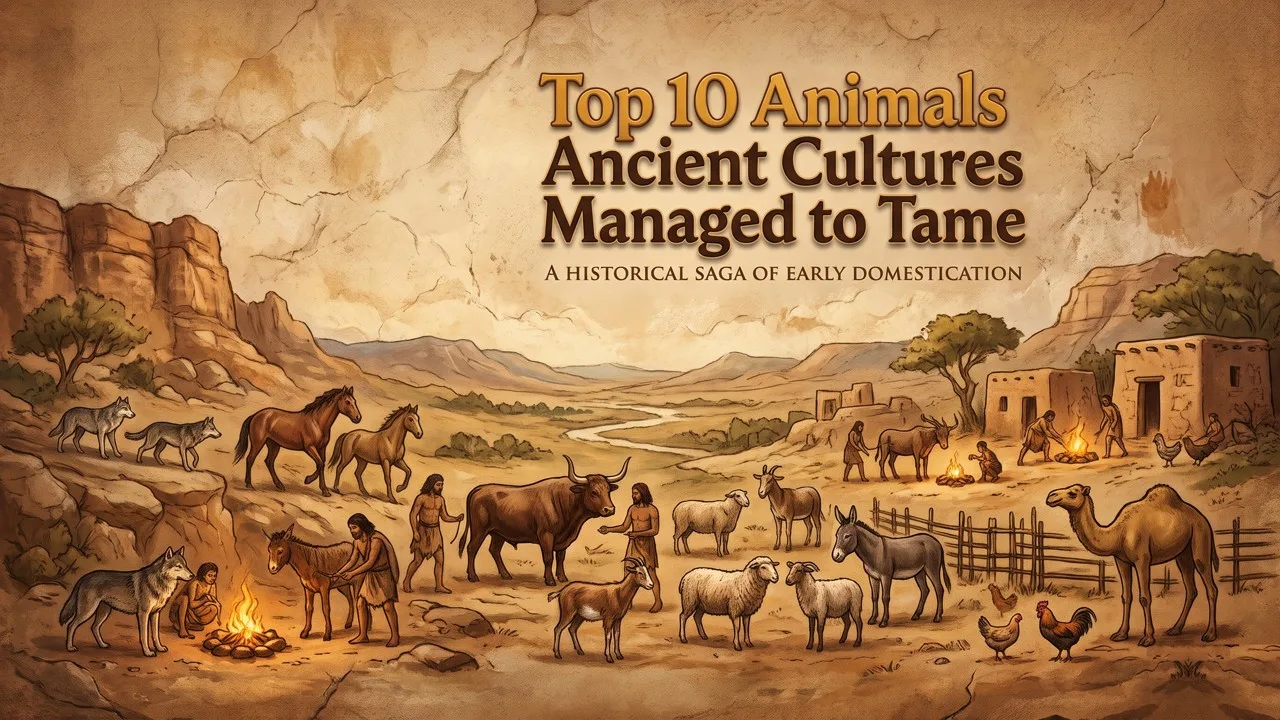
Ancient societies did not only keep dogs, cattle and horses. They also trained cheetahs, eagles, cormorants, and, in one coastal culture, a woolly dog. Domestication, in the strict sense, means a breeding population changed by people over many generations. Taming is narrower: a living animal is made tractable, perhaps even trained to hunt or to work, without the whole species becoming a farm animal [1][6]. This list keeps that distinction. Llamas and turkeys were domesticated. Cheetahs, war elephants, and golden eagles were, with important limits, tamed and used.
The ten cases below are documented in texts, images, bones, or, in the Coast Salish case, in genetics and oral and museum history. A few popular versions run ahead of the evidence, especially for Egyptian baboons and for Greek "weasels," and those entries say so.
Key Facts
Domestication is a population process. Taming is an individual or working relationship. Several animals on this list were never fully domesticated.
Ten Tamed or Domesticated Animals at a Glance
| Rank | Animal | Culture | Domesticated or tamed? | What people used it for |
|---|---|---|---|---|
| 1 | Turkey | Mesoamerica, including the Aztecs | Domesticated | Meat, feathers, and ritual |
| 2 | Llama | Andean societies, including the Inca | Domesticated | Transport, fiber, and meat |
| 3 | Salish wool dog | Coast Salish, Pacific Northwest | A kept, breeding dog, now gone as a type | Wool for blankets |
| 4 | Cheetah | Mughal India, and earlier courts | Tamed, not a domestic breeding stock | Hunting |
| 5 | War elephant | Carthage and other ancient armies | Captured and trained | War and display |
| 6 | Cormorant | China, and later other East Asian fisheries | Tamed working birds | Fishing |
| 7 | Golden eagle | Steppe peoples, including later Mongol and Kazakh traditions | Tamed hunting birds | Hunting with a raptor |
| 8 | Dormouse | Ancient Rome | Raised in confinement | Food |
| 9 | Baboon | Ancient Egypt | Kept and, in some cases, trained | Ritual, display, and possibly some tasks |
| 10 | Weasel or polecat-type animal | Ancient Greece and neighbors | Kept as a mouser, evidence mixed | Pest control |
1. The Mesoamerican Turkey
The turkey, Meleagris gallopavo, was domesticated in Mesoamerica well before the Spanish arrived, and it was an important bird in Aztec and earlier economies for meat, feathers, and ceremony [1]. A second, smaller domestication of the ocellated turkey has also been discussed in the archaeological literature, but the familiar domestic turkey is the Mexican and southwestern bird that later went to Europe and then around the world [1].
This is one of the cleanest entries on the list. The turkey is a true domesticate, not only a tamed wild animal, and the cultural setting is not a footnote to a later Thanksgiving story. When Aztec households and markets dealt in turkeys, they were dealing in an already ancient Mesoamerican achievement [1].
2. The Andean Llama
The llama, a South American camelid, was domesticated in the Andes thousands of years ago and became the Inca state's essential pack animal, as well as a source of fiber, hide, and meat [2]. Unlike horses, llamas were never a cavalry animal; they are mild and sure-footed, and they made long-distance transport possible in high country where wheeled vehicles were not the local solution [2]. Alpacas, a related domesticate, were bred more for fiber.
The llama is easy to treat as scenery in a mountain photograph. In Andean history it is infrastructure. A political system that moved goods on a road network without horses was not short of a working animal; it had a different one, domesticated on the spot [2].
Related: Top 10 Facts About Dogs
3. The Coast Salish Wool Dog
Coast Salish peoples of the Pacific Northwest kept a type of small, white, woolly dog whose hair was shorn and woven, often with goat wool and plant fibers, into blankets and other textiles [3]. The dogs were a managed breeding population, carefully kept from mixing with ordinary village dogs, and the tradition is recorded in oral history, early written accounts, and surviving textiles [3]. In 2023, a genetic study of a museum specimen helped confirm that the wool dog was a distinct lineage, now gone as a living type after the trade in machine-made blankets and other colonial disruptions [3].
This is domestication, or something very close to it, aimed at fiber rather than at herding or hunting. It is also a reminder that "the" dog is many dogs, and that some of the most interesting ones never became global breeds.
4. Mughal Hunting Cheetahs
Cheetahs have been kept for coursing game in parts of Asia and the Middle East for centuries. In Mughal India the practice is especially well recorded: emperors, including Akbar, kept large numbers of tame cheetahs for the hunt, and paintings and texts show hooded, collared animals taken out on litters or on horseback [4]. Cheetahs, unlike dogs or horses, breed poorly in older captive systems, so the courts usually relied on animals caught from the wild and then tamed [4].
That is why the cheetah is a taming story, not a domestication story. The working relationship was real and could last for years. The breeding population in the wild paid the cost, and the Asiatic cheetah later declined toward disappearance in India. The Mughal hunt is documented court culture, and it should be read with that ecological ending in view.
5. Carthaginian and Other War Elephants
Ancient Mediterranean and Asian armies used elephants in war. Carthage is the example most often remembered in the West, because Hannibal took elephants across the Alps in 218 BCE, but the practice was wider: Hellenistic kings, Indian armies, and later Roman opponents all fielded trained elephants [5]. The animals were captured and schooled, not bred as a full domestic species in the way cattle were. They carried towers or drivers, broke infantry lines, and sometimes panicked and did as much damage to their own side as to the enemy [5].
Related: Top 10 Most Bizarre Phobias: Strange Fears That Exist
The entry is about training and use, not about a battle narrative. A war elephant was a tamed wild animal at the edge of what a handler could control. That edge is part of the historical record, and it is one reason the weapon was impressive and unreliable at the same time.
6. Chinese Cormorant Fishing
In parts of China, and in some neighboring traditions, fishermen have long used trained cormorants to catch fish. A snare or collar around the bird's neck, in the classic arrangement, stops it from swallowing larger fish, which the fisher then takes [6]. The practice is still demonstrated in a few places as a cultural survival, even where it is no longer an everyday commercial method [6]. It is documented in older Chinese sources and in later ethnography, so it is not a tourist invention, even if tourism now keeps some of it visible.
The cormorant is a tamed working bird. It is not a domesticate in the cattle sense. The skill sits in the relationship between a fisher and a wild species that can be trained, year after year, to hunt in partnership.
7. Golden Eagles on the Steppe
Hunting with golden eagles is a living tradition among some Kazakh and Kyrgyz communities, and it has deeper steppe roots that later writers have often linked, broadly, to Mongol and other Inner Asian practices [7]. A trained eagle is taken on the arm or on a horse, released at foxes or other game, and then recalled. The bird is a wild or recently taken raptor, not a barnyard species, and the training is demanding for both the bird and the hunter [7].
Using "the Mongols" as a single label over-simplifies a set of Inner Asian hunting cultures. The solid fact is that people on the steppe have long flown golden eagles at game, and that the tradition is historically attested as well as still practiced in places today [7]. It is among the most spectacular forms of taming on this list, and among the best documented in later photography and ethnography.
Related: Top 10 Oldest Buildings in the World
8. Roman Dormice
Romans raised the edible dormouse, Glis glis, in special containers called gliraria and fattened the animals as a food, including as a dinner-party dish [8]. This is not companionship in the modern pet sense. It is close confinement and feeding, a form of small-scale husbandry that the agricultural writer Varro and later sources describe clearly enough to be unambiguous [8].
The dormouse therefore sits on the border between taming and farming. The species was not turned into a global domesticate, but it was, in a Roman villa economy, a managed animal. The surprising part, for a modern reader, is not that Romans ate unusual foods. It is that they built equipment specifically to raise a wild rodent for the table.
9. Egyptian Baboons
Ancient Egyptians kept hamadryas baboons and depicted them in tombs and temples, sometimes in connection with the god Thoth, sometimes as imported or valued animals in elite settings [9]. Some images and later discussions have suggested trained animals, including baboons in fruit-picking or other task scenes, but the evidence for systematic working roles is thinner than the evidence that baboons were present, transported, and symbolically important [9]. Recent archaeological science has also traced some sacred baboons to distant sources, which underlines how much effort went into obtaining them.
This entry is therefore cautious. Egyptians did keep baboons. They may have tamed some individuals. They did not, on present evidence, found a domestic baboon in the llama or turkey sense. The honest surprising fact is the investment in a difficult, dangerous primate, not a completed story of a working species.
Related: 10 Sikh Gurus: The Pillars of Sikhism Who Shaped Faith, Equality, Courage, and Humanity
10. Greek and Neighbors' Mousers
Before the house cat was common in every Mediterranean household, people in the Greek world and nearby regions kept small carnivores to control mice. Classical references and later scholarship have pointed to weasels or polecat-like animals, and the exact species is not always clear from the words used in the texts [10]. Ferrets, which are domesticated polecats, have a later, better-documented European history as hunting and mousing animals; reading that later history straight back onto every Greek mention would be too neat [10].
The cautious conclusion is still worth having. Ancient households needed a mouser, the cat's later dominance was not inevitable at every date, and a weasel or polecat-type animal is a serious candidate in the Greek evidence. "The ancient Greeks tamed weasels" is a fair headline only if the uncertainty about names and species stays in the paragraph.
Conclusion
A short list of "animals people have always kept" usually names the dog, the sheep, and the horse, and then stops. The record is wider. Some species, such as the turkey, the llama, and the Coast Salish wool dog, were truly domesticated for meat, transport, or fiber. Others, such as the cheetah, the war elephant, the cormorant, and the golden eagle, were tamed for the hunt, for war, or for work, without becoming farm animals. Roman dormice, Egyptian baboons, and Greek mousers sit in between, in practices that are documented but not always easy to classify.
The useful distinction is still the first one. To tame an animal is to change a life. To domesticate a species is to change a lineage. Ancient cultures did both, and they did not do them only with the animals that later filled textbooks.
- ^ [1] "Domestic turkey" and "Turkey (bird)." Wikipedia. Wikipedia: Domestic turkey
- ^ [2] "Llama." Wikipedia. Wikipedia: Llama
- ^ [3] "Salish Wool Dog." Wikipedia, including later genetic work on museum specimens. Wikipedia: Salish Wool Dog
- ^ [4] "Cheetah" and historical hunting with tame cheetahs, including Mughal practice. Wikipedia. Wikipedia: Cheetah
- ^ [5] "War elephant." Wikipedia. Wikipedia: War elephant
- ^ [6] "Cormorant fishing." Wikipedia. Wikipedia: Cormorant fishing
- ^ [7] "Golden eagle" and "Eagle hunting." Wikipedia. Wikipedia: Eagle hunting
- ^ [8] "Edible dormouse" and Roman gliraria. Wikipedia. Wikipedia: Edible dormouse
- ^ [9] "Hamadryas baboon" and scholarship on baboons in ancient Egypt. Wikipedia. Wikipedia: Hamadryas baboon
- ^ [10] "Ferreting," "Least weasel," and classical references to household mousers. Wikipedia. Wikipedia: Ferreting




















Discussion
Log in with