






 By
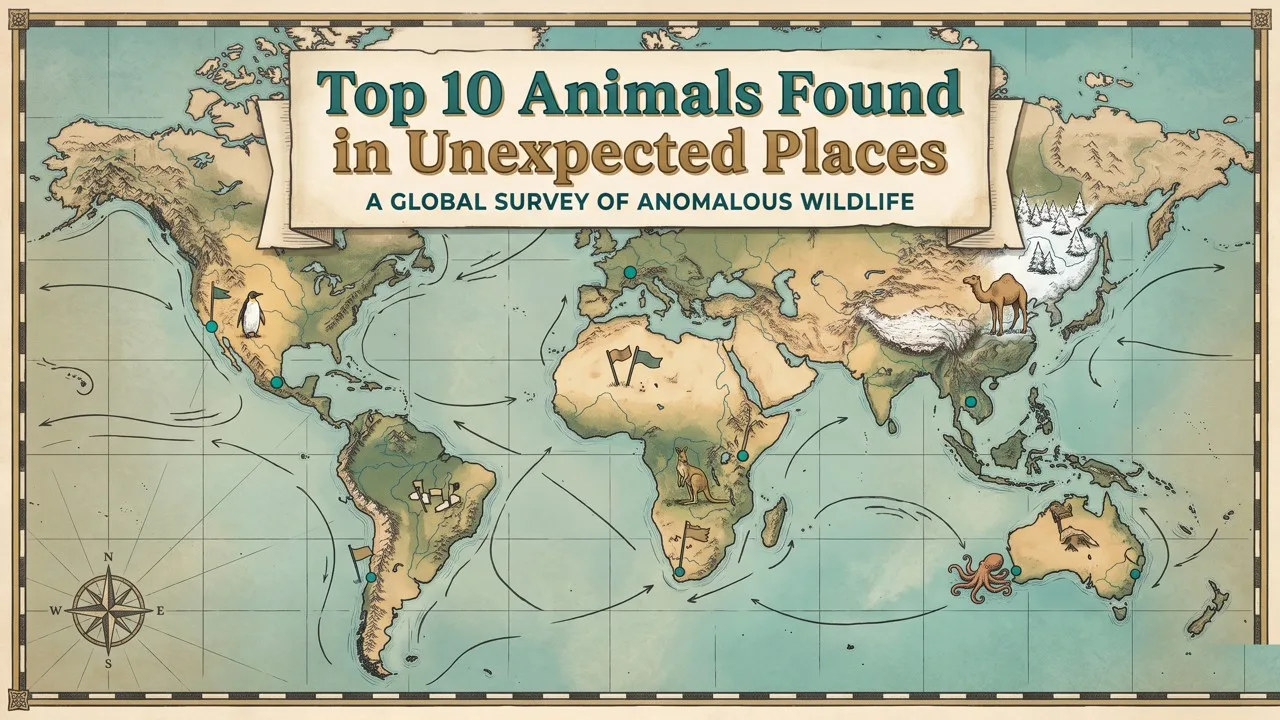
A lab fish, a market isopod, a parking-lot tardigrade and a borewell on a video: ten animals turned up in places no one expected to find a new species. Some were in museum drawers or laboratory tanks for years before anyone realized they were undescribed [1][6]. Some were collected in cemeteries, airports, or a supermarket crate. This list is a curated set of ten documented cases, each tied to a paper or a standard historical record, not to an unverified anecdote.
Three colourful claims that could not be independently confirmed here — a lizard by a runway, a cave cricket in man-made tunnels, and a tropical moth in a Welsh living room — are replaced by better-sourced discoveries in unexpected places: the first megamouth shark, caught in a ship's sea anchor; the mosquito that breeds in the London Underground; and the coelacanth that appeared in a South African fish catch [7][8][9].
Key Facts
A species can be new to science and still familiar to local fishers, or it can sit mislabelled in a collection. "Unexpected place" here means the setting of the find, not a judgment about whose landscape counts as scientific.
Ten Unexpected Finds at a Glance
| Rank | Animal | Where it turned up | Why the place was unexpected |
|---|---|---|---|
| 1 | Danionella cerebrum | Neuroscience laboratories, later recognized as a new species | It had been studied under the wrong name |
| 2 | Bathynomus vaderi | Vietnamese seafood markets | A giant isopod arrived as food, then as a described species |
| 3 | Indotyphlops laca | Nicolau Lobato International Airport, Dili | A blind snake at an airport |
| 4 | Vaejovis castanoae | A cemetery in Michoacán, Mexico | A new scorpion from graveyard habitat |
| 5 | Macrobiotus shonaicus | Parking-lot moss in Tsuruoka, Japan | A tardigrade in an ordinary urban sample |
| 6 | Megachasma pelagios | A U.S. Navy ship's sea anchor, off Hawaii, 1976 | The first megamouth shark was an accidental catch |
| 7 | The olinguito, Bassaricyon neblina | Museum drawers, and a misidentified zoo animal | A new mammal hiding in collections |
| 8 | Culex molestus in the London Underground | Subway tunnels | A mosquito population adapted to a man-made underground |
| 9 | The coelacanth, Latimeria chalumnae | A fish-market catch, East London, 1938 | A "living fossil" arrived with the day's fish |
| 10 | Gangaichthys indonepalicus | A borewell, seen first in a 2024 video | A new fish documented after a clip circulated online |
1. A Lab Fish with the Wrong Name
Danionella cerebrum is a tiny, almost transparent freshwater fish that became valuable to neuroscientists because its head is clear enough for imaging, and because it is one of the smallest known vertebrates [1]. For years, laboratory stocks were treated as Danionella translucida, a related species. In 2021, Ralf Britz and colleagues formally described D. cerebrum as distinct, after comparing morphology and genetics and showing that the widely used lab fish was not the species people thought they had [1].
The unexpected place, in this case, was not a jungle. It was the rack of a laboratory, where an animal can be handled daily and still be misidentified. The paper is a warning about captive lineages and a reminder that "new to science" sometimes means "new to the label on the tank."
2. A Giant Isopod Sold as Seafood
Bathynomus vaderi, a giant deep-sea isopod, was described in 2025 from specimens associated with Vietnamese seafood trade, a path that has become familiar in modern taxonomy: unusual animals arrive at markets and docks before they arrive in a formal description [2]. The species name nods to a film villain's helmet-like head, which is a nomenclatural choice, not a claim about the animal's life. What matters for this list is the setting. A large crustacean from deep water was being handled as food.
Market specimens are a real, if unromantic, way to find new species, especially when fisheries reach depths or grounds that scientists sample less often. The risk is obvious — locality data can be messy — and the papers have to be careful about origin. The opportunity is obvious too: the crate is a collection.
Related: Top 10 Animals That Can Live Without Food for Months
3. A Blind Snake at an Airport
Indotyphlops laca, a small blind snake, was described from specimens collected at Nicolau Lobato International Airport in Dili, Timor-Leste, in a paper in the Canadian Journal of Zoology [3]. Blind snakes are easily missed: they are small, fossorial, and look, to a hurried eye, like worms. An airport, with its landscaped soil, cargo, and disturbed ground, is not the place most field guides tell a herpetologist to begin, which is precisely why the find belongs here.
Whether the animal is native, recently arrived, or associated with transported soil is a question papers of this kind have to ask. The documented fact is already enough. A new snake can be described from the edge of a runway district, in a national capital, in soil that thousands of travellers pass every day.
4. A Scorpion from a Cemetery
Vaejovis castanoae was described in 2024 in the journal Dugesiana, from a cemetery locality in Michoacán, Mexico [4]. Cemeteries can be, biologically, patches of less-disturbed or differently disturbed ground in a settled landscape, and they are also places taxonomists actually walk. A new scorpion from such a site is unexpected only if one assumes that new species live exclusively in remote forest.
The paper is a straightforward taxonomic description, not a gothic tale. The habitat is named because that is where the specimens were found. Science does not need a more theatrical explanation than that.
5. A Tardigrade in a Parking Lot
Macrobiotus shonaicus, a tardigrade, or "water bear," was described in 2018 from moss collected in a parking lot in Tsuruoka, Japan, in a PLOS ONE paper by Daniel Stec, Kazuharu Arakawa, and Åukasz Michalczyk [5]. Tardigrades are famous for extreme resistance in the laboratory; they are also common in ordinary moss and lichen if someone bothers to soak and look. The surprise was not that a tardigrade lived in a city. It was that an undescribed species was sitting in a sample so unromantic it could have been collected on the way to work [5].
Related: Top 10 Extraordinary Lizards of the World
Urban microfauna are still under-described. A parking-lot moss cushion is a reminder that the next new animal may be closer than a remote transect, if the tools and the taxonomist are available.
6. A Shark in a Sea Anchor
In November 1976, a U.S. Navy ship operating off Hawaii hauled in a large, unfamiliar shark that had become entangled in a sea anchor [6]. The animal was later described as Megachasma pelagios, the megamouth shark, a filter-feeding species so unexpected that it required a new family as well as a new genus [6]. No one had gone out to collect it. It arrived as an accident of naval gear.
The find is one of the classic modern examples of a large vertebrate remaining undescribed into the late twentieth century. Later specimens have confirmed the species. The first one remains a lesson in how an "unexpected place" can be the equipment of a ship that was not fishing for science.
7. The Olinguito in the Drawers
The olinguito, Bassaricyon neblina, a small Andean mammal related to olingos, was described in 2013 by Kristofer Helgen and colleagues, after a re-examination of museum specimens and field work in Ecuador [7]. Some of the skins and skulls had been in collections for decades, identified as other members of the genus. A zoo animal, too, had been living under the wrong name. The "discovery" was in part a discovery of what museums already held [7].
New mammals are rare, and new mammals that have been sitting in drawers are a special kind of surprise. The cloud-forest animal was real in the Andes all along. It was also real, mislabelled, in the cabinets. Both facts can be true.
Related: Top 10 Surprising Animal Partnerships in Nature
8. Mosquitoes of the London Underground
A form of mosquito, long discussed as Culex molestus or as a subterranean form of Culex pipiens, became famous through work on populations breeding in the London Underground, including a 1999 paper by Katharine Byrne and Richard Nichols [8]. The insects had adapted to life in a man-made tunnel system: biting mammals, including people, and breeding in underground water without the open-air seasonal cues of their surface relatives [8]. Later genetic work has continued to debate names and origins, but the unexpected habitat is not in doubt.
This entry stands in for a less clearly sourced "cave cricket in man-made tunnels." The Underground mosquito is the better-documented animal in a human tunnel: a 150-year-old railway became an ecosystem, and a biting insect became a case study in rapid urban evolution.
9. A Coelacanth at the Market
In December 1938, Marjorie Courtenay-Latimer, curator at the museum in East London, South Africa, spotted an unusual fish in a catch brought in by the trawler Nerine [9]. The fish was later described, with J. L. B. Smith, as Latimeria chalumnae, a living coelacanth, a group known to science until then mainly from fossils [9]. The unexpected place was a dock and a museum courtyard, not a deep-sea laboratory on a planned expedition.
The story is famous because the animal was famous. It still belongs on a list of unexpected places. A "living fossil" — a journalistic phrase that should be used with care — arrived among ordinary market fish, and a curator with a good eye refused to treat it as just another specimen.
Related: Top 10 Most Dangerous Wild Animals in Canada
10. A Fish from a Borewell Video
In 2024, a fish from a borewell near the India–Nepal border, first widely noticed after a video circulated on TikTok and similar platforms, was described as Gangaichthys indonepalicus, a new species, in work reported by Nature India and in the formal taxonomic literature [10]. The setting was a hole in the ground, pumped or opened in a settled landscape, and a phone camera, not a collecting expedition. Cave- and groundwater fishes are often found this way, when a well is sunk into a hidden channel.
The unexpected place is both the aquifer and the social-media clip. Taxonomy still needed a specimen, a comparison, and a name. The path to those things began with a video that was not made for a journal. That path will probably become more common, and it will still need the same standards.
Conclusion
New animals appear in tanks, crates, airports, cemeteries, parking lots, anchors, drawers, tunnels, fish markets, and wells. The ten cases above are all on the record. The three substitutions are named as substitutions, which is better than repeating a claim that could not be checked. The common theme is not that nature is a prank. It is that people already occupy, ship, dig, and store the habitats in which undescribed species live.
A field worker can still go to a remote forest and find something new. These entries show the other map: science looking again at a label, a crate, a moss cushion, or a clip that was filmed for a different reason.
- ^ [1] Britz, R., Conway, K.W. and Rüber, L., 2021. "The tiny species Danionella cerebrum, new species, from Myanmar, and a review of the genus." Scientific Reports. Scientific Reports: Danionella cerebrum
- ^ [2] 2025 description of Bathynomus vaderi from Vietnamese market and fishery material; taxonomic reporting. Wikipedia: Bathynomus vaderi
- ^ [3] Description of Indotyphlops laca from Nicolau Lobato International Airport, Dili, in the Canadian Journal of Zoology. Canadian Journal of Zoology
- ^ [4] Description of Vaejovis castanoae, Dugesiana, 2024, cemetery locality in Michoacán. Dugesiana
- ^ [5] Stec, D., Arakawa, K. and Michalczyk, Å., 2018. "An integrative description of Macrobiotus shonaicus sp. nov. from Japan." PLOS ONE. PLOS ONE: Macrobiotus shonaicus
- ^ [6] Taylor, L.R., Compagno, L.J.V. and Struhsaker, P.J., 1983, and later overviews of the 1976 megamouth discovery. Wikipedia: Megamouth shark
- ^ [7] Helgen, K.M. et al., 2013. "Taxonomic revision of the olingos (Bassaricyon), with description of a new species, the olinguito." ZooKeys. ZooKeys: Olinguito
- ^ [8] Byrne, K. and Nichols, R.A., 1999. "Culex pipiens in London Underground tunnels: differentiation between surface and subterranean populations." Heredity 82: 7–15. Heredity: Underground mosquitoes
- ^ [9] "Coelacanth" and the 1938 East London specimen. Encyclopaedia Britannica. Britannica: Coelacanth
- ^ [10] Reporting on Gangaichthys indonepalicus, a 2024 borewell fish first widely seen in online video. Nature India. Nature India




















Discussion
Log in with