






 By
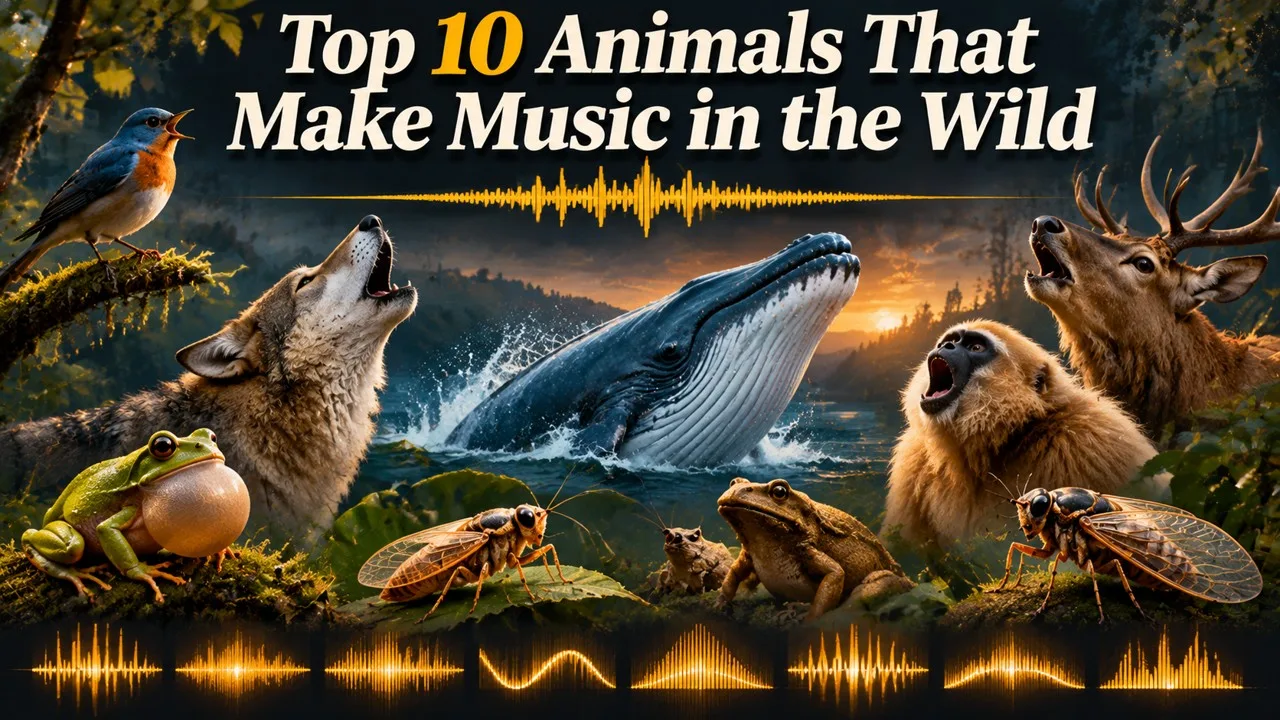
Chimps drum, palm cockatoos make sticks, and whales and gibbons sing in the wild; zoo harmonica acts and a copyrighted film theme do not belong here. A list of "musical animals" is only as good as its definition. The useful cases are wild or free-living animals that produce structured, repeated sound, keep a beat, or fashion a tool to make one [1][8]. A captive elephant blowing a harmonica, a house cat at a piano, a gorilla with a recorder, and a seal trained to a film theme are entertainment, and two of them raise copyright problems that this article will not enter [5][10]. They are replaced below by humpback whale song, nightingale song, gibbon duets, and the pied butcherbird, all documented without a studio prop.
The remaining zoo or lab cases that stay on the list, including Ronan the sea lion, are kept only because the underlying skill, beat-keeping, has been tested with methods that can be described without quoting a melody.
Key Facts
Music, in this article, means structured sound or rhythm with a documented biological function or a measured timing skill. It does not mean a cover version.
Ten Musical Animals at a Glance
| Rank | Animal | What is musical | Setting |
|---|---|---|---|
| 1 | West African chimpanzees | Buttress drumming with individual timing styles | Wild forests |
| 2 | Certain bats | Distorted, growl-like call segments with nonlinear vocal production | Wild and recorded calls |
| 3 | Ronan, a California sea lion | The ability to keep a beat with a moving cue | Laboratory tests, not a concert |
| 4 | Humpback whales | Long, structured, socially learned songs | Wild oceans |
| 5 | Rock hyraxes | Complex, individually distinctive songs with rhythmic structure | Wild colonies |
| 6 | Common nightingales | Long, varied, and highly structured territorial song | Wild woodlands |
| 7 | Indris and some other lemurs | Categorical rhythms in loud songs and duets | Wild Madagascar forests |
| 8 | Palm cockatoos | Crafted sticks used to drum on hollow trees | Wild Australia |
| 9 | Gibbons | Pair duets with species-typical phrasing | Wild forests of Asia |
| 10 | Pied butcherbirds | Long, structured phrases often described as flute-like | Wild Australia |
1. West African Chimps Keep a Drum
In several West African populations, chimpanzees drum on the buttress roots of trees during displays, and recent work has shown that the timing is not a random bang [1]. Individuals and communities can have distinctive rhythms, and the drumming carries through forest in a way that a mere chaotic slap would not [1]. The behavior is a communication tool, tied to travel and display, not a jam session, but it meets a fair definition of structured percussion produced without a human teacher in the moment.
The finding matters because it places a rhythmic, tool-on-resonator habit in our closest living relatives, in the wild, where it evolved. Drumming is only one part of a chimpanzee display, which may also include calling and movement, but the percussion can be analyzed on its own as timing, not only as noise.
2. Bats That Growl with Distortion
Some bats produce call segments with nonlinear distortion, a growl or roughness that researchers have compared, in technical papers, to the vocal timbre of extreme metal singers [2]. The comparison is acoustic, not cultural. The animals are not performing a genre, and no band, logo, or lyric is required to describe the sound [2]. What the work actually shows is that a small mammal can drive its vocal folds or membranes into chaotic vibration, creating a harsh, broadband signal that may startle, advertise, or otherwise function in the bat's social life.
A growl can be musical in the broad sense of controlled, repeated sound, and it can still be a threat display. Both things can be true, and the papers are about the voice, not about dressing an animal in a concert identity it does not have.
Related: Top 10 Unexpected Abilities Found in Animals
3. A Sea Lion That Keeps Time
Ronan, a California sea lion trained at the University of California, Santa Cruz, became a central subject in experiments on beat-keeping: she could bob her head in time with a metronome-like cue and adjust when the tempo changed [3]. The result, reported by Peter Cook, Andrew Rouse, and colleagues, challenged the idea that only vocal-learning animals, such as some birds and humans, can entrain to a beat [3]. The skill was measured in a lab. It was not a nightclub act, and it does not require a named popular song to be understood.
One animal is not a species-wide concert tradition. It is a proof of capacity, and that is already a substantial finding. Later popular clips of sea lions moving to popular tracks are a separate, often sloppier genre, and they are not the evidence this entry relies on.
4. Humpback Songs, Learned at Sea
Male humpback whales produce long, hierarchically structured songs that change over months and can spread across an ocean basin as animals pick up new versions [4]. The songs have themes, phrases, and repetition, and they are among the most carefully described nonhuman musical systems we have [4]. No lyrics are involved, and none will be invented here. The function is still discussed, with courtship and male-male communication as leading ideas, but the structure itself is not in doubt. Recordings made decades apart in the same ocean can be compared like revisions of a document, which is why the song is a standard example of animal culture as well as of animal sound.
This is the substitution that belongs in a wild-music list: an animal composing, in the loose sense of assembling and transmitting a patterned acoustic display, without a harmonica or a film cue.
5. Rock Hyraxes That Sing
The rock hyrax, a small African mammal more closely related to elephants than its look suggests, produces loud, complex songs with a mix of notes, clicks, and wails [5]. Studies have found individual signatures, regional differences, and rhythmic or syntactic patterns that are unusual for a mammal of this kind [5]. Males sing, especially in the breeding season, and the performances can last for minutes. The "human rhythms" sometimes claimed in popular summaries should be handled carefully: the interesting result is that a hyrax song has measurable structure and can carry information about the singer, not that the animal has borrowed a time signature from a conservatory.
Related: Top 10 Most Intelligent Animals
It is one of the better reminders that musical complexity in mammals is not limited to whales and primates.
6. Nightingales and a Long Performance
The common nightingale is a textbook singer: a male may deliver a long, varied, and precisely timed stream of phrases, by night and by day, as a territorial and courtship signal [6]. The repertoire is large, the transitions are structured, and the bird has been a reference point for human music for centuries, which is a cultural fact, not a claim that the animal is quoting a composer [6]. In a list that refuses copyrighted tunes, the nightingale earns its place the other way: a wild song that is already complex enough.
The performance is "musical" because of its organization, not because a piano was placed under the bush. A listener who comes to the bird with a human song in mind will miss the structure that is already there, phrase after phrase, without accompaniment.
7. Lemurs with a Sense of Rhythm
Indris, the large singing lemurs of Madagascar, produce loud songs, often as a family or pair, with intervals that researchers have described as categorical, falling into regular rhythmic types rather than a smear of random gaps [7]. Related work on other lemurs has asked how far this rhythmicity goes and whether it resembles, in a limited statistical sense, categories found in human music [7]. The honest conclusion is modest and still important: some primate songs are timed, not just loud, and the timing can be measured.
Related: Top 10 Most Extreme Hearing Animals
These are wild forest vocalizations. They are not a recital on a borrowed recorder.
8. Palm Cockatoos Make a Stick and Drum
In northern Australia, male palm cockatoos fashion sticks or seed pods and use them to drum on hollow tree limbs as part of a display [8]. Robert Heinsohn and colleagues have shown that the rapping has individual rhythm signatures and that the tool is modified for the job, which makes the species a rare example of a nonhuman animal building an instrument, in a fair, narrow sense of the word [8]. The drumming is visible and audible on the display tree. It is courtship and advertisement, and it is percussion.
Among the ten, this may be the cleanest case of music as a made object plus a beat. A broken stick is discarded or replaced; the bird is not borrowing a human instrument and then being asked to "play."
9. Gibbon Duets in the Canopy
Gibbons are among the most reliably musical primates in the wild. Mated pairs of many species produce loud, species-typical duets, with male and female parts that interlock and that function in territory and pair bonding [9]. The phrasing is stable enough that a trained listener can often identify the species by song alone [9]. No lyrics, and no need for a human tune. The duet is the point: two animals, a shared structure, and a forest that can hear the boundary being announced.
Related: Top 10 Courtship Displays in the Animal Kingdom
A recorder in a gorilla enclosure is not a competitor to this, except on a poster.
10. The Pied Butcherbird's Phrases
The Australian pied butcherbird sings long, clear, flute-like phrases, often in the early morning, with motifs that have attracted the attention of both ornithologists and composers because of their apparent structure and development [10]. The bird is wild. The song is learned and varied, and it can be described in ordinary musical language, phrase, motif, repetition, without stealing a copyrighted melody to make the point [10]. Like the nightingale, it stands in for a class of birds whose vocal performances are already "more musical than you might think," if the listener is willing to take the animal on its own terms.
That is the standard this list has tried to keep.
Conclusion
Structured sound is widespread. Chimpanzees drum with style, palm cockatoos make a stick for the same purpose, whales and hyraxes and nightingales and butcherbirds sing in organized bouts, and some lemurs and a laboratory sea lion show that timing itself can be controlled. Those cases can be told from field recordings and papers.
What does not belong, except as a caution, is a zoo novelty or a trained cover of a film theme. They confuse music as a human show with music as a biological signal, and they can drag lyrics and protected tunes into an article that has no need of either. The wild and the carefully tested lab are enough, and they already supply percussion, song, duet, and beat-keeping without a borrowed melody.
- ^ [1] Studies of chimpanzee buttress drumming in West Africa, including work on individual and community rhythmic signatures. Britannica: Chimpanzee
- ^ [2] Acoustic studies of nonlinear, growl-like vocalizations in bats, described in terms of vocal production, not as a tribute to any recording artist. Britannica: Bat
- ^ [3] Cook, P., Rouse, A., Wilson, M. and Reichmuth, C., on beat-keeping in a California sea lion (Ronan). Journal listings for the Ronan sea lion rhythm experiments
- ^ [4] Payne, R., and later reviews of humpback whale song structure and cultural transmission. Encyclopaedia Britannica. Britannica: Humpback whale
- ^ [5] Research on rock hyrax song, individual signatures, and rhythmic or syntactic structure. Britannica: Hyrax
- ^ [6] Common nightingale song and territorial function. Encyclopaedia Britannica. Britannica: Nightingale
- ^ [7] Studies of indri songs and categorical rhythms in lemur vocalizations. Britannica: Indri
- ^ [8] Heinsohn, R. et al., on palm cockatoo tool-assisted drumming and individual rhythms in northern Australia. Britannica: Cockatoo
- ^ [9] Gibbon pair duets as territorial and pair-bonding signals. Encyclopaedia Britannica. Britannica: Gibbon
- ^ [10] Accounts of pied butcherbird song structure in Australia. Wikipedia: Pied butcherbird



















Discussion
Log in with