






 By
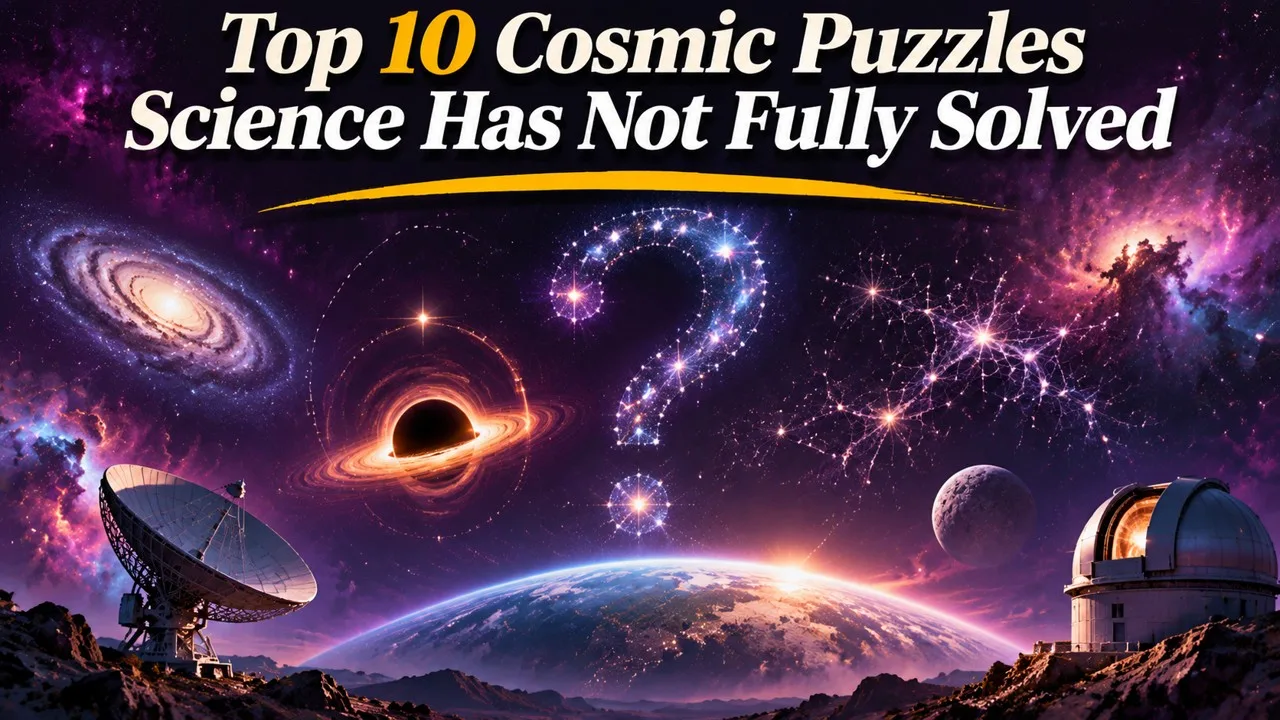
Dark matter, dark energy, the Hubble tension and the cosmic endgame remain open: science has sharp measurements, and still no complete account. This list is a curated set of ten unsolved, or only partly solved, problems in cosmology and high-energy astrophysics, not a collection of unexplained newspaper objects [1][3]. Some headlines, including claims that the cosmic microwave background might not be a relic afterglow, go against a very large body of evidence; they are not treated here as if they were on the same footing as dark matter [10].
The entries below say what is measured, what is not understood, and when a popular idea is still only a proposal. That is the useful kind of "mystery" in science: a gap with a well-stated question [2][6].
Key Facts
Modern cosmology has a working model, Lambda-CDM, that fits many data sets and still leaves the nature of its two largest components, dark matter and dark energy, unknown. Tension between measurements is itself a scientific result.
Ten Open Problems at a Glance
| Rank | Puzzle | What is solid | What is still open |
|---|---|---|---|
| 1 | Dark matter | Extra gravity in galaxies, clusters, and the early universe | The identity of the missing component |
| 2 | Dark energy | The expansion is accelerating | Whether it is a cosmological constant or something that changes |
| 3 | The Hubble tension | Two precise routes to the expansion rate disagree | Whether the error is in the data or in the model |
| 4 | The baryon asymmetry | The observable universe is matter, not a matter-antimatter mix | What process made the imbalance |
| 5 | The fate of the universe | A constant dark energy implies a long cooling | The details depend on what dark energy is |
| 6 | Ultra-high-energy cosmic rays | Particles arrive at extreme energies | Where the most energetic ones are born, and how they travel |
| 7 | Fast radio bursts | Millisecond radio flashes, some repeating, some from magnetars | How many engines exist, and what the non-repeating ones are |
| 8 | The black-hole mass gaps | Stellar and supermassive holes are abundant | How some intermediate masses form, and where they sit |
| 9 | The "missing" ordinary matter | A large share of baryons is not in galaxies | How completely the cosmic web accounts for the rest |
| 10 | Inflation's unfinished questions | An early burst of expansion is a successful idea | What field drove it, and how it began |
1. What Is Dark Matter?
Galaxies rotate too quickly, clusters hold themselves together too tightly, and the pattern of the early universe in the microwave background and in galaxy surveys all point to a gravitational component that does not emit ordinary light [1]. That component is called dark matter. The evidence that something with mass is there is strong. The evidence for any particular particle — a WIMP, an axion, a sterile neutrino, or a still more exotic candidate — is not yet decisive [1]. Laboratory searches have closed some doors and left others open.
The puzzle is therefore not whether extra gravity is needed. It is what the extra gravity is made of, and whether a small change in the law of gravity could still explain some, though probably not all, of the data. After decades of work, that remains one of the central open questions in physics.
2. What Is Dark Energy?
In the late 1990s, two supernova teams found that the expansion of the universe is accelerating, a result later reinforced by other probes [2]. In the standard model the acceleration is attributed to dark energy, often taken to be Einstein's cosmological constant: a uniform energy density with negative pressure. The measured density is small, and why it has that value is a theoretical embarrassment. It is also still possible, in the data, that dark energy changes slowly with time [2].
Unlike dark matter, dark energy does not clump into galaxies. It shows itself in the expansion history and in the growth of structure. Naming it was a start. Identifying it is the unsolved step, and it controls, among other things, how the universe might end.
Related: Top 25 Interesting Facts About the Universe
3. The Hubble Tension
The Hubble constant is the present expansion rate of the universe. One precise route, using the cosmic microwave background and the standard model, gives one number. Another, using calibrated stars and supernovae in the nearby universe, gives a slightly higher number, and the disagreement has not gone away as the error bars have shrunk [3]. This "Hubble tension" is now one of the most discussed problems in cosmology [3].
It may yet be a hidden systematic error in one of the ladders. It may be a sign that the standard model is incomplete — a different early expansion history, or a different dark-energy behavior, or some other new piece. The honest status is that careful people disagree, and that the disagreement is quantitative, not vague.
4. Why Is There More Matter Than Antimatter?
Particle processes, run in the laboratory, produce matter and antimatter in very nearly equal amounts. The visible universe, by contrast, is made of matter, with only traces of antimatter in cosmic rays and in artificial beams [4]. Something in the early universe must have generated a small excess of matter, later left behind when the rest annihilated. The conditions for that process, often called baryogenesis, are known in outline, from work by Andrei Sakharov and later theorists. The actual mechanism is not [4].
This is a puzzle with a clean statement and no accepted laboratory confirmation. It is also a reminder that some cosmic questions are particle-physics questions in disguise.
5. How Will the Universe End?
If dark energy is a true cosmological constant, the long-term picture is a continued acceleration, a thinning of galaxies beyond one another's horizon, and a cold, dilute future sometimes called a heat death [5]. If dark energy grows, a more violent "big rip" is imaginable. If it fades, a recollapse is imaginable, though present data do not point that way. The end is therefore not a single cartoon, and it is not scheduled for any human timescale [5].
Related: Top 10 Ideas That Changed How We Think About Black Holes
The unsolved part is the same as item two, viewed from the other end of time: without a theory of dark energy, the last chapter is a set of if-then statements. Astronomy can still rule some endings out. It has not yet ruled one ending in.
6. The Most Energetic Cosmic Rays
Cosmic rays include protons and heavier nuclei that can reach energies far above anything a terrestrial collider produces [6]. At the highest end, a charged particle should be limited in how far it can travel through the microwave background, which is why the sources of ultra-high-energy cosmic rays are expected to lie, in some sense, relatively nearby on a cosmic scale. Identifying those sources, and explaining the extreme acceleration, is still an open problem, even as large observatories have mapped arrival directions and spectra [6].
The puzzle is not that the particles exist. It is how nature builds an accelerator so efficient, and why the sky at the highest energies looks the way it does.
7. Fast Radio Bursts
Fast radio bursts are millisecond flashes at radio frequencies, coming from distant galaxies, first recognized as a real astronomical class in the 2010s [7]. Some repeat. At least some repeating bursts have been tied to magnetars, highly magnetized neutron stars. Others, especially one-off bursts, may have the same engine or a different one. The bursts have already been used as probes of the thin matter between galaxies, which is a scientific success, not a failure [7].
What remains unsolved is the full family of engines, the reason some sources repeat and some have not been seen to, and the detailed physics of the flash. That is a younger puzzle than dark matter, and it is moving quickly, which is why a list should not pretend the subject is frozen.
Related: Quasars: Distant Beacons or Local Oddballs?
8. Where Are Some of the Black Holes?
Stellar-mass black holes and supermassive black holes are now abundant in catalogs, from X-ray binaries, gravitational waves, and galactic nuclei [8]. Between them, and in certain mass ranges predicted by supernova theory, there are "gaps" or thinly populated bands: a possible lower mass gap above the heaviest neutron stars, an upper pair-instability range, and a long-standing question about how the first supermassive holes grew so large so early [8]. Observations have begun to put objects into some of those gaps, which only sharpens the formation question.
The puzzle is not a missing cartoon hole. It is a set of formation channels that are still being mapped, including the path from a heavy star, from a merger, and from a seed in the young universe.
9. The Missing Ordinary Matter
The amount of ordinary, baryonic matter in the universe is well measured from the microwave background and from primordial nucleosynthesis [9]. The stars and cold gas inside galaxies do not add up to that total. A large share was long called "missing baryons," with the leading idea that it sits in a hot, thin gas in the cosmic web, the so-called warm-hot intergalactic medium [9]. Fast radio bursts and X-ray studies have begun to close the gap, which is progress, but a complete, agreed census is still being finished.
This entry is a useful contrast with dark matter. Here the substance is known: protons and nuclei. The question was, and to some extent still is, where they hid.
Related: Top 10 Interesting Facts About the Milky Way Galaxy
10. What Drove Inflation?
An early period of accelerated expansion, cosmic inflation, is a successful idea: it helps explain why the universe is so uniform, why it is spatially close to flat, and why there is a nearly scale-invariant spectrum of initial ripples [10]. Those ripples are seen, with great precision, in the microwave background, which remains, on the standard reading, the afterglow of a hot, dense early universe, not a misidentified local effect [10]. What is still open is the physical driver: what field, or what more complete theory, produced the burst, how it started, and how it ended.
Inflation is therefore both a pillar and a puzzle. The data have made a strong case for something like it. They have not handed over the particle, or the mechanism, in a unique form. That is a better final item than a rumour that the afterglow itself is an illusion.
Conclusion
Cosmology is not a subject without answers. It is a subject with a working model, sharp instruments, and a short list of very large remaining questions: the identity of dark matter and dark energy, a disagreement about the expansion rate, the origin of matter's excess, the long-term fate of the expansion, the sources of the most energetic particles, the engines of fast radio bursts, the formation of black holes in awkward mass ranges, the last of the hidden baryons, and the mechanism of inflation.
Those are enough. They do not need to be padded with fragile headlines. The measurements will keep improving, and some of these puzzles may close, or split, within a generation. Until then, the honest list is a list of questions that can already be stated clearly.
- ^ [1] "Dark matter." Encyclopaedia Britannica and Particle Data Group reviews. Britannica: Dark matter
- ^ [2] "Dark energy" and the accelerating expansion. Encyclopaedia Britannica. Britannica: Dark energy
- ^ [3] Reviews of the Hubble constant tension. NASA and later scientific summaries. NASA Hubble: expansion rate
- ^ [4] "Baryogenesis" and the matter-antimatter asymmetry. Reviews in particle cosmology. Wikipedia: Baryogenesis
- ^ [5] "Ultimate fate of the universe." Standard cosmological overviews. Wikipedia: Ultimate fate of the universe
- ^ [6] "Ultra-high-energy cosmic ray." Pierre Auger and related observatory overviews. Britannica: Cosmic ray
- ^ [7] "Fast radio burst." Nature reviews and observatory pages. Wikipedia: Fast radio burst
- ^ [8] LIGO–Virgo–KAGRA catalogs and reviews of black-hole mass gaps and early supermassive seeds. LIGO
- ^ [9] Reviews of the missing baryons and the warm-hot intergalactic medium. Wikipedia: Missing baryon problem
- ^ [10] "Inflation (cosmology)" and standard accounts of the cosmic microwave background as a recombination afterglow. Encyclopaedia Britannica. Britannica: Inflation





















Discussion
Log in with