






 By
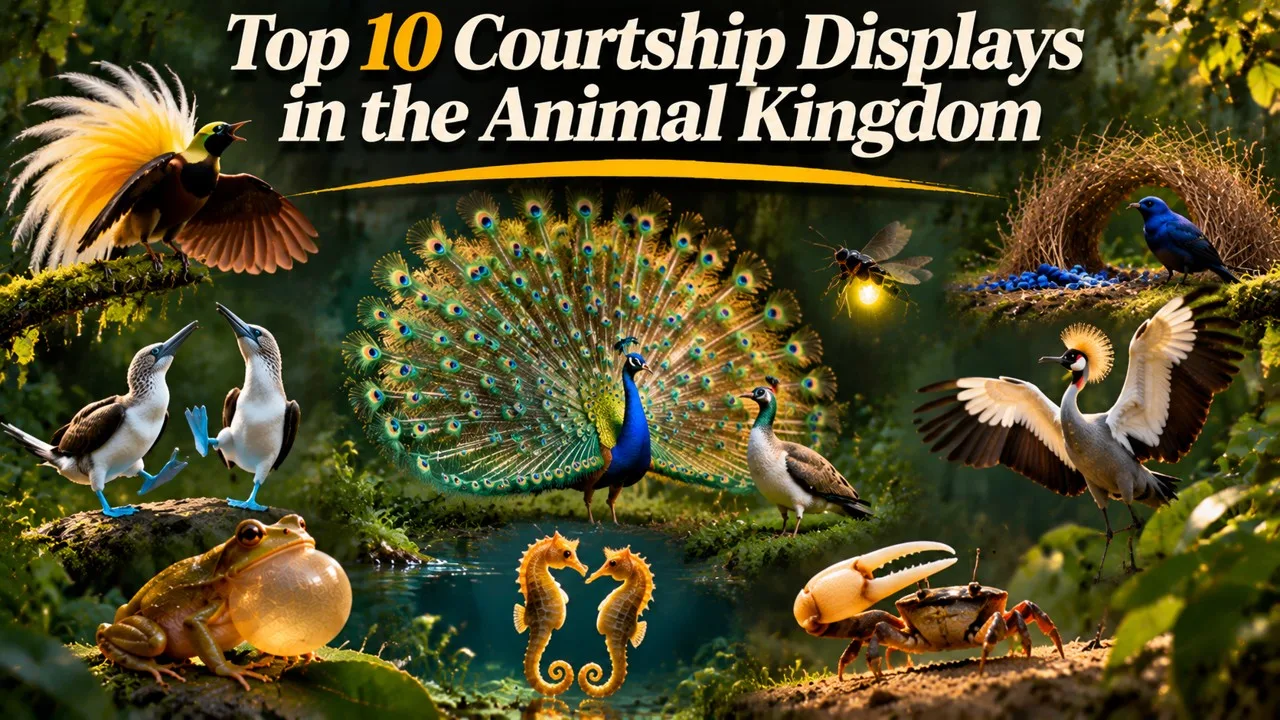
Flamingos, grebes, manakins and peacock spiders have documented courtship displays; a foraging dance does not belong on the same list. A "greatest dance moves" frame is tempting, and it is a poor guide to biology. Courtship is a signal aimed, in the usual case, at a potential mate. A honeybee's waggle run is a foraging map, not a proposal, and a bird that happens to look as if it is performing a trademarked stage step is still a bird, not a music video [3][8]. This list stays with ten displays that have been described in the scientific literature as courtship or as a mating ritual, with the choreography named in ordinary language.
The point is not to rank species by spectacle. It is to show how widespread, and how strangely specific, mate-directed movement can be, from a soda-lake flamingo to a millimetre-scale spider. A list that mixed foraging maps and pop-culture nicknames into that set would be more entertaining than accurate, and it would teach the wrong lesson about what a display is for.
Key Facts
Courtship displays are evolved signals. They are not copies of human dances, and they should not be sold that way.
Ten Courtship Displays at a Glance
| Rank | Species or group | What is displayed | Why it is courtship |
|---|---|---|---|
| 1 | Greater and related flamingos | Group marching, head-flagging, and wing salutes | Synchronized signaling in dense breeding colonies |
| 2 | Birds of paradise | Species-typical postures, clearings, and plumes | Male display on a lek or perch, judged by females |
| 3 | Manakins of the American tropics | Backward slides and cooperative leaps on a perch | Fast, ritualized movement at a display court |
| 4 | Great crested grebe | The weed ceremony and a rush across the water | A mutual dance that precedes nesting |
| 5 | Seahorses | Daily greeting dances and a courtship promenade | Pair-bonding before the male receives the eggs |
| 6 | Greater sage-grouse | Inflated air sacs and a booming strut on a lek | Classic lekking, with females choosing among males |
| 7 | Peacock spiders (Maratus) | Colored flaps and a vibrating courtship dance | Visual and vibratory signals aimed at a watching female |
| 8 | Superb lyrebird | Song and mimicry in a mound-court display | A concert and a dance, both directed at mates |
| 9 | Fiddler crabs | The waving of an enlarged claw | A visual signal on a mudflat territory |
| 10 | American woodcock | A ground strut and a towering display flight | Sound and silhouette used in spring courtship |
1. Flamingos March in Groups
On soda lakes and in large captive flocks, flamingos gather into display groups that march, flag their heads, and flash black-and-crimson wing patches in a coordinated salute [1]. The behavior has been described in the greater flamingo and in related species as a courtship or pre-breeding display: the birds are not dancing for an audience of tourists, even if that is how the footage is often sold [1]. Synchrony appears to matter. A bird that can keep time in a dense flock is advertising condition and, perhaps, readiness to nest in a colony where timing is everything.
The choreography is simple, repeated, and loud with color. It is also a reminder that "dance" in animals is often a collective signal, not a solo, and that the unit of the display may be the flock as much as the individual bird.
2. Birds of Paradise on a Stage
In New Guinea and nearby islands, male birds of paradise clear courts, puff into odd shapes, and freeze in poses that would look abstract if they were not so clearly aimed at a visiting female [2]. Species differ: some hang inverted, some transform the head and cape into a single dark oval, some hop on a horizontal perch. The displays have been documented for more than a century of natural history and, more recently, in detailed field video [2]. They are among the textbook examples of sexual selection, in which female choice has pushed male form and motion to extremes.
No human dance name is required to describe this. A male on a court is running a species-typical program, and the female is the judge.
Related: Top 10 Most Intelligent Animals
3. Manakins and the Backward Slide
Male manakins in the American tropics use a display perch or a court on the forest floor. In some species, including the red-capped manakin, a male may slide backward along a branch in a fast, smooth motion that popular accounts have compared, unhelpfully, to a trademarked stage step [3]. The comparison is a camera trick. The biology is a high-speed, ritualized courtship movement, sometimes coordinated between cooperating males, and it is judged by females who visit the court [3].
The honest description is enough: a small bird, a bare perch, and a backward slide that has nothing to do with a music catalog.
4. The Great Crested Grebe's Ceremony
The great crested grebe became a landmark of animal behavior when Julian Huxley described its courtship in the early twentieth century, including the "weed ceremony," in which a pair rises breast to breast and offers water plants, and a rush across the surface that looks, from a distance, like a single two-headed bird [4]. The ritual is mutual, not a one-sided male show, and it is part of a long pair-bonding sequence that precedes nesting [4]. It remains one of the best-documented waterbird dances in Europe, and it is still worth describing without Victorian embroidery.
A pair that can complete the ceremony is a pair that has agreed, in the only language the species has, to go on.
5. Seahorses Change Color and Dance
Seahorses are unusual among fish because the male, not the female, carries the developing eggs in a brood pouch [5]. Before the transfer, many species perform a daily greeting or a longer courtship dance: the pair may change color, circle, and rise in the water together, a sequence that can last minutes or, in some accounts, hours [5]. The dance is not an optional flourish. It is how a pair confirms identity and synchronizes the moment when eggs will be deposited.
Related: Top 10 Unexpected Abilities Found in Animals
The image that sticks, a vertical fish with a coiled tail, is only half the story. The other half is a repeated, ritualized promenade in which both animals take part.
6. Sage-Grouse on the Lek
Before dawn on a western North American lek, male greater sage-grouse inflate yellowish air sacs, fan pointed tail feathers, and produce a hollow booming as they strut in a tight, traditional arena [6]. Females walk the grounds and choose. The system is one of the classic leks in ornithology: males cluster, they display, and they do not form a lasting pair with the hens that select them [6]. Habitat loss has made the species a conservation concern, which is one reason the display is now as often a management subject as a purely natural-history one.
The "dance" is a strut with sound. It does not need a soundtrack laid over the film.
7. Peacock Spiders Raise a Fan
Male peacock spiders, in the genus Maratus, are small Australian jumping spiders with a colored abdominal flap that can be raised, like a tiny fan, and with legs that are waved or vibrated during courtship [7]. The display is both visual and vibratory: the female watches, and she also feels the substrate. Researchers, including Jürgen Otto and colleagues who have described many of the species, have documented a repertoire that is species-specific and clearly directed at a prospective mate [7]. A female may reject a male, sometimes lethally, which is part of the same literature and should not be turned into gore for its own sake.
The honest picture is a millimetre-scale animal running a precise program. Calling it a "peacock" is already a metaphor. It does not need a second one borrowed from a concert stage.
Related: Top 10 Animals That Make Music in the Wild
8. The Lyrebird's Concert
The superb lyrebird of Australia is famous for mimicry, but the mimicry sits inside a courtship display. A male builds or maintains a mound, spreads a lyre-shaped tail, and sings a long, complex performance that may include copied notes from other birds and, in some places, mechanical sounds from the human landscape [8]. The display is visual and vocal at once. Females visit and assess. The bird is not "rocking out to music" in any useful biological sense; it is broadcasting a learned, competitive courtship signal [8].
Mimicry makes the performance strange to human ears. The function, mate attraction on a court, is ordinary for a lekking or polygynous bird.
9. Fiddler Crabs Wave a Claw
On tropical and subtropical mudflats, a male fiddler crab has one greatly enlarged claw, which he waves in a species-typical pattern while standing at the entrance of a burrow [9]. The wave is a courtship and territorial signal, visible across a flat that would otherwise hide a small crab. Females approach, inspect, and may enter a burrow; rival males are warned off by the same banner [9]. The choreography is repetitive by design. A good wave is one that can be seen and recognized, not one that invents a new step every time.
It is a simple display, and it is one of the best illustrations that courtship can be a flag as much as a dance.
Related: Top 10 Animals That Can Live Without Food for Months
10. The American Woodcock's Flight
In early spring, a male American woodcock struts on the ground with a peenting call, then launches into a towering, circling flight in which air through modified wing feathers produces a twittering sound, before dropping back to the display ground [10]. The sequence has long been called a "sky dance" in popular writing, a phrase that is fair as a nickname and still describes a courtship flight, not a stage act [10]. Females may be watching from nearby cover. The display is timed to dusk and dawn, when the light is low and the silhouette is the message.
A woodland bird that looks stout and unglamorous by day becomes, for a few minutes, a moving sound in the sky. The flight can be easy to miss if a listener waits only for a songbird melody, because much of the sound is in the wings. That is the display, and it is enough.
Conclusion
Courtship displays are easy to oversell and still worth describing carefully. A flamingo march, a grebe's weed ceremony, a sage-grouse lek, and a peacock spider's fan are all documented signals aimed at mates or at the social situation in which mating will occur. A honeybee waggle run is not, and a comparison to a trademarked dance or to "rocking out" adds nothing except a copyright problem and a category error.
The ten entries above stay inside that line. They also show how much of the "dance" is species-typical, repeated, and judged: by a female on a court, by a pair in the water, or by a crab on a mudflat. Some displays are mutual, as in grebes and seahorses. Some are one-sided contests on a lek. The motion is real in every case. The metaphor should work for the motion, not the other way around.
- ^ [1] Accounts of flamingo courtship and group display, including the greater flamingo. Encyclopaedia Britannica. Britannica: Flamingo
- ^ [2] "Bird-of-paradise" courtship and sexual selection. Encyclopaedia Britannica. Britannica: Bird-of-paradise
- ^ [3] Field studies of manakin display courts and the red-capped manakin's backward slide, described without trademarked dance names. Wikipedia: Red-capped manakin
- ^ [4] Huxley's classic description of great crested grebe courtship, and later summaries. Britannica: Great crested grebe
- ^ [5] Seahorse reproduction and courtship, including the male brood pouch. Encyclopaedia Britannica. Britannica: Seahorse
- ^ [6] Greater sage-grouse lekking behavior and conservation context. Britannica: Sage grouse
- ^ [7] Descriptions of Maratus courtship displays by Jürgen Otto and co-authors, and museum summaries of peacock spiders. Wikipedia: Peacock spider
- ^ [8] Superb lyrebird display, mimicry, and mound courts. Encyclopaedia Britannica. Britannica: Lyrebird
- ^ [9] Fiddler crab claw-waving as a courtship and territorial signal. Britannica: Fiddler crab
- ^ [10] American woodcock display flight and "peenting" ground call. Cornell Lab of Ornithology, All About Birds. Cornell: American Woodcock



















Discussion
Log in with