






Top 10 Historical Myths and the Texts That Started Them
 By Dhiraj Sharma · Published
Share Post
Loading…
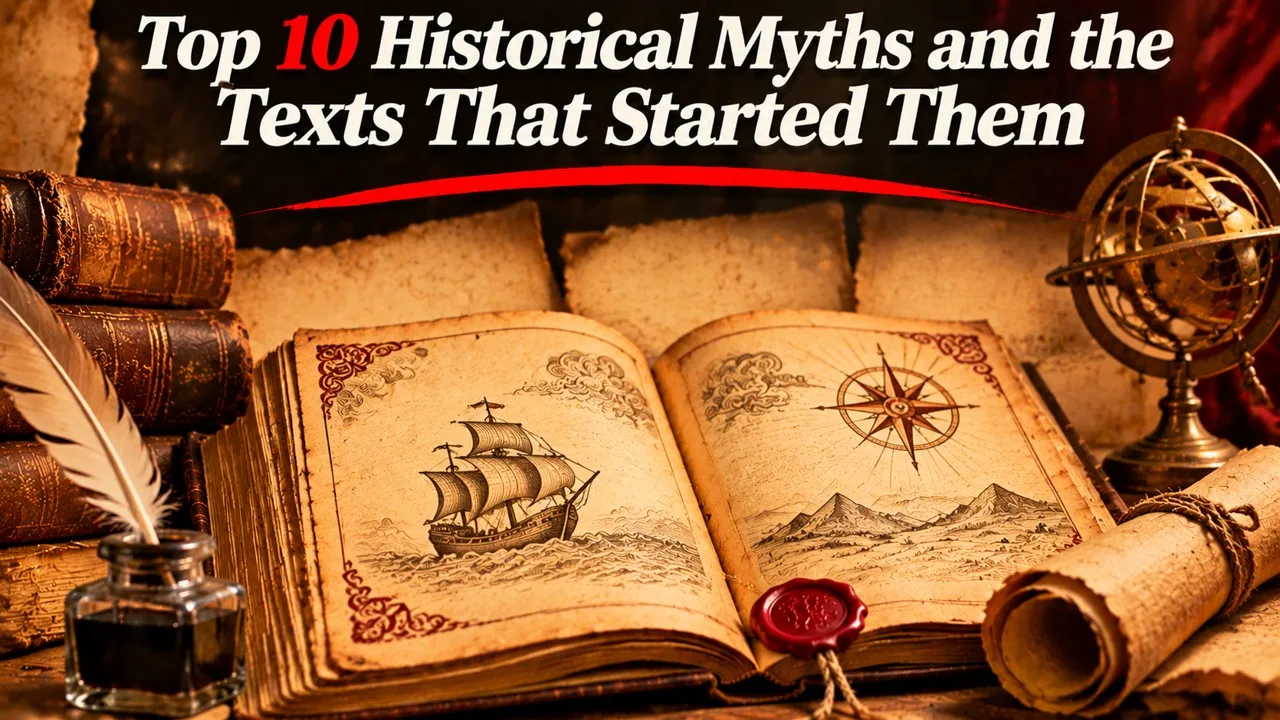
Bushido handbooks, Tudor histories and Treasure Island helped turn flexible pasts into rigid stories that later readers took for facts. This list is a curated set of ten familiar claims and of texts, or clusters of texts, that helped them travel [2][5][8]. The aim is not to replace one cartoon with another. Some of the people and events below were real; what hardened was a later picture, often written for moral instruction, politics, or entertainment [4][7].
A myth, here, is a story that outran the evidence, not a claim that nothing happened. Where historians still argue, the entry says so [1][9].
Key Facts
Popular history often rests on a vivid book, a play, or a schoolroom sentence. Naming that source is part of checking the claim.
Ten Claims and Their Texts at a Glance
| Rank | Familiar claim | Texts or genres that helped || What a cautious account says | |
|---|---|---|---|
| 1 | The Black Death raced west along a single Silk Road story | Later textbooks more than one medieval source | The pandemic's routes were plural; research on origins is still being refined |
| 2 | Samurai lived by one strict moral code | Nitobe's Bushido (1900) and later popularizations | Warrior ethics existed, but they were not one timeless handbook |
| 3 | Spartans were uniformly ascetic warriors | Plutarch, Xenophon, and later "Spartan" admirers | The "Spartan mirage" flattened a more complicated society |
| 4 | Cleopatra was defined by seduction | Augustan poetry, later Plutarch, then Shakespeare | She was a Hellenistic ruler; Roman propaganda shaped the portrait |
| 5 | Richard III was a hunchbacked tyrant | Thomas More, then Shakespeare's play | The Tudor case is a source, not a verdict; the king's body is a separate fact |
| 6 | Anne Boleyn had six fingers | Later hostile writing, especially Nicholas Sander | Contemporary evidence does not support the deformity tale |
| 7 | London can expect a white Christmas | Dickens, Victorian cards, later seasonal songs | Measurable snow on 25 December is uncommon in the city |
| 8 | Pirates buried treasure and kept parrots | Robert Louis Stevenson's Treasure Island | The book created a costume; buried hoards were rare |
| 9 | Franklin proved electricity with a schoolbook kite | Franklin's 1752 letter, then later retellings | He argued that lightning is electrical; the illustrated kite is more complicated |
| 10 | Humans use only 10 percent of the brain | Self-help and popular psychology, not a founding paper | The figure has no basis in modern neuroscience |
1. The Black Death and the Silk Road
A common textbook picture has the mid-fourteenth-century plague travelling in a straight, rapid line along the Silk Road from an eastern origin to the Mediterranean [1]. Medieval chronicles describe outbreaks and routes, but they do not all tell a single, modern "Silk Road" story, and later maps often simplified a slower, mixed spread by land and sea [1]. Recent genetic and archaeological work has added evidence about earlier reservoirs in Central Asia, which complicates, rather than confirms, a simple schoolroom arrow.
The myth is the straight line and the single road, not the reality of a terrible pandemic. A responsible history keeps the disease, the trade networks, and the uncertainties of origin in view at once, and it does not pretend that one medieval page invented the later diagram. Maps in later classrooms were doing a job the chronicles never signed up for.
2. The Samurai and a Single Code
Samurai ethics, house rules, and later memory are a real historical subject. The idea that all samurai, across centuries, lived by one strict, chivalric "bushido" is much more modern [2]. Inazo Nitobe's Bushido: The Soul of Japan, written in English and published in 1900, presented a tidy moral code to a foreign and then a domestic audience, and later school and popular texts amplified that picture [2]. Earlier warrior writings, including Tokugawa-period works such as Hagakure, were more various, more local, and less like a national scouting manual.
Nitobe was a Meiji-era Christian diplomat explaining Japan to the world, not a medieval lawgiver. The book is a key text in the myth's circulation. It should be read as a modern construction, not as a secret rulebook recovered from every battlefield.
Related: Top 10 Historical Facts That Sound Fake but Are True
3. The Spartan Mirage
Ancient and modern admirers have described Sparta as a city of laconic, equal, iron-hard warriors who scorned luxury [3]. Two of the most influential ancient portraits are Xenophon's account of Spartan institutions and Plutarch's Life of Lycurgus, written centuries after the archaic reforms they describe [3]. Later European and American writers used those pages as a political mirror. Historians now often speak of a "Spartan mirage": a literary image that hid inequality, helot labor, and change over time.
The texts are not worthless. They are late, idealizing, or both, and they were reused by people who wanted a model, not a census. Sparta was a military society by the standards of many Greek cities. It was not the cartoon those books helped to freeze.
4. Cleopatra in Roman Writing
Cleopatra VII was a Hellenistic queen who fought a political and military struggle with, and then against, Rome [4]. Augustan poets, including Horace and Propertius, and later Plutarch's Life of Antony, gave later ages a portrait in which her power was recast as seduction, a useful story for a regime that had defeated her [4]. Shakespeare's Antony and Cleopatra, much later, made that portrait unforgettable in English.
The myth is not that Cleopatra had allies or lovers. It is that her historical meaning shrinks to a personal enchantment. Reading the Roman texts as victory literature, rather than as neutral biography, is the first step back toward a ruler with a treasury, a navy, and a court.
5. Richard III on the Tudor Page
The familiar Richard III — a physically marked, calculating tyrant — owes a great deal to Thomas More's unfinished History of King Richard III and, even more, to Shakespeare's play [5]. Both were written in a Tudor world that had reasons to blacken the last Yorkist king. The 2012 Leicester excavation showed that Richard had a scoliosis, a fact about a skeleton, not a confirmation of a stage hump, and it could not, by itself, settle the political charges [5].
Related: Top 10 Mythical Creatures in World Mythology - That Inspired Myths Across Civilizations (unchanged)
More and Shakespeare are the texts that started the English-language myth in the form most people still know. They are also works of art and of faction. A later reader can admire the play and still refuse to treat it as a deposition.
6. Anne Boleyn's Extra Finger
Stories that Anne Boleyn had six fingers, or other monstrous marks, belong mainly to later hostile writing, not to the everyday record of her lifetime [6]. The Catholic polemicist Nicholas Sander, in De origine ac progressu schismatis Anglicani (The Rise and Growth of the Anglican Schism), circulated an ugly physical portrait that later popular history sometimes repeated as fact [6]. Contemporary observers and the portrait tradition do not establish the deformity.
The text matters because it shows how a religious war could invent a body. Henry VIII's court was already a machine for rumor. That is still not evidence of a sixth finger.
7. The White Christmas in London
The idea that a true Christmas should be white, and that London often has one, grew with seasonal literature and commercial art rather than with the city's climate record [7]. Washington Irving's Christmas sketches, Charles Dickens's A Christmas Carol, and later Victorian and twentieth-century cards and songs fixed snow as a moral and nostalgic weather [7]. In the actual meteorological record, measurable snow on 25 December in central London is uncommon.
Dickens did not invent winter. He, and the industry that followed him, invented an expectation. The myth is the expectation, imported into a damp, maritime city that usually fails it.
Related: Top 10 Mythical Creatures of Indian and Asian Mythology
8. Pirates After Treasure Island
Pirates existed, and some sought portable wealth. The familiar kit — a buried chest marked on a map, a talking parrot, a one-legged cook — became standard after Robert Louis Stevenson's Treasure Island (1883), which gathered earlier yarns and then outgrew them [8]. Historical pirate hoards of the storybook type are rare; parrots were not an official uniform. Later films copied the novel more faithfully than they copied the archives [8].
Stevenson was writing an adventure book, and he succeeded almost too well. The text started a costume. It did not start the Caribbean, the slave trade, or the violence of real raids, which are a bleaker history than the map in the book.
9. Franklin's Kite, and the Letter
Benjamin Franklin argued, in the mid-eighteenth century, that lightning is an electrical phenomenon, and a 1752 letter associated with him describes a kite experiment with a key [9]. Joseph Priestley and later schoolbooks retold the scene until it became a national picture: a man, a kite, a spark, a proof [9]. Historians still discuss how, exactly, the experiment was performed, how dangerous later illustrations made it look, and how much of the public memory is a cleaned-up emblem rather than a laboratory notebook.
The myth is the cartoon completeness of the proof. The text is the letter and its retellings. Franklin's wider electrical work does not stand or fall with a single engraved kite.
Related: 11.22.63 Explained: Plot, Characters, and Critical Reception
10. The Ten-Percent Brain
The claim that humans use only 10 percent of their brains has no foundation in modern neuroscience: imaging, lesion studies, and metabolism all show a working organ, not a nine-tenths spare loft [10]. The figure is hard to trace to a single scientific paper. It appears to have grown in popular psychology and self-help, sometimes by stretching earlier remarks about unused powers or reserve energy, including language associated with William James and with later motivational writing [10]. By the late twentieth century the claim was a film and advertising staple.
The "text that started it" is therefore a cluster, not a scripture. That is part of the finding. A precise-sounding number can travel without a precise source, which is why it is still necessary to say, plainly, that the number is wrong.
Conclusion
Myths about the past often have addresses: a Meiji handbook, a Roman poem, a Tudor history, a play, a polemic, a Christmas book, an adventure novel, a founding letter, a self-help slogan. Naming those addresses does not close every historical debate. It does show how a flexible past became a hard story, and how later readers mistook style for evidence.
The cure is not cynicism about every famous episode. It is to ask which page carried the claim, what that page was for, and what the rest of the record will still support once the page is put back in its time. A play, a handbook, or a novel can be worth reading after that test. It just cannot be asked to do the work of an archive on its own.
- ^ [1] Histories of the Black Death and of later Silk Road simplifications; recent work on plague origins in Central Asia. Britannica: Black Death
- ^ [2] Nitobe, I., Bushido: The Soul of Japan (1900), and later historical critiques of a single bushido code. Britannica: Bushido
- ^ [3] Plutarch, Life of Lycurgus; Xenophon, Spartan writings; modern discussion of the "Spartan mirage." Britannica: Sparta
- ^ [4] Augustan poets; Plutarch, Life of Antony; Shakespeare, Antony and Cleopatra. Encyclopaedia Britannica. Britannica: Cleopatra
- ^ [5] More, T., The History of King Richard III; Shakespeare, Richard III; later archaeological reporting from Leicester. Britannica: Richard III
- ^ [6] Sander, N., De origine ac progressu schismatis Anglicani, and later discussions of the Anne Boleyn legend. Britannica: Anne Boleyn
- ^ [7] Dickens, C., A Christmas Carol; Irving's Christmas sketches; meteorological records of snow in London. Britannica: A Christmas Carol
- ^ [8] Stevenson, R.L., Treasure Island (1883), and historical studies of piracy. Britannica: Treasure Island
- ^ [9] Franklin's 1752 electrical letter and later retellings, including Priestley. Britannica: Benjamin Franklin
- ^ [10] Scientific and historical debunkings of the "10 percent of the brain" claim. Wikipedia: Ten-percent of the brain myth


















Discussion
Log in with