





 By
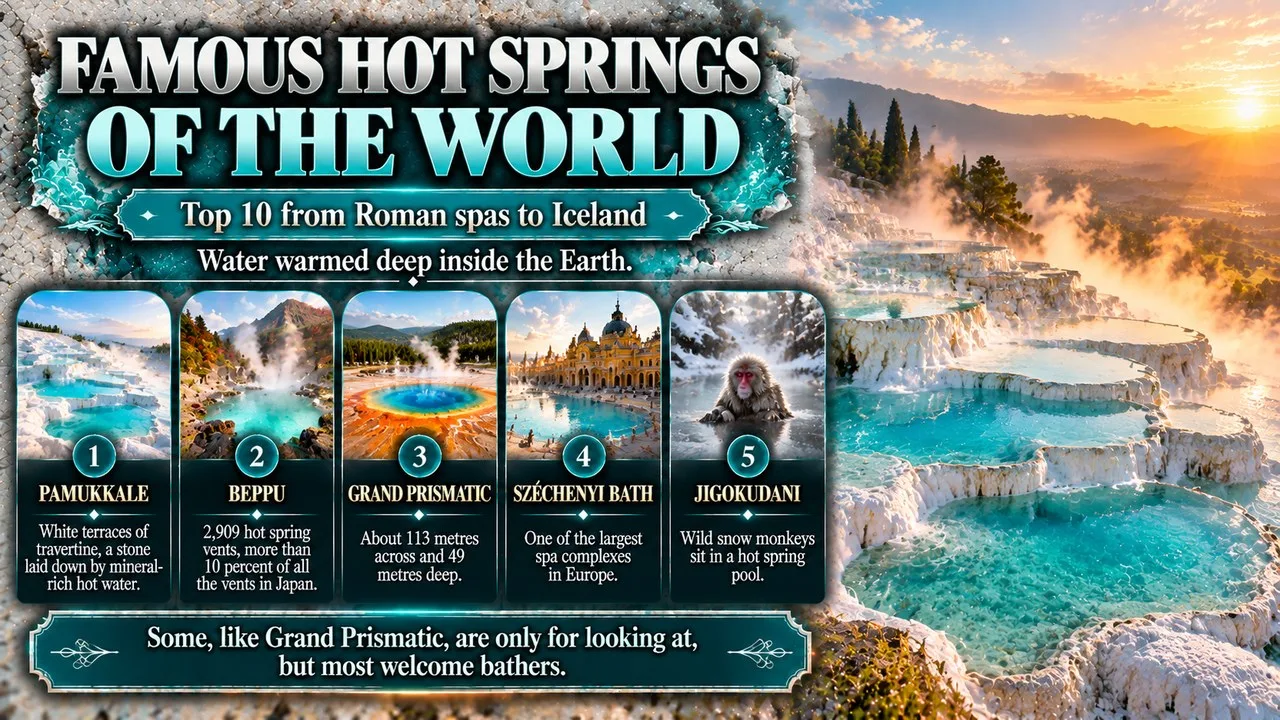
Famous hot springs of the world range from white terraces of Pamukkale and the Roman Baths of England to Iceland's Blue Lagoon and Japan's snow monkeys.
This Finepedia guide, written in October 2026, looks at ten famous hot springs, from ancient spa towns to a colourful pool in Yellowstone that nobody may enter. Each entry gives the water temperature or flow where it is known, the history of bathing at the site and what makes it special. For more of the planet's hot spots, see the Finepedia guide Top 10 Most Stunning Volcanoes in the World.
A hot spring is a spring of water that has been heated underground, usually by volcanic rock or by deep circulation through the Earth's crust [1]. Rain or snowmelt seeps down through cracks, warms as it sinks and rises again through faults, picking up minerals along the way. People have bathed in hot springs for thousands of years, for health, for pleasure and as part of religious ritual, and many of the world's spa towns grew up around a single source.
How We Chose These
We picked hot springs that are famous around the world for their beauty, their history or their bathing culture. The list runs roughly in order of when people began using or recording each spring, from ancient times to the 1970s. Nine of the ten can be bathed in, at least in part, and one is included because it is the most photographed hot spring on Earth. Water temperatures change over time, so treat every figure as approximate.
The 10 Famous Hot Springs at a Glance
| No. | Hot spring | Country | Famous for | Bathing |
|---|---|---|---|---|
| 1 | Pamukkale and Hierapolis | Turkey | white travertine terraces | yes, in set pools |
| 2 | Roman Baths, Bath | United Kingdom | Roman bath house | at the nearby modern spa |
| 3 | Saturnia | Italy | waterfall of warm pools | yes |
| 4 | Beppu | Japan | huge output of hot water | yes |
| 5 | Hot Springs, Arkansas | United States | Bathhouse Row | yes |
| 6 | Grand Prismatic Spring | United States | rainbow colours | no |
| 7 | Banff hot springs | Canada | birthplace of Canada's national parks | yes, at the Upper Hot Springs |
| 8 | Széchenyi Thermal Bath | Hungary | one of Europe's largest spas | yes |
| 9 | Jigokudani Monkey Park | Japan | wild monkeys in hot pools | no, monkeys only |
| 10 | Blue Lagoon | Iceland | milky blue water | yes |
1. Pamukkale Has Terraces of White Stone
Pamukkale, Turkish for "cotton castle", is a hillside in southwestern Turkey covered in white terraces of travertine, a stone laid down by mineral-rich hot water [2]. The area has 17 hot springs, with temperatures from about 35 °C to 100 °C. The ancient Greek city of Hierapolis was built on top of the travertine formation, which is about 2,700 metres long. Hierapolis-Pamukkale became a World Heritage Site in 1988 [3].
Key Facts
- Location: Denizli Province, Turkey
- Springs: 17, from about 35 °C to 100 °C
- Rock: white travertine terraces
- World Heritage: 1988, as Hierapolis-Pamukkale
Did You Know?
Visitors can bathe in the Antique Pool, often called Cleopatra's Pool, where ancient marble columns lie under the warm water [2]. To protect the terraces, people must walk on them barefoot.
2. Bath's Roman Baths Still Steam After 2,000 Years
The city of Bath in England grew up around Britain's most famous hot springs, used since Roman times. The Romans built a temple on the site between AD 60 and 70 and a bath house around it, and the town became known as Aquae Sulis [4]. Hot water at about 46 °C rises here at a rate of about 1.17 million litres a day. The Roman Baths are now a museum, and visitors can no longer bathe in them. The City of Bath is a World Heritage Site [5].
Key Facts
- Location: Bath, Somerset, England
- Water: about 46 °C, about 1.17 million litres a day
- Built: temple from AD 60 to 70
- Roman name: Aquae Sulis
Did You Know?
The water fell as rain on the nearby Mendip Hills thousands of years ago and sank through limestone to a depth of 2,700 to 4,300 metres before rising again [4]. Bathers today use a modern spa next to the old baths, fed by a newer borehole.
Related: Top 10 Best Attractions in Iceland
3. Saturnia Pours Over a Mill Waterfall
Near the village of Saturnia in southern Tuscany, about 800 litres of sulphur-rich water a second, at about 37 °C, gush over a waterfall into a chain of natural pools [6]. The best known spot, the Cascate del Mulino, or mill falls, sits beside an old mill and is free to visit at any hour. The pools were formed by minerals settling out of the warm water. A nearby spa resort uses the same springs.
Key Facts
- Location: Saturnia, Grosseto, Tuscany, Italy
- Water: about 37 °C, rich in sulphur
- Flow: about 800 litres a second
- Best known pools: Cascate del Mulino
Did You Know?
A local legend says that the god Saturn grew tired of human wars and threw a thunderbolt to Earth, creating a warm spring that would calm people down [6]. The village is named after him.
4. Beppu Has More Hot Water Than Anywhere in Japan
Beppu, on the island of Kyushu, has 2,909 hot spring vents, more than 10 percent of all the vents in Japan [7]. The volume of water it discharges is the largest in Japan and the second largest in the world, after Yellowstone. In the Kamakura period, from the late 12th century, wounded samurai came to Beppu to heal in its waters [8]. The town has hundreds of public baths, sand baths and steam baths.
Key Facts
- Location: Beppu, Ōita Prefecture, Japan
- Vents: 2,909
- Output: the largest in Japan, second only to Yellowstone
- Spa use: since at least the Kamakura period
Did You Know?
Beppu's seven famous "hells", or jigoku, are springs for looking at rather than bathing in [9]. The Sea Hell is a vivid blue, and the Blood Pond Hell is coloured red by minerals.
5. Hot Springs, Arkansas Is America's Oldest Federal Reserve
The springs on Hot Springs Mountain in Arkansas flow at an average of about 62 °C [10]. In 1832 the United States Congress set the area aside as Hot Springs Reservation, decades before Yellowstone became the first national park, and it was made a national park in 1921. The town became a famous spa, and its Bathhouse Row holds the grandest group of bathhouses of its kind in the country. Two bathhouses still offer thermal baths.
Key Facts
- Location: Hot Springs, Arkansas, United States
- Water: about 62 °C on average
- Protected: 20 April 1832
- National park: since 4 March 1921
Why It Matters
Because of its 1832 date, Hot Springs is the oldest park now run by the National Park Service [10]. That is why it was the first park chosen for the America the Beautiful quarter coin series.
Related: Top 10 Best Attractions in Budapest
6. Grand Prismatic Spring Glows in Rainbow Colours
Grand Prismatic Spring in Yellowstone National Park is the largest hot spring in the United States and the third largest in the world [11]. It is about 113 metres across and 49 metres deep. Its bright bands of orange, yellow and green come from mats of heat-loving bacteria and archaea living around the edges, while the hot centre is a deep blue. Geologists of the Hayden Survey noted it in 1871 and named it for its colours.
Key Facts
- Location: Midway Geyser Basin, Yellowstone, Wyoming, United States
- Size: about 113 metres across, 49 metres deep
- Colours: made by heat-loving microbes
- Named: 1871, by the Hayden Geological Survey
Why It Matters
Bathing is banned, and visitors must stay on boardwalks, because the water is scalding and the ground around it is thin. Yellowstone is a World Heritage Site and holds about half of all the world's geysers.
7. Banff's Hot Springs Started Canada's National Parks
In 1883 three Canadian Pacific Railway workers climbed down into a cave on the slopes of Sulphur Mountain and found warm springs inside [12]. A dispute over who owned the springs led the government in 1885 to set aside the land as the Banff Hot Springs Reserve, the start of Canada's national park network. The Cave and Basin is now a national historic site. Higher up the mountain, the Banff Upper Hot Springs, at 1,585 metres, is the highest hot spring in Canada [13].
Key Facts
- Location: Sulphur Mountain, Banff, Alberta, Canada
- Found by railway workers: 1883
- Protected: 1885, as the Banff Hot Springs Reserve
- Upper Hot Springs elevation: 1,585 metres
Did You Know?
The warm pools of the Cave and Basin are home to the Banff Springs snail, a tiny animal found nowhere else on Earth [12]. Visitors may not bathe there, to protect it.
8. The Széchenyi Bath Is a Palace of Thermal Pools
The Széchenyi Thermal Bath in Budapest's City Park is one of the largest spa complexes in Europe [14]. It opened in June 1913 in a grand yellow building designed by Győző Czigler, and it is named after the statesman István Széchenyi. Its water comes from two thermal springs at about 74 °C and 77 °C, cooled for bathing. The complex has indoor and outdoor pools, saunas and steam rooms.
Related: Top 10 Most Bizarre Phobias: Strange Fears That Exist
Key Facts
- Location: City Park, Budapest, Hungary
- Opened: June 1913
- Springs: two, at about 74 °C and 77 °C
- Architect: Győző Czigler
Did You Know?
Players gather in the steaming outdoor pools to play chess on floating boards, even in winter. Budapest has so many thermal springs that it is often called the City of Spas.
9. Jigokudani's Snow Monkeys Take Hot Baths
Jigokudani Monkey Park in Nagano Prefecture, Japan, is famous for its wild Japanese macaques, known as snow monkeys, which sit in a hot spring pool to keep warm [15]. The valley's name means "hell's valley", after the steam and boiling water that rise from the ground. The monkeys come down to the valley in winter, and because park staff feed them, hundreds can be seen there at any season. The park is part of Jōshin'etsu Kōgen National Park.
Key Facts
- Location: Yamanouchi, Nagano Prefecture, Japan
- Bathers: wild Japanese macaques
- Best season: winter, when snow covers the valley
- Park: part of Jōshin'etsu Kōgen National Park
Did You Know?
People may not bathe in the monkeys' pool, but there are human hot spring inns a short walk away. Scientists have found that monkeys that bathe in winter have lower levels of stress hormones.
10. The Blue Lagoon Is Fed by a Power Station
Iceland's Blue Lagoon sits in a lava field on the Reykjanes Peninsula and is supplied by water used in the nearby Svartsengi geothermal power station [16]. Its milky blue colour comes from silica, which also forms a soft white mud that bathers rub on their skin. The water in the bathing area averages 37 °C to 39 °C. It is one of Iceland's most visited attractions.
Key Facts
- Location: Reykjanes Peninsula, Iceland
- Water: about 37 °C to 39 °C
- Source: water from the Svartsengi power station
- Colour: milky blue, from silica
Why It Matters
Since 2023 the lagoon has had to close several times because of volcanic eruptions on the Reykjanes Peninsula. Earth walls were built to keep lava away from the power station and the spa.
Related: Top 10 Oldest Buildings in the World
Frequently Asked Questions
What makes a hot spring hot?
Water seeps deep underground, where it is heated by hot rock or by magma, and then rises back to the surface through cracks [1]. In volcanic areas the heat source is close to the surface, while elsewhere the water may sink kilometres deep, as it does at Bath.
Is it safe to bathe in hot springs?
At managed pools, yes, as long as you follow the rules. In wild springs the water can be scalding, acidic or home to harmful microbes, so it is unsafe to bathe anywhere that is not clearly marked for bathing.
Is the Blue Lagoon a natural hot spring?
Not exactly. It is filled by water used in the Svartsengi geothermal power station, which comes from deep under the lava field [16]. The water is natural, but the lagoon formed as a result of the power plant.
What is an onsen?
Onsen is the Japanese word for a hot spring and for the bathing places built around one. Japan has more than 27,000 hot spring vents, and bathing in onsen is a central part of Japanese culture [7].
Conclusion
Famous hot springs of the world show how the Earth's hidden heat has shaped places where people rest, heal and gather, from Roman Bath to Budapest. Some, like Grand Prismatic, are only for looking at, but most welcome bathers. For more natural wonders, read the Finepedia guides Top 10 Most Stunning Volcanoes in the World and Top 10 Most Unusual Lakes in the World.
- ^ [1] "Hot spring". Wikipedia. Hot spring on Wikipedia.
- ^ [2] "Pamukkale". Wikipedia. Pamukkale on Wikipedia.
- ^ [3] "Hierapolis-Pamukkale". UNESCO World Heritage Centre. UNESCO listing 485.
- ^ [4] "Roman Baths (Bath)". Wikipedia. Roman Baths on Wikipedia.
- ^ [5] "City of Bath". UNESCO World Heritage Centre. UNESCO listing 428.
- ^ [6] "Saturnia". Wikipedia. Saturnia on Wikipedia.
- ^ [7] "Beppu Onsen". Wikipedia. Beppu Onsen on Wikipedia.
- ^ [8] "Beppu". Wikipedia. Beppu on Wikipedia.
- ^ [9] "Hells of Beppu". Wikipedia. Hells of Beppu on Wikipedia.
- ^ [10] "Hot Springs National Park". Wikipedia. Hot Springs National Park on Wikipedia.
- ^ [11] "Grand Prismatic Spring". Wikipedia. Grand Prismatic Spring on Wikipedia.
- ^ [12] "Cave and Basin National Historic Site". Wikipedia. Cave and Basin on Wikipedia.
- ^ [13] "Banff Upper Hot Springs". Wikipedia. Banff Upper Hot Springs on Wikipedia.
- ^ [14] "Széchenyi thermal bath". Wikipedia. Széchenyi thermal bath on Wikipedia.
- ^ [15] "Jigokudani Monkey Park". Wikipedia. Jigokudani Monkey Park on Wikipedia.
- ^ [16] "Blue Lagoon (geothermal spa)". Wikipedia. Blue Lagoon on Wikipedia.
- [17] "10 Great Hot Springs You Can Bathe In". 10 Most Today. Topic reference on 10mosttoday.com.





















Discussion
Log in with