






 By
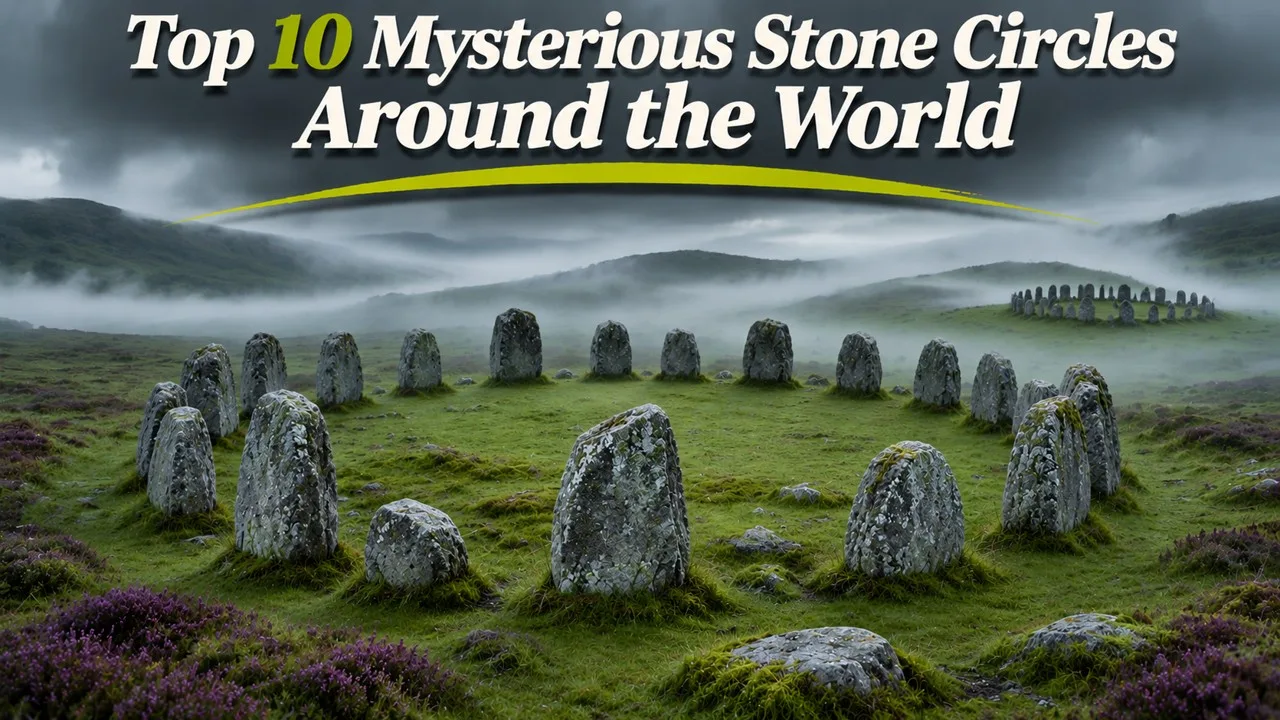
Stonehenge is only one of many documented stone circles, from a Wyoming medicine wheel and Jomon Japan to a solstice site in Amapa, Brazil. The ten sites below are all on the archaeological record: surveyed, dated where dating is possible, and described in official or standard scholarly sources [1][6][10]. This list is not a collection of unsolved riddles. "Mysterious" here means that purpose, sequence, and meaning are still argued, as they are for most prehistoric monuments, not that the stones arrived without human labor [1][9].
The selection is slightly more global than a list that stays on one moor. Three well-known Cornish circles could have filled a third of the page; one of them is replaced here by the Callanish stones on the Isle of Lewis, so that a second British tradition, and a different landscape, is represented [8].
Key Facts
A stone circle is a human-built ring, or a set of rings, of standing stones or laid boulders. Some are funerary, some appear to mark solar or lunar events, and many probably served more than one role over time.
Ten Documented Circles at a Glance
| Rank | Site | Place | What is firmly known |
|---|---|---|---|
| 1 | Stonehenge | Wiltshire, England | A long-lived ceremonial monument with a well-studied construction sequence |
| 2 | Bighorn Medicine Wheel | Wyoming, United States | A stone wheel on a high ridge, still a Native ceremonial place |
| 3 | Carisbrook stone arrangement | Victoria, Australia | An Aboriginal stone arrangement, recorded and protected |
| 4 | The Hurlers | Bodmin Moor, Cornwall | Three adjacent Late Neolithic or Early Bronze Age circles |
| 5 | The Merry Maidens | West Cornwall | A well-preserved ring with a later folk name |
| 6 | The Oyu stone circles | Kazuno, Japan | Large Jomon ceremonial stone circles |
| 7 | Dolni Glavanak | Southern Bulgaria | A cromlech-like circle in the Eastern Rhodope |
| 8 | Callanish (Calanais) | Isle of Lewis, Scotland | A circle with avenues, older in plan than a simple ring |
| 9 | Rujm el-Hiri | Golan Heights | Concentric stone walls and a central cairn, of debated function |
| 10 | Calçoene / Solstice Park | Amapá, Brazil | A later prehistoric stone enclosure used in solstice observations |
1. Stonehenge
Stonehenge, on Salisbury Plain in Wiltshire, is the most heavily studied stone circle in the world, which is a reason to start with it and a reason not to stop with it [1]. Its sequence runs from early earthwork and burial activity, through bluestones transported from the Preseli hills in Wales, to the great sarsen circle and horseshoe, with later reuse and rearrangement [1]. Alignments with the solstices are real and measurable. They do not exhaust the site's use as a cemetery, a gathering place, and a monument that was altered over centuries.
The "mystery" that remains is not whether people built it. It is how, exactly, a prehistoric society organized the labor, why particular stones were moved so far, and how ritual, astronomy, and ancestry were combined. Official excavation, survey, and a large specialist literature make those questions more precise, not more occult.
2. The Bighorn Medicine Wheel
The Bighorn Medicine Wheel, in the Bighorn National Forest of Wyoming, is a stone circle with radiating spokes and cairns on a high mountain ridge [2]. Archaeological work and Native testimony treat it as a ceremonial and observational site, with alignments that have been related to solar and stellar events, and as a place that remains sacred to several Plains peoples [2]. It is not a European "henge" transplanted to the Rockies, and it should not be described as an orphaned riddle.
The unusual documented fact is the form: a wheel, at altitude, still used, and protected as a landmark. Interpreting it without the people who still visit it would be a mistake. The stones are a monument and a continuing religious place.
Related: Top 10 Architectural Wonders of the Ancient World
3. The Carisbrook Stone Arrangement
Near Carisbrook, in central Victoria, a stone arrangement attributed to Aboriginal builders has been recorded as an archaeological and cultural site [3]. Australian stone arrangements vary widely in plan; some are circles or arcs, some are more complex figures, and many are tied to ceremony and to knowledge that is not all in the public record [3]. A responsible description stops at what survey and traditional owners have chosen to make public.
This entry is here because a list of "stone circles around the world" that never left Europe would be a distortion. The Carisbrook arrangement is a documented Australian site, not a curiosity item, and its meanings belong first to the people whose country it is on.
4. The Hurlers
The Hurlers, near Minions on Bodmin Moor in Cornwall, are a group of three stone circles in a line, dating to the Late Neolithic or Early Bronze Age [4]. The name comes from a later legend about men turned to stone for playing a Sunday game, which is folklore about the monument, not evidence for its original use [4]. The circles have been excavated and restored in part, and they sit in a wider moorland of ceremonial and mining remains.
Three rings together are the unusual, checkable fact. A single circle can be a local gathering place. A row of three suggests a more composed ceremonial landscape, even if the exact script of that ceremony is lost.
5. The Merry Maidens
The Merry Maidens, or Dawn's Men, near St Buryan in west Cornwall, are a well-preserved late-Neolithic or early Bronze Age stone circle, a ring of regular granites in relatively open ground [5]. As at the Hurlers, a later story — girls turned to stone for dancing — has attached itself to the site and has nothing useful to say about prehistoric practice [5]. The circle is easy to visit and easy to photograph, which is why it is famous, and it remains a standard example of a Cornish ring.
Related: Top 10 Lost Cities That Were Rediscovered
Its value on this list is as a comparatively complete, still-standing plan. Many British circles are ruined to a few stumps. The Maidens still read as a ring, which is what allows later viewers, sometimes too quickly, to invent a dance.
6. The Oyu Stone Circles
The Oyu stone circles, at Kazuno in Akita Prefecture, are among the most important Jomon-period ceremonial sites in Japan, and they form part of a UNESCO World Heritage inscription of Jomon sites in the north of the country [6]. Two large arrangements, often called the Manza and Nonakado circles, were built of river stones in the late Jomon, with burials, earthworks, and a plan that is circular at a scale different from a Cornish ring of standing pillars [6].
They matter because they show that the "stone circle" is not a uniquely Atlantic idea. A hunter-gatherer society with a long, settled village tradition in northern Japan also composed circular ceremonial ground in stone. The comparison with Stonehenge is useful only if it is a comparison, not a claim that one site is a copy of the other.
7. Dolni Glavanak
The cromlech at Dolni Glavanak, in the Eastern Rhodope of southern Bulgaria, is a circle of standing stones, investigated by Bulgarian archaeologists and dated, in published work, to later prehistory, with use stretching through the Iron Age in some interpretations [7]. It is less famous in English-language lists than the British rings, which is not a measure of its quality as a site. The regional context includes other sacred enclosures and rock-cut places in the Rhodope.
Including it is a way of remembering that southeastern Europe has its own prehistoric circles, not only tombs and cities. The "cromlech" label is a convenience. The archaeology is local: a ring, a setting, a sequence that has to be read from excavation, not from a British legend.
Related: Top 10 Oldest Surviving Buildings on Earth
8. Callanish
The Callanish stones, or Calanais, on the Isle of Lewis in the Outer Hebrides, are a circle with a tall central stone and rows that form a kind of avenue or cruciform approach, set in a wider landscape of other circles and cairns [8]. Construction began in the late Neolithic. Later generations inserted burials, and later still the stones were partly buried in peat until modern clearance and study [8]. Lunar alignments, especially a dramatic southern moon event in the landscape, have been carefully argued in the specialist literature.
This site stands in for a third Cornish ring that would have duplicated the Merry Maidens and the Hurlers. Callanish is not a simple circle. It is a composed monument, as architectural in plan as Stonehenge, in a very different stone and weather, and it has a Gaelic name and a Hebridean setting that a Cornwall-only list would miss.
9. Rujm el-Hiri
Rujm el-Hiri — also known as Rogem Hiri and as Gilgal Refaim — is a massive complex of concentric stone walls and a central cairn in the Golan Heights [9]. Surveys and excavations have produced dates in later prehistory, often in the Chalcolithic or Early Bronze Age, and a long list of proposed functions: a tomb, a ceremonial enclosure, an astronomical device, or a combination [9]. None of those proposals is a consensus. The masonry, the scale, and the plan are not in doubt.
The site sits in a politically contested landscape. This entry is about the archaeology: a built, concentric stone monument, unusual in plan, still being interpreted. It is not a place on which to hang later myths about "wheels of giants" as if they were excavation results.
Related: Top 10 Ancient Sites That Keep Yielding New Finds
10. The Calçoene Stones
At Calçoene, in the state of Amapá in northern Brazil, a later prehistoric stone enclosure has been excavated and presented as the Solstice Archaeological Park, sometimes nicknamed, unhelpfully, an "Amazon Stonehenge" [10]. Researchers have described granite blocks set in a roughly circular plan, with at least one opening that aligns with the December solstice, and a context in the pre-colonial societies of the Guianas and the Amazon's northern fringe [10]. Work is still relatively recent compared with the British sites, and interpretation should stay close to the published archaeology.
The nickname is a marketing problem, not a finding. The useful fact is that a solstice-oriented stone enclosure exists in northern Brazil, was built by Indigenous predecessors, and can be visited and studied as a park. A world list of circles that stopped at the Atlantic would have missed it.
Conclusion
Stone circles are a widespread way of making a place: a ring that people can stand in, align, bury in, and return to. The ten above run from Wiltshire and the Hebrides to Cornwall, Wyoming, Victoria, northern Japan, Bulgaria, the Golan Heights, and Amapá. Their builders were not one culture, and their purposes were not one purpose.
What they share is a documentary trail — survey, excavation, heritage listing, or a careful ethnographic record — that is more interesting than a rumour of mystery. The stones are heavy, local, and human. The arguments that remain are arguments about meaning, date, and use, which is the ordinary unfinished business of archaeology.
- ^ [1] "Stonehenge." English Heritage and Encyclopaedia Britannica. English Heritage: Stonehenge
- ^ [2] "Bighorn National Forest — Medicine Wheel." U.S. Forest Service. U.S. Forest Service: Medicine Wheel
- ^ [3] Heritage records of the Carisbrook stone arrangement, Victoria. Aboriginal Victoria / state heritage listings. Heritage Victoria
- ^ [4] "The Hurlers stone circles." Historic England. Historic England: The Hurlers
- ^ [5] "The Merry Maidens." Historic England and Cornwall heritage overviews. Historic England
- ^ [6] "Jomon Prehistoric Sites in Northern Japan," including the Oyu stone circles. UNESCO World Heritage Centre. UNESCO: Jomon prehistoric sites
- ^ [7] Archaeological publications on the Dolni Glavanak cromlech, Eastern Rhodope, Bulgaria. Wikipedia: Dolni Glavanak cromlech
- ^ [8] "Calanais Standing Stones." Historic Environment Scotland. Historic Environment Scotland: Calanais
- ^ [9] "Rujm el-Hiri." Archaeological overviews of the concentric stone complex in the Golan Heights. Wikipedia: Rujm el-Hiri
- ^ [10] Research and park presentations of the Calçoene megalithic enclosure, Amapá, Brazil. Wikipedia: Calçoene



















Discussion
Log in with