





 By
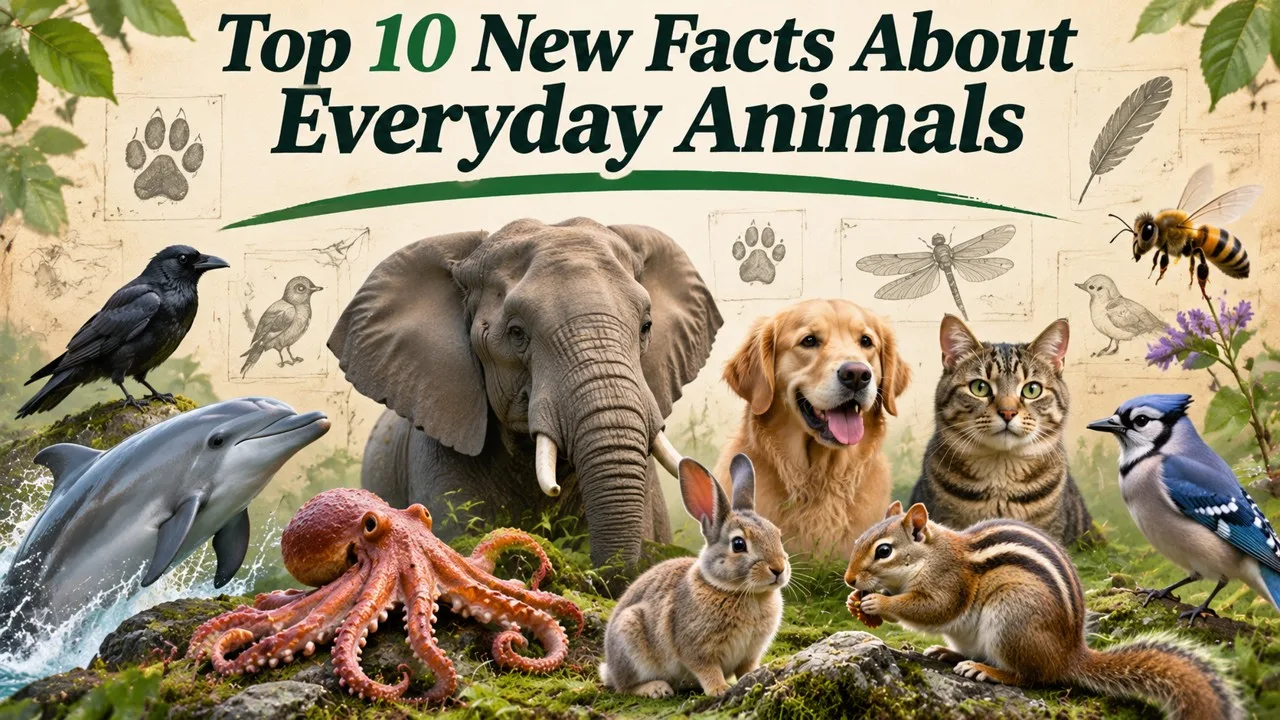
Bogong moths can steer by the stars, and nematode worms can stack themselves into living towers, two of the clearer recent results on familiar animals. "Everyday" is a relative word. A house dog, a house cat, and a garden moth are ordinary. A blue shark, a Burmese python, and a sea spider are everyday only in the sense that they are living animals, not mythical ones, and that new papers have still found something unexpected in them [3][4][9]. This list is built so that it does not simply repeat the octopus, courtship, music, or unexpected-ability lists in the same batch. Where a python's digestion of bone is mentioned, the description stays physiological. It does not become a feeding scene [4].
The ten items are recent or newly sharpened facts, with the usual duty not to oversell a single paper.
Key Facts
A new fact about a familiar animal is still only as strong as the study behind it. Several of the results below are fresh and should be allowed to age in the literature.
Ten Findings at a Glance
| Rank | Animal | Finding | Caution |
|---|---|---|---|
| 1 | Dogs | Attention to television can vary with personality and with what is on the screen | Not every breed or household will show the same pattern |
| 2 | Moths and tomato plants | Stressed plants can emit ultrasonic sounds, and moths may avoid laying eggs on them | The plants are not "screaming" in the human sense |
| 3 | Blue sharks | Skin nanostructures may allow a color shift with conditions such as pressure | Confirmation in wild, swimming sharks is still needed |
| 4 | Burmese pythons | They can break down swallowed bone with unusual completeness | The fact is digestive physiology, not a spectacle |
| 5 | Domestic cats | A recent study reported a tendency to sleep on the left side | A tendency is not a rule for every cat and every nap |
| 6 | Octopuses | Suckers are chemotactile, tasting as they touch, including chemical cues from microbes | This is not a second, separate tongue in each arm in the casual sense |
| 7 | Killer whales | Some populations show reciprocal grooming or close contact care | The behavior is social, and it varies by group |
| 8 | Bogong moths | They can use the night sky, including stars, to navigate a long migration | The stellar compass is part of a larger cue mix |
| 9 | Sea spiders at seeps | Some species make use of methane-linked food webs on the seafloor | They are not "eating methane" as if it were a gas snack |
| 10 | Nematode worms | Individuals can assemble into living towers that help with dispersal | A laboratory tower is a clue to a wild habit, not the whole story |
1. Dogs Do Not All Watch the Same Way
A domestic dog can glance at a screen, track a moving animal, or ignore the set entirely, and recent work has asked whether personality, and the kind of image on the screen, helps to explain the difference [1]. More socially engaged or visually reactive dogs, in some tests, attend more to certain kinds of footage than calmer or less social animals do [1]. The result is a small piece of companion-animal science, not a theory of canine cinema. It also depends on a thoroughly un-natural object, a television, being present in the room.
The everyday animal, in this case, is everyday because it shares a sofa. The new fact is that the sofa experiment can be done with a bit of rigor.
2. Moths and the Sound of a Stressed Plant
Tomato plants, and other plants, can emit high-frequency sounds when they are dry or cut, a finding that reached a wide audience after work led by researchers including Itzhak Khait and colleagues [2]. The sounds are ultrasonic, outside ordinary human hearing, and they are a physical consequence of stress in the stem, not a cry for help in any folk sense [2]. Follow-up and related work has asked whether female moths, which must choose a plant on which to lay eggs, avoid the "noisy," stressed individuals. That would be an ecological use of a cue, and it should be stated as a developing result, not as a completed fable about screaming vegetables.
If moths do steer clear, the useful picture is a mother insect avoiding a poor host, not a plant raising an alarm bell.
Related: Top 10 Most Intelligent Animals
3. A Blue Shark's Changeable Blue
The blue shark's color comes, in part, from photonic nanostructures, including guanine crystals in the skin, rather than only from a simple pigment paint [3]. A 2025 study reported that those structures can shift with pressure or humidity, tightening or loosening the spacing and moving the color between blue and greener or gold tones, a mechanism popularly compared to a chameleon even though the animals are not close relatives and the skin is not the same [3]. The authors themselves have noted that the effect still needs to be confirmed in wild sharks at depth. That caution belongs in the first telling, not in a footnote.
Structural color that can be tuned is already a strong result, even before the last field test is in.
4. How a Python Handles Bone
A Burmese python can swallow prey whose skeleton would be a problem for many predators, and recent physiological work has described how the snake's gut can dissolve bone with unusual completeness, through acid, enzymes, and intestinal processes that recover the minerals [4]. The fact is about digestion, timing, and a gut that can be remodeled after a large meal. It is not an invitation to dwell on the prey [4]. Bone that is fully broken down does not appear later as a pellet, which is the surprising comparative point for readers used to owls or other animals that regurgitate leftovers.
The everyday animal, here, is everyday only in captivity and in parts of its introduced range. The new fact is a gut, not a scene.
5. Cats and a Preferred Side
A recent study of sleeping cats reported a bias toward lying on the left side, a finding that, if it holds, may relate to lateralization in the brain and to the way an animal prefers to wake and face the world [5]. Popular coverage has been quicker than the data: the result is a tendency in a sampled group, not a law that your cat has agreed to obey [5]. Side biases exist in many species, and they are often small. A reader who owns a cat that sleeps in a spiral, or always on the right, has not disproved biology. They have met individual variation.
Related: Top 10 Unexpected Abilities Found in Animals
The useful version of the paper is modest, and still interesting, because an everyday nap turns out to have a statistic.
6. Octopus Suckers That Taste as They Touch
An octopus samples the world with its arms. The suckers carry chemotactile receptors, so the animal tastes and smells by touching, a fact that has been sharpened by molecular and behavioral work on how those receptors are tuned [6]. Recent papers have included the detection of microbial and other chemical cues, which would matter on a reef or in a den where surfaces are never clean in a laboratory sense [6]. The ability is not a metaphor. It is a sense organ in a place where a human being would expect only a gripper.
This entry is about reception, not about a second tour of unusual octopus species already described elsewhere.
7. Killer Whales That Groom One Another
Some killer whale groups have been observed in close, apparently affiliative contact, including rubbing and grooming that can be returned, a reciprocal pattern more often discussed in primates than in dolphins [7]. Recent work has added detail, including reports of animals using kelp or other objects as part of a contact routine in some populations [7]. The behavior is social, it is not universal in every ocean, and it should not be flattened into a single cute story. Reciprocal care is still a meaningful finding in a predator that is more often filmed hunting than touching.
Related: Top 10 Colourful Parrots of the World
The contrast with another batch entry, in which pilot whales can move orcas on, is useful. The same species is a hunter in one context and a careful social partner in another.
8. A Moth That Reads the Night Sky
The bogong moth of Australia migrates long distances to alpine caves, and research led by scientists including David Dreyer and colleagues has shown that the moth can take a compass from the stars, a stellar navigation skill once thought to be the property of birds, seals, and people [8]. The insects can be tested in a planetarium-like setting, which is how the stellar component was isolated from other cues [8]. The sky is not their only guide. A magnetic sense and the landscape still belong in the story. The unexpected fact is that a moth, an everyday animal in a summer house in some parts of Australia, and a famous one in others, can steer by a pattern of stars.
Migration makes the skill necessary. The experiment made it visible.
9. Sea Spiders at a Methane Table
Some sea spiders live at methane seeps, where microbes turn a greenhouse gas into living carbon, and recent work has described how the animals can tap that food web, grazing on or otherwise taking up methane-linked production on the seafloor [9]. They do not "gobble methane" as a gas, which is why the popular verb needs a translator [9]. The everyday animal, in this case, is everyday only to a specialist. The new fact is a pathway: a pycnogonid standing in a chemical garden that starts with a leak from the seabed.
It is a reminder that an ordinary-looking arthropod can be part of an extreme chemistry.
Related: Top 10 Most Gluttonous Creatures in Nature
10. Worms That Build a Tower
Nematodes, including familiar laboratory species and related worms, have been shown to climb one another and assemble into living towers, a collective structure that can help the group attach to a passing animal or otherwise leave a crowded patch [10]. The images are strange, a wriggling architecture, and the analysis is about cooperation, dispersal, and when an individual should climb [10]. A tower in a dish is not automatically the same as a tower in the soil, but it is a strong clue that "a worm" is sometimes a team.
An everyday animal does not have to be a pet. It can be a millimetre-long worm doing something that, until the paper, almost no one had thought to watch.
Conclusion
The last few years have been kind to ordinary animals, or to animals that only look ordinary once they have a common name. A moth can migrate by the stars. A worm can become a tower. A shark's blue may be tunable. A plant can make a sound a moth might use, without "screaming" in any human way. A python's gut can finish a job that many digestive systems leave incomplete, and that fact can be told without turning the meal into the story.
The weaker items on the list are the ones that still need to settle: a sleep-side bias in cats, a television personality in dogs, a color shift not yet confirmed at sea. They are worth including if they are labeled as early. The stronger items do not need a label of that kind. They need only a careful sentence.
- ^ [1] Recent studies of how dogs attend to television and other screens, including personality differences. Britannica: Dog
- ^ [2] Khait, I. et al., and related work on ultrasonic sounds from stressed plants, and moth responses to those cues. Cell Press reporting on plant bioacoustics
- ^ [3] 2025 research on tunable photonic nanostructures and possible color change in blue shark skin. Britannica: Blue shark
- ^ [4] Physiological studies of bone digestion in Burmese pythons, described here in digestive terms only. Britannica: Python
- ^ [5] A recent study reporting a left-side sleeping tendency in domestic cats, summarized as a sample bias, not a universal law. Britannica: Cat
- ^ [6] Molecular and behavioral work on chemotactile receptors in octopus suckers, including sensitivity to chemical and microbial cues. Britannica: Octopus
- ^ [7] Observations of reciprocal grooming and affiliative contact, including object-assisted contact, in some killer whale populations. Britannica: Killer whale
- ^ [8] Dreyer, D. et al., on stellar navigation in the Australian bogong moth. Britannica: Owlet moth
- ^ [9] Research on sea spiders in methane-seep food webs, and their use of methane-linked carbon. Britannica: Sea spider
- ^ [10] Studies of collective "tower" assembly in nematodes and its role in dispersal. Britannica: Nematode




















Discussion
Log in with