






Top 10 Ideas That Changed How We Think About Black Holes
 By Dhiraj Sharma · Published
Share Post
Loading…
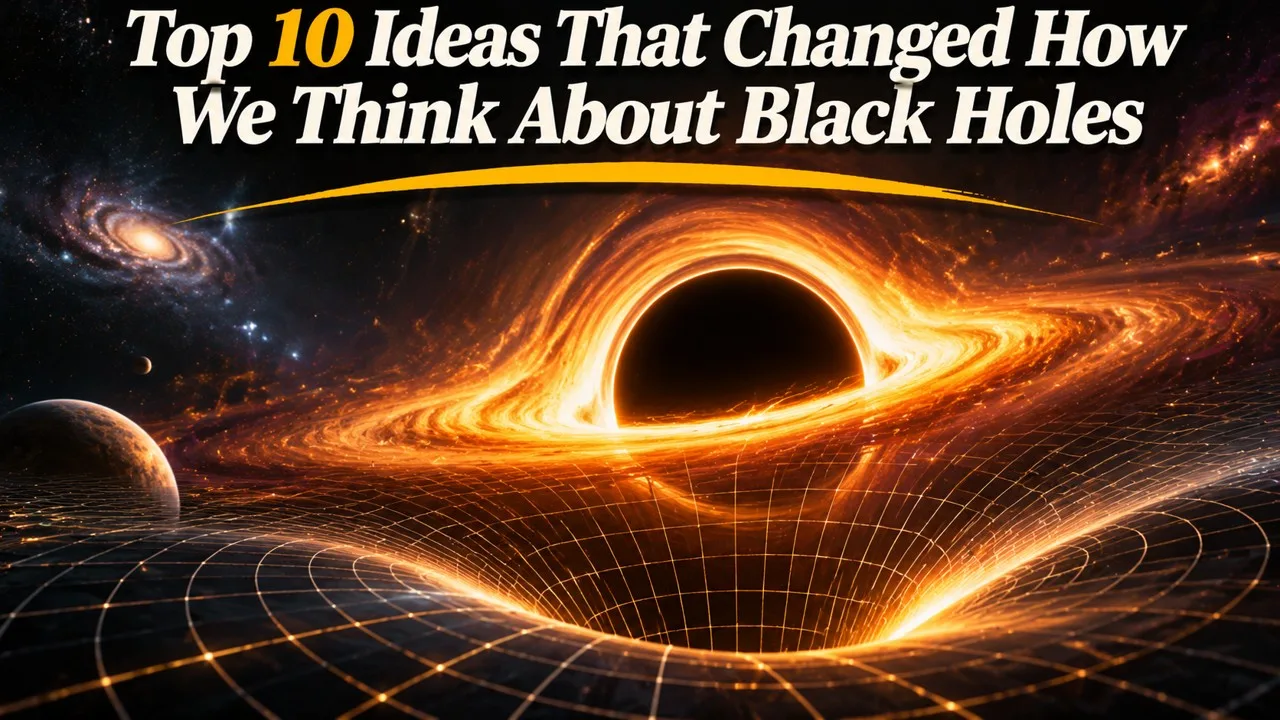
From Schwarzschild's solution to Hawking radiation and the first telescope image, ten ideas recast black holes from a quirk of equations into observed objects. Early on, a black hole was a mathematical region from which light could not escape [1]. Today the same objects are inferred from orbits, from gravitational waves, and from a ring of glowing plasma on the sky [8][9]. This list is a curated set of ten ideas, not a digest of every recent headline, and not a tour of speculation about living inside one.
Where a newer claim is still being tested — for example, that growing black holes might contribute to dark energy — it is labelled as such [10]. The better-settled ideas below are the ones that actually changed the working picture.
Key Facts
In general relativity, a black hole is a region bounded by an event horizon. Stellar-mass, intermediate, and supermassive black holes are now part of standard astrophysics, with distinct observational signatures.
Ten Ideas at a Glance
| Rank | Idea | Usual dating | What changed |
|---|---|---|---|
| 1 | The Schwarzschild solution and the event horizon | 1916, later clarified | A star's collapse could hide a surface behind a one-way boundary |
| 2 | The Chandrasekhar limit | 1930s | A white dwarf cannot be arbitrarily massive; collapse has a threshold |
| 3 | Oppenheimer–Snyder collapse | 1939 | A star could, in the theory, form a black hole in finite time |
| 4 | The Kerr rotating solution | 1963 | Real black holes should spin, with a more complex horizon and exterior |
| 5 | Cosmic censorship | 1969 onward | Singularities, if they form, should be hidden behind horizons |
| 6 | Hawking radiation | 1974–1975 | Black holes can slowly evaporate, with a temperature and a paradox |
| 7 | The information paradox and later answers | 1970s onward | Whether information is lost became a central theoretical test |
| 8 | Gravitational-wave detections of mergers | 2015 onward | Black-hole binaries became a recorded signal, not only a model |
| 9 | Horizon-scale images | 2019, 2022 | A bright ring around a dark region was photographed in two galaxies |
| 10 | Black holes and cosmic expansion | 2020s, still debated | A recent proposal links black-hole growth to dark energy; it is not settled |
1. The Event Horizon
In 1916, Karl Schwarzschild found a solution of Einstein's equations for a spherical mass, and later work showed that if the mass is packed inside a critical radius, now called the Schwarzschild radius, nothing, including light, can climb back out [1]. The boundary is the event horizon. For decades many physicists treated the solution as a curiosity, or worried that it was an artifact of coordinates. Later coordinate systems, and later theorems, made the horizon a real geometric feature, not a bookkeeping error [1].
The idea changed the subject because it turned a "dark star" intuition into a precise object in a field theory of gravity. A black hole, in this sense, is not a cosmic vacuum cleaner with a suction. It is a region defined by a causal boundary.
2. The Chandrasekhar Limit
In the early 1930s, Subrahmanyan Chandrasekhar showed that a white dwarf supported by electron degeneracy pressure cannot exceed a mass of about 1.4 solar masses, a limit that now bears his name [2]. Above that threshold, the star cannot remain a white dwarf. The result was controversial at the time, and it did not, by itself, prove that black holes exist. It did make stellar death a quantitative problem: some remnants have to become something denser, a neutron star or, if the mass is high enough, a collapse with no familiar surface [2].
Astrophysics after Chandrasekhar had a number, not only a metaphor, for when ordinary matter fails. Black holes became one of the possible endpoints of that failure.
Related: Top 25 Interesting Facts About the Universe
3. Collapse in Finite Time
In 1939, J. Robert Oppenheimer and Hartland Snyder published a general-relativistic model of a pressureless star collapsing through its Schwarzschild radius [3]. In the mathematics, an outside observer sees the collapse freeze and redden; a co-moving observer reaches the horizon in finite proper time. The paper is one of the first clear theoretical demonstrations that a black hole can form from stellar matter, not only sit in the equations as a static oddity [3].
The wartime and postwar decades did not immediately turn the result into observational astronomy. The idea was already in place: collapse is a process, and the horizon is a destination, not only a boundary drawn on a diagram.
4. The Kerr Solution
Almost every astrophysical object rotates. In 1963, Roy Kerr found a solution of Einstein's equations for a rotating black hole, later extended to include charge in the Kerr–Newman family [4]. The Kerr horizon is not a simple sphere in the same sense as Schwarzschild's, and the exterior contains an ergosphere, a region where spacetime is dragged so strongly that standing still, relative to distant stars, is impossible [4]. Energy can, in principle, be extracted from that rotation, an idea later associated with work by Roger Penrose and with models of jets.
The practical change was large. Once astronomers had spinning holes, they had a way to think about accretion disks, frame dragging, and the holes in real galaxies, which are not expected to sit still.
5. Cosmic Censorship
General relativity allows singularities, regions where the classical theory breaks down. In 1969, Penrose proposed, in what became known as cosmic censorship, that those singularities should be hidden behind event horizons, not left "naked" for distant observers to see [5]. The idea is a conjecture, not a theorem, and special counter-examples have been studied in restricted settings. It remains a guiding principle of classical black-hole physics [5].
Related: Quasars: Distant Beacons or Local Oddballs?
The change in thinking is almost philosophical, and it is also practical. If censorship holds, the outside universe is protected from the worst unpredictability of a singularity. If it failed in nature, the theory's predictive power would shrink. The conjecture is one reason physicists talk about horizons as a kind of dress code for collapse.
6. Hawking Radiation
In 1974 and 1975, Stephen Hawking argued that, once quantum field theory is considered on a black-hole background, the horizon should radiate, with a temperature inversely proportional to the hole's mass [6]. A stellar or supermassive hole is extremely cold; a tiny hole would be hot and short-lived. The calculation implied that black holes have an entropy, already associated with work by Jacob Bekenstein, and that they can, in the long run, evaporate [6].
The idea destroyed the picture of a black hole as a perfectly inert sink. It also created a problem that has not gone away: if the radiation looks thermal, what happens to the information that fell in?
7. The Information Paradox
Hawking's result suggested that a black hole could form from a unique, information-rich collapse and later evaporate into radiation that seemed not to encode that information, in tension with the reversibility expected in quantum theory [7]. For decades this "information paradox" has been a test of how gravity and quantum mechanics should fit together. Proposed resolutions have included subtle correlations in the radiation, the idea that information is stored on the horizon, and holographic arguments in which the interior is encoded on a boundary [7].
No single laboratory experiment has settled the paradox. The idea still changed the field, because a black hole became a thought-experiment about unitarity, entropy, and what a "horizon" is allowed to hide. Later popular physics sometimes treats the problem as solved. The careful literature treats it as a live constraint on any deeper theory.
Related: Top 10 Cosmic Puzzles Science Has Not Fully Solved
8. Mergers as a Detected Signal
On 14 September 2015, the LIGO detectors recorded a gravitational-wave signal, GW150914, interpreted as the merger of two black holes of tens of solar masses, with a later confirmation and a Nobel Prize in 2017 for the broader effort [8]. Since then, a catalog of binary black-hole and neutron-star mergers has made compact-object populations a statistical science, not only a set of X-ray binary case studies [8].
The change in thinking is empirical. Before LIGO, stellar-mass black-hole binaries in the distant universe were a theoretically expected source. After it, they are a dataset. The waves also offered a new test of the Kerr picture: the ringing of the final hole, in broad terms, has matched the idea of a spinning remnant.
9. A Picture of the Horizon Scale
In April 2019, the Event Horizon Telescope collaboration released an image of the supermassive black hole in the galaxy M87, a bright, lopsided ring around a dark central region; in 2022 it released a comparable image of Sagittarius A*, the hole at the centre of the Milky Way [9]. The ring is synchrotron emission from orbiting plasma, lensed by gravity, not a photograph of the horizon as a solid object [9]. Even so, the images made a horizon-scale structure into a public, checkable picture, and they fitted the expected shadow size from general relativity.
The idea that changed here is almost pedagogical. A black hole had been, for a century, a diagram. It is now also a resolved silhouette, built from many radio telescopes acting as one Earth-sized instrument.
Related: Gamma-ray Bursts: The Universe's Most Energetic Explosions
10. A Link to Cosmic Expansion, Still Tested
A 2023 line of work, associated with Duncan Farrah and colleagues, asked whether the growth of black holes in elliptical galaxies is consistent with a contribution to the universe's dark energy, a "cosmological coupling" idea that would, if right, change both black-hole physics and cosmology [10]. The claim is published and debated; it is not a consensus result, and later comments have been sceptical as well as interested. It belongs on this list only as a current idea that would, if it survived, be a major recasting, not as a fact already in the textbooks [10].
That caution is the point of closing with it. Some ideas about black holes became infrastructure. Some are still arguments. A responsible list should keep those boxes separate, and should not treat a press-friendly question such as "are we living inside a black hole?" as if it had the same standing as the Kerr solution or a LIGO event.
Conclusion
Black holes moved from a peculiar solution, through a mass limit and a collapse model, to spinning objects with conjectured censorship, a quantum temperature, an information problem, a gravitational-wave catalog, and a picture on the sky. The tenth idea, a possible link to dark energy, is still on probation. That sequence is the real change in thought: from "this cannot be physical" to "this is a class of objects we can count, weigh, and, in a radio sense, see."
The subject will keep moving. Horizon images will get sharper, merger catalogs will get larger, and the paradox will keep attracting new proposals. The ten ideas above are the spine that later work still has to live on.
- ^ [1] "Schwarzschild metric" and "event horizon." Encyclopaedia Britannica. Britannica: Schwarzschild radius
- ^ [2] "Subrahmanyan Chandrasekhar" and the white-dwarf mass limit. Encyclopaedia Britannica. Britannica: Chandrasekhar
- ^ [3] Oppenheimer, J.R. and Snyder, H., 1939. "On Continued Gravitational Contraction." Physical Review 56: 455–459. Physical Review: Oppenheimer and Snyder
- ^ [4] Kerr, R.P., 1963, and later overviews of rotating black holes. Britannica: Kerr black hole
- ^ [5] Penrose, R., on cosmic censorship; standard reviews of the conjecture. Wikipedia: Cosmic censorship hypothesis
- ^ [6] Hawking, S.W., 1974–1975, papers on black-hole radiation. Encyclopaedia Britannica. Britannica: Hawking radiation
- ^ [7] Overviews of the black-hole information paradox and holographic proposals. Wikipedia: Black hole information paradox
- ^ [8] Abbott, B.P. et al., 2016, "Observation of Gravitational Waves from a Binary Black Hole Merger," and later LIGO–Virgo–KAGRA catalogs. LIGO: First detection
- ^ [9] Event Horizon Telescope Collaboration, 2019 and 2022, images of M87* and Sagittarius A*. Event Horizon Telescope
- ^ [10] Farrah, D. et al., 2023, and subsequent discussion of cosmologically coupled black holes. Astrophysical Journal Letters: Farrah et al.



















Discussion
Log in with