






 By
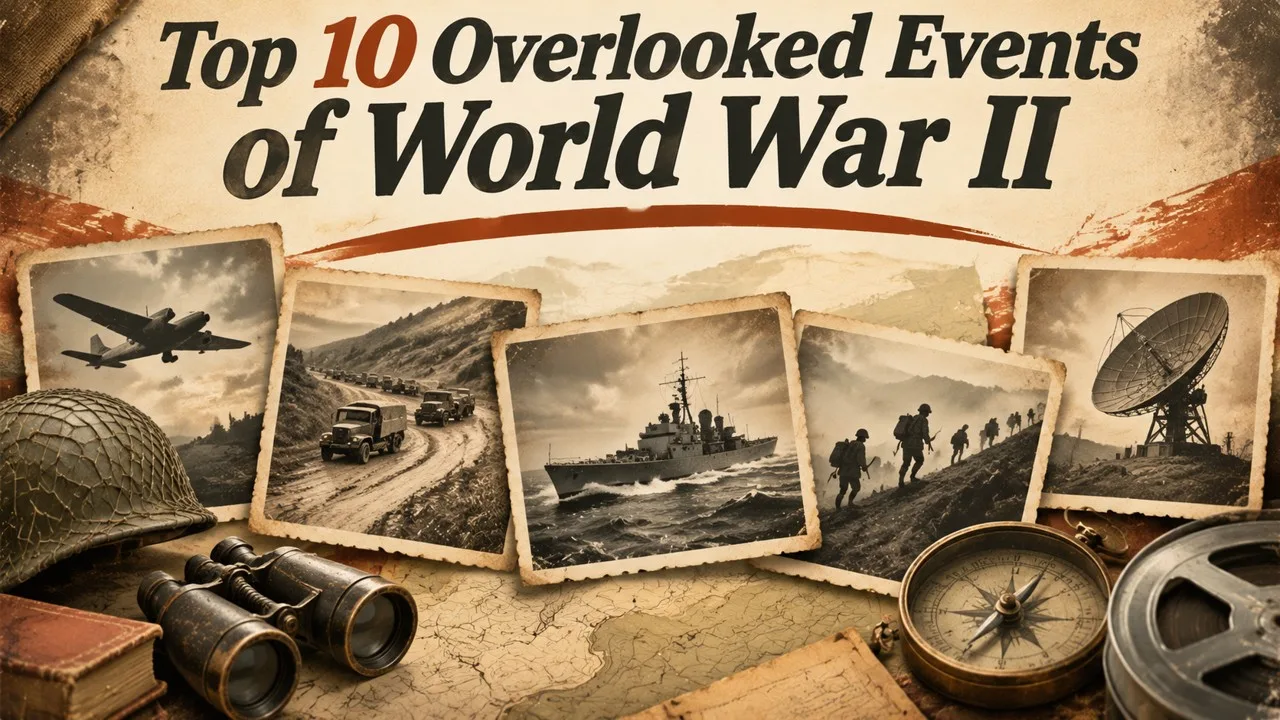
From the Rohna sinking and a canoe raid to balloon bombs and Attu, ten documented episodes sat at the edge of the familiar Second World War map. This list is a curated set of events that are well recorded in official histories, unit studies, or later scholarship, and that often missed the first wave of public memory [1][6][10]. The tone here is factual. Casualties are stated as numbers or as legal outcomes where they matter; this is not a catalogue of wounds, and it does not linger on violence [5][8].
"Overlooked" is relative. Specialists know all ten of these stories. A general reader who can name a handful of campaigns may still not have them on the mental map, which is the only reason they are grouped together [3][7].
Key Facts
The Second World War was larger than its most filmed battles. Convoys, rehearsals, prisoner camps, secret raids, and Arctic islands were part of the same war, with paper trails to match.
Ten Documented Episodes at a Glance
| Rank | Event | Date and place | Why it is easy to miss |
|---|---|---|---|
| 1 | Sinking of HMT Rohna | November 1943, Mediterranean | A huge troop loss, long under-publicized in the United States |
| 2 | Operation Postmaster | January 1942, Fernando Po | A small special-operations raid in then-neutral Spanish territory |
| 3 | Operation Halyard | 1944, occupied Yugoslavia | A large evacuation of airmen, awkward in later politics |
| 4 | The battle at Schloss Itter | May 1945, Austria | A late, small fight that does not fit simple side-taking |
| 5 | The Cowra breakout | August 1944, New South Wales | A major prisoner escape far from the European front |
| 6 | Exercise Tiger | April 1944, off Slapton Sands | A deadly rehearsal, kept quiet because of D-Day |
| 7 | The Fu-Go balloon campaign | 1944–1945, Japan to North America | A long-range weapon that left a thin, scattered record |
| 8 | Cephalonia after the Italian armistice | September 1943, Ionian Islands | A mass killing of Italian soldiers, long poorly publicized |
| 9 | The Bari air raid and a chemical cargo | December 1943, Italy | A port disaster whose mustard-gas element was officially muted |
| 10 | The Battle of Attu | May 1943, Aleutian Islands | A harsh island fight at the edge of the North Pacific |
1. The Sinking of HMT Rohna
On 26 November 1943, the troopship HMT Rohna, sailing in a convoy in the Mediterranean, was struck by a German guided bomb and sank with very heavy loss of life, most of it among United States soldiers [1]. The death toll was among the worst for a single American troop transport of the war, yet the event remained comparatively little known to the public for decades, in part because of wartime secrecy and later official caution [1]. Survivors' accounts and later memorial work eventually put the ship back on the record.
The overlooked quality is not a lack of documents. It is a mismatch between the scale of the loss and the space the story later occupied in popular memory, which preferred other convoy and landing names. Memorial associations have had to do some of the work that a wartime press office would not.
2. Operation Postmaster
In January 1942, a small Special Operations Executive party seized Axis-associated ships in the harbor of Santa Isabel on Fernando Po, then a Spanish colony in West Africa, and took them to sea [2]. Spain was officially neutral, so the raid was politically sensitive as well as tactically bold, and it was dressed, in some tellings, with a great deal of later color [2]. The useful facts are already striking: a canoe and small-boat operation, a harbor in a neutral territory, and a successful theft of ships.
Postmaster is easy to miss because it was designed to be deniable and because it sits far from the main European fronts. It is a reminder that the war's secret services had a global geography, including the Gulf of Guinea.
Related: Top 20 World War II Facts: Little-Known Details and Essential History
3. Operation Halyard
In 1944, Allied airmen who had been shot down over occupied Yugoslavia were evacuated by air from improvised airstrips, in an operation later known as Halyard, with local Chetnik cooperation and American mission support [3]. Hundreds of airmen were flown out, making it one of the largest such rescues of the war [3]. The episode later sat awkwardly in Cold War and Yugoslav politics, which is one reason it did not become a standard textbook chapter in some countries.
The documents, the airlift, and the numbers are not in serious doubt. What was "overlooked" was often a matter of later alliances, not of a missing event.
4. Schloss Itter
In early May 1945, Schloss Itter, an Austrian castle used to hold high-value French prisoners, became the scene of a short, confused fight as the German front collapsed [4]. American troops, some German soldiers who had broken with the SS, prisoners, and local fighters were caught in a defense of the castle against a unit still loyal to the dying regime [4]. The event is small, late, and famous among specialists precisely because the usual labels of side and uniform do not apply cleanly.
A fact list should not turn the day into a fable of reconciliation. It was a local combat in a collapsing occupation, and it is documented as such. Its oddity is real, and it is also easy to over-tell.
5. The Cowra Breakout
On 5 August 1944, Japanese prisoners of war at a camp near Cowra, New South Wales, staged a large breakout, one of the most significant prisoner escapes of the war [5]. Many prisoners were killed in the attempt and in the following manhunt; several Australian guards also died. Those facts belong on the record as casualties, without a narrative of the wounds [5]. The event forced Australia to reckon with a prison-camp front far from Europe and from New Guinea's better-known campaigns.
Related: History of Bombay: From Seven Islands to Mumbai
Cowra is well studied in Australian history and less so in many general Western overviews. That imbalance, not a lack of archives, is why it appears here.
6. Exercise Tiger
In April 1944, Allied forces rehearsing the Normandy landings off Slapton Sands, on the Devon coast, were attacked by German E-boats during Exercise Tiger, with heavy loss of life among American troops [6]. The disaster was tightly controlled in the news, for fear of damaging D-Day security and morale, and families were long left with incomplete official stories [6]. Later inquiries and memorials established a clearer count and a public commemoration.
The rehearsal is a documented warning about the cost of large amphibious practice, and about how wartime secrecy can hide even a friendly-fire and enemy-action disaster in home waters.
7. Japan's Balloon Bombs
In 1944 and 1945, Japan launched thousands of Fu-Go balloon bombs, designed to ride the high-altitude jet stream to North America and to start fires or cause terror [7]. Most caused little damage; a few reached the continent, and one explosion in Oregon killed six people on a church outing, the only deaths from the campaign on the United States mainland [7]. American authorities asked the press not to dwell on the balloons, to deny Japan any useful feedback.
The campaign is overlooked because it was technically ambitious, strategically weak, and deliberately under-reported. The balloons themselves are a matter of surviving specimens, military records, and that somber, limited casualty list.
Related: Ukraine: A Historical Overview of Eastern Europe's Heartland
8. Cephalonia After the Armistice
After Italy's armistice in September 1943, the Italian Acqui Division on the island of Cephalonia was caught between German demands to surrender and orders and instincts that ran the other way [8]. In the fighting and in the killings that followed, a very large number of Italian soldiers died, an episode later recognized as a massacre and long poorly publicized in some official memories [8]. This entry records that historical fact and stops there, without a description of the violence.
The event belongs on an "overlooked" list because it sits in the gap between Italy's exit from the Axis and the later Allied story of liberation. The documents and the commemorations, especially in Italy, are the proper sources.
9. The Bari Raid and a Hidden Cargo
On 2 December 1943, German aircraft raided the crowded Italian port of Bari, sinking ships and killing many sailors, soldiers, and civilians [9]. One of the wrecks, the American Liberty ship SS John Harvey, was carrying mustard gas, a chemical cargo that Allied leaders had brought into the theater as a deterrent stockpile. The release of the agent added a second, partly secret medical and environmental disaster to the raid, and official statements long downplayed that element [9].
The chemical facts can be stated without clinical detail: a prohibited or tightly controlled weapon, present as cargo, complicated a conventional air raid, and secrecy slowed the public account. Later histories, and later medical reviews, put the cargo back into the narrative of the disaster. The raid would have been a tragedy even without that cargo; the cargo is why the official silence lasted.
Related: Top 10 Inventions That Changed Warfare: Chariots to Drones
10. The Battle of Attu
In May 1943, American forces landed on Attu, in the Aleutian Islands, to retake the island from a Japanese garrison that had occupied it in 1942 [10]. The fight was short in calendar time and severe in weather, terrain, and casualties on both sides, including a final Japanese banzai charge and very few prisoners. Attu was one of the few land battles of the war fought in the North American Arctic-Aleutian chain, and it has often been a footnote to the better-known Pacific island campaigns farther south [10].
The overlooked quality is geographic. A map of "the Pacific war" that jumps from Midway to the Gilberts can miss this wet, fogged battlefield, even though the occupation of the Aleutians had already been a shock to the Alaskan and Canadian coasts. Weather, distance, and a thin civilian audience all helped to keep Attu off the later poster list.
Conclusion
These ten episodes are not a secret history. They are a reminder that a war this large left important events at the edges of later storytelling: a troopship, a harbor raid, an airlift, a castle, a prison camp, a rehearsal, a balloon, an armistice massacre, a port with a hidden cargo, and an Aleutian island. Each has a date, a place, and a paper trail.
A general picture of the Second World War is still possible, and still necessary. It is only more accurate when it has room for the edges, stated plainly and without a taste for horror. Official histories, when they are finally opened or rewritten, usually confirm that the edge was already in the files. The remaining work is to read those files, and then to keep each story in proportion to the wider war. That proportion is the last form of respect.
- ^ [1] Histories of the sinking of HMT Rohna, November 1943. U.S. Army and later memorial accounts. Wikipedia: HMT Rohna
- ^ [2] Accounts of Operation Postmaster, Special Operations Executive, January 1942. Wikipedia: Operation Postmaster
- ^ [3] Operation Halyard histories and U.S. Army Air Forces rescue accounts, 1944. Wikipedia: Operation Halyard
- ^ [4] Documented accounts of the fighting at Schloss Itter, May 1945. Wikipedia: Battle for Castle Itter
- ^ [5] Official and historical accounts of the Cowra breakout, 5 August 1944. Wikipedia: Cowra breakout
- ^ [6] Exercise Tiger, April 1944, official inquiries and later memorials. Wikipedia: Exercise Tiger
- ^ [7] Fu-Go balloon bomb campaign, Japanese and U.S. military records. Wikipedia: Fu-Go balloon bomb
- ^ [8] Historical studies of the Acqui Division on Cephalonia, September 1943. Wikipedia: Massacre of the Acqui Division
- ^ [9] The Bari air raid, 2 December 1943, and later accounts of the SS John Harvey cargo. Wikipedia: Air raid on Bari
- ^ [10] Official U.S. and Japanese accounts of the Battle of Attu, May 1943. Britannica: Battle of Attu




















Discussion
Log in with