






 By
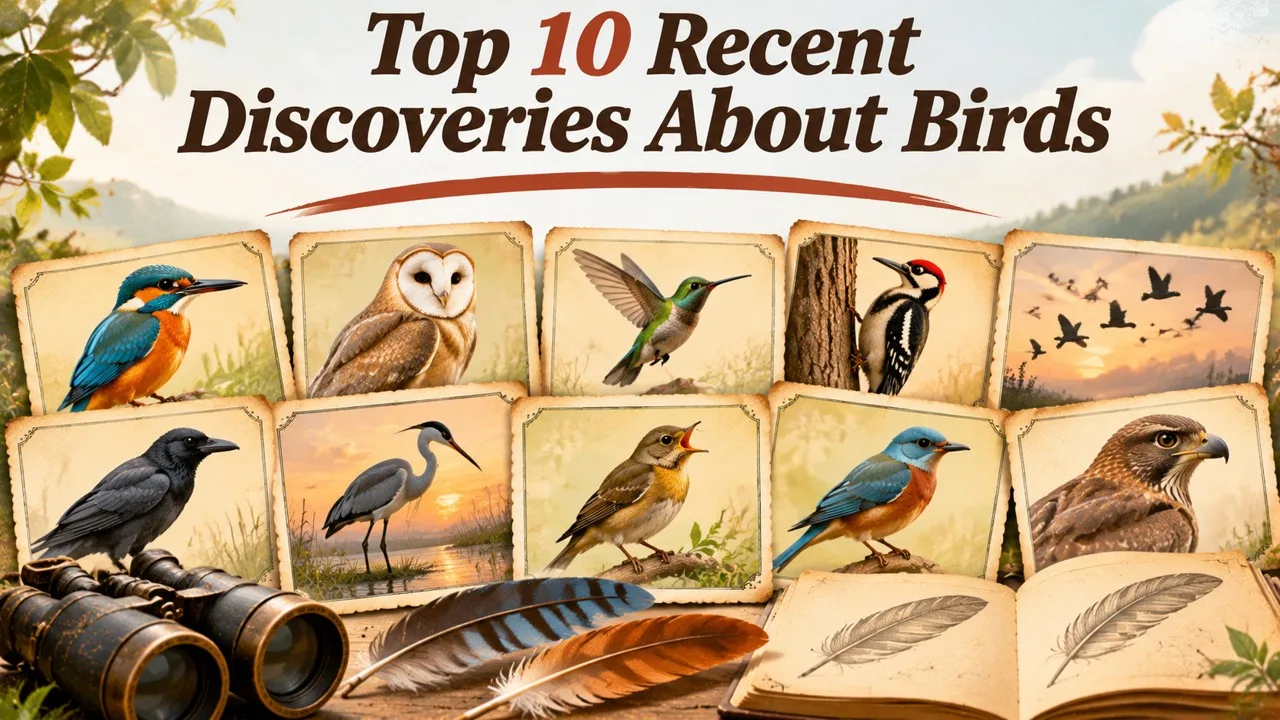
Dye-stained peacock feathers can lase in the lab, and a 2025 paper finds sex-chromosome mismatches in some wild birds, not a fish-like sex change. Bird biology is moving quickly: field museums, GPS tags, and genomes have all produced results that would have sounded like exaggerations a generation ago [5][9]. A "mind-boggling" frame is still a poor excuse for overclaiming. Peacocks do not fire lasers on a lawn. Albatrosses do not break a mystical law of aging just because one famous bird is still nesting. And "birds that swap sexes" is a headline that needs a precise meaning, which the 2025 study does not quite supply [9].
The ten entries below are documented findings, several of them recent, with the qualifications that belong to them.
Key Facts
Recent does not mean miraculous. Several of the results below are extensions of older work, newly measured or newly explained.
Ten Bird Findings at a Glance
| Rank | Finding | What was shown | What to keep in view |
|---|---|---|---|
| 1 | Laser-like emission from peacock feathers | Dye-infused eyespot barbules can emit narrow laser lines in the lab | The feathers were stained and pumped; this is not a wild display |
| 2 | Two behavioral morphs in one sparrow | White-throated sparrows have tan and white forms with different personalities and almost exclusive opposite-morph mating | They do not have four kinds of gonads |
| 3 | A record-breaking Laysan albatross mother | Wisdom, the oldest known wild bird, has continued to nest at Midway Atoll into her mid-seventies | One bird is a record, not a new species-wide law |
| 4 | Long-term social bonds in birds | Crows, ravens, and parrots form stable partnerships and alliances, not only seasonal pairs | "Best friends" is a useful metaphor, not a technical term |
| 5 | Earlier short-tailed birds in the Jurassic? | A 2025 fossil, Baminornis, was reported as an early short-tailed bird | Later commentary has questioned the pygostyle identification |
| 6 | Smaller bodies, longer wings | A 40-year Chicago collision series found declining body size and longer wings in many migrants | The changes are small, and the wing explanation is a hypothesis |
| 7 | True navigation, tracked | Tagged birds can return across seas and continents, using magnetic and other cues | The full cue mix is still being worked out |
| 8 | Pacific birds and chili peppers | Micronesian starlings disperse a hot wild chili in the Mariana Islands | Birds are not "immune" to capsaicin in every experiment, but they tolerate levels that burn mammals |
| 9 | Sex reversal in some wild birds | A 2025 study found mismatches between genetic sex and gonads in Australian birds | This is not sequential hermaphroditism of the fish type |
| 10 | Crows that remember faces | American crows can learn, remember, and socially transmit a scolding response to a dangerous human face | "Revenge" is a popular word for a learned, collective alarm |
1. Peacock Feathers Can Lase, in the Lab
In 2025, Anthony Fiorito, Nathan Dawson, and colleagues reported in Scientific Reports that male Indian peafowl tail feathers, infused with the dye rhodamine 6G and pumped with green light, emitted narrow yellow-green laser lines at highly repeatable wavelengths [1]. The emission was not a typical random laser, and it did not simply follow the color of each eyespot ring, which pointed to small, persistent mesoscale structures inside the barbules acting as low-quality resonators [1]. The result is a tool for probing hidden structure in a biological material, and a striking physics demonstration.
It is not a claim that a displaying peacock projects a beam. The feathers had to be stained, sometimes through several wet-dry cycles, and the laser light was too faint to see without instruments. The discovery is about structure, not about a new courtship weapon.
2. A Sparrow with Two Personalities
The white-throated sparrow comes in white-striped and tan-striped forms. The difference is tied to a chromosomal inversion, or supergene, and it is expressed in both sexes [2]. White-striped birds tend to be more aggressive and less parental; tan-striped birds lean the other way. Birds almost always mate with the opposite morph, a system sometimes nicknamed "four sexes," which is a shorthand for four social types, not four kinds of gonads [2]. Recent genetic and behavioral work has made the arrangement a model for how a inversion can partition personality, color, and mate choice inside one species.
A "split personality" is the wrong image if it suggests one bird flipping from hour to hour. The better image is a species that stably contains two coexisting types, each with a package of traits, and a mating rule that keeps both in the population.
Related: Top 10 Most Dangerous Birds on Earth
3. A Superannuated Albatross Mother
Wisdom, a Laysan albatross banded on Midway Atoll in 1956, is the oldest known wild bird, and she has continued to return and, in multiple recent seasons, to nest successfully [3]. In the 2024-2025 season she was estimated at about seventy-four years old when she produced another chick, a record that has been followed closely by the United States Fish and Wildlife Service and by researchers who work on the atoll [3]. Albatrosses are long-lived and have a slow reproductive schedule. Wisdom shows that reproductive capacity can persist to an extreme age in at least this individual.
She is a data point, and a famous one, not a proof that every albatross can do the same. The useful discovery is that the species' aging curve, at the far end, is still being written in the field.
4. Birds That Keep Partners and Allies
Ravens and other corvids form alliances that can last well beyond a single breeding attempt: they share information, support partners in conflicts, and appear to value particular individuals, a pattern documented in years of observation and experiment [4]. Many parrots, likewise, maintain tight pair bonds and affiliative relationships, with mutual preening, food sharing, and coordinated calling [4]. Calling these relationships "friendships" is a vernacular convenience. The underlying finding is that some birds have long-term, individualized social bonds, not only seasonal pairing or anonymous flocking.
Viral videos of pets are a thin basis for the same claim. The field studies are not.
5. Before the Familiar Bird Tail
Birds evolved from theropod dinosaurs, a conclusion built from feathers, skeletons, and a century of fossils from Archaeopteryx onward [5]. In February 2025, a team reported Baminornis zhenghensis, a Late Jurassic fossil from China, as an early short-tailed bird with a pygostyle, which would push that tail configuration further back than many previous accounts had allowed [5]. The paper was widely covered as a rewrite of early bird history. Subsequent commentary has questioned whether the fused structure is in fact a pygostyle or is better read as a synsacrum, so the short-tail claim should be treated as new and still discussed, not as a closed case [5].
Related: Top 10 Colourful Parrots of the World
Even with that caution, the specimen is a reminder that "when birds became birds" is a phased transition, still being refined by each well-prepared Jurassic slab.
6. Smaller Birds, Longer Wings
A University of Michigan and Field Museum analysis of 70,716 specimens, from 52 species of migrants that died in building collisions in Chicago between 1978 and 2016, found a consistent decline in body size, including a 2.4 percent shortening of the tarsus, and a 1.3 percent increase in wing length [6]. Brian Weeks, David Willard, Benjamin Winger, and colleagues linked the body-size decline to warming summer temperatures on the breeding grounds, in line with Bergmann's rule, and they suggested that longer wings may help compensate for the higher relative cost of migration in a smaller body [6].
The millimeter-scale changes are not visible on a backyard visitor. They are visible in a museum drawer, and they are one of the clearer morphological signals yet tied to a warming climate in living birds.
7. Finding the Way Home
Homing pigeons, shearwaters, and long-distance migrants can return to a precise site after displacements that would defeat a simple familiar-landmark strategy [7]. Experiments and, more recently, lightweight GPS and satellite tags have shown true navigation across seas and continents, with a magnetic compass and, in many accounts, a map sense among the cues, alongside smell, stars, and vision, depending on the species [7]. Bar-tailed godwits and other extreme migrants have made the scale of the feat impossible to treat as folklore.
The phrase "fly away home" is a movie title. The scientific result is older and newer at once: birds do find home, and we can now watch the route, even if the exact sensory mix is still a research problem.
Related: Top 10 Epic Animal Migrations Across the Planet
8. Pacific Birds and Chili Heat
Mammals feel capsaicin as burning pain; many birds can swallow the same peppers and disperse the seeds, a fact that has long explained why chilies are hot to us and still attractive to avian consumers [8]. In the Mariana Islands, research on a rare wild chili, including work associated with Iowa State University, has shown that the Micronesian starling is an important disperser, and that the loss of native birds, especially on Guam, has consequences for the plant [8]. Birds are not magically numb in every test: some experiments find reduced feeding only at extremely high concentrations. The ecological point stands. In the Pacific, a "spicy" fruit and a bird can be partners, not enemies.
This is a different story from New Guinea's pitohuis, which carry batrachotoxins and can tingle or burn a handler's mouth. Both are real. Only the chili partnership is a Pacific crop-and-bird story in the strict geographic sense used here.
9. Sex Reversal, Carefully Defined
In 2025, a study in Biology Letters examined wild Australian birds and reported that sex reversal, a mismatch between genetic sex and gonadal or phenotypic sex, was more frequent than many ornithologists had assumed [9]. The result matters for field identification, for population sex ratios, and for any study that treats a blood-sexed bird as if its gonads must match. It does not show that birds routinely change sex in the adaptive, sequential way that some wrasses and other fish do [9]. Avian sex reversal, in the literature, is usually a developmental or pathological mismatch, and it is often incomplete.
A headline about "birds that swap sexes" is therefore only half true. The careful version is already interesting enough: genetic sex and body sex can part company in free-living birds, and the phenomenon is no longer a handful of poultry anecdotes.
Related: Top 10 Most Bizarre Phobias: Strange Fears That Exist
10. Crows That Remember a Face
Work led by John Marzluff and colleagues at the University of Washington has shown that American crows can learn to recognize a dangerous human face, scold that person on later encounters, and transmit the alarm to birds that never saw the original event [10]. Mask experiments made the point sharply: the face, not the clothes, was the cue, and the scolding could persist for years [10]. Popular accounts call this "revenge." The better terms are learning, memory, and cultural transmission of an anti-predator response.
The finding has held up as one of the clearest demonstrations that a common city bird is watching us with a social intelligence that is easy to underestimate.
Conclusion
The last two decades have been generous to bird science, and they have also been generous to overstatement. Peacock feathers can be made to lase; they do not lase on the bird. A sparrow can have two stable social morphs; it does not have four kinds of gonads. A Jurassic fossil may push short tails earlier; the identification is already under discussion. A 2025 paper finds sex-chromosome mismatches in wild birds; that is not a fish-like career of sex change.
What remains, after the qualifications, is still a strong list: museum drawers that show climate written into wing and tarsus, crows that remember a face, an albatross still nesting in old age, and Pacific starlings that move a chili crop. Those results do not need to be mind-boggling. They need to be accurate.
- ^ [1] Fiorito, A., III, et al., 2025. "Spectral fingerprint of laser emission from rhodamine 6g infused male Indian Peafowl tail feathers." Scientific Reports 15:20938. Scientific Reports
- ^ [2] Reviews of white-throated sparrow morphs, supergenes, and disassortative mating, including recent syntheses. Cornell: White-throated Sparrow
- ^ [3] United States Fish and Wildlife Service and reporting on Wisdom, the Laysan albatross of Midway Atoll. USFWS: Midway Atoll
- ^ [4] Field studies of raven and parrot social bonds, including work associated with Thomas Bugnyar and long-term corvid projects. Britannica: Raven
- ^ [5] Chen, R. et al., 2025. "Earliest short-tailed bird from the Late Jurassic of China." Nature, reporting Baminornis zhenghensis, with later discussion of the pygostyle identification. Nature
- ^ [6] Weeks, B.C. et al., 2020. "Shared morphological consequences of global warming in North American migratory birds." Ecology Letters. Ecology Letters
- ^ [7] Reviews of avian true navigation and magnetoreception, and tracking studies of long-distance migrants. Britannica: Animal migration
- ^ [8] Iowa State University research on bird dispersal of wild chilies in the Mariana Islands, and the comparative physiology of capsaicin in birds and mammals. Iowa State: Wild chili peppers
- ^ [9] 2025. "Prevalence and implications of sex reversal in free-living birds." Biology Letters. Biology Letters
- ^ [10] Marzluff, J.M. and colleagues, on American crow recognition of dangerous human faces and social transmission of scolding. University of Washington news archives




















Discussion
Log in with