





 By
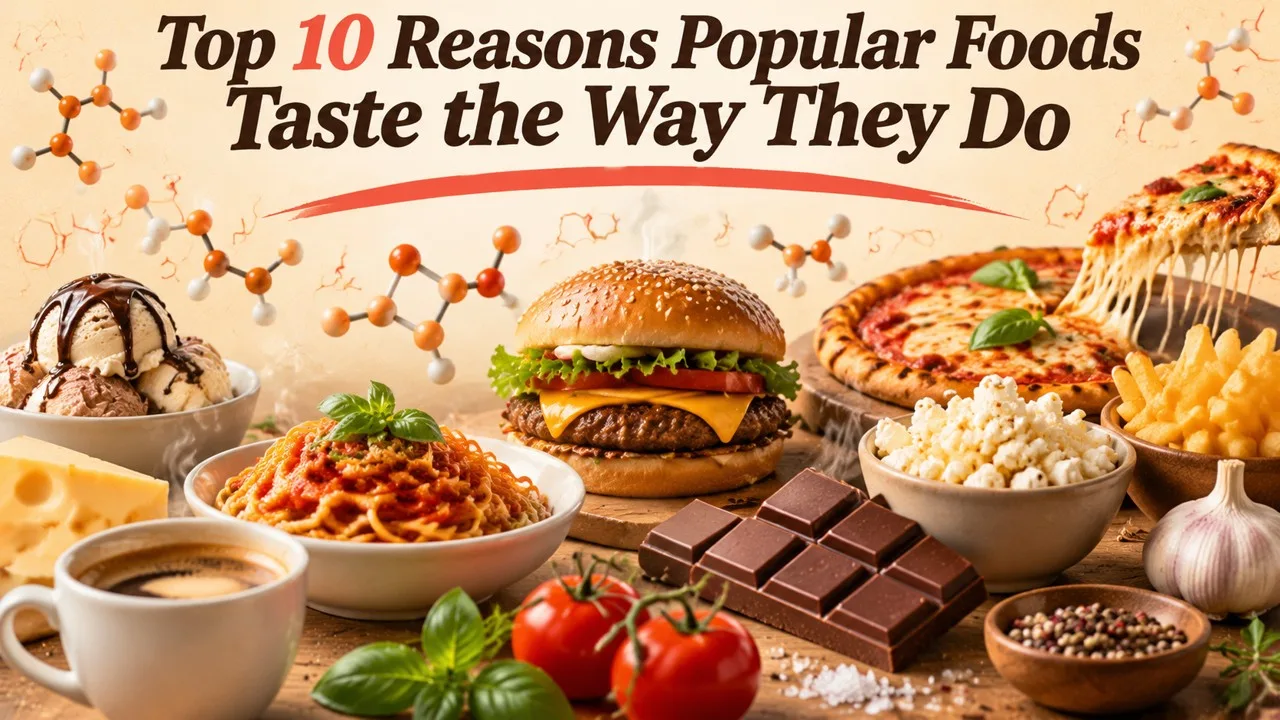
Caramel, coffee, bread, pizza and fried chicken taste the way they do because of a short list of chemical reactions, not kitchen folklore alone. This list is a curated set of ten well-studied processes, from browning and fermentation to acid "cooking," umami, and chili heat [1][5][10]. The aim is to name the chemistry, not to sell a recipe, and not to treat a single popular molecule as a complete explanation of a cuisine.
Food science is ordinary laboratory work applied to supper. The reactions below can be checked in textbooks and in review papers, even when a dish also carries culture, technique, and memory [3][8]. A cook already controls these processes with time, heat, salt, and acid; the list only names what the pot is doing.
Key Facts
Taste and aroma come from volatile and non-volatile compounds produced by heat, enzymes, microbes, and mixing. Several different dishes on this list share the same underlying reactions, especially caramelization and the Maillard reaction.
Ten Taste Mechanisms at a Glance
| Rank | Everyday food | Core chemistry | What you actually sense |
|---|---|---|---|
| 1 | Caramel | Heating sucrose and its breakdown products | A crowd of nutty, toasty, bitter-sweet compounds |
| 2 | Coffee | Roasting reactions, including Maillard chemistry | Aromatic volatiles built from the green bean |
| 3 | Leavened bread | Yeast fermentation plus oven browning | Rise, ethanol and acid aromas, and a browned crust |
| 4 | Ceviche | Acid denaturation of fish protein | A firm, opaque texture without kitchen heat |
| 5 | Doughnuts | Frying and a sugar glaze | A crisp, oil-cooked crust and a sweet, set coating |
| 6 | Pizza | Glutamate and related umami compounds, plus browning | A savory depth in cheese, tomato, and crust |
| 7 | Ice cream | Sugar, salt, fat, and freezing-point control | Sweetness, body, and a scoopable texture |
| 8 | Kimchi | Lactic acid bacteria on salted vegetables | Sourness, aroma, and preservation |
| 9 | Chili heat | Capsaicin on TRPV1 receptors | A burn that the brain can learn to like |
| 10 | Fried chicken | Maillard browning in fat, plus juices and seasoning | Aromatic crust and seasoned meat |
1. How Sugar Becomes Caramel
When sucrose is heated well above everyday warm-kitchen temperatures, it melts, loses water, and breaks into a large family of smaller compounds, a process food chemists call caramelization [1]. The result is not "just burnt sugar." It is a mixture that can taste sweet, bitter, toasty, and nutty at once, depending on how far the reaction is taken [1]. Butter and cream, if they are present, add dairy fats and proteins that brown by other routes as well.
The useful idea is that a single, familiar ingredient can become a flavor library under heat. A light caramel and a dark caramel are chemically different objects, which is why a sauce can tip, in a minute, from butterscotch to bitterness. Professional kitchens treat that tipping point as a craft; the chemistry explains why the point is so sharp.
2. What Roasting Does to Coffee
Green coffee is a dense seed with limited aroma. Roasting drives off water, changes sugars and amino acids, and produces hundreds of volatile compounds through Maillard reactions, caramelization, and the breakdown of chlorogenic acids and other bean components [2]. The roast level is a chemical choice: a lighter roast keeps more acidity and some origin character; a darker roast emphasizes roast-born bitterness and smokiness, and can hide the bean's finer differences [2].
Coffee tastes "rich" because it is a solution of acids, bitter compounds, and a cloud of aromas, not because of a single official molecule. The chemistry of the cup starts in the roaster, and it continues in the grind and the brew, which decide what actually reaches the water. Two beans roasted differently are, for the nose, two different foods.
Related: Top 10 Unusual Science Experiments Involving Food
3. Yeast, Gas, and the Aroma of Bread
Baker's yeast, Saccharomyces cerevisiae, eats sugars in dough and produces carbon dioxide, which raises the loaf, and ethanol, which mostly bakes off but leaves a trail of fermentation aromas [3]. Bacteria in some doughs, especially sourdough, add organic acids and a longer flavor list. In the oven, crust sugars and proteins brown, so the finished loaf is a fermentation product and a roasting product at once [3].
The "airy rise" is a physical fact about trapped gas in a gluten network. The "rich aroma" is a chemical fact about yeast metabolites and crust reactions. Both have to work, which is why a loaf can fail either by collapsing or by tasting bland.
4. How Citrus "Cooks" Fish
In ceviche, raw fish is dressed in citrus juice. The acid changes the proteins, causing them to denature and to firm and turn opaque, a change that looks a little like cooking with heat [4]. It is not the same as pasteurization. Acid can reduce some risks and does not automatically make a raw-fish dish safe in every kitchen, which is why public-health guidance still matters [4]. The flavor is a mix of the fish, the acid, salt, and aromatics, not a miracle of "cooking" in quotation marks alone.
The chemistry is still striking. A low pH can rearrange a protein enough to change texture, color, and the way the flesh takes up seasoning, without a pan.
5. Frying and Glazing a Doughnut
A yeast or cake doughnut cooked in hot fat undergoes rapid surface dehydration and browning, while the interior sets as a steamed, softer crumb [5]. The oil is not only a medium; it carries flavor and changes the crust's texture. A sugar glaze is a supersaturated or cooked sugar solution that cools into a thin, shiny solid, adding sweetness and a snap or a soft coat depending on its formula [5].
Related: Top 10 Most Bizarre Phobias: Strange Fears That Exist
The "yummy" result, if one wants a less sentimental word, is a contrast: fat, sugar, a browned exterior, and a tender middle. That contrast is engineered by temperature and by water, not by a secret spice.
6. The Umami in Pizza
Pizza often tastes deeply savory because several of its standard parts are rich in umami compounds, especially free glutamate, and sometimes inosinates and guanylates that reinforce it [6]. Aged cheeses, tomato products, and long-cooked sauces are classic sources. A browned crust adds Maillard aromas on top. Umami is a recognized basic taste, with receptors that respond to these compounds, not a marketing slogan invented for menus [6].
No single topping is the whole story. The pie works when salt, acid, fat, browning, and glutamate-rich ingredients support one another. That is why a good slice can taste "more tomato" or "more cheese" than a raw inventory of the same foods would suggest.
7. Sugar, Salt, Fat, and Ice Cream
Ice cream is a frozen foam: ice crystals, concentrated sugar solution, fat droplets, and air [7]. Sugar, and sometimes a little salt, lowers the freezing point so that the mixture does not freeze into a solid block, and the fat and proteins help trap air and give body. The pleasure of the food is as much texture as sweetness. A coarse, icy scoop is a crystal-size problem; a greasy scoop is an emulsion problem [7].
The "sugary and salty chemical secrets" of popular tellings are mostly this: dissolved molecules control ice, and fat carries aroma. Vanilla, chocolate, or fruit then ride on that physical structure.
Related: Top 10 Oldest Buildings in the World
8. Lactic Acid and Kimchi
Kimchi is produced by salting vegetables, usually cabbage and seasonings, and allowing lactic acid bacteria to ferment the sugars into organic acids, especially lactic acid, along with carbon dioxide and a range of aroma compounds [8]. The falling pH preserves the food and gives the sour, savory edge that defines a well-made jar. Different bacteria dominate at different stages, which is why the flavor changes over days and weeks [8].
The "kick" is not only chili, if chili is present. It is acidity, sulfur compounds from garlic and alliums, and the savory contribution of fermentation. The chemistry is close to that of other lactic pickles, even when the seasoning is distinctive.
9. Capsaicin and Chili Heat
Capsaicin and related compounds in chili peppers bind to the TRPV1 receptor, a sensor that also responds to real heat and to some irritants, which is why a curry can feel as if it were burning [9]. The sensation is not a taste in the sweet-sour-salty-bitter-umami sense; it is chemesthesis, a feeling. Popular accounts often add a rush of endorphins as the whole explanation of why people learn to like the burn. Endogenous opioids and other reward systems may play a role in some eaters, but the science is more modest than the slogan, and culture, repetition, and flavor do a great deal of the work [9].
The chemical fact that remains is sharp enough. A plant molecule was built as a deterrent, and human cuisine turned it into a sought-after sensation by using the body's own heat sensor.
Related: 10 Sikh Gurus: The Pillars of Sikhism Who Shaped Faith, Equality, Courage, and Humanity
10. Maillard Browning and Fried Chicken
The Maillard reaction is a family of reactions between amino acids and reducing sugars that, at cooking temperatures, produces brown pigments and a large set of savory, roasted, and meaty aromas [10]. In fried chicken, the coating and the surface of the meat brown in hot fat, while the interior cooks more gently. Fat also carries flavor and helps the crust crisp as water leaves [10]. Seasoning salt and spices add their own compounds, but the characteristic "fried" smell is heavily Maillard plus lipid oxidation in a controlled, culinary range.
The same reaction browns bread crust, coffee, and the edges of a pizza. Fried chicken is simply a place where people meet it in an especially concentrated, fatty form. Once the reaction is named, a lot of everyday cooking starts to look like variations on one chemical theme. Toast, gravy, roasted nuts, and a darkened cheese edge all sit in the same family, even when the recipes do not admit the shared name. The ordinary kitchen is more economical, chemically, than any long cookbook index would ever suggest.
Conclusion
A caramel pot, a roaster, a loaf, a bowl of acid-dressed fish, a fryer, a pizza oven, an ice-cream freezer, a kimchi jar, a chili pepper, and a skillet of chicken are different kitchens. They rest on a short list of processes: caramelization, Maillard browning, fermentation, protein denaturation, freezing-point control, umami compounds, and a plant irritant that happens to fit a human receptor.
Understanding the chemistry does not make the food less enjoyable. It makes the results less mysterious, and it explains why small changes in time, temperature, acid, or salt can turn a familiar dish into a different one. That is the reason these ten foods taste the way they do, and it is a better reason than folklore standing alone. The same reactions will still be running the next time a pan comes off the heat. That continuity is part of their power.
- ^ [1] "Caramelization." Food-chemistry overviews; Harold McGee, On Food and Cooking, and textbook accounts. Wikipedia: Caramelization
- ^ [2] "Coffee roasting" and coffee chemistry reviews. Encyclopaedia Britannica. Britannica: Coffee
- ^ [3] "Bread" and yeast fermentation. Encyclopaedia Britannica. Britannica: Bread
- ^ [4] "Ceviche" and acid denaturation of proteins; food-safety notes on raw fish. Wikipedia: Ceviche
- ^ [5] "Doughnut" and the food science of frying and sugar glazes. Wikipedia: Doughnut
- ^ [6] "Umami" and glutamate-rich foods. Encyclopaedia Britannica. Britannica: Umami
- ^ [7] "Ice cream" composition and freezing-point depression. Encyclopaedia Britannica. Britannica: Ice cream
- ^ [8] "Kimchi" and lactic acid fermentation. Encyclopaedia Britannica. Britannica: Kimchi
- ^ [9] "Capsaicin" and TRPV1. Encyclopaedia Britannica. Britannica: Capsaicin
- ^ [10] "Maillard reaction." Encyclopaedia Britannica. Britannica: Maillard reaction



















Discussion
Log in with